
For companies operating across borders, giving back isn’t always as straightforward as it sounds. Different markets come with different rules, and in India, corporate social responsibility (CSR) isn’t just encouraged. For qualifying companies, it’s required by law.
India’s landmark Companies Act of 2013 made the country one of the first to mandate CSR spending. Qualifying companies must invest at least 2% of their average net profits in eligible activities. For companies expanding their operations in India or reaching the qualifying thresholds for the first time, meeting these requirements while creating meaningful impact can raise new questions.
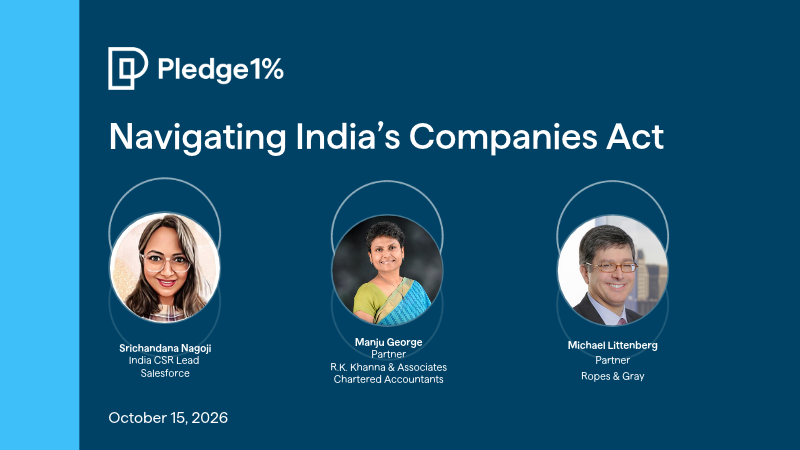
To help answer those questions, Pledge 1% brought together experts from Salesforce, R.K. Khanna & Associates, and Ropes & Gray to share practical guidance on making informed decisions and getting more out of their CSR efforts in India.
Build on your existing impact strategy
India’s CSR requirements don’t mean starting your giving strategy from scratch. Companies can align their local investments with broader philanthropic priorities while meeting India’s specific requirements.
Srichandana (Sri) Nagoji, India CSR Lead at Salesforce, shared how the company incorporates its India CSR investments into its global impact strategy. While giving priorities are coordinated globally, Salesforce works with local finance and legal teams to meet India’s requirements.
Look beyond eligibility
An eligible nonprofit isn’t necessarily the right nonprofit. Before committing funds, companies should look closely at whether an organization has the experience and capacity to carry out the proposed work.
Manju George, Partner at R.K. Khanna & Associates, highlighted the importance of reviewing organizational documents, applicable registration and track-record requirements, and implementation capacity. Beyond these initial checks, ongoing communication and accurate recordkeeping can help companies monitor progress and maintain accountability.
Don’t navigate it alone
India’s CSR requirements can be complex, with nuances around eligible activities, reporting obligations and cross-border giving.
Michael Littenberg, Partner at Ropes & Gray, emphasized the value of consulting legal advisors alongside experienced local practitioners and peers who have navigated similar requirements. These perspectives can help companies distinguish what’s legally required from what’s recommended and make more informed decisions about their giving.
For companies looking to learn more, we’ve also developed a short India CSR explainer as a starting point for conversations with their legal advisors.
New to Pledge 1%? Learn more about joining our community and making social impact part of how your company does business.
This article is for informational purposes only and does not constitute legal advice. Companies should consult qualified advisors regarding their specific obligations under Indian law.