As Anthropic prepares to go public with the share price set at $83, its recent announcement of an extraordinary commitment to philanthropy takes on even greater significance. The company has pledged 5% of its equity to a new Public Benefit Fund, with the potential to add another 2% for every 50% increase in the company’s value over a set baseline, at its board’s discretion. The initial commitment is subject to stockholder approval.
That commitment sits on top of a pledge its co-founders made at founding to donate 80% of their personal equity, and an employee equity donation match program in which roughly half the company participates. Together, Anthropic says these commitments represent roughly 20% of its shares dedicated to the public good, with the potential for more.
And equity is only part of the story. Anthropic has adopted a multi-layered governance structure with the goal of ensuring that their product benefits humanity. They’ve incorporated as a public benefit corporation, and created a long term benefit trust to whom the board reports, making it clear and defensible to focus not solely on shareholder profits but also benefiting society. To that end, they’ve built impact into their business through AI safety and biomedical research, discounted access to its technology for nonprofits and scientific institutions, and initiatives addressing AI’s effects on workers.
Company, founders, employees. Three sources of equity, one shared conviction: when a company creates enormous value, a meaningful share of that value should flow back to society.
That conviction is not new. The scale is. And for those of us who have spent years in boardrooms making this case, it is a moment worth pausing on.
From a pioneering idea to a global movement
In 1999, Marc Benioff founded Salesforce and set aside 1% of its founding stock, along with 1% of employee time and 1% of product, to fund Salesforce’s social impact initiatives. He called it the 1-1-1 model. The idea was simple: build giving into the company from day one so that as the business grows, so does its impact.
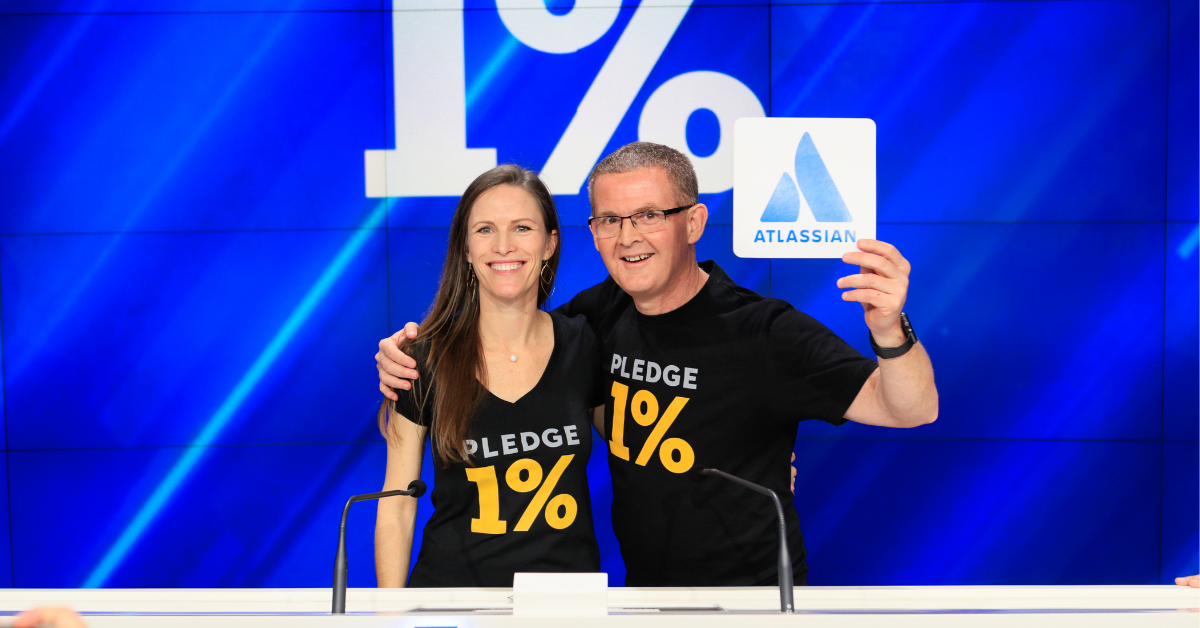
The idea traveled. Google made an equity commitment to Google.org around its IPO. Halfway around the world, Atlassian embraced the same thinking in Australia. Marc Benioff and Atlassian co-founder Scott Farquhar, together with legendary seed-stage venture capitalist Ron Conway and other leaders, launched Pledge 1% in 2014 to make that framework available to every company, at every stage, anywhere in the world.
That was the spark. The Pledge 1% team set to work educating companies about how and why to build a social impact program, and developing the tools that could turn a founder’s conviction into something a board could approve, a lawyer could paper, and an investor could support.
Inspiration doesn’t pass a board resolution. Process does.
In 2019, we codified what we had learned into the Pledge 1% CEO Equity Playbook, with a companion guide for CFOs and general counsels. We also built the Boardroom Allies, engaging leading venture capitalists and other ecosystem partners, including law firms, investment banks, and exchanges, to support companies in making equity commitments. When a board member hears from a respected investor or partner that this is smart governance, not a distraction, the conversation changes.
The results speak for themselves. Companies including Airbnb, Circle, Chime, Reddit, Slack, Toast, Twilio, and many others have helped unlock more than $3.2 billion in new philanthropy through their equity commitments.
The part we don’t talk about enough
Here is the honest truth. For every founder I supported in setting aside equity, there were roughly twice as many who said no.
Some worried they couldn’t win over their boards. Some were simply heads-down on building the business and didn’t feel compelled to give back yet.
One founder we worked with had to overcome the objections of a board member who sent over Milton Friedman’s famous essay arguing that the sole responsibility of business is to increase its profits. We helped the company craft a rebuttal, and the company was able to obtain board approval and formalize its equity commitment.
Why does Anthropic’s announcement matter so much? It sends a powerful message to every founder, board, and investor watching: businesses have both an enormous responsibility and an enormous opportunity to give back. Not as an afterthought, but as part of how value is created and shared.
Equity is particularly powerful because it allows companies to make a commitment before they have significant profits or cash to give. Every company eventually has a down year. When it does, one of the first line items to be cut is often the community or social impact budget. Equity reserved before a liquidity event sidesteps that problem. It is committed in advance, independent of the annual operating budget, and its potential value grows as the company grows. An IPO can be a defining moment when that commitment begins to translate into substantial philanthropic resources.
Equity philanthropy is about sharing in the upside of innovation. Anthropic’s approach takes that principle further by tying potential additional contributions directly to increases in company value. The more the company succeeds, the more the public benefits.
What could your company’s commitment look like?
The Pledge 1% framework asks companies to use their existing assets: their people, their product, their profits, and their equity. Anthropic’s commitment demonstrates – at scale – how companies can combine approaches and build impact into different aspects of their business.
If you’re an entrepreneur considering how to build impact into your company, here are four questions worth asking.
1. What impact do you want your company to have on the world?
Start with the challenges you care about and where your company can make a meaningful difference. That might mean supporting communities where your employees live and work, expanding access to your technology, or addressing societal challenges directly related to your business.
2. What assets can you put to work?
Equity can create long-term philanthropic capital, even before your company is profitable. Donating or discounting your product can put your innovations to work for nonprofits and communities. Employee time and expertise can create direct impact, while profit commitments can provide recurring funding. You don’t have to choose just one.
And don’t overlook your employees’ generosity. Companies can educate employees about strategic giving, match donations of cash or stock, and help them turn their own financial success into lasting impact. Anthropic’s employee equity matching program offers an exciting example that will have a significant impact on the nonprofit sector – in the Bay Area and beyond.
3. How can you make your commitment last?
Consider setting aside equity early, reserving shares around an IPO, or tying additional contributions to company milestones. The right approach depends on your stage, your cap table, and your goals. Engage your board, legal counsel, and financial advisors to determine the structure that works for your company.
4. How will you turn your commitment into impact?
A donor-advised fund, fiscal sponsor, or your own foundation may be the right vehicle. In our experience, there is no single structure that works for every company.
Ultimately, the measure of success isn’t the legal structure. It is whether the structure gets resources to people and communities and delivers demonstrable public benefit. Clear governance, transparent reporting, and visible impact build trust over time.
The 1% was always a starting point
Despite the name, the 1% was always meant as a guidepost, not a ceiling. Some of our member companies committed more, some less. We have always encouraged meaningful commitments that fit each company’s circumstances.
I don’t believe Anthropic’s approach is a one-off, and I don’t think 5% will automatically become the new 1%. What we are seeing is something more important: companies becoming more sophisticated about aligning their giving with their business models, the value they create, and their impact on society. I hope many more companies experiment with similarly ambitious approaches.
If you are a founder, CFO, general counsel, or investor thinking about the mark your company can make on society in the long run, now is the time. As Anthropic approaches its IPO,it’s a powerful reminder that decisions and plans companies make long before a liquidity event can shape a company’s impact for decades to come. The earlier you set aside equity, the simpler it can be and the more powerful it can become.
Pledge 1% can help you explore your options, engage your board, and formally set aside equity for impact. We can help you systematically turn your intention into commitment and your commitment into action. Get in touch with us at equity@pledge1percent.org or explore our Equity Learning Path.