AI Agents Took Over Giving Tuesday. Here’s What Comes Next.

At 6:58 a.m. on Giving Tuesday, a nonprofit operations center felt like the quiet before a storm. In less than an hour, the room would normally erupt into the sector’s version of Black Friday urgency colliding with Cyber Monday volume. Donations spike, questions pour in, and staff race to keep up with a day that compresses a year’s worth of pressure into a few critical hours.
But this year, something unusual happened.
Before anyone arrived, an AI agent had already worked through the night—answering inquiries, drafting records, flagging early trends, and clearing routine bottlenecks that typically stack up before sunrise. When the team walked in, instead of reacting to chaos, they stepped into a morning that felt unexpectedly calm and unusually controlled. They weren’t scrambling. They were directing.
This is how AI agents are quietly reshaping Giving Tuesday, the broader nonprofit sector, and the future of work.
Across the country, similar scenes emerged. While retailers celebrated record-breaking Black Friday and Cyber Monday performance, nonprofits experienced an operational turning point. As a former board chair of Tides and an advisor to national nonprofits navigating digital transformation, I have never seen such rapid adoption. AI agents are quickly becoming essential frontline infrastructure. Because these systems were developed on Agentforce, teams could design agents that mirror their real frontline workflows.
The CEOs and board leaders I advise are now asking sharper questions:
- What happens when nonprofits stop responding to crises and start orchestrating mission flow?
- Which frontline workflows are mature and safe enough for AI agent automation?
- How will rising donor expectations reshape the speed at which nonprofits must now operate?
These questions reflect a simple truth: the workload has outpaced the workforce.
The Demand Surge Is Outpacing Human Ability
Giving Tuesday now carries an outsized share of the sector’s annual pressure, generating more than $3.1 billion in donations in just 24 hours last year. Donations spike at the same time donor expectations accelerate.
In recent reports, donor response-time expectations have dropped below two hours. Mobile activity now accounts for 85 percent of Giving Tuesday engagement, meaning inquiries and contributions arrive constantly and from multiple channels. Burnout remains the number-one workforce challenge for 66 percent of nonprofit teams. And more than half of nonprofits still lack real-time data systems, which intensifies operational strain exactly when the work peaks.
This combination means organizations must operate at real-time speed without real-time tools. That is the gap AI agents filled this year.
Lori Freeman, vice president and global GM of nonprofit at Salesforce, sees the same shift across thousands of organizations. “The use cases for AI agents within the sector are vast,” she said. “They’re already providing always-on support for everything from donor questions to prospecting research.” Freeman added that agents are also helping match volunteers to shifts, streamline personalized service delivery, and simplify year-end reporting—work that becomes especially valuable as the Giving Tuesday surge compresses expectations. “When agents take on manual and time-consuming tasks, staff are freed to focus on the high-value, mission-critical work the season demands.”
At Blue Star Families, the STAR pilot restructured the frontline experience. “STAR’s superpower is cutting down the time it takes our team to create account, opportunity, and interaction records,” said Michael Kang, vice president of technology and analytics. “We’ll have double the data integrity in half the time.” Before STAR, staff spent an average of 20 percent of their time on data entry. With STAR deployed, about 400 staff hours per week will now shift to mission delivery instead of manual tasks.

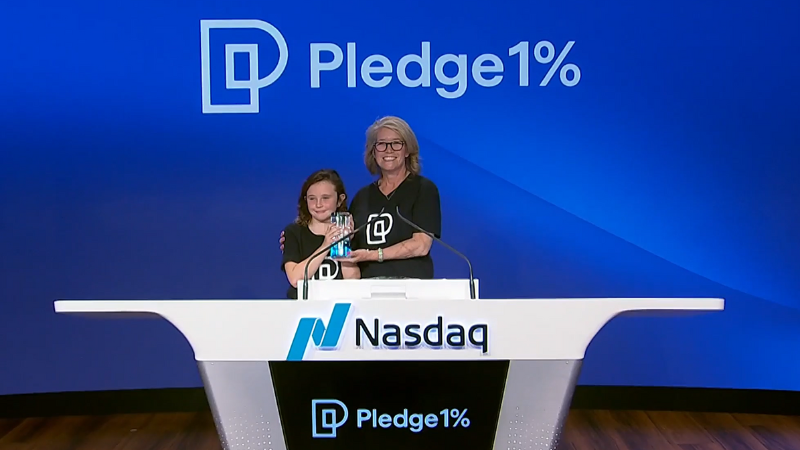
At Pledge 1%, CEO Amy Lesnick said the organization’s agent is designed to remove the biggest friction points companies face when beginning their social impact commitments. “It gives members personalized recommendations, answers common questions, and walks them step-by-step through their commitments,” she said. The team anticipates a 30 percent increase in new members completing digital onboarding within 45 days. “We’re a small but mighty team, and the agent frees us to focus on high-value conversations.”
At Pacific Clinics, an AI agent rebuilt outreach for Enhanced Care Management, a Medi-Cal benefit supporting people with complex health needs. “Instead of cold calling members to explain eligibility, our team can begin conversations with people who are informed and ready to engage,” said Executive Director Garret Zabel. “The agent handles questions anytime. Our employees remain at the center of every critical interaction.”
Across organizations, the theme is consistent: agents are stabilizing the operational middle—the historically fragile backbone of nonprofit work.
How AI Agents in Nonprofits Are Becoming the Sector’s New Frontline Support
Nonprofits run on relationships, communication, and trust. Administrative overload weakens all three.
Leaders now point to three clear areas where AI agents are delivering the strongest value.
- Donor communication at scale. Organizations are delivering timely acknowledgments, FAQs, and updates that previously required days of manual effort. This means donors feel informed and valued at the exact moments that increase engagement and retention. Freeman emphasized the shift in donor experience. “Agents are improving donor interactions by enabling faster, more personalized support,” she said. “Our new donor support agent can provide tailored answers to donor questions 24/7 in ways that weren’t possible before.” This level of responsiveness resets expectations for how nonprofits engage supporters during high-volume periods.
- Volunteer management and task routing. Agents match needs with availability, eliminate logistics delays, and route inquiries rapidly. For example, volunteer onboarding becomes continuous rather than episodic. Freeman noted that the shift is beginning to reshape the nonprofit workforce. “Managing workload is a top challenge for nonprofits. Hundreds of hours are spent updating records, reading past client notes, or manually connecting volunteers to shifts. AI agents can take on this work so nonprofit teams can focus on the high-value, mission-driven tasks that brought them into the sector in the first place. By reducing busywork, leaders can help ease burnout and keep staff engaged in the work that matters.”
- Program support and knowledge retrieval. Staff gain real-time access to donor history, program data, and insights without complex manual processes. It’s one of the clearest areas where AI agents remove friction, especially when frontline teams need accurate information under time pressure.
In my Forbes analysis on AI-fluent leadership, I noted that the highest value emerges when humans apply judgment and strategy while technology handles mechanics. That principle is playing out across the sector.
Pledge 1% sees this daily. “By meeting each company where they are—based on stage, goals, and growth—the agent provides the next right action,” said Lesnick. “Every member feels supported the moment they join.”
At America On Tech, the transformation is dramatic. “Previously, each report could take up to four days per funder,” said CEO Jessica Santana. “Tableau Next and Agentforce have made reporting 32 times faster and reduced manual data gathering by more than 90 percent.” This shift gives staff the equivalent of one full workday per week. “Funders receive updates almost immediately, which strengthens relationships.”
Pacific Clinics reports similar benefits. “Our employees can put their energy where it matters most: building relationships that change lives,” Zabel said.
Major platforms like Salesforce see the same trend across thousands of organizations.
How AI Agents in Nonprofits Are Redefining Nonprofit Strategy
This Giving Tuesday accelerated three structural shifts that will define nonprofit strategy moving forward.
- Human judgment becomes the core asset. Agents execute the mechanics so people can handle nuance, trust, and strategy. For example, staff can now focus on conversations involving complex decisions rather than data entry.
- Data literacy becomes mandatory. Organizations must strengthen governance, privacy, and responsible use. This means frontline teams need training to interpret data rather than simply manage it.
- Funding models evolve toward tech-enabled mission delivery. As foundations once funded websites and CRMs, the next era will support agents, data platforms, and intelligent workflows. For example, funders are beginning to tie grant-making to an organization’s digital readiness and real-time reporting capabilities.
A decade ago, while serving as dean at Columbia University, I sat with a principal donor who told me: “If you can’t modernize how you measure and communicate impact, we can’t scale what matters.” At the time, we couldn’t yet deliver on what he was describing. Today nonprofit leaders do. AI agents finally give organizations the operational intelligence donors were calling for long before the technology existed.

At America On Tech, that long-term view is already taking shape. “Our early experience shows that AI agents can become a core, always-on operational tool—not just a reporting accelerator,” Santana said. “They strengthen a data-driven culture, streamline dashboards, and free staff for higher-value work.”
Pacific Clinics sees the same trajectory. “Our early learnings suggest the agent can help members obtain answers any time, any day,” Zabel said. “But employees remain at the heart of every critical interaction.”
What Every Board Should Ask Right Now
Boards are increasingly aware that AI agents reshape not only operations but also governance and strategy. As organizations prepare for 2026, every board should start with these questions:
- Do we have a real-time data foundation?
- Which workflows can safely shift to agents over the next 12 months?
- How will our staffing model evolve when routine tasks disappear?
- What safeguards ensure transparency, equity, and ethical use?
- How will AI elevate the trust that defines our mission rather than undercut it?
The Leadership Call to Action for AI Agents in Nonprofits
The lesson from this Giving Tuesday is clear: nonprofits must begin scaling their intelligence, not just their effort. AI agents will not replace the values that define the sector—empathy, equity, trust—but they will force a new level of operational clarity.
Leaders should prioritize three actions:
- Invest in operational intelligence, not incremental capacity.
- Equip teams with data literacy and judgment skills that complement agents.
- Build a technology-enabled mission strategy that is as dynamic as the communities you serve.
Giving Tuesday 2025 may be remembered as the moment nonprofits crossed a threshold. Organizations that leaned into AI agents in nonprofits emerged not just faster, but freer. And as Lori Freeman’s forthcoming insights will highlight, this is the beginning of a model where nonprofits move from surviving seasonal surges to shaping year-round mission power.