As originally published on Feld.com
Over the years, I’ve written about my belief in the importance of giving back to your communities and #givefirst. In this spirit, one of the key organizations my partners at Foundry Group have helped create and nurture is Pledge 1%.
In 2007, we were a founding member in the predecessor organization to Pledge 1%, called Entrepreneurs Foundation of Colorado (or EFCO). EFCO started as an experiment here in Boulder, not unlike Techstars and Startup Week/Weekend that got their start in our backyard. In 2014, Pledge1% Global launched as a joint effort between Foundry Group, The Entrepreneurs Foundation of Colorado, The Salesforce Foundation and The Atlassian Foundation which we helped seed financially and continue to support.
Pledge 1% Colorado has now distributed over $8 million back to various organizations in our community. And, the companies that have pledged 1% globally is remarkable.
While all of the Foundry Group partners have been involved, Seth Levine has been spearheading our engagement and the transformation from EFCO to Pledge 1% (he, along with key members of the teams from Salesforce, Atlassian and Ryan Martens are the founders of Pledge 1%). At a partner offsite at the end of last year, we were reflecting on some of the gifts from Foundry Group through our Pledge 1% involvement, which included:
- The Community Trust of Boulder – We believe that a rising tide raises all boats and wanted to do our part to support our local community here in Boulder and Colorado.
- United Way Foothills – After the Colorado flood in 2013 we decided to step up and fill a gap in funding from Foothills United Way.
- Museum of Boulder – Our city has a rich history on numerous dimensions. We now have a museum in downtown to be proud of.
- BCH Foundation Mental Health Campaign – Mental health is a major issue in our society, as well as in entrepreneurship. We are pleased to be able to help expand the mental health resources in our community.
We had some extra money left in our Pledge 1% Colorado account from distributions over 2018 and decided that, rather than saving it up for another larger gift, we’d give a series of modest gifts to a handful of local (and one non-local but nearby) organizations as a surprise holiday gift. Those organizations were:
- Access Opportunity
- Boulder Community Foundation Leadership Fellows
- Colorado FIRST Robotics
- Community Food Shares
- CU Science Discovery
- Defy Ventures Colorado
- Donors Choose – Sphero Match
- Emergency Family Assistance Association in Boulder (“EFAA”)
- I Have A Dream – Boulder
- Our Center
- Ranger Projects Yellowstone Forever Institute
If you are a co-founder at a startup, leading a company, or an employee at a company and want to learn more, check out the Pledge1% (or here if you’re in Colorado). Or email me or Micah Mador if you want to get involved.
As originally published on PRNewswire.com
DroneDeploy, the enterprise-grade drone data platform, announced today the roll out of two major philanthropic efforts: the organization’s commitment to the Pledge 1% Initiative and the launch of DroneDeploy.org, the philanthropic arm of the company focused on employing the use of “Drones for Good.”
“We think it is critically important that we utilize the power of technology to make our world a better place and to empower others to join us in our mission,” said DroneDeploy Chief Customer Officer and Co-Founder Jono Millin. “It is equally important that outside of our technology, we are giving our time and support to the many great nonprofits both here in the Bay-Area and across the globe that believe just as strongly as we do in creating value for our people and our planet.”
The Pledge 1% movement seeks to change the world by inspiring companies of all sizes and stages to donate 1% of employees’ time, 1% of profits, 1% of equity, and/or 1% of products to nonprofits.
DroneDeploy will join Pledge 1% in two ways. First, DroneDeploy will continue partnering with nonprofit organizations engaging in work that meets the mission of “Drones for Good” by providing its drone software free of charge. Second, DroneDeploy team members will be volunteering at charities such as the Ronald McDonald House and the Bay-Area’s own Room to Read and Project Open Hand.
DroneDeploy.org is the evolution of the Flyanthropy program, which was designed to equip organizations on a mission to improve the health of the world’s people, habitats, and history with software and intelligence to support data-driven decisions. The Flyanthropy program has contributed to multiple success stories, including supporting relief efforts during last year’s “Camp Fire” in California and devastating earthquake in Sulawesi, Indonesia.
With the launch of DroneDeploy.org, DroneDeploy is seeking to partner with even more organizations committed to creating a better future for people and communities across our planet. By visiting the new website and sharing their stories, individuals and organizations across the globe will have the chance to partner with DroneDeploy to achieve our shared purpose.
To learn more about “Drones for Good” or to partner with DroneDeploy on these important missions, please visit DroneDeploy.org.
About DroneDeploy
DroneDeploy is the enterprise-grade drone data platform. Trusted by leading brands globally, DroneDeploy makes the power of aerial data accessible and productive for everyone by transforming data collection and analysis across industries, including construction, energy, agriculture, and mining. Simple by design, DroneDeploy enables professional mapping, 3D modeling, and reporting from any drone on any device. To learn more visit www.dronedeploy.com and join the conversation on Twitter @DroneDeploy.
ABOUT PLEDGE 1%
Pledge 1% is a global moment that is creating a new normal for companies of all sizes and stages to donate 1% of either their product, equity, profit, or staff time to whatever charity of their choosing. Founded in 2013 by Atlassian, Rally, Salesforce, and Tides, Pledge 1% aims to encourage and empower companies to bake social impact into the DNA of their business. Thousands of companies around the world have taken the pledge and used Pledge 1%’s framework and toolkits to give back. To learn more or to take the pledge, please visit www.pledge1percent.org.
As originally posted on PRNewsWire.com
As one of the first customer experience management companies to join this social impact initiative, Medallia will drive action at the community level to help nonprofits improve and transform lives.
Medallia, Inc. (www.medallia.com), the worldwide leader in experience management, announced today it has joined Pledge 1%, the global philanthropy movement that makes giving back to communities a fundamental piece of every business, and is one of the first customer experience management (CEM) companies to join this social impact initiative.
Pledge 1% integrates giving back into the DNA of companies of all sizes, and challenges them to pledge 1 percent of equity, profit, product, and/or employee time to community causes. Aligning with this global network of companies adds to Medallia’s long list of employee-led volunteering and fundraising initiatives, and formalizes its commitment to harnessing people and product power for social good.
“Our strong culture that values people is best demonstrated by the way we come together to give back,” said Susan Lovegren, Chief People Officer at Medallia. “These shared experiences bring people together to serve the communities in which we live and work, and I believe that giving back together is one of the best team-building opportunities and wellness activities any organization can offer. I am super proud of Medallia’s Pledge 1% commitment and look forward to what we will accomplish this year!”
Since the company established its nonprofit social impact group, Medallia.org, in 2017, it has garnered over 10,000 volunteer hours; fundraised more than $100,000 worth of nonprofit donations; and contributed nonprofit resources benefiting a diverse range of causes, from LGBTQ+ rights to closing the opportunity divide. Now, Medallia’s Pledge 1% focus will be on using employee time to serve diverse local and global communities by investing in processes and policies that make employee volunteerism and fundraising as easy as possible, including a Volunteer-Time-Off and an Employee Resource Groups Gift-Matching Policy. The company also aims to focus its pledge on using Medallia’s pioneering CEM product services to help nonprofits transform donor, grantee, beneficiary, volunteer, and employee experiences through the power of feedback.
“Two years ago, a few passionate Medallians and I began this grassroots effort and it fills me with pride to now formally announce Medallia.org as the company’s social impact arm, as well as joining the Pledge 1% global movement,” said Heather Jin, Global Head of Corporate Social Impact at Medallia. “We have inspirational employees all around the world who founded charities, mentor nonprofits as board members, fundraise for organizations, and donated their skills in transformative ways. I am excited to create opportunities for our employees to make more of these stories as we start our journey with Pledge 1%.”
This initiative was first announced at Medallia’s Experience 2019 conference in San Diego, CA, which took place from June 3 to June 5, 2019.
For more information on Medallia, please visit www.Medallia.com.
About Medallia
Medallia is the pioneer and market leader in Experience Management. Medallia’s award-winning SaaS platform, the Medallia Experience Cloud, leads the market in the understanding and management of experience for customers, employees and citizens. Medallia captures experience signals created on daily journeys in person, digital and IoT interactions and applies proprietary AI technology to reveal personalized and predictive insights that can drive action with tremendous business results. Using Medallia Experience Cloud, customers can reduce churn, turn detractors into promoters and buyers, and create in-the-moment cross-sell and up-sell opportunities, providing clear and potent returns on investment.
About Pledge 1%
Pledge 1% is an effort spearheaded by Atlassian, Rally, Salesforce and Tides to accelerate their shared vision around integrating philanthropy into businesses around the world. Pledge 1% encourages and challenges individuals and companies to pledge 1% of equity, product and employee time for their communities, because pledging a small portion of future success can have a huge impact on tomorrow. Pledge 1% offers companies turnkey tools and best practices, making it accessible for any company to incorporate philanthropy into their business model. To learn more or to take the pledge, please visit pledge1percent.org.
As originally posted on Forbes.com
In decades past, business leaders had to focus on two things: product and profit. In modern times, they must add social impact to the list. If leaders want to win the war for talent and customers, they must abandon the traditionally siloed approach to social impact and instead integrate social consciousness into every seam of their business.
The data speaks for itself. More than two-thirds (67%) of millennials would not work for a company that does not have strong social responsibility commitments, and alternatively, 87% of consumers would purchase a product simply because the company “advocated for an issue they cared about.” It is understandable why a study from the Harvard Business Review and EY found that businesses with a clearly established purpose perform better than those without one.
One company with a comprehensive social impact strategy is Google and its philanthropic arm Google.org. “[O]ur goal is to identify how we can bring the best of who we are as a technology company to help address complex challenges,” said Jacquelline Fuller, president of Google.org, via email. “Everyone benefits from a more equitable world.” Although most companies cannot operate at the level of Google.org, which awards $200 million in grants each year, companies of all sizes can be inspired to implement social impact into their overarching strategies.
As a member of the board of Tides, a globally-known philanthropic partner and nonprofit accelerator, I have witnessed these changes in action. It can be difficult for leaders to know where to begin, so here I highlight three companies who have been successful in their efforts. All of them have worked with Tides, and all of them are achieving their social responsibility objectives in the central impact areas of employees, supply chains, and customers.
Pledge 1%
Pledge 1% is a unique organization that encourages companies at all stages, from founding to post IPO, to pledge at least 1% of their equity, profit, product, or employee workday time to their communities. Spearheaded initially by the founders of tech companies Salesforce, Atlassian, Rally, and now a special initiative of Tides, Pledge 1% provides an outstanding example of the social impact movement at scale.
Since its launch in 2014, it has grown 150% each year and has amassed pledges from more than 8,500 companies across 100 countries. “Imagine a world where giving back is baked into the DNA of every single business. At Pledge 1%, that’s our goal,” said Scott Farquhar, board member and co-founder and CEO of Atlassian.
Pledge 1% understands the importance of involving employees in social impact initiatives, encouraging its member businesses to commit 1% of staff time to volunteering. At Salesforce, the company that pioneered the concept, team members have volunteered more than 1 million hours since 1999, undoubtedly having a measurable impact on their communities — and on the employees themselves.
Kate Spade New York
When seeking an arena in which to create social impact, companies can also tackle their supply chains. While there are myriad examples of companies lambasted for unsustainable practices, such as Nike and Apple, there are few examples of companies who have gotten it right. Kate Spade New York is one notable exception.
“[W]e encourage all women to be the heroines of their own stories,” CEO Anna Bakst said in an email. “Our brand promise carries over to the way we think about social impact and responsibility.” In terms of supply chain, the company has progressed beyond a basic negative screen — ensuring no child labor is involved, for example — to a positive screen that supports small producers through its On Purpose initiative.
As Bakst explained, the company is “empowering women by intentionally bringing our supply chain to marginalized communities.” For its first project, it focused on a community in Masoro, Rwanda, where it built and financed an independent, employee-owned business staffed by local women. (Tides supports this work through grantmaking in the community.) Last year the new company, Abahizi Rwanda, produced 32,000 handbags for KSNY.
“We know that our customer connects with On Purpose and the stories of the women who make this product,” said Bakst. “By going direct to the supplier, we found that we could scale our business along with creating greater social impact.”
Twilio
As Bakst suggested, companies should also consider their customer base when evaluating social impact initiatives — how can they help more people, while also reaching new markets? Cloud communications platform Twilio is one company that found great success in using its expertise to expand both reach and impact.
In 2017, it launched an impact fund, funded by its 1% pledge and managed by Tides in the form of a corporate Donor Advised Fund, which “supports nonprofits and social enterprises” that are utilizing “innovative communications technologies.” The fund provides both grants to nonprofit organizations and equity and loan investments to for-profit social ventures whose missions align with Twilio and Tides, such as Hack the Hood and Edovo.
From 2017 to 2018, Twilio’s revenue increased by 63%. Erin Reilly, executive director of Twilio.org, believes the success of the “for-profit” and “for-good” arms of the company are intertwined. “[W]hen our social impact program grows, so too does our business,” she wrote. “Creating a virtuous cycle between the two and actively making them inextricably tied is important for the sustainability of both efforts.”
As these examples have shown, social responsibility can spur corporate success . To many emerging leaders, in fact, generating social impact is more than a catalyst; it is an essential component of running a business in the modern world. “At the end of the day, social impact will not be successful if it’s a ‘nice to have,’” explained Reilly. “Put the full weight of the company behind your program, and you will be amazed by the impact it has on the strength of your business, your customer’s trust in you as a company, and your employee culture.”

Moment marketing company commits to giving with new charitable arm, joins the Pledge 1% movement
Aki Technologies, the moment marketing company that improves the mobile ad experience by identifying moments consumers are most receptive to marketing messages, is doubling down on its commitment to better experiences with the launch of Aki for Good, a new philanthropic arm dedicated to giving back.
As one of its first Aki for Good initiatives, the company has joined the global Pledge 1% movement. Pledge 1% encourages and challenges individuals and companies to Pledge 1% of equity, profit, product, and/or employee time for their communities. Every Aki office (New York, Chicago, Los Angeles, Mexico City and San Francisco) will designate a day of service each quarter. Aki’s New York team recently spent a day with the Make-A-Wish Foundation, while Aki’s San Francisco office helped Glide, a community dedicated to alleviating suffering and breaking the cycle of poverty.
“Today’s business leaders are challenged to consider their impact on the world beyond the bottom line, and it’s deeply inspiring for us,” said Scott Swanson, CEO of Aki Technologies. “For Aki Technologies, the decision to be a part of this broader philanthropic movement rose organically—whether in the context of ad experiences or building a team, it’s part of our DNA to be thoughtful about how our actions impact others. I couldn’t be more excited to launch Aki for Good and join Pledge 1% as one of our first initiatives.”
Last year, Aki celebrated the holiday season by launching Aki Giving Moments, in which it donated $10,000 to the Make-A-Wish Foundation. As part of that effort, Aki also donated bonus impressions to the charity of choice for advertisers who executed Q4 campaigns. The annual campaign is coming back for the 2019 holiday season.
To learn more about Aki for Good, or Aki’s Giving Moments, visit Aki for Good. For information on how Pledge 1% can help your company give back, check out Pledge 1%.
About Aki Technologies
Aki Technologies helps brands personalize advertising through the power of mobile moments. Through its unique methodology, Aki uncovers patterns in mobile behavior to give brands an unprecedented view of consumer needs and wants as people move through their days. Leading brands use Aki’s moment marketing science to inform strategy and drive meaningful impact on campaign metrics like awareness, engagement, foot traffic and sales. The company has offices in San Francisco, New York, Boston, Los Angeles, Chicago, Bentonville and Detroit. To learn more about the company visit http://www.a.ki.

OpenMRS is a global community that has developed an open-source electronic medical record system (EMR), made to support healthcare in low and middle-income countries. It supports both patients and doctors by providing easy access to medical records, diagnosis, prescriptions, and test results. Any healthcare system or member of the healthcare team, worldwide, can download the OpenMRS application for free and customize it according to their needs. This free software allows clinics and hospitals that use OpenMRS to provide efficient and effective medical care.
OpenMRS mission is summed up perfectly in their motto: Write code. Save lives.
What started as a simple fix in a single database in a clinic in Kenya, soon became something much more: a community. Almost 9 million patients in more than 3000 sites have registered digital medical records thanks to OpenMRS.
SolDevelo, an IT company from Poland, that often works with digital development initiatives, was very happy when in 2013 could join this incredible community. Our first project was to introduce a new Concept Dictionary Open Web App to the OpenMRS and create a library of UI components. Three developers, working pro-bono, spend over 2000 hours to make this software better for everyone. Thanks to this work, adding new features to the OpenMRS became easier and faster. The community could add new functionality that will help bring better healthcare in the most vulnerable regions in the world.
SolDevelo created the Concept Dictionary OWA – a dictionary of medical terms which stores terms describing diseases, drugs, diagnoses, tests, procedures, other questions and potential answers, including measures defining the patient’s condition. Thanks to it, it becomes possible to manage dictionary medical terms (medical concepts) from the level of the new user interface. It allows collecting data in a simple and standardized way. And this saves time and effort for the healthcare workers in the developing world.
In addition, the SolDevelo team created a library of UI (User Interface) components. Thanks to this library, all of the new modules for the OpenMRS system has the uniform feel and greatly improve the experience of the users while using the new feature. It can be used when creating new Open Web Apps for OpenMRS in AngularJS, which is one of the most modern and popular technologies.
What was the impact of this work?
- Modern solutions were delivered to OpenMRS
- New technologies were implemented, commonly used in developed countries
- The more intuitive and friendly system was introduced to facilitate non-developers using the OpenMRS system
- Unified interface and modernized look & feel, lowered the barrier to entry for identifying new developers capable of working with OpenMRS without Java expertise
- The system has become easier to modify for developers, which increased efficiency, helping developers creating new applications and features.
- Costs of system maintenance have lowered
- Modern front-end tools were introduced for OpenMRS developers, which attracted more contributors

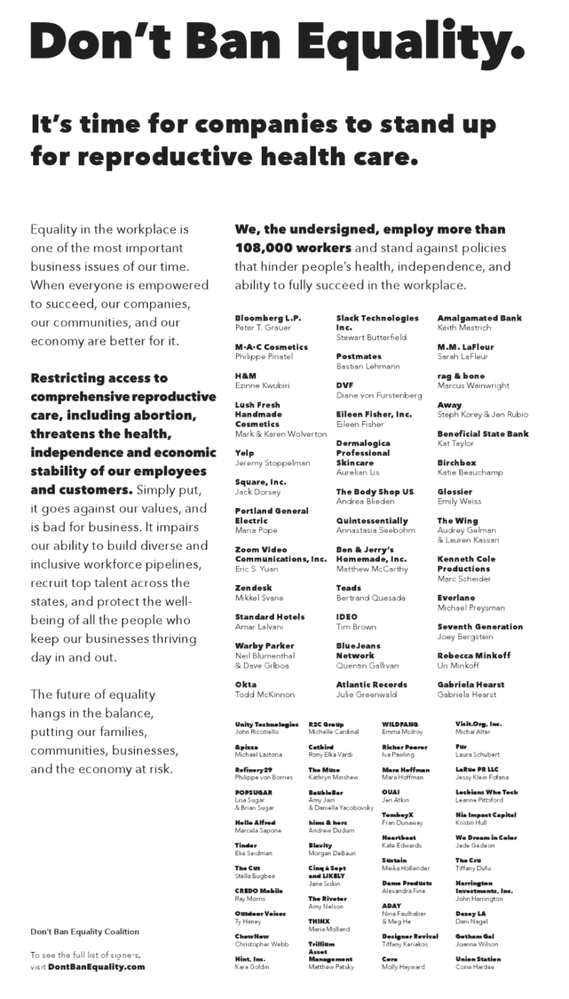
With over 60% of female customers, and tens of thousands of woman-owned businesses who earn and sell through the Postmates marketplace — today we joined the ACLU, PPFA, and NARAL in a full-page New York Times ad to underscore why banning equal access to health & reproductive services can weaken the independence, choice, and economic well-being of people around the country.
Restricting access to comprehensive reproductive care, including abortion, threatens the health, independence and economic stability of our employees and customers. Simply put, it goes against our values and is bad for corporate America. It impairs our ability to build diverse and inclusive workforce pipelines, recruit top talent to states that have extremist policies, and protect the well-being of all the people who keep our businesses thriving day in and out.
The future of gender equality hangs in the balance, putting our families, communities, businesses and economy at risk. We, the undersigned, represent more than 180 workers and stand against policies that hinder people’s health, independence and ability to fully succeed in the workplace.

Despite what you hear about the greed of the top 1 percent or the .01 percent, and the blame for some social ills aimed there, Philanthropy isn’t dead it is alive and well and changing with the times. Thanks to technology, specifically, cloud computing, everyone can be a philanthropist to a degree never thought possible. The Pledge 1 Percent movement represents part of the new philanthropy giving us all new ways to consider how we can best give back to society.
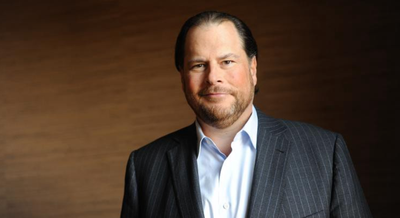 Marc Benioff, Co-founder, Chairman, CEO, Salesforce.
Marc Benioff had a vision. When the co-founder, co-CEO, and chairman of Salesforce started his cloud computing company twenty years ago, his idea of what cloud computing could be was not the only visionary thing about his startup.
From the beginning under Benioff’s direction the company donated one percent each of its equity, product, and employee time to charity. “It was easy then,” Benioff has told audiences, “We had no equity or product and there were very few of us to donate our time.” But donate they did and as the company grew so did its commitment to philanthropy.
Thanks to this example, thousands of companies today have taken the same pledge. Throughout its history, Salesforce has given employees time off with pay to donate 1 percent of their work time to a charity of their choosing, no questions asked. There’s no pressure to donate time but it has become a part of the culture and when employees get together they’re as likely to speak about the work they’re doing with a local non-profit or public school, as they are to discuss the philanthropy projects they’re working on. Lest you think this philanthropic effort is a drain on productivity, you might be interested to know that Salesforce is a highly successful, publicly traded company that has been on Fortune Magazine’s list of top 100 places to work for a decade and counting.
Over the last 20 years, Salesforce has donated $260+ million to 40,000+ non-profits and more than 3.8 million service hours through its 501 © (3) subsidiary and unlike 20 years ago, it’s no longer unique in this. In 2014 Salesforce joined forces with Atlassian and Rally to form Pledge1Percent.org. According to the Pledge1Percent.orgwebsite,
“They came together with the Entrepreneurs Foundation of Colorado to accelerate a shared vision of every business around the globe integrating philanthropy into its corporate DNA. In 2016, Pledge 1% became a special initiative of Tides, a leading global philanthropic partner and non-profit accelerator.
Salesforce Philanthropy Cloud
There’s no way to tell the story of new philanthropy without a short digression into the business side of the house. Please be assured this is not a sales pitch.
 Another approach to giving.
Customer relationship management (CRM) is Salesforce’s primary business but it has also diversified into software development tools and developer training. At first the tools and training were focused on enhancing and expanding the core CRM product but that quickly gave way to supporting a robust community of developers. The AppExchange is the market place for developers that construct complementary products using the Salesforce Lightning platform and its tools.
Typically, AppExchange partners offer solutions that Salesforce has determined are not on its critical path, like accounting and finance systems. The AppExchange has a large contingent of vendors that have developed those solutions and they are plug compatible with the rest of Salesforce’s offering.
Also, a robust community of online users accesses the company’s development tools and Trailhead learning platform (for free) to learn application development skills that help people launch or relaunch careers in software. The research service IDC predicts that more than 3 million jobs for Salesforce architects, developers and administrators of various skill levels will continue to open up over the next few years.
With all that development capability it’s little surprise to people who know Benioff that the Salesforce Foundation, Salesforce.org (which was recently incorporated into the for-profit company) would build an application that would begin to revolutionize how philanthropy is done. The Salesforce Philanthropy Cloudis the result. The offering connects corporations, employees and non-profits in a network that enables employees or corporations to find non-profits they wish to engage with. This might mean volunteering, but it can also mean donating resources, not just money.
Timing is everything
The Salesforce Philanthropy Cloud comes along at a good time. According to research conducted by Povaddo, an opinion research and issues management consultancy, 57 percent of people working in America’s biggest companies–especially millennials–have demonstrated strong feelings that their employers should play more active roles in addressing important societal issues. That’s a lot to add to a CEO’s to-do list but it becomes relatively straightforward through the Salesforce Philanthropy Cloud. You could say that this opportunity has always existed but until recently there has been no technology to help bring the disparate threads together.
 A modern version of philanthropy.
The demands on nonprofits continue to expand and not just in the obvious ways. Research performed for the company shows that demands on nonprofits outpace resources in several dimensions. For instance, demand for programs and services is up an amazing 77 percent over the past 5 years. But the desire on the part of the public to participate in the work of nonprofits is also up 59 percent. Finally, demand for transparency in how funding is raised and deployed, donation amounts, and donation volumes are all up with similar increases.
Philanthropy and charity, what’s the difference?
There’s a small difference between philanthropy and charity. Charity generally involves people donating to good causes. On the other hand, philanthropy can be seen more as a leadership position in which big players establish charities and lend their names and time to attract others to these good causes.
The big players can shine a bright light on a cause and that’s good, but most causes linger in obscurity unable to get their messages and causes to the public. A nonprofit might have a website and might do some small amount of social media, but it’s hard at that level to become known, gather resources and assume a greater role.
The Salesforce Philanthropy Cloud is important because it provides a new model for an old practice; it is beginning to link people and causes in ways that shift the dynamic. The Philanthropy Cloud fosters a market place where volunteers, donors, and charitable causes meet to better match people, needs, and resources. This helps everyone to become more involved, and to donate time and other resources for the greater good.
Philanthropy at work
How important is that? As noted, studies show the millennial generation wants greater participation in charitable causes and it even wants its employers to participate in, if not lead, the charge. Importantly, today some people even make job decisions based on a company’s philanthropic profile. This should not be surprising given a tight labor market and the increasing demand of Millennials to find meaning in their work.
Data supporting much of this can be found in another report from Povaddo. “Giving Your Workforce a Voice, Employee volunteerism and corporate philanthropy’s impact on talent attraction and retention in the 21stcentury,”is the consultancy’s second annual look at how doing good can also be good for a corporate bottom line. From the report,
· 73 percent of employees are either very familiar or somewhat familiar with their companies’ corporate philanthropy efforts. (In other words, employees are paying attention.)
· 63 percent say their company’s commitment to corporate philanthropy and employee volunteering is excellent or good.
But corporations could be doing more in their employee’s eyes. Half (49 percent) of the 1501 people surveyed said they get paid time off to volunteer in the community. But that percentage would rise to 68 percent if all employees could be guaranteed paid time off for charitable work.
Lest you think this is an anomaly, the prior year’s report discovered that 45% of respondents felt corporate America’s role in addressing philanthropic issues was more important than it was a year ago.So the evidence suggests that philanthropy is emerging as a factor in attracting talented employees. How businesses respond is an open question, but it suggests that the Salesforce Philanthropy Cloud is timely.
Last word (for now)
There’s no doubt that the upper end of the demographic scale has done very well since the turn of the century. The dot.com boom and the recovery after the housing collapse have benefitted the wealthiest segment of society and coined many new billionaires. But it’s a fallacy to claim, as some have, that the all of the wealthiest members of society are avaricious and greedy, though some undoubtedly are.
The new philanthropy is a small counter factual to all this. It’s creating opportunities in many sectors of the economy for people to give their time as well as money to social needs they deem important.
 Some businesses pledge profits.
In addition to the three topics we’ve discussed here, the organization also supports a fourth way of giving, pledging 1 Percent of profits, an idea that’s also gaining popularity. The 1,1,1 formula of philanthropy initially supported by Benioff and his company, is a flexible framework that many organizations have customized to their own needs and circumstances. It is by far not a perfect tool for organizing society for giving back but it will serve nicely until something even better comes along.

Denver area Littles let their dreams soar in a new event to promote interest in aviation-related careers
On Saturday, May 18, Big Brothers Big Sisters of Colorado (BBBSC) hosted an Aviation Day to encourage Littles in our community to take an interest in flight and aviation-related careers. For many, this was their first time ever in an airplane. Working with Wings Over the Rockies (WOTR), Experimental Aircraft Association Young Eagles (EAA), Spartan College of Aeronautics and Technology, and the Mustang Cadet Squadron of the Civil Air Patrol (CAP), the event also served as an opportunity to introduce the Littles to professionals in the Colorado aviation community as well as flight. As a part of their Pledge 1% initiative, Denver-based Flonomics brought the idea for Aviation Day to BBBSC and contributed their volunteer time to make it a reality.
Citing a growing shortage of commercial and military pilots, the event gave Littles and their Bigs the chance to live the ins and outs of being a real-life pilot, if only for half a day. The hope of organizers was for the Littles to see themselves one day crisscrossing the skies as a pilot, or working on the ground as a mechanic or other aviation professionals. Indeed, seeing just how interesting and fun aviation can be, hopefully encouraged them to take that vision seriously going forward.
“This event was a unique opportunity to spark curiosity and imagination in aviation-related fields among the youth in our community,” said Flonomics CEO Charles Von Thun.
Aviation Day began with Littles from the Denver metro area attending Ground School, a safety briefing to help them get the most out of their experience. Next, the Littles and their Bigs learned pre-fight and radio procedures, and met their pilot for the main event: a 15-20 minute flight aboard a general aviation aircraft. For many Littles in attendance, this was their first ever flight in an aircraft – and they got to handle the controls!
The flying portion was donated by EAA Young Eagles. As a further benefit, EAA provided each Little with a logbook and free online ground school. The day also included working with CAP cadets to simulate landings and understand the management of glideslope and speed when approaching the airfield. CAP cadets also shared their passion for aerospace education with the Littles.
Von Thun said, “Flonomics has been a proud supporter of BBBSC for the past 5 years. It gives us such joy to watch kids in our community thrive through the power of positive adult mentorship. And to see that through an industry as exciting and impactful as aviation is, even better.”
About Big Brothers Big Sisters of Colorado
Big Brothers Big Sisters of Colorado has served youth in Colorado since 1918 and is the largest mentoring agency in the state. The mission is to provide children facing adversity with strong and enduring, professionally supported one-to-one relationships that change their lives for the better, forever. Big Brothers Big Sisters of Colorado supports over 1,700 one-to-one mentoring relationships between youth and volunteer mentors in the metro Denver and Colorado Springs areas. The agency holds itself accountable for proven, measurable outcomes – helping children who face adversity succeed in school, avoid risky behaviors, and have higher aspirations and self-confidence.
About Flonomics
Flonomics is a technology company based in Denver, CO. Flonomics software is used by retailers, museums, libraries and other attractions worldwide to improve performance.