
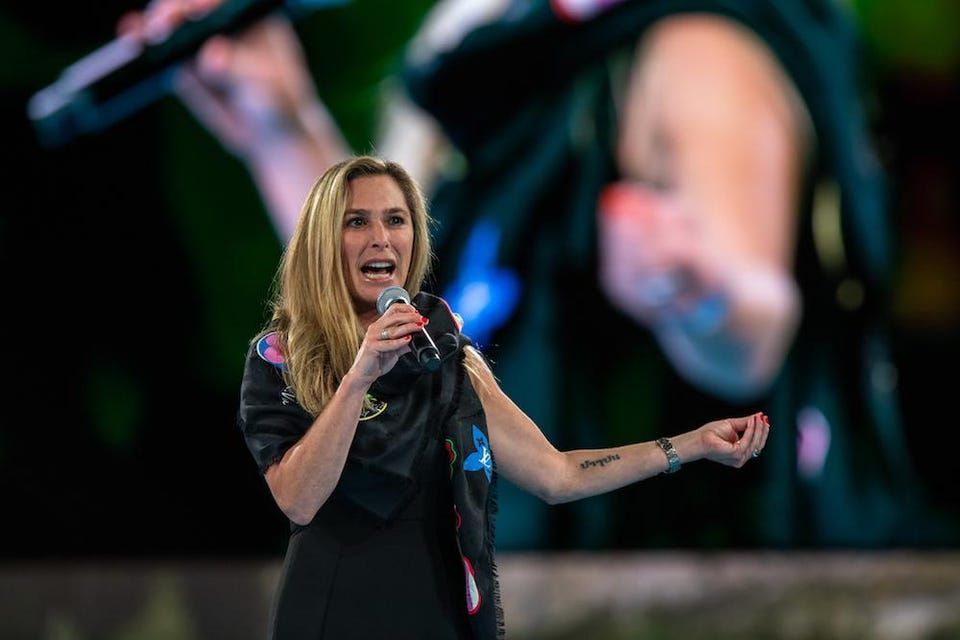
 Suzanne DiBianca, Chief Impact Officer and EVP of Corporate Relations at Dreamforce 2018, Salesforce.com’s user and developer conference JAKUB MOSUR PHOTOGRAPHY
Suzanne DiBianca is Chief Impact Officer and EVP of Corporate Relations at Salesforce, where she leads the company’s stakeholder strategy—including all corporate giving, community relations, and sustainability efforts. DiBianca was previously co-founder and president of the Salesforce Foundation and Salesforce.org. Under her leadership, Salesforce pioneered the Pledge 1% model of integrated corporate philanthropy, which dedicates 1% of Salesforce’s equity, employee time or product back into the community, which has so far generated more than $280 million, 3.8 million employee volunteer hours, and technology to 40,000 nonprofits and educational institutions around the world.
In addition, over 8,500 companies in 100 countries (including companies like Box, Yelp, Docusign, Postmates, Twilio, Okta, Harry’s and General Assembly) now participate in Pledge 1% (now its own separate non-profit run by Amy Lesnick) which in itself has donated a staggering amount; more than a $1 billion in volunteer hours, product licenses, pro bono resources and philanthropic funding–making it the B2B equivalent of the TOM’s “One-For-One” B2C model in its simplicity and scale. I caught up with DiBianca to find out more about the genesis of the program and how companies should be guided by their employee’s passions as much as strategic goals.
DiBianca talked about her role at the beginning of the company. “I joined 18 years ago. The company was about 60 people. I was actually hired to run the Foundation. So Marc Benioff had a very unique vision of creating a new kind of company, that took community service and baked it in really early on. He really was trying to create sort of a new model of business from the very beginning. In the early dayswe had no money and very little product. So, in the beginning, we were really focused on our employees and the volunteer part of it. And looking back it was the right place to start, it really became part of the hearts and minds of the people who work there.”
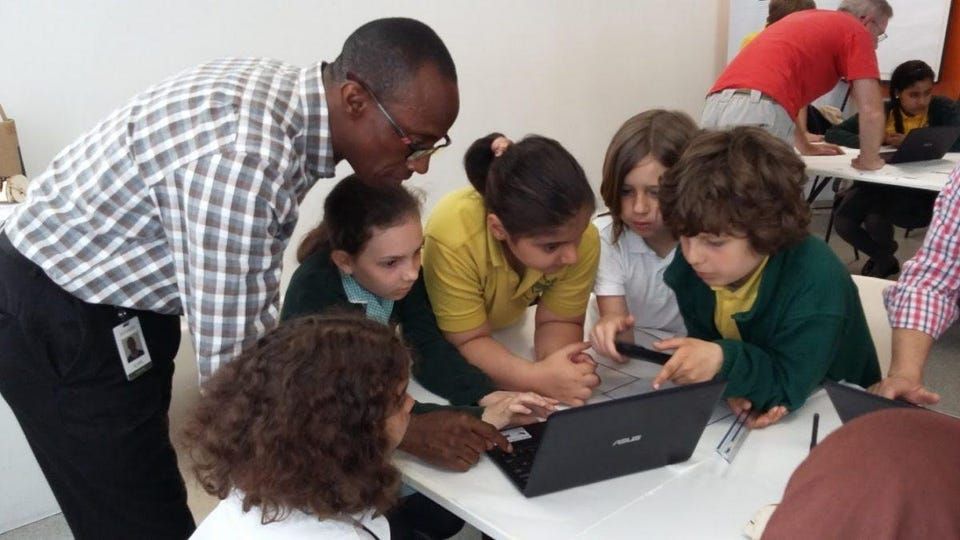 Salesforce’s ‘Future Ready’ program SALESFORCE
I asked her about how she created the genesis of the Pledge 1% model.
“That was me going out and doing a review of the industry landscape to look at what people doing in this space that I really respected, like Levi’s and Cisco. eBay was, I think, the first company who put a percentage of their pre-IPO equity into a foundation and that fascinated me as it related to a business going public. The second part I looked at was the product donation programs, and Cisco was phenomenal at that. And Hasbro really stood out from the time perspective, they had an excellent employee engagement program. So we smashed them all together because what we realized was every company on the planet, no matter where you are, what you do, has those three assets.”
DiBianca elaborated on how centralizing purpose also helped. “I think what we did uniquely about it was not only smash them all together and put a brand on it that could resonate with any company, but also integrate it. At the time there were many companies that believed in philanthropy and had embedded it into their company but it was disintermediated. They would give product from one place, give their people’s time somewhere else, put their grants in a third area. There wasn’t a lot of integration on how to focus those resources for maximum impact. So when we started working in afterschool programs, for instance, we gave them product, people and funding that we directed centrally, which just made for a much better partnership and a way bigger impact,” said DiBianca.
Part of the success was picking the right partners from inception. “Google was one of the original Pledge 1% partners that really made it to scale. So they were sort of the tipping point on the equity set-aside because of their IPO. I give a lot of credit to Atlassian, who are co-founders of the Pledge 1% with us, and talked a lot about it because they saw the power of the movement. And then it really took off in our Salesforce ecosystem. We’re a platform company and we’re a big believer in our ecosystem of AppExchange marketplace partners, who then began to pick it up. These are companies like Twilio, Okta and others who have had had successful IPO’s. I think its the simplicity and the holistic model that resonates, and because it’s translatable across industry, region, and size.” When I ask her about the similarities with the TOMS One-for-One model, DiBianca points out one crucial difference. “I think the distinction is that its much less scary than a one-for-one model because you can start anywhere on the continuum. You can just start with employee time which doesn’t cost you anything, so it takes the fear out of it.”
 Salesforce celebrated the Grand Opening of Salesforce Tower with numerous events in San Francisco JAKUB MOSUR
DiBianca’s also revealed how she visualized the different areas of focus for Salesforce which allows both leveraging its massive scale but also allow customization down to an employee level. “When I draw it out for people, I draw a triangle that’s divided into three. The top is ‘strategic philanthropy.’ For us right now that means education and workforce development and the work we do around ending family homelessness. The second part of it is ‘technology innovation’, your core competency as your company, as the middle layer, like the nonprofit success pack that we built. The bottom is what I call ‘citizen philanthropy’ which is, for instance, getting behind people who lost a loved one to a disease and they want to fight for that, or someone who wants to foster animals. That is totally valid. So we tried to not put up a lot of guard rails and really let people’s passions blossom. That’s my mental model.”
From DiBianca’s perspective, everything comes down to how purpose manifests itself in the companies core values.”It’s about our core values and how they translate. And those core values are number one, trust: nothing is more important than trust. Trust with your customers, trust with your employees. The second is customer success: if our customers are not successful, we are not successful. And the third is around innovation, for human beings at work, for our product, for our lines of business….innovation is going to keep a company and a human being strong over time. Those values haven’t changed in 18 years. And recently we added ‘equality’ which has really added to the further deepening of the notion of purpose; so we believe in equality of every human being: equal access, equal rights.”
Developing Salesforce’s unique approach involved a lot of innovation and experimentation. DiBianca said, “I think what we did really, really well, was we listened to the needs of the community and we listened to our employees and their passions and we matched them up. It was not my agenda, or Marc’s agenda, it was really driven from the grassroots. For a long time, we didn’t have strategic grants, we just put our money behind our people. We’re very committed to building what we call ‘citizen philanthropists’ and ‘democratic philanthropy.’ So we took that principle and we experimented with it: we like to say in our company that ‘tactics drive strategy’ and as a former management consultant, I had a real big problem with that in the beginning. And yet I realized also (as an Italian!) ‘The Spaghetti Principle’ where you throw stuff on the wall and you see what sticks? I began to see actually made for really robust, authentic programs. When you really listened and you really experimented alongside of people, you meet people where they are.”
Originally posted: April 23rd, 2019

As originally published on recode.net
Giving Pledge is the brainchild of some of the most prominent elders of Silicon Valley — people like Bill Gates, Pierre Omidyar, and Larry Ellison — who made billions of dollars in the first wave of tech giants only then to pledge to give most of it away.
Silicon Valley, though, thrives on disruption. And in an age when billionaires are on the ropes — and when tech leaders are reckoning with their corporate and personal responsibilities — there is new movement behind the scenes in tech to broaden the conversation that Gates began nearly a decade ago.
That’s the backdrop for efforts gaining steam like the Founders Pledge, which on Monday shared with Recode that it had amassed $1 billion in commitments. That milestone reflects both its recent momentum and also (in tech-speak) the strength of an incumbent like the Giving Pledge, which is expected to route close to $500 billion in commitments to philanthropy.
Rivals to the Giving Pledge — including a separate effort spearheaded by Salesforce founder Marc Benioff — are, in ways, trying to both disrupt it and replicate it simultaneously.
“They sort of made the market of pledges of this kind, and started challenging the wealthiest of the wealthy to do more than token philanthropy — to really put their name and reputation on the line,” David Goldberg, the head of Founders Pledge, said in an interview. “Founders Pledge is a way to hold their future selves to account.”
To be clear, the Founders Pledge has not signed up brand names like Warren Buffett or Mark Zuckerberg. Its highest-profile commitments are from people like Miguel McKelvey, a cofounder of WeWork; Niklas Adalberth, the founder of Klarna; and Jose Neves, the founder of Farfetch. But it’s trying to appeal to a younger, less-endowed class of the aspiring rich — and focusing exclusively on tech.
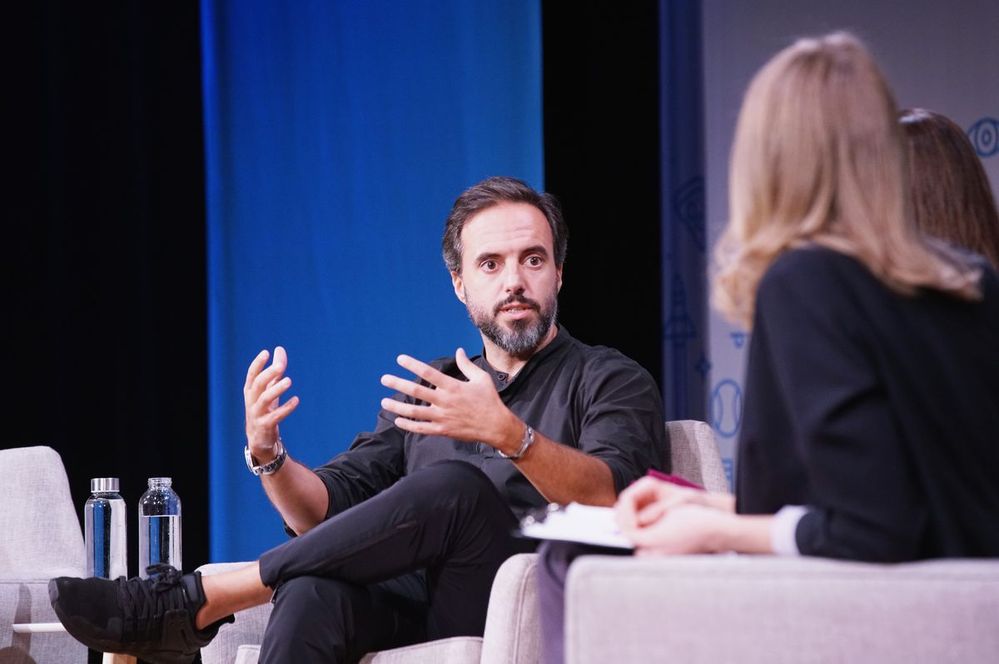 Founders Pledge signer Jose Neves, the founder of Farfetch. Bennett Raglin/Getty Images for Fast Company
In fact, not only do you have to not be a billionaire to sign the Founders Pledge like you must with the Giving Pledge, you don’t even have to be a millionaire. Or even have a likely company exit. Or even have company revenue. Or anything, really. (Okay, you generally need to be the company’s founder.)
All it asks is that you commit to a future gift. It’s a percentage of your profits — a minimum of 2 percent of your personal proceeds — which leaves open the possibility that you could be giving away hundreds of millions of dollars if you build a unicorn company or, more likely, a big fat zero.
That also makes the effort much more accessible. About 1,500 people have signed the Founders Pledge — eight times the number who have signed the Giving Pledge — which has led to about $360 million in commitments that have been fulfilled, according to the organization.
The big idea here: What if there were a way for today’s younger aspiring tech billionaires to publicly affirm their willingness to donate some of their personal fortunes — but to do so before they really have the money to make good on the promise?
In 2019, billionaires find themself in a philanthropic bind
critics generally admit that the Giving Pledge has shifted the conversation around philanthropy, bestowing some social stature around large donations (even if not quite stigmatizing the act of passing along inheritances). Since 2010, 190 billionaires have signed the Giving Pledge, committing to give away at least half of their assets.
But the easiest-to-convince pledgers signed up, as you’d expect, early on: 122 people committed in the first four years, but only 65 over the next five years (three have signed up so far in 2019). And while adding roughly 15 people a year might sound like a lot, only about 7 percent of the world’s billionaires have affixed their name to a document; the Giving Pledge particularly has work to do overseas.
The most prominent snub is the world’s wealthiest person, Jeff Bezos, whose omission fits with his historically paltry giving to charity (although he has recently tried to atone for that). Some of the wealthiest people in tech remain conspicuously absent from the Giving Pledge rolls: Google founders Larry Page and Sergey Brin, Steve Ballmer, and Michael Dell, who are each worth tens of billions of dollars.
And the on-the-rise set? The 40-and-under leaders of the next generation of iconic tech companies? People like Evan Spiegel, Adam Neumann, or Ben Silbermann are also no-shows.
Rob Rosen, who oversees philanthropic efforts like the Giving Pledge from his perch at the Gates Foundation, argues that it still appeals to today’s younger tech entrepreneurs, naming recent additions like Brian Armstrong, the founder of Coinbase; Garrett Camp, the co-founder of Uber; and especially citing the trio of 30-something Airbnb founders who announced together in 2016 that they would join the effort.
Rosen said it felt it had “strong representation” from the tech community, with his team pointing to 46 couples that it says signed the pledge from that sector.
The broader challenge for the Giving Pledge — and, to be fair, for all philanthropic efforts — is that newly rich CEOs are often less than eager to want to commit to giving away half their net worth. Who knows what life could bring? So they tend to set up family offices, preserving their options; maybe they’ll begin to think more seriously about philanthropy as they get older, when the money appears less “spendable,” so to speak.
But a big push in the philanthropy world is to encourage lifetime giving so that the principals can be hands-on with their charitable efforts rather than passing those duties to offspring. More time to give also means more time to improve as philanthropists. That’s why younger entrepreneurs can have such a big impact if they commit early.
That’s essentially the premise of the Founders Pledge — but committing even earlier. People who experiment with philanthropy only when they become billionaires, Goldberg says, are going to have some pretty painful experiences.
“When you’re a billionaire, those mistakes are at a different scale than when you’re just Joe on the street,” Goldberg said.
Neither Rosen nor Goldberg considers the other a rival — you could certainly sign both pledges, or maybe you’d graduate to the Giving Pledge once a few more millions hit your bank account.
“One of the goals of the pledge is to put the conversation on the table of what’s even possible,” said Rosen. “Tech has historically been quite innovative in doing this, so it’s not surprising that you’re seeing some traction.”
One reason why rivals’ efforts are gaining traction? Well, the problem with megadonors committing $5 billion to the Giving Pledge in 2019, for instance, is that they still might have $5 billion more in assets that they’re not committing to the Giving Pledge.
And being a billionaire is not particularly popular right now. Some Giving Pledge signers these days, such as hedge funder Paul Tudor Jones, are barely publicizing when they sign it lest they remind people of their massive net worths during a time when voices on the left are pounding billionaires for personifying American income inequality.
Rosen said his donors are as aware as ever about how their wealth is perceived, but that when it comes to the new dialogue about bllionaires, “net-net, I don’t think it’s had an impact.”
Another big difference between the two: The Giving Pledge, as its critics point out, has no teeth but is merely a public affirmation. Founders Pledge is a binding document; it can recoup the money if the signatory renegs.
The Founders Pledge, which is headquartered in London and at first hooked European founders, clearly is getting beat in Silicon Valley. So, last month, it opened an office in San Francisco, and Goldberg visits the Bay Area once or twice a quarter for dinners with prospective pledgers. He says his program has merely been a “beta test” until now.
What Goldberg has been hearing from Silicon Valley millionaires during that beta: Show me the numbers, not the narrative.
“Our members were increasingly frustrated with being told stories,” Goldberg said. “The same way we invest money — we’re hyper-rational and utilitarian in a certain respect — I’d rather achieve more return than less,” he said. “They want to be as rational with their philanthropy as they are with their investments.”
And just like Silicon Valley investors claim to offers startups more than money, almost all Silicon Valley-focused philanthropic efforts claim to be more than soliciting money: They offer a “network.” They help you think “long term” and are “patient.” They are a “partner” that wants to be part of a “movement.”
Can’t all the Pledges get along?
third pledge effort that has adopted some of this VC-style messaging — and seen some of this traction — too: Pledge 1%, which asks tech companies to promise to donate 1 percent of their company equity, time, product, or profit to philanthropic efforts. If that sounds like a rather loose way for a corporation to satisfy a philanthropic commitment, that’s intentional. It’s also, like the Giving Pledge, not binding in any way, and it’s pretty difficult to track. (How do you define “time,” really?)
More than 8,500 companies have signed this classic initiative in corporate and social responsibility, which Pledge 1% says has led to over $500 million in philanthropy.
Amy Lesnick, the Pledge 1% CEO, said she considered the two other efforts not competitive because she is focused on signing up a company rather than a billionaire.But her organization is still competing for the mindshare of a company founder — who might be a Giving Pledge-eligible billionaire, too — who is trying to weigh his personal and professional charitable obligations.
Lesnick still stressed ways in which her organization differs from the other pledge drives trying to remake tech philanthropy.
“I think that Pledge 1% has a reach and accessibility that is infinitely broader,” Lesnick told Recode in an interview. “We are not just saying, ‘Hey, I’m going to look at who are going to be the companies that are going file for IPO in the next 12 months — and we are only going to talk to them.’”
To be sure, there is a world in which all three of these programs patch together to make a philanthropic quilt. Maybe a young entrepreneur signs the Founders Pledge, setting a standard for her personal philanthropy, and then Pledge 1% to set a standard for her company’s philanthropy. And when she really makes it big — becoming a bona fide billionaire — she signs the Giving Pledge.
For instance, Benioff, the Salesforce founder behind the Pledge 1% initiative, has signed the Giving Pledge as well. But Benioff is perhaps Silicon Valley’s most omnipresent (and, yes, abrasive) advocate for philanthropy. And given Benioff’s own words in the past about Silicon Valley billionaires, it probably wouldn’t surprise him to learn that they’re not jumping to participate in all three programs simultaneously.
“Not all of them are giving money away. A lot of them are just hoarding it,” he told the Guardian last year. “They’re keeping it. That’s just who they are and how they look at their money.”
Originally posted: April 23rd, 2019
As originally published on Flexport.com.
Recently, Flexport.org shared the progress we’re making in delivering humanitarian aid, increasing environmental sustainability, and demonstrating social responsibility. We believe that social and environmental issues are deeply intertwined, so we’re proud to announce our newest initiative: making all of our disaster relief shipments carbon neutral!
87% of people in extreme poverty live in countries that are environmentally fragile. The communities living in these vulnerable environments are more likely to be disproportionately impacted by the effects of climate change, like the increased frequency of droughts, floods, and severe weather events. Community development is severely inhibited as a result. Droughts and floods destroy crops, disrupt water systems, and contaminate water reserves. Severe weather events disrupt or destroy critical infrastructures like schools, medical facilities, and transportation.
Cyclone Idai, for example, one of Mozambique’s worst disasters, recently caused massive destruction and a rise in cholera outbreaks. Flexport.org, together with Airlink and many other nonprofit partners, delivered over 50,000 lbs of aid supplies to Mozambique in the past few weeks, but we want to take our efforts even further.
Because shipping is a major contributor to climate change, we are expanding our carbon neutral services in honor of 2019’s Earth Day. Last year, we launched carbon neutral LCL to make climate-friendly solutions accessible to all Flexport clients at no additional cost. This year, starting on Earth Day, Flexport will offset all shipping-related carbon emissions of every disaster relief shipment we procure and manage. We partner with Carbonfund.org Foundation, a leading 501(c)3 climate solutions provider, to donate to third-party verified, international offset projects.
We are proud to be the first freight forwarder to deliver 100% carbon neutral aid shipments, leading the new way forward in partnering with both our international communities and our planet.
You can ship carbon neutral too. Join us at flexport.org/carbon-offsets.
Originally posted: April 23rd, 2019

As originally published on yourstory.com
Anyone who has ever lived in a hostel will relate to this pain point: getting approval from the warden for a night out. Assuming that your parents or local guardians have already greenlit your plans, the steps that follow are tedious and cumbersome, entailing much back-and-forth and a lot of manual paperwork.
And this is just one issue out of a pile of concerns involved in the day-to-day task of hostel management. Most Indian educational institutes and their student housing units, in fact, are still caught in the web of redundant paperwork, time-consuming manual processes, and an obsolete style of parent-student-management communication. Now, when there’s an app for everything under the sun, why not an app that makes hostel management painless and automated?
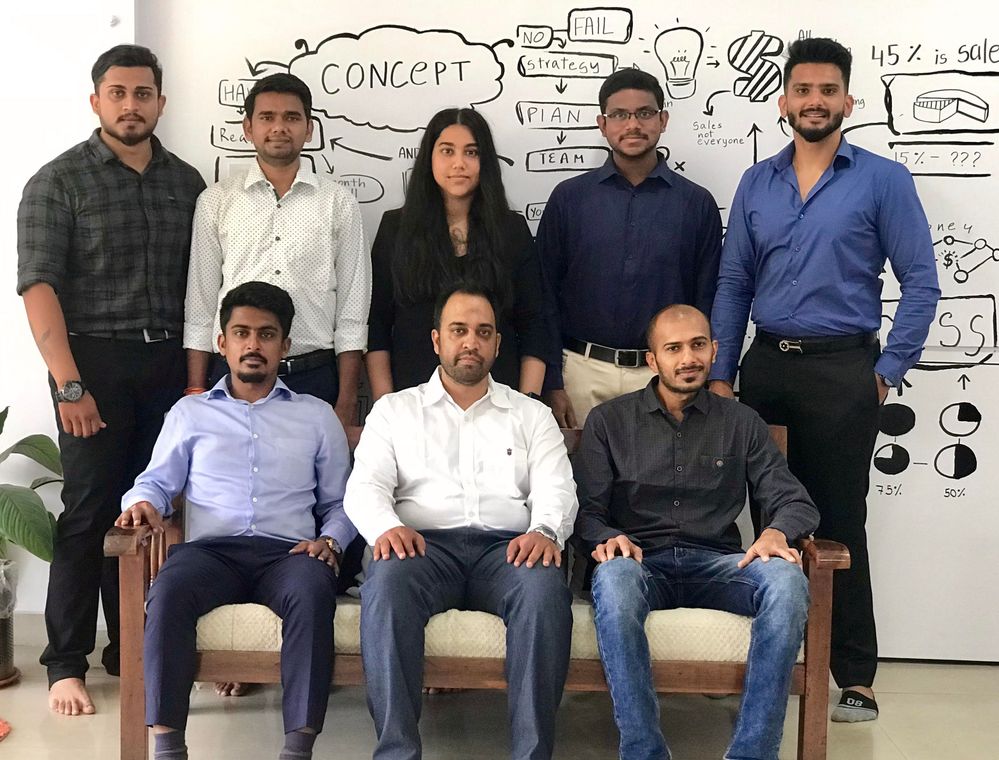 SpaceBasic team
California-headquartered SpaceBasic, which has an office in Bengaluru, addresses this very concern. Born out of the founders’ experience across different fields, the SaaS-based platform aims to do away with old-school methods to facilitate seamless communication between hostel management, students, and parents.
Of chance meetings and varied experiences
In early 2016, when Madhavi Shankar, now CEO and Co-founder of SpaceBasic, was working in Australia, her father introduced her to a successful entrepreneur based in San Francisco, US. They met on a Friday afternoon at Four Seasons in Palo Alto, and within no time the meeting pivoted towards a chat around startups and brainstorming ideas.
 Indu Navar, SpaceBasic
“I thought it would be a social meeting. Now we are co-founders,” says Madhavi, who launched SpaceBasic in March 2017, along with Indu Navar, who ran venture-backed logistics company Serus Corporation for 10 years until a successful exit in the Silicon Valley. The third founding member, Aiden Bingham, was juggling between life as a freshman in college and entrepreneurship while Madhavi was working as a product manager with Vodlo, for the Asia-Pacific region in Australia at the time
Talking of their combined experience across diverse backgrounds, Madhavi says, “We each bring very different skills, talents, and perspectives to the table.”
Initially built as a mobile app to assist a charity student hostel, the SpaceBasic app now offers a two-fold advantage: firstly, it allows hostels to eliminate all manual processes, and secondly, it helps hostels to communicate with students more efficiently.
Social media for hostel dwellers and much more!
When it comes to managing hostel administration, “SpaceBasic is a welcome change”, according to Christo Joseph, who heads strategy and planning at Garden City University, Bengaluru. He says, “We have been able to bring about a cultural change among students in the hostel.”
The SpaceBasic application itself is extremely simple and easy to use. Madhavi adds, “we had designers build this app keeping these two things in mind. It’s a clean UI, not too complicated, and because it’s role-based users only get to see the actions they must provide. It’s not a clutter.”
Besides digitising the hostel administration, SpaceBasic also serves as an interactive social networking platform for information sharing and process management among students, parents, student housing communities, and more. Additionally, students can use the platform to apply for leaves, lodge complaints, track submitted applications, and access real-time status updates without being physically present.
The app also allows students to post announcements to fellow students, requesting or offering valuable services.
“Our key feature is the networking platform that gives students access to our global industry partners who provide students with skill development programmes, jobs, internships, trainings, scholarships, and other such student-centric opportunities,” Madhavi explains.
As of now, the startup is working with partner companies based out of both India and the US.
The end goal, Madhavi adds, is to create a talent pool of the underrepresented and provide students “opportunities without bias of background or location”. This entails offering the opportunities availed by students from the crème de la crème colleges in India to students in the Tier II and III cities.
Scaling up and expansion
Almost two years into operation, the platform is already making its presence felt pan-India, with team-ups and partnerships with key private and government institutes, including Indus International Schools, DY Patil University, PES University, and University of Agricultural Sciences.
“Our growth has been completely organic with a team of five-seven people,” Madhavi says.
When they started out, in 2017, the SpaceBasic team was just three-member strong. It added five-seven members in the next year, and has now expanded to a team of 13 and counting. Along the way, the co-founder explains, they have garnered recognition from the United Nations, Government of India, as well as Government of Karnataka. Even their user base has grown during this period, from 3,000 to around 25,000 users by the end of 2018, an impressive growth in the second year.
Madhavi says,
“Today, we are a high growth startup with 700 percent growth in 2018, 25,000+ users, and 30 K12, universities, and colleges pan-India.”
Perhaps the biggest advantage with SpaceBasic is that it works as a plug-and-play module and as a standalone, multiplatform application optimising communication and collaboration processes in hostel management. Simply put, “universities and student housing communities pay us per student per year,” explains Madhavi, while “companies pay us monthly fees”.
“For charity-based institutes, we provide our software free of charge as part of our give-back programme,” she adds. As part of their corporate philanthropy, they are involved with the Pledge 1% movement, whereby they pledge 1 percent of their profit, time, and software to invest back into “our community and towards educating women each year”.
The very fundamentals of running a startup involve preparedness for unexpected challenges and the usual ups and downs, and Madhavi is quite familiar with the cycle. From quitting a well-paying corporate job in Australia to testing waters in a unfamiliar startup community, and now doubling their revenues month on month, she is doing it all while relying on what she calls “my gut”.
SpaceBasic plans to raise seed funding this year to scale operations even as it sticks to its one true mantra: “customer is the king (or queen)”.
“We are building a culture that focuses on customer experience and quality products,” Madhavi says.
Originally posted: April 17th, 2019

PLEDGE 1% vision: A new business paradigm whereby social impact is integrated into the DNA of companies of all sizes and stages.
Impact to Date
Pledge 1% has experienced incredible growth since its inception:
• 150% growth per year
• Over ½ billion in new philanthropy ignited by members
• Over 8,500 companies in 100 countries
• Named Fast Company’s most innovative non profit in the world in 2017
Addteq is proud to Take the pledge 1% more than three years ago. Since joining, Addteq actively participates in Pledge 1% initiatives within the community and continues to plant the seed of giving back within Addteq’s culture.
“During the new employee orientation we host a new team members welcome breakfast at our Princeton office. And, during the welcome breakfast I host an impact activity ( Thank you to Amy. Lesnick, CEO of pledge 1% for giving me this idea). How the impact activity takes place – we have a canvas in the office and during the breakfast the new employees receive information about the Pledge 1% and room2read and giving back programs.
I also, make sure that our recruiters mention giving back to the community while recruiting new hires. The reason I ask our recruiters to mention to each and every person they speak to over phone become 1. It’s unique identifier over and our competitive edge. 2. I want to make sure that even if the person on the phone won’t end up working at Addteq and if they will hear about pledge 1% and room2read they may become active members or contributors in the near future. So, its win win”
-Amanda Deol, Partner at Addteq
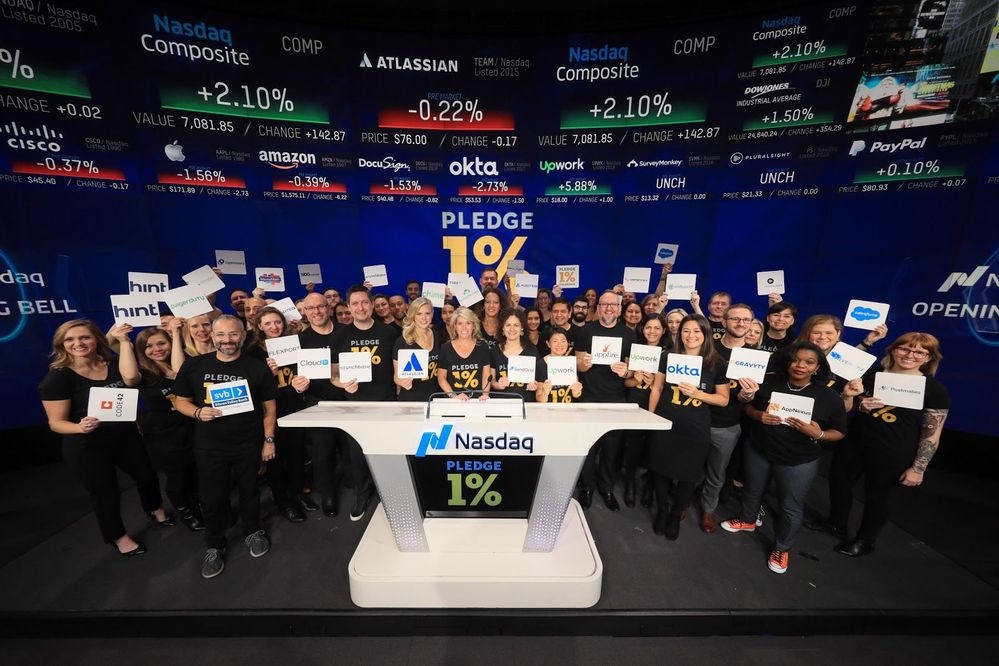
Pledge 1% celebrated their 4th anniversary on November 27th, 2018 by ringing the opening bell at NASDAQ! In celebration of Pledge 1%’s Fourth Anniversary, core founders and builders stood together and rang the Nasdaq Stock Market Opening Bell. Addteq was proud to be listed alongside these amazing companies.
Pledge 1% celebrated their 4th anniversary on November 27th, 2018 by ringing the opening bell at NASDAQ! In celebration of Pledge 1%’s Fourth Anniversary, core founders and builders stood together and rang the Nasdaq Stock Market Opening Bell. Addteq was proud to be listed alongside these amazing companies.
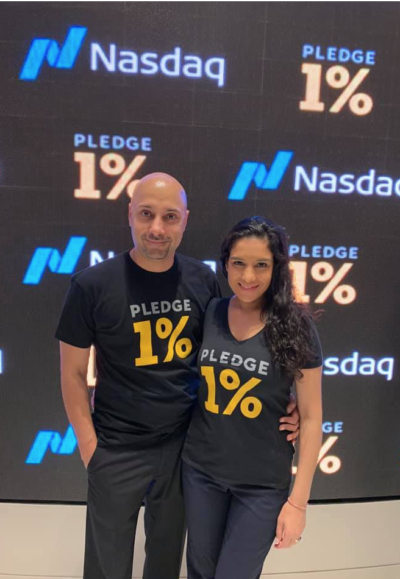 Addteq Founder Sukhbir Dhillon and Partner & Wife Amanda Deol attending the Pledge 1% 4th Anniversary celebration at NASDAQ.
Why join Pledge1% Builder’s network with Addteq
Addteq Joined the Pledge 1% builder’s network in November 2018. Pledge 1% builders, is a group of companies that are investing in the future of Pledge 1%.
We are excited to be part of the core funders and builders who are not only having a direct impact with their own social impact programs, but also committed to building the Pledge 1% movement and propelling thousands of other companies to accelerate social impact globally. Builders are the future of the Pledge 1% movement. Builders serve as thought leaders, advisors, and supporters to the initiative. They enable pledge1% to educate and empower the community and drive impact at scale.
Pledge 1%’s core funders include tech leaders like Salesforce and Atlassian, and Pledge 1% Builders include recent IPOs like DocuSign, Pluralsight, and Upwork, hot acquisitions like SendGrid and Weebly, as well as some of today’s fastest growing companies like Addteq, Appfire, Box, Classy, Cloud Co-Op, Contentstack, Crunchbase, Flexport, Gliffy, Hint Inc., MapAnything, MediaMath, Okta, Optimizely, PagerDuty, Postmates, Silicon Valley Bank, Silverline, and Twilio. Influential tech ecosystem partners have also backed the movement, including 500 Startups, Foundry Group, Salesforce Ventures, StartCon, SV Angel, Techstars, TechCrunch, and WebSummit. Read more.
Addteq’s Pledge% in practice
Addteq’s Pledge 1% initiative is to donate 1% of Excellentable revenue to sponsor the students who are smart enough to be an aspiring Engineer but, are not fortunate enough to afford the school fees. Some of our other recent initiatives include: We are with Women , Spotlight on #BeBoldForChange Campaign at Addteq , Giving Back to Community: Addteq’s Story , Small first steps turn into a search for Einsteins , Iris Foundation , A Transformational time for women around the world, World Read Aloud Day from a Enterprise DevOPS Engineer and most recent fundraiser with book author Oanh Ngo and Room2read New Jersey Chapter to celebrate international Day of Women. Few our employees at Addteq donate their 1% their paycheck toward Iris foundation and room2read. And, we continue to activate and expand Pledge 1% program within our company culture.
Why Give Via Room2Read & Why Invest in Education and How you can get Involved
Addteq wanted to offer the opportunity to continue education with a tuition reimbursement program and flexible work schedules. We were set out to allocate one tuition reimbursement for the year. However, we exceeded our original goal and allocated three tuition reimbursements for employees. Two of the three recipients were women. According to the Department of Labor, only 11% of all engineers in the U.S. are women. Among computer programmers, the situation is only slightly better. According to a Wired study, only 26% of all American coders are women. To solidify and strengthen the impact of Pledge 1% and Room2Read Addteq’s 2018 holiday party was dedicated to #donotreadthis Room2Read campaign and Pledge 1%. We nominated and awarded the employees based on the activities with Pledge 1% , Room2Read and volunteerism and giving back.
Addteq’s founder grew up in a humble environment, in a home that was only 150 square feet. He believes that in order to take this society forward, everyone should have an opportunity to education. Here at Addteq, we are strong believers of giving back to the community and launched the Iris Foundation in 2015. The purpose of the Iris Foundation is to help provide scholarships to students who are smart enough to become engineers but not privileged enough to pay for school fees. We believe every child deserves to become what they want to be. When you are in poverty and don’t have any resources to climb up, education is the only way to success.
In February of 2019 I was in India for my sister’s engagement celebration. While I was in India I visited many villages in state of Punjab, city of Pune and Delhi.
Throughout my trip in Delhi and Pune I visited many places which were 5 star hotels, penthouses. While busy in conversations, sipping on drinks and fancy coffee, something really bothered me: children begging on streets. I kept thinking about the little kids, little girls and boys, I saw begging on streets, or doing child labor in front of restaurants, bars & hotels (of course they were not allowed in front of the main gate). I asked many people why they are begging. Some said that their parents send them on street to beg, some said their families are poor, some said parents take drugs while others said that it’s just a business. The answers I got were neither convincing nor did they answer any questions I had about the children. I do know that giving money to child beggars won’t help anyone in the long run, but at same time I don’t want to look the other side or the cycle of poverty will never break. I remember the concept Sukbhir Dhillon, CEO of Addteq always refers to “Give a Man a Fish, and You Feed Him for a Day. Teach a Man To Fish, and You Feed Him for a Lifetime.” He believes that in order to take this society forward, everyone should have an opportunity to education. Based on that Addteq will continue to invest in education and continue to invest in programs like Room2Read and Pledge 1% .
One of Partner Amanda Deol’s goal at Addteq is “Think globally, act locally” that being said being in Princeton, NJ we have abundance of wealth of resources in our community. In April Addteq will be sponsoring 49th Annual Communiversity event by Art council of Princeton. We will be donating our sponsored booth to Room2Read New Jersey Chapter so, we can spread the word about Room2Read.
What is Communiversity?
It’s produced by the Arts Council of Princeton with participation from the students of Princeton University and support from the town of Princeton, Communiversity ArtsFest features over 200 booths showcasing original art and contemporary crafts, unique merchandise and culinary masterpieces from local chefs, plus six stages of continuous live entertainment. Communiversity ArtsFest draws over 40,000 art lovers and fun seekers to downtown Princeton, making it Central New Jersey’s largest and longest running cultural event. So, do the math for Room2Read awareness………….. I am personally excited to volunteer at the booth and talk to the community about Room2Read.
So, How you can help?
PLEDGE1 Today: join the Pledge 1% Builder’s and give back via Room2Read.
Originally posted: April 15th, 2019
As originally published on TechForceservices.com.au
Techforce Services announces today that it has joined Pledge 1%, a corporate philanthropy movement dedicated to making the community a key stakeholder in every business. Spearheaded by Atlassian, Rally, Salesforce and Tides, Pledge 1% empowers companies to donate 1% of product, 1% of equity, 1% of profit or 1% of employee time to improve communities around the world.

Techforce Services is joining an impressive network of entrepreneurs and companies across the globe that have committed to philanthropic efforts through the Pledge 1% movement. By pledging 1% of its employee time, Techforce Services is demonstrating a commitment to philanthropic leadership.
“We strongly believe in participating in the community. Be it the immediate community of Salesforce customers, users and partners or the overall community around us. Since our inception over three years ago, the team at Techforce Services has volunteered for different causes, largely independently. By formally joining the 1% Pledge, we aim to scale up these efforts,”said Vamsi Krishna, Founder and Director, Techforce Services.
As a company, Techforce Services is committed to supporting Good Company and the charities they support.
“Increasingly giving back isn’t just the right thing to do, it’s also the smart thing to do,” said Pledge 1% Chief Executive Amy Lesnick. “The Pledge 1% movement empowers founders to integrate giving back and doing the right thing into the core culture and values of their companies and to leverage all of their assets (equity, product, technology, talent, voice, partner ecosystem) to be a force for good. We are delighted that TechForce Services has joined the movement and we welcome them to our community.”
“We’re excited that Techforce Services is joining us in giving their resources back to the community. This is another great example of the power that business has to drive social change.” said Suzanne DiBianca, EVP of corporate relations and chief philanthropy officer, Salesforce. “At Salesforce we believe that every business can be a platform for positive change and we co-founded Pledge 1% with the intention of evangelizing that message.”
Pledge 1% is an effort spearheaded by Atlassian, Rally, Salesforce and Tides to accelerate their shared vision around integrating philanthropy into businesses around the world. Pledge 1% encourages and challenges individuals and companies to pledge 1% of equity, profit, product and/or employee time for their communities, because pledging a small portion of future success can have a huge impact on tomorrow. Pledge 1% offers companies turnkey tools and best practices, making it accessible for any company to incorporate philanthropy into their business model. To learn more or to take the pledge, please visit www.pledge1percent.org.
Techforce Services is a Salesforce Implementation partner that helps you simplify Salesforce for your business. We work across the entire Salesforce Implementation spectrum, build custom Salesforce applications and integrate Salesforce with other on-premise or cloud-based systems.
With our simplified approach, you can achieve steadfast results: a productive team, customer satisfaction, improved analytics and a higher ROI. We believe in growing together; in going above and beyond for our customers. Once you start on this journey, it’s a virtuous cycle of business growth.
Originally posted: April 15th, 2019

As originally published on blog.procore.com
Procore’s clients are making a physical mark on the world – building our community’s schools, homes, hospitals, airports, and more. We’re honored to create products for the people in construction and we are continuously inspired by our users to help improve the industry we serve and the communities we call home.
Procore drives social impact through two company initiatives: Procore.org and Procore’s employee volunteer program. These initiatives have been growing and we wanted to take the next step in our commitment to corporate philanthropy. By partnering with Pledge 1%, a global movement of organizations dedicated to making giving back a fundamental piece of business, we’re formalizing Procore’s dedication to social impact through our product and time.
At Procore, more than one percent of our total active client accounts are nonprofit or educational organizations that receive Procore’s software, implementation, and support at no charge. In addition, Procore employees spend at least one percent of their annual working hours engaging in community service.
Procore.org – Giving Our Product
Established in March 2017, Procore.org connects nonprofit builders, schools, associations, and local organizations with construction education, workforce development and training programs, and free access to the full Procore product suite in order to support building for charity and advancing the construction industry. Procore clients through Procore.org have a dedicated implementation manager and unlimited customer support, data storage, and user seats. What started as a grassroots effort by employees who wanted to do more for the industry is now an essential and strategic initiative towards realizing our vision of improving the lives of everyone in construction. Take a look at the 2018 progress of Procore.org.
Employee Volunteering – Giving Our Time
Our employee volunteer program, Procore Cares, is an employee-led initiative and is designed to connect employees with volunteer opportunities in their local areas. Procore’s volunteer policy encourages employees to take paid time off each year to participate in community service, and establishing a volunteer program was key in promoting this policy. As our team grows, so do our efforts, impact, and interests in how we volunteer our time. Whether it’s hands-on, such as packaging food for those in need, or skills-based, like mentoring local engineering students, we’re always looking for opportunities to incorporate service into our work at Procore.
Giving back isn’t only the “right thing to do,” it’s an effort that impacts a company’s business, customers, employees, and communities. By sharing news of our partnership with Pledge 1%, we hope to inspire others to prioritize philanthropy in their businesses.
As our team continues to grow across the globe, we’re always looking for new team members to grow with us. If you’re interested in career opportunities with Procore, visit our jobs page.
Originally posted: April 15th, 2019
As originally published on DealRoom.net
As part of DealRoom’s newly developed giving program, our organization is proud to sponsor a Tutoring Chicago event.
DealRoom was proud to sponsor Tutoring Chicago‘s inaugural Celebrity Spelling Bee!
Tutoring Chicago is a private, non-profit organization that offers free one-on-one tutoring services to an average of 700+ students in grades 1 – 6 every week. Their mission is to empower economically disadvantaged children through education. Each year, adult volunteers from all over the city work with students on homework, math, technology, reading, and life skills.
Tutoring Chicago was founded as the Cabrini Green Tutoring Program in 1965 by a group of employees at Montgomery Ward. The program officially became incorporated as a private non-profit organization in 1990 with dedicated efforts towards the youth of Cabrini Green. As the program continued to grow, Cabrini Green Tutoring Program wanted to target local neighborhoods beyond Cabrini Green and rebranded the organization as Tutoring Chicago in 2012. Today, Tutoring Chicago is working on opening a fourth site location.
They have received numerous awards including the the Sun-Time Literacy Award, the Impact 100 Award, and the Thomas A. Demetrio Lend-A- Hand Award of Excellence.
The spelling bee was comprised of local Chicago celebrities and emceed by Ryan Asher and Jeff Murdoch from The Second City, one of Chicago’s premiere comedy clubs. After eight rounds of spelling ,Team SYKES TalentSprout came out on top! The duo included Chicago Sun-Times interim CEO/COO, Nykla Wright, and a TalentSprout representative, Jonathan Gray.
Most importantly, the event raised more than $30,000 to help Tutoring Chicago continue their work. If you are interested in learning more about Tutoring Chicago, or donating to the cause, go to https://www.tutoringchicago.org/donate/.
In order to more effectively support Chicago’s community, DealRoom recently joined the movement Pledge 1%. Along with leading companies around the world, DealRoom proudly pledges to donate one percent of profit, employee time or product to local charities and nonprofits.
DealRoom as an organization greatly values strengthening Chicago’s educational resources as a way of advancing the community’s youth. DealRoom will focus our charitable efforts towards this cause and look forward to making a meaningful impact.
Originally posted: April 15th, 2019

SmartRecruiters announces a new corporate responsibility initiative (CSR), and three other moments worthy of a mic-drop.
This morning, merry conference-goers were greeted by a classic case of San Francisco rain and fog. Is it any surprise that the number one tourist purchase in San Francisco is sweatshirt? However, damp environs proved no match for attendees’ giddy spirit or the palpable enthusiasm of a giant dancing alien named Winston the Smartian, SmartRecruiters’ brand new mascot.
The revelries began at the crack of 7:30. As conference-goers rolled into Pier 27 and began catching up over delicious cups o’ quiche, they couldn’t help but notice our friends at G2 crowd collecting surveys from SmartRecruiters customers. For every completed survey, SmartRecruiters made a $10 donation to Defy Ventures, a non-profit organization providing career training and mentorship for formerly incarcerated people in the US. Forgive the shameless plug, but it’s for a good cause, people!
But, enough of work. The sun is setting on our first day at the conference, and we’re all headed to the Smarty Party carnival, so let’s take a moment to recall some of the top moments of our first day at Hiring Success 19 – Americas.
When SmartRecruiters announced a new CSR: ‘Reverse Recruiting’ Invites Hiring Success Community to Give Back.
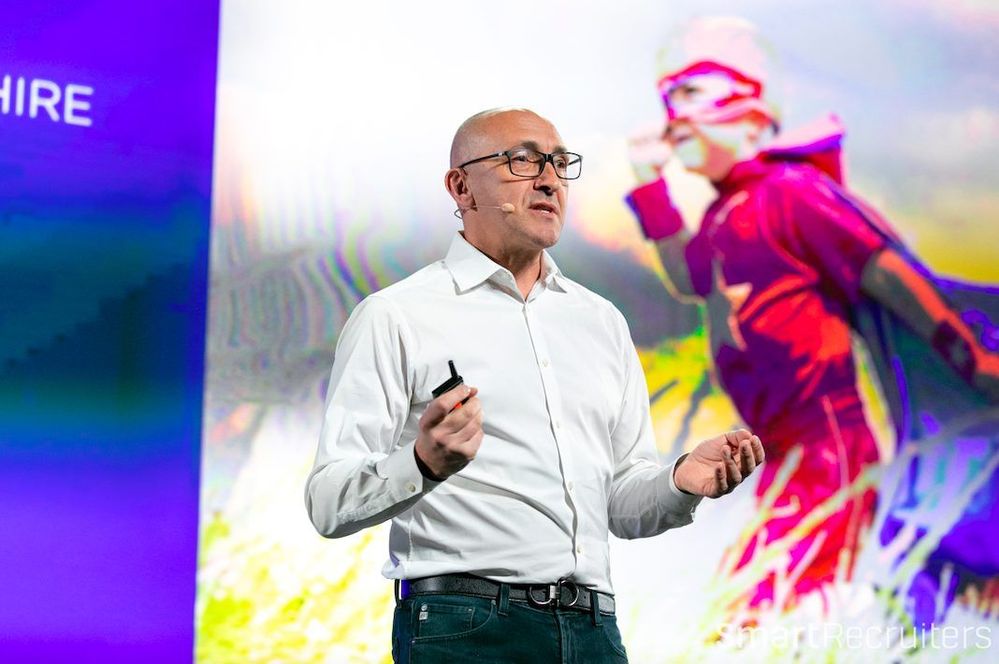
In the opening keynote by Jerome Ternynck, CEO and founder of SmartRecruiters, attendees learned about the launch of a new corporate social responsibility program, Reverse Recruiting!
This CSR goes well beyond the SmartRecruiters business. It starts with SmartRecruiters pledging one percent of their equity towards a future foundation. SmartRecruiters also wants to ensure non-profits have access to top-level hiring technology through free and discounted services for organizations of all sizes, and ends with everyone (including your company) getting involved with Reverse Recruiting!
What is Reverse Recruiting?
On Reverse Recruiting days, recruiters no longer work for their companies — they work for candidates. They invite rejected candidates and previously overlooked talent to review their resumes, conduct mock interviews, offer suggestions, and assist struggling candidates in their job search. And guess what? Managers are invited as well! What a great way for everyone to give back.
SmartRecruiters will participate in Reverse Recruiting days once a quarter in all of our global offices, and the hope is your office will consider this as well. Sign up to learn more and receive a toolkit with all the materials you need to host your very own Reverse Recruiting session.
How to ‘backtest’ your hiring practice like the folks in finance do.
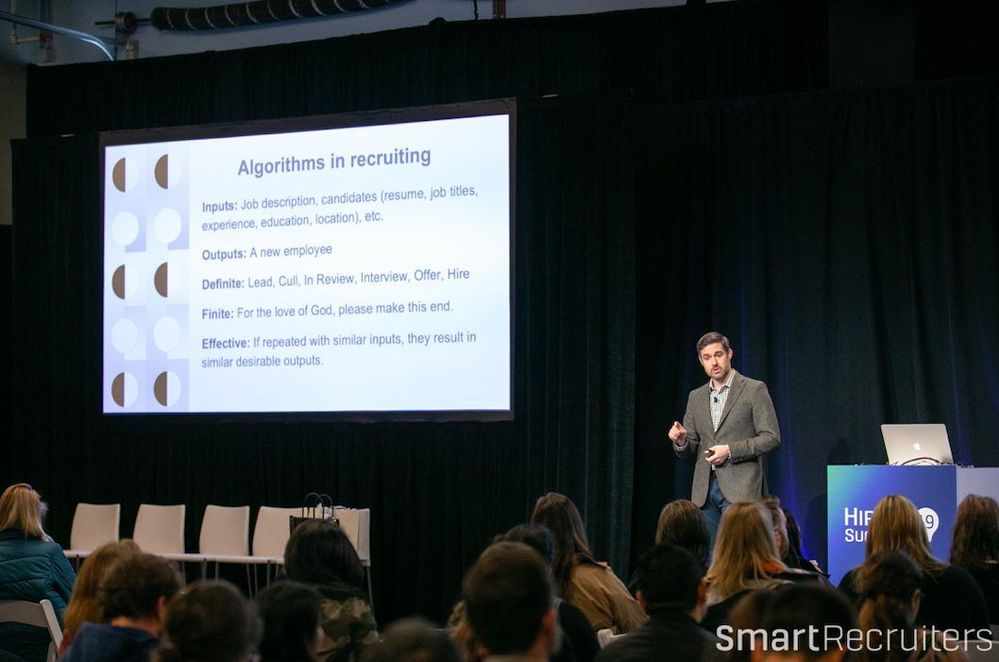
In today’s Select track, Are Purple Unicorn Hires Repeatable, Robert Coombs, CEO of Head of Business Operations at CredSimple, talked algorithms. It’s a word we hear a lot, and before today this author defined it as ‘the magical computer thing that figures stuff out for us lowly humans’. Now I know it’s actually as simple as a set of rules we use to problem solve. A low-tech example of an algorithm is a recipe. We can reasonably expect chocolate chip cookies when we put the right ingredients through the right preparation and cooking steps, but let’s get more specific.
An algorithm, whether it be for cooking or financial gains, has several elements in common:
- Inputs – The thing that is applied: data, ingredients, historical trends,
- Outputs – The thing that comes out: transactions, delicious cookies, great hires
- Definite – Clear, unambiguous, and feasible
- Finite – Must have an endpoint
- Effective – Similar inputs yield similar desired outputs
So, let’s look at a recruiting example. Take one of your really successful hires, and let’s reverse engineer the process to see if your recruiting algorithm is effective. This is called ‘backtesting’.
We took the example of Roy Baladi, head of the marketplace for SmartRecruiters. Say we want to test effective keyword searches — we look at the job description and start pulling keywords to search for candidates. Again and again, Roy’s name does not show up in the shortlist. What does this tell us? Maybe we need to revisit the job description (i.e. our input) and revise our wording to be more relevant towards the role.
Some people call this process ‘dogfooding’, which basically means internally testing your external processes to see if they are indeed effective. Have hiring managers test this on themselves to increase empathy and produce more accurate job descriptions!
Three recruiting lessons from teachers, that are scalable for your TA function.
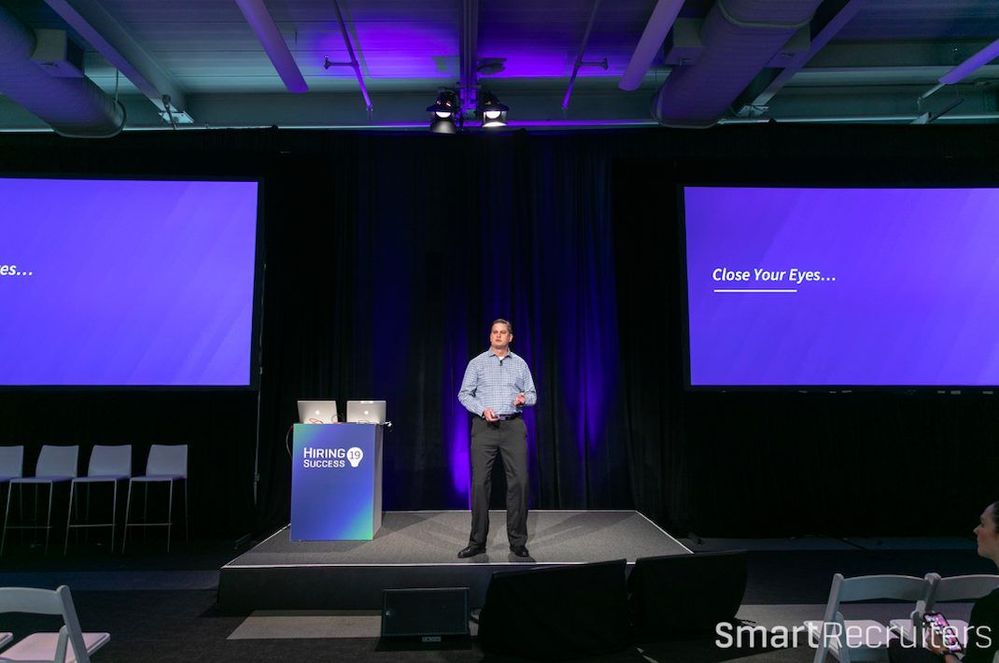
Speaking on the Attract track, Brian White of the Auburn-Washburn Unified School District 437 asked everyone seated at the session Get Ahead of Seasonal Hiring Challenges to close their eyes and think of a teacher who made a positive influence in their life. For most attendees, it didn’t take long for inspirational educators to come to mind. Whether it was the math teacher who sat with you until multiplying fractions finally made sense, or the tutor who helped you master the past perfect in Spanish, the examples are practically infinite.
When we are asked to think of similar moments with recruiters, the examples are far fewer. So what can TA take from teachers’ best practices to boost candidate experience?
- Learn what’s important to the student. The most effective teachers find out what motivates their students, what they care about, and use that knowledge to inspire learning.
- Learn to communicate based on the individual. For teachers, this can mean catering to different learning styles. Brian’s team used this advice to create a texting line for job inquiries and implement a chatbot.
- Understand the student is more than a number. Even with the incredible volume of students teachers interact with every year, they think of each one as an individual person. For recruiters this can be as simple as including a personal detail their outreach to show talent they really care.
The biggest myth is that anyone is normal.
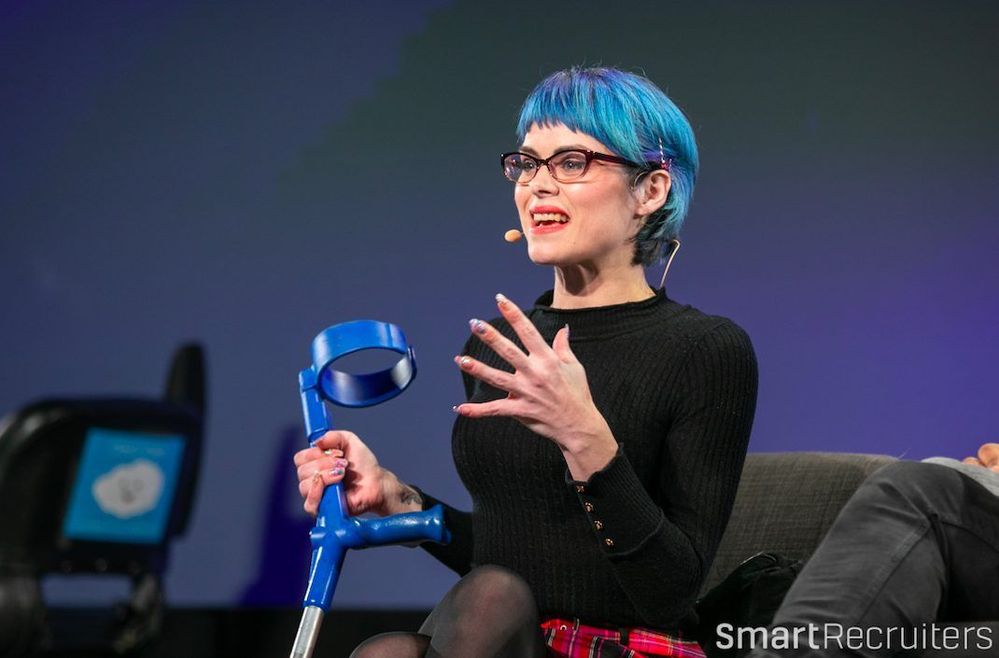
In today’s hire track, during Mind Mix: Neurodiversity at Work’ Sara-Jane Harvey, an autism advocate who also is on the spectrum herself, helped our audience understand the prevalence and value of neurodiversity in our society.
The biggest mental health myth is that there is indeed a “normal”. Normal doesn’t exist. If your mind is a computer, then the way you process information is your operating system, and just because your computer doesn’t run Windows doesn’t mean it’s broken.
There’s no need to be ‘realistic’ when setting goals.
In today’s closing keynote, Colin O’Brady, four-time world record holding endurance athlete, reminds us how crazy his goals seemed when he first set them.
When Colin told his mother from a hospital bed in Thailand, where he was recovering from third-degree burns covering a quarter of his body, that he wanted to train for a triathlon, she didn’t say, ‘let’s set a more reasonable goal.’ Even with doctors saying Colin may never walk normally again, his mother took him seriously, and immediately got Colin small weights to start training.
Eighteen months later, Colin entered the Chicago marathon — and won! He continued to set outrageous goals, and continued to check them off like items on a grocery list. Climb the seven highest peaks in the world in a record-breaking 132 days – check! Be the first to cross Antarctica solo and unaided – check!
“I don’t think everyone wants to go walk across Antarctica,’ said Colin, ‘but I know that people certainly have challenges in their life. Everyone has reservoirs of untapped potential inside of themselves and can achieve really incredible things.”
Originally posted: April 15th, 2019