For foundations and most nonprofits, supporting issues and furthering causes is at the heart of what they do. And because of their status, these organizations are able to benefit from gifts and other third-party funding sources themselves. Whether its donations, volunteer hours, tax breaks, grants or other similar funding streams, special funds and gifts are primarily what keep many of these giving organizations afloat.
Conversely, most corporations are built around a “profit above all else” mentality. Historically, for these organizations, giving was often something reserved for PR reasons or certain tax breaks. Giving was “a nice thing to do,” but was far from being a requirement.
Thanks to the efforts of visionary leaders like John Elkington and campaigns like Pledge 1%, corporate giving today is far more than just a nice thing to do. Giving is now part of the bottom line for many for profit corporations – giving rise to the notion of the triple bottom line.
During the mid-1990’s, John Elkington strove to measure sustainability by developing a new framework to measure performance in corporate America. The new accounting framework he developed, called the triple bottom line, went beyond the traditional measures of profits, return on investment and shareholder value. It included environmental and social dimensions as well.
By focusing on comprehensive investment results, along with the interrelated dimensions of profits, people and the planet, triple bottom line has become an important tool to support corporate social responsibility and environmental sustainability goals. The reason for this is that behind the triple bottom line lies the fundamental principle that what you measure is what you get – because what you measure is what you are likely to pay attention to. Only when companies measure their social and environmental impact will they have socially and environmentally responsible organizations.
Not wanting to become a nonprofit, Brian and Patricia Fitzgerald, who founded Innovation Station in 2016, wanted to create a for profit enterprise that acted like a nonprofit by putting giving above all else.
“It’s great when companies develop philanthropic initiatives that are tied to what the company does, rather than being separate from it,” said Patricia Fitzgerald, Chief Innovation Officer at Innovation Station. “And this is what we were aiming to do when we launched Innovation Station. However, we took things a step further by creating a company that was developed 100% to support the advancement of Science, Technology, Engineering, Art and Mathematics (S.T.E.A.M.) education and opportunities in both rural and underserved communities.”
Developed for fairs, festivals, schools, amusement parks, community events and similar venues, Innovation Station features hands-on, immersive experiences that take visitors of all ages on an epic journey through the worlds of Science, Technology, Engineering, Art and Mathematics. Through hair-raising demonstrations, high-speed challenges and interactive exhibits, visitors not only become inspired to innovate and create, they walk away ready to experience the world in a whole new way.
“Innovation Station is a highly interactive experience that is great for all ages,” said Mark Hansen, Grounds Attractions Manager, San Antonio Stock Show & Rodeo. “Guests spent hours building, playing and learning together. This was a great addition to our event because it gave families a chance to bond while being immersed in all things STEAM. I look forward to the great ideas and exhibits that Innovation Station will continue to create!”
To date, Innovation Station gives roughly 20% of its revenue to paid internships, apprenticeships, giveaways, matching funds for schools and a new scholarship program (which is launching in 2018). Innovation Station also plans to develop a business incubator for talented people that want to get into S.T.E.A.M. related fields, but that don’t have the education or experience required by most organizations in the field today.
“Contrary to traditional thinking, we have been able to create a sustainable, profitable business by giving a lot of it away,” added Fitzgerald.
Originally posted: November 28, 2017
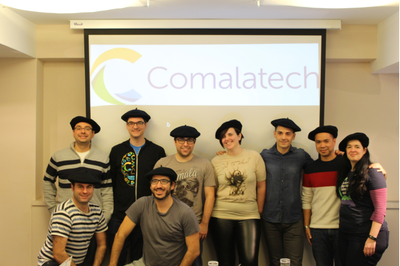
2017 marks the tenth year that Comalatech has been building software solutions inside the Atlassian ecosystem. A decade may have passed, but our core company values are still going strong. From the start, Comalatech has been committed to giving back to the communities we call home. But, as a distributed team that works in cities across the globe, giving back comes with its own set of challenges.
The Challenges of Giving at a Remote Company
Our team spans the planet, from Vancouver, to Brisbane, to Barcelona. With such a distributed group, giving back together is nearly impossible; we would all love to run a charity 5K together, if we weren’t 17,000K apart. And, with no physical office to share, the company bake sale would be poorly attended.
The challenges of distance and timezones are no different from our day to day work, so we meet them in the same way – disciplined communication, and teamwork. For the former, we use Atlassian Confluence to create our annual giving plans, a place for every team member to advocate for charities to support. Using Confluence along with our text chat app, HipChat, we can have the conversations that other teams might have around the water cooler, or in a boardroom. As for teamwork, management has created an open supportive environment where anyone is comfortable expressing their opinions, and so people are encouraged to share their own personal causes, resulting in a diverse set of charities we support.
We’re Committed to Pledge 1%
At the end of 2015, Comalatech followed the lead of tech companies like Atlassian, Sales Force, and CA Technologies to make a vow regarding our corporate giving – we committed ourselves to Pledge 1%. For our objective we chose to pledge 1% of our profits to charity. We are such big believers in this movement that we are once again committing to Pledge 1% in 2018, and we would encourage other business in our space to do the same.
As 2018 dawns we’re excited to grow Comalatech even larger, each new team member bringing with them a fresh perspective and background. But, no matter who joins our team they will be sure to share our corporate values, including a commitment to giving back to our communities. We can’t wait to see which new causes we’re going to support next year.
Originally posted: November 28, 2017
By Ben Rooks, ST Advisors, Inc.
After spending ten years of my career as a sell-side equity research analyst and six years as an investment banker, I began ST Advisors as a way to do the work I loved while living my values, one of which is intellectual integrity (something that was often challenging in the two prior phases of my career). Another core value is working to have a sense of gratitude for the multiple areas of good fortune in my life.
From inception I decided that ST Advisors would support charities that matched my values, historically around women’s empowerment, education and entrepreneurship. To that end, I looked for charities that support these causes. A few years after ST Advisors began, I was fortunate to be joined by a like-minded partner who shared my belief in supporting some of the many worthy causes that exist. Over the years as ST has grown, we have increased the donations each year, deciding a few years ago to commit to donating at least 1% of ST Advisors’ revenues to a portfolio of charities that supported causes we believe are important and reflect our core values.
In researching a company prior to meeting its CEO recently, I saw it had the Pledge 1% logo on its website. Intrigued, I clicked through and learned this was a way to institutionalize our commitment and, more importantly, to try to inspire others to do the same. As a small professional services firm, ST Advisors is profoundly unlikely to have a liquidity event, making its equity irrelevant. We are, however, proud to have taken the 1% Pledge and will continue to donate 1% of revenues to charities whose work inspires us. To date these charities have included:
- Year Up
- American Civil Liberties Union
- Propublica
- Reach Out and Read
- Endowing two perpetual scholarships with Plan International’s Because I Am a Girl campaign
- Heifer International’s Women’s Empowerment Project in Cambodia
- Acumen Fund
- Developments in Literacy
Originally posted: November 28, 2017
Cloud Co-op joined the Pledge 1% movement with a commitment to pledge 1% of our profit and time to charitable causes in our community.
Our Pledge 1% motto, “Plant seeds to grow where you live so others can benefit from you being there.”
We believe that our success is tied to our local community and that is why we chose to donate time and resources to helping Operation Supply Drop, a local Austin area Non-Profit.
The fact that Operation Supply Drop works to serve military members was a key determiner in our decision to help their organization.
Cloud Co-Op is a Service Disabled Veteran Owned Small Business, founded by David Franklin, our CEO who served 8 years in the United States Navy.
By leveraging twenty years of corporate experience, and twelve within the Salesforce eco-system, David has been able to build an organization that focuses on mentoring and coaching veterans into a certified business consultant career. “In doing so, the veterans connect to a meaningful post-military purpose, receive valuable real world experiences, and become the heartbeat of our mission,” says David. On a mutual understanding the clients in turn reduce implementation and development cost, ensure governance controls, user adoption and strategies for growth.
“As conflicts in various parts of the world end, our soldiers return home to a different kind of battle field – one of a virtual composition surrounded and fortified by a concrete jungle with its own unique set of rules and challenges. While a war veteran may be able to adapt and survive under the most unbearable conditions, chances of survival in the corporate world however are few and far between.” The idea of bridging this gap between the corporate world and the transitioning veterans was what motivated David Franklin, a former navy veteran to start Vets2Cloud.
While Salesforce is a common tool today, it cannot be utilized effectively in a corporate setting without years of corporate experience and further certifications. This hinders the veterans from using their newly earned certifications as they are often viewed simply as providers of pro-bono work for nonprofits. Cloud Co-Op helps the veterans get around this obstacle by incorporating a “Warriors” apprenticeship program called Vets2.Cloud which allows experienced persons in corporate roles to give back in group training sessions in addition to its own mentoring and coaching. Cloud Co-Op also reinforces a training program provided by Salesforce called Trailhead which incorporates gamification and applies these skills to much-needed real working situations in the field.
A message from Cloud Co-Op’s CEO: David Franklin
I started my military career prior to entering my senior year of high school (John F. Hodge, St. James, Mo). I enjoyed 8 years in the Navy as a Radioman. I didn’t have the assistance during my transition which is available today. That would have been amazing. There are many great organizations helping now. I’ve transitioned without it, I know first hand how difficult it can be. I entered the military with what is described as complex PTSD and my tours only supported the behavior and shielded me for many years. I was living my life on auto-pilot. Since then, I’ve worked through corporate roles from Service to Sales to Marketing over 19 years. I found areas to excel in the military and in those corporate positions. I’ve experienced great highs and extreme lows during those same time frames and now I am here to help others succeed.
It is now, with my military and corporate experience, that I return my service to the community from which I was given my start. I often wonder how many Veterans entered the military as I did or lived without knowing important values or behaviors that impacted them for too long. Having a new understanding and finding a purpose to serve my fellow Veterans, I created Vets2Cloud and Cloud Co-Op. I believe Veterans need more than training and more than an opportunity to work in a corporate role, they need real work experience with mentoring and coaching that allows them to become consulting professionals or business owners. Most importantly, as I have learned, we can address their personal needs so they experience the freedom to move forward.
Many people, specifically non-Veterans have joined my cause to support the Veterans transition. I don’t stand alone and I am very grateful for their service and commitment to Cloud Co-Op. As we grow and partner with other organizations and source work for the Veterans, I want to thank these companies in advance for working with us.
Cloud Co-Op expands Vets2Cloud™ Apprenticeship service to include Military Veteran Staffed Help Desk
Cloud Co-Op is a Registered Salesforce Consulting Partner providing Salesforce business consulting services for clients wishing to evolve their business processes into the cloud – is expanding its commitment to helping military veterans transition into the workforce, through its Vets2Cloud™ apprenticeship program that provides on-demand, fractional support to Salesforce clients. This help desk is staffed by former military veterans looking to transition into full-time careers as Salesforce administrators and developers.
“Our goal is to make the transition from military to civilian (corporate) life a little easier. As these veterans go from boots on the ground to boots in the cloud,” says Cloud Co-Op founder and CEO David Franklin, who happens to be a Service Disabled US Navy veteran.
Vets2Cloud is an apprenticeship program under the mentorship and coaching leadership of senior consultants at Cloud Co-Op and supporting entities. In co-operation with Veteran Service Organizations (VSO) like VetForce, Jewish Vocational Services and the Merivis Foundation, transitioning veterans and spouses are able to obtain Salesforce certifications before they enter the Vets2Cloud™ Apprenticeship program for advanced job readiness skills.
Once qualified veterans finish their initial training with the VSO, they have the opportunity to continue to advance their careers by receiving on-the-job training, and being paid to provide support to Salesforce customers facing real-world business challenges for companies with no dedicated resource or an admin requiring fractional on-demand support.
Service and Support That Matters
All of our clients salesforce support teams are staffed in-part by service minded military veterans and salesforce certified administrators that act as an extension of a company’s existing team.
Businesses get real-time, proactive support from a US based team of Salesforce certified admins capable of handling any technical questions and product support related issues. And military veterans get real-world experience, while getting paid and learning skills that lead to future careers in the Salesforce ecosystem.
The Road Ahead
Established in 2015, Cloud Co-Op intends to become a strategic, or Platinum business partner with Salesforce.com by uniting small firms nationally that function as one to support the growing eco-system. By doing so, Cloud Co-Op will have the technical capabilities of many firms which in turn can be translated into their growth on a substantial scale. “We will have the strength of many, while contributing to the growth and success of all. We are many members but one body that allows for many specialties and client opportunities. In doing so, our mission will flourish and our veterans will grow into leading consultants and future employees within the workforce,” reiterates David. In the next five years Cloud Co-Op looks for 20 small firms and 100 veterans to join their group.
Quote from a graduate of the Cloud Co-Op Apprenticeship Program:
“Cloud Co-op has been one of the most rewarding experiences of my life. My transition from the military to the civilian world has been a challenge. David and his staff have provided me with an opportunity to start a wonderful career as a Salesforce Consultant. The training has been top notch, with plenty of resources and staff that are more than willing to help you reach you full potential. It is truly amazing! Cloud Co-op shows great appreciation for Veterans and their service for our nation. It makes me very proud to be apart of such a great organization. – Sheldon Simmons, US Navy, Salesforce Certified Consultant.
Originally posted: November 28, 2017
Three and a half years ago, we set out on a radical mission to change the healthcare industry. We had friends and family diagnosed with cancer told to wear tube socks over their PICC lines and felt that there had to be something better. We wouldn’t and couldn’t accept that using a tube sock was the norm for covering and protecting something so important. I mean, tube socks are meant for your feet and went out of style decades ago right?! There had to be something in the market that provided better quality and dignity yet we couldn’t find anything that came close. So we decided to change that. We went to the community and shared our vision with nurses and patients. And what transpired was absolutely amazing. We were able to create our ultra-soft, antimicrobial PICC line cover in collaboration with leading nurses and doctors while also getting the input from patients and people from the design community. And through that – our comprehensive design process was born.
Being involved in the community was paramount for us and while we were building a for purpose company, we realized there was an incredible need to do something more than just creating absolutely amazing products. And so we decided to give a portion of our sales back to non-profits and today partner with some amazing organizations such as Stand Up 2 Cancer, the American Cancer Society, Global Lyme Alliance, Rock CF, Cancer Schmancer, MitoAction and The Oley Foundation. We’ve had the opportunity to partner with these phenomenal foundations to ensure that together we’re making a difference. So when Pledge 1% asked us to take the pledge – it was an absolute no-brainer. Giving back to the community is paramount to our brand and company and we’re honored and thrilled to have the opportunity to be working with such amazing partners.
So while we eat our leftover turkey and get to spend time with loved ones this holiday season, we wanted to say thank you to our community. You inspire us every day to do better and we wouldn’t be here without you. We’re excited to continue building great products and working together to help even more people on a daily basis.
-Chat, Susan and the Care+Wear team
Originally posted: November 28, 2017
By Jason Payne, CEO of Ada Diamonds, the world’s first custom fine jeweler exclusively using laboratory-grown diamonds.

My wife and I founded Ada Diamonds in 2015 on the belief that diamond jewelry should brighten the entire world, not merely the recipient’s world. To achieve that goal, Ada Diamonds proudly utilizes real diamonds that are sustainably grown by mankind above the Earth, rather than mined diamonds that cost the Earth. In other words, we believe that powerful technology and new ideas can polish the diamond industry and create a more brilliant future for all.
Ada Diamonds is named in honor of Lady Ada Lovelace, the Enchantress of Numbers. She was an audacious and brilliant 19th century mathematician, mother, musician, socialite, and philanthropist who is widely credited as the world’s first computer programmer.
On Giving Tuesday 2017, Ada Diamonds is proudly joining Pledge 1% and committing to a donation of at least 1% of Ada’s profits every year as well as a donation of 1% of our equity to fund philanthropic causes upon an IPO or acquisition of Ada Diamonds, Inc.
We call our CSR efforts the Sixth Element Program in honor of carbon, the sixth element of the periodic table of elements. Ada Diamonds proud to support the following six organizations in their efforts to brighten the world:
- Doctors Without Borders – Support of Mining Communities
- World Wildlife Fund – Ecological Recovery from Mining
- Direct Relief – Women’s Health
- Finding Ada – STEM Education
- Swords to Plowshares – Overcoming Substance Abuse
- Team Rubicon – Natural Disaster Response Efforts
Corporate and personal philanthropy are quite important to me. Before founding Ada Diamonds, I was the founder and leader of the Philanthropy Engineering Program at Palantir Technologies. In that role, I donated big data analysis software and forward deployed engineering resources to help data driven nonprofits better fulfill their missions. One my focus areas at Palantir, fighting modern day slavery, led me to start Ada Diamonds as there is still bonded and child labor involved in the cutting of diamonds into gemstones, as you can see in this AP report.
Many of the organizations Ada is supporting today are organizations that I had the pleasure of supporting while at Palantir. Here’s President Clinton discussing recovery efforts of Team Rubicon we supported after Hurricane Sandy, and here’s the CEO of Direct Relief discussing how they use data analysis to improve lives around the world.
On this Giving Tuesday, I encourage you to explore Guidestar or Charity Navigator to find a cause you believe in and support them with a donation of your time or resources.
Originally posted: November 28, 2017
What makes your giving program stand out? Have you done a unique combination of time + product donation (or another combination)?
As a newer player in the corporate social impact space, we’re focusing heavily on learning and listening. Okta for Good is still fairly limited in breadth right now – and intentionally so. We’re in early stages of our defining our program, and we’ve been very deliberate about what we’ve chosen to incorporate at each stage of our growth.
For example, for employees, we don’t yet have donation matching or a company service day, and instead we center our quarterly impact efforts on thematic volunteer events with clear opportunities for employee education. We want to root our employees in an understanding of community issues and help them develop their own personal giving strategies so that they are poised to maximize their impact as we roll out more programs. This is also why we’ve worked closely with experienced partners like Tides Foundation to develop educational resources for our global teams.
For corporate giving, in lieu of a large-scale grant program out of the gates, we’ve started with a deep commitment to a single grantee: NetHope. Our work with NetHope offers us a way to wrap all of our resources (people, technology and funding) around one partner, and we hope the insights from this first partnership will help inform our long-term approach to strategic philanthropy through our recently announced Okta for Good Fund, a donor advised fund of Tides Foundation.
We are also constantly learning from our customers: on the product side, we offer nonprofits 25 free licenses for all Okta products, as long as they’ll share feedback on our offering. Their insights are a critical piece to growing Okta for Good.
How is Pledge 1% integrating into the core values of your business? Is it impacting other areas of your work (such as sustainability programs/sourcing/green policy, etc) and/or shaping your internal employee culture?
Pledge 1% has given shape and structure to our social impact efforts and was an important catalyst in taking the work to the next level. It has also been helpful in thinking about the ways in which we build a sustainable social impact practice and enable the work to scale with our company. This pursuit of a sustainable business model (as opposed to relying on a perpetual company handout) is a priority for us at this stage along with many of our Pledge 1% peers.
Have you collaborated with other companies in your local community or within your ecosystem on giving back? What about leveraging your technology and skills to tackle a shared issue?
We’re lucky that collaboration and connection is such a fundamental element of Okta’s business. This spirit translates directly to our social impact work, and we see tremendous potential to partner with like-minded companies and community partners to drive positive change together. In fact, we’re already engaged in many exciting efforts on this front.
From a global perspective, we’re working closely with NetHope as a founding partner of the Center for the Digital Nonprofit, which connects a strong community of technology and nonprofit leaders to enable large-scale digital transformation across NetHope’s global members. We’ve also joined forces with Box, Salesforce.org, DocuSign, Splunk, Tableau and Twilio as a part of ImpactCloud, a coalition of cloud vendors leveraging our technical savvy and business insights to help humanitarian organizations take advantage of the latest technologies.
Locally, we’ve teamed up with civic-minded companies in the San Francisco Bay Area to fight poverty through Tipping Point Community’s SF Gives initiative. We also recently partnered with Adobe, mentoring students as a part of the organization’s summer Girls Who Code program. And throughout the year, we’ve worked with a variety of other organizations in the areas where our teams live and work.
What is your advice to startups or companies that are waiting to give until after their IPO or reach profit? What made your company decide to give, and when, and how has that shaped who you are?
One of the reasons I was proud to join Okta as the first social impact hire was the authentic commitment I saw from our leaders. Our co-founders Todd McKinnon and Frederic Kerrest were very intentional about committing Okta to giving back pre-IPO. Establishing Okta for Good was an important signal to employees, customers and the broader community about what kind of company we are. As Todd said when we first joined Pledge 1%: “Whether you work at a multinational corporation or a nonprofit with three employees, every organization deserves the opportunity to bridge the innovation gap and build the best experiences for their people.”
Social impact delivers value when it comes to recruiting talent, building trust with customers and partners, and connecting meaningfully to your communities – at any stage. Our best advice: just start!
Have you integrated a specific product or service based on a nonprofit’s needs?
Not yet, but we are looking closely at our nonprofit offering in the coming year to better understand needs and opportunities for us to deliver more relevant solutions. Stay tuned!
Originally posted: November 28, 2017
From day one, our mission at Postmates has been to help people unlock the best of their cities. While some companies try to build a warehouse outside of a city and funnel goods into it — we know that our cities, our towns and our communities are our warehouses. A big part of what we do is help local brick and mortar businesses better compete against retail goliaths. But as we’ve grown to operate in more than 250 cities, we now want to re-invest in building a more sustainable future for the communities we serve.
This past summer, we hosted a town hall meeting where we sat down with teams across the company to discuss our core values:
Be eccentric: Do things differently — and better, do them your way. Inspire others to experience a different point of view.
Create things that last: There is incredible value in infrastructure & utilities others can rely on. We liberate people by creating it.
Embrace the new, new: Dream up new ways to see and live the future. Once upon a time, all we do today sounded like science fiction.
Out of many, one: Be aware of the responsibility we have to look out for each other — both within our own Postmates team and the larger world we live in.
Now, we’re taking a big step in fully realizing that last value — “Out of Many, One.”
We’ve recently formed a new team — Civic Labs, a social impact team with the mission to tap into Postmates ingenuity to build a thriving, sustainable future that works for everyone. The team is focused on developing programs and partnerships to promote climate action, food security and local business and independent workforce advocacy.
In addition, we are also dedicating 1% of our collective workforce time to support the communities and causes we care most deeply about. Postmates has joined Pledge 1%, a movement spearheaded by Atlassian, Rally, Salesforce and Tides, which is dedicated to making the community a key stakeholder in every business.
As part of the Postmates Civic Labs efforts and Pledge 1% partnership, teammates can now choose the nonprofit of their choice, and we’ll pay them for their workday — up to 24 hours per year. Postmates full-time employees can use 1% of their workdays days to join one of our company volunteer events — such as our recent community garden harvest or our upcoming project with Open Hand; or employees can volunteer at the local nonprofit that they’re most passionate about.
To kick off our renewed focus on enabling the Postmates community to give back, we were proud to partner with TNDC Tenderloin People’s Garden harvest — to help harvest fresh food for low-income residents in the SF bay area. TNDC Volunteer and Corporate Partnerships Lead Haley Caldwell was equally heartened by the turnout. “I’ve never seen so many people out at that front table before… It was really fun to have Postmates here. It’s not always easy for some volunteers to be in the Tenderloin, but you guys fit right in.”

Josh Phillips, Chief of Staff at Postmates and Civic Labs founder also echoed that sentiment. “Harvesting the Tenderloin People’s Garden was an incredibly rewarding way for our team to serve the community.”
“In addition to providing fresh food to low-income residents in a food desert less than a mile and a half from our office, we got to explore our complicated relationship with food. We spend our lives far removed from the production of what we eat. When you get even just an inch closer you naturally start to ask questions about our food system’s equitability, the impact it has on our health, the role it plays in climate change, and, ultimately, our dependence on others to feed ourselves.”
With Harvest Day down, there’s still more to come for Civic Labs and the volunteers at Postmates. You can find out more about the larger Pledge 1% effort here.

Originally posted: November 28, 2017