
By Olive Keogh. Originally published in The Irish Times.
When it comes to their careers, most millennials (roughly those born between 1980 and 2000) are not driven by money. They are natural job hoppers and they “hop” more for learning and personal development opportunities than they do for higher salaries.
Income is typically not even in the top five reasons why millennials change jobs.
“They need to be convinced why and how an organisation will help them learn, grow and develop, and further their careers,” say the authors of What Millennials Want from a New Job, Brandon Rigoni and Amy Adkins of Gallup.
The authors also point out that millennials comprise the fastest-growing consumer group and are willing to pay more for ethical products, are more prepared to share than buy and will take a pay cut to work for companies they believe demonstrate responsibility and strong social values.
One of the ways to millennials’ hearts is through good corporate social engagement. But it must be relevant and real rather than lip service. Companies have to put their money where their mouth is. If they don’t, millennials will see through the flam and move on.
What has changed in the world of corporate social responsibility (CSR) is how the process is structured. In the past, it was mainly about giving money. Now it’s a combination of money and people’s time. Employees want to get stuck in and to make a tangible difference.
Volunteers
In 2016, volunteers from aviation capital company SMBC helped build a children’s hostel in Malawi. This year the company is funding the construction of a feeding station there. The volunteers go to Malawi for five working days, two of which are taken as annual leave, with the company footing the bill for the other three.
Closer to home, more than 50 SMBC employees have been involved with lunchtime literacy and numeracy initiatives with the Irish-based education and social change organisation, Suas.
“SMBC’s contribution has made a very real difference,” says Suas interim chief executive Joanne Malone. “For example, an intensive eight-week input from a group of literacy mentors can help kick-start a child’s learning and improve their reading age by six months. The mentors also act as role models for the children who get to see a world (their ‘graduation’ event was held in SMBC’s offices) which is very different to what they are used to.”
Multinational CRM software solutions company Salesforce has had social engagement as one of its core values since its formation 17 years ago. “We have a 1-1-1 model of integrated philanthropy based around technology, people and resources,” explains Mark Stanley, vice-president for web marketing and marketing operations EMEA.
“We offer donated and discounted technologies to higher education and not for profits, we promote a culture of helping people give back and we provide grants. Last year, employees in Ireland (it has more than 1,000 staff here) donated more than 25,000 hours in volunteer time.
“Each employee gets seven paid days a year to volunteer with a cause they feel passionate about. I personally have been involved with a children’s literacy programme where we also provided funding to build a library and a wonderful multisensory room that is of huge benefit to children with special needs.
Helping others
“Apart from helping others, the volunteering is very good for employee morale,” Stanley adds. “It helps build teams and lets people interact in a different type of environment. Most of our staff members get involved and we also ask potential employees if they are willing to do so, as we want people who are a good cultural fit for our organisation.”
In an effort to get other companies actively involved in social projects, Salesforce has launched the Pledge 1% initiative to encourage all entrepreneurs to commit to integrating philanthropy into their businesses from an early stage. Since its foundation, Salesforce has given more than $160 million in grants, two million hours in community service and provided product donations to over 31,000 higher education and non-profit organisations.
The Irish operation of Big Four accountancy practice Deloitte has been involved in CSR programmes for more than 15 years.
Deloitte has about 2,300 people employed in Ireland and among other things it provides two volunteering days per year per employee matched to the same in personal leave. It also backs a two-week volunteering programme in Uganda by supporting half the time off.
Supported to volunteer
By far its biggest event is its Impact Day which takes place each September. “All staff are encouraged and supported to volunteer on that day and to provide their time, labour and expertise to our chosen projects,” says corporate responsibility manager, Claire Bergin.
“Impact is a fundamental part of Deloitte’s CR Strategy and one of the most popular days of the year for our people to get involved. Over 700 people took part in 2016.”
The skills contributed varied from helping with business strategy and marketing to decorating and gardening.
CSR used to be seen as something for big organisations with big budgets. Now companies of all sizes are beginning to recognise that, even in small doses, it’s good for their bottom line as well as for those being helped. It holds sway when it comes to recruiting millennials in particular, it promotes employee buy-in and it creates employee engagement.
Does that really matter? Yes. Companies with engaged workforces have higher turnovers, higher profits and lower staff attrition rates.

By Philip Rojc. Originally published on Inside Philanthropy.
It’s nothing new to see corporate donations that complement the company’s core business and reflect its worldview. A set of grants last month from cloud communications firm Twilio certainly fits the bill. Totaling $1 million, the grants represent part of the company’s 2015 pledge to commit 1 percent of its equity to social impact programs. At some point during this calendar year, Twilio plans to give out another $1 million in grants.
Established in 2007, Twilio sells a cloud communications platform, essentially taking care of underlying infrastructure like servers and databases. Through Twilio’s API (app programming interface), clients can then construct their own bespoke communications systems. In 2013, the company launched a social impact arm, twilio.org, catering to nonprofit B corp and social enterprise clients. These eight initial grants were awarded through the newly created Twilio.org Impact Fund.
Twilio’s commitments here underscore the growing embrace of philanthropy among newer tech companies. As we’ve reported, a great many such firms have joined the Pledge 1% campaign, which Salesforce developed to spread its 1+1+1 model.
Twilio’s recent grantees represent an array of constituencies and causes. Linking the projects together, unsurprisingly, is digital communications, as well as several plans to utilize Twilio’s service. Like a lot of corporate funders these days, Twilio is clearly keen to align its philanthropy with its core competencies—a strategy that has the added benefit of promoting its brand and products.
Twilio’s niche is increasingly critical to nonprofits. As we’ve reported, communications can be the make-or-break factor for social service and aid campaigns. When information flows poorly, as is often the case in poverty-stricken or underprivileged communities, aid can be stalled. NetHope, an initiative to enhance connectivity amidst humanitarian crises, has gotten support from a range of tech titans like Google.org, Paul Allen, Gates and Intel. Cisco has also been a big player in global aid through tech. During the ongoing global refugee crisis, various tech and communications companies have stepped forward to address the connectivity needs of displaced people.
Many of Twilio’s grants benefit causes closer to home. Recipients like CareMessage and Mission Asset Fund serve underprivileged communities in the U.S., in part by engaging people via SMS and other mobile technologies. Trek Medics, an emergency care provider, is improving its dispatch system. And initiatives like Lesbians Who Tech and #YesWeCode present underrepresented communities with paths to potential tech employment. Another grantee, Fast Forward, serves tech entrepreneurs tackling social issues.
One interesting component of Twilio’s grants is a focus on civic engagement. A grant to the OpenGov Foundation supports open-source tools in the hope of decreasing the distance between elected officials and their constituents. Another grant to Democracy Works backs voter engagement by digital means (i.e. through messaging to remind voters when the polls open).
In a lot of ways, these kinds of grants come down to narrowing the digital divide, both in the United States and overseas. That’s a cause with significant traction among tech companies, carrying with it the bonus of potential new business along with their social investments.

Ostendio has joined the Pledge 1% movement, a national philanthropic organization encouraging companies to give 1 percent of their equity, employee time and products to good causes. Ostendio has committed to 1/1/1, which means committing at least 1% of employee time, equity and product to worthy causes.
At Ostendio we have a deep commitment to the concept that everyone deserves to have access to excellent and affordable healthcare, independent of where they live or how much they can afford. This is why Ostendio joined Pledge 1%, which now has over 2,700 members in over 60 countries.
Pledge 1% in Action
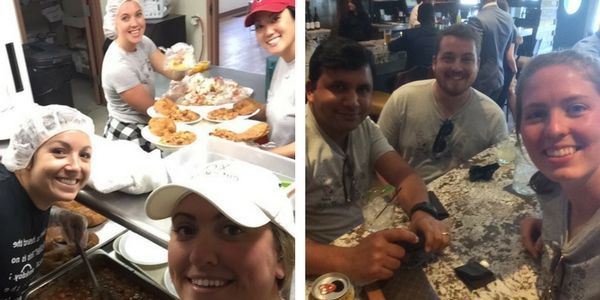
The Ostendio team spent an afternoon in February giving back to the local community by volunteering with the Arlington Food Assistance Center. Ostendio was tasked with bagging food for the Backpack Buddies program. The Backpack Buddies program provides weekend and holiday meal packs for food-insecure Arlington County schoolchildren.
A recent study commissioned by AFAC and conducted by Virginia Tech’s Center for Social Research estimates that as many as 9,400 children in Arlington are food insecure. For many of these children, their lunchtime meal at school is their only meal each day. Over weekends or holiday breaks, these children often go with little to no food. AFAC’s Backpack Buddies program strives to help these children.

The Ostendio Team Volunteering
On Fridays at their school, each child in the Backpack Buddies program is given a backpack filled with nourishment for the weekend. Items usually distributed in the backpacks are ready-to-eat meals, microwave soups, snack bars, fruit cups, shelf-stable milk, fresh produce, and canned vegetables. There is enough food in each pack to feed the child for two days (six meals, plus snacks). Members from Ostendio packed up 200 bags of food.
The Backpack Buddies program runs year-round. AFAC coordinates with all of the Arlington Public Schools as well as several community centers, after-care programs, and summer camps to make sure all children in our community have the food they need when the weekend comes.
The Ostendio team had a great time knowing that they had spent the day helping young children get access to additional food resources. We’re already planning our second volunteer day in August!
Pledge 1% is thrilled to partner with Bessemer Venture Partners, Forbes and Salesforce Ventures for their Cloud 100 event, which honors the top 100 private cloud companies in the world. Cloud 100 Pledge 1% members have had incredible impact- donating their time, product, and profits to their communities. To recognize this, we formally launched the Pledge 1% Impact Award to recognize one company who has gone above and beyond in leveraging their time, talent, money, and resources to make a difference. We are thrilled to share that the 2017 Pledge 1% Impact Award winner is DocuSign.

DocuSign IMPACT is committed to harnessing the power of DocuSign’s people, products, and profits for good. Their goal is to make a difference in the global communities where their employees and customers live and work. In addition, they match employee donations to qualifying 501(c)(3) organizations and global equivalents.
We congratulate all Pledge 1% companies for making this year’s Cloud 100 list. You can learn more and view the full list here.

By Mark Reading. Originally published on the Atlassian blog.
When I joined Atlassian as the Head of Foundation last December I knew I was becoming part of something very special. Atlassian’s 5 values really do drive behaviours (so much more than anything I have experienced elsewhere during a career spanning more than 35 years) and the passion of all Atlassians (from the founders, Scott and Mike, through to our most recent joiners) to make a difference in the world is something to behold.
It sounds a little corny, but this place gives me energy that I’ve not felt for a long time. Today, I’m excited to share an opportunity for people outside Atlassian to contribute their energy and ideas to the cause of educating disadvantaged children.
But wait: what’s the Atlassian Foundation?
At Atlassian, we believe in the power of both business and education as forces for good. In the very early days of Atlassian the two founders, Scott and Mike, pledged that if ever Atlassian was successful then 1% of Atlassian’s resources (equity, profit, employee time and products) would be used for the good of humanity. This pledge, which was made at a time when Atlassian had very little, evolved into what is now known as the Pledge 1% movement.
Because of the generosity of Scott and Mike and the subsequent success of Atlassian, the Atlassian Foundation is now very well resourced (at least by corporate Australian standards). The Foundation has about a $60m in net assets and all Atlassians are encouraged to use their 5 days per year of “foundation leave” for the good of the community.
From its beginning, the Atlassian Foundation has focused on maximizing its impact through education. This is because education is widely acknowledged as something that goes to the very core of addressing poverty, rather than relieving a symptom or consequence of poverty. Education changes lives and helps to break the cycle of poverty – not just for the current generation, but also for future generations. Educated parents appreciate the opportunities that education provides and therefore typically place great importance on the education of their children.
Education is the greatest weapon you can use to change the world. – Nelson Mandela
Over the last decade or so, the Atlassian Foundation has contributed to the education of children in Cambodia – primarily through our support for a truly inspiring organization, Room to Read. We’ve also supported local education initiatives in the locations in which we have an office.
Recently, we have substantially increased our ambitions around education. We have now set a bold goal: to help prepare 10 million disadvantaged youth for the workforce of the future – within 10 years. We refer to this as our “10 million in 10 years” goal.
Great achievements come from teams
Atlassian is fundamentally a team company – our core software products are designed to improve team collaboration and productively. Our NASDAQ ticker is not “ATL” or something similar. It’s “TEAM”.
To achieve our “10 million in 10 years” goal, we need to create a great team by identifying and supporting the most innovative, scalable, technology-based approaches to the education of disadvantaged youth (children and young adults up to the very early twenties). That’s where you come in.
We have committed up to US$1 million in funding the first year and we intend to be long-term supporters of whatever initiatives are best placed to have the impact we’re seeking. We also plan to bring the skills of Atlassians to the table in order to provide as much support as possible. The Australian Government, through DFAT’s Innovation Xchange has matched this funding. Together, we have partnered with MIT (through their “Solve at MIT” initiative) to launch the Youth, Skills and Workforce of the Future challenge.
If you are working on a great scalable education initiative that benefits disadvantaged youth, please apply. If you know someone who would be interested, please share this post with them. Even if you don’t know someone who would be interested, please consider sharing this post anyway. We want the people behind the very best education initiatives to learn of our desire to support them.
We hope to hear from you soon!

By Joshua Hall. Originally posted on Techpoint.
You already know about part of Salesforce’s impact in Indiana — the software giant is creating more than 800 new jobs and 500 new apprenticeships, and investing $40 million that’s causing a ripple effect of growth and prosperity in the state’s tech sector.
What you might not know is that the Pledge 1% movement, a model of corporate philanthropy inspired by Chairman and CEO Marc Benioff’s 1/1/1 program at Salesforce, has the potential to compound that positive ripple effect through cooperation with other Indiana companies like Appirio, Torchlite and TrendyMinds.
Founded in 2014 by Salesforce, Atlassian, and Rally, Pledge 1% is a new normal for companies of all stages and sizes to give back to their communities. By pledging just a small portion of future success — one percent of corporate equity, profit, product and/or employee time — these three founding partners proved that the model can have an enormous impact on their local communities, which will be the same for Indianapolis.
Even if you are not quite ready to take the pledge, you can fill out this form to stay in the loop and receive more information about the Pledge 1% movement.
For example, the Salesforce employees in Indianapolis will donate more than 200,000 volunteer hours by the end of this year, mostly within public schools. That massive amount of volunteer time is achieved by employees giving their time simply four hours a month, or a total of six days of paid volunteer time a year that has a huge impact for the schools as well as the employees.
Susan Marshall, Founder & CEO, Torchlite

“We have found that the Pledge 1% program just naturally brings people together and lets them get to know one another. I think when you find out what people are passionate about it reveals common ground beyond just getting the work done and helps improve collaboration, communication and empathy.”
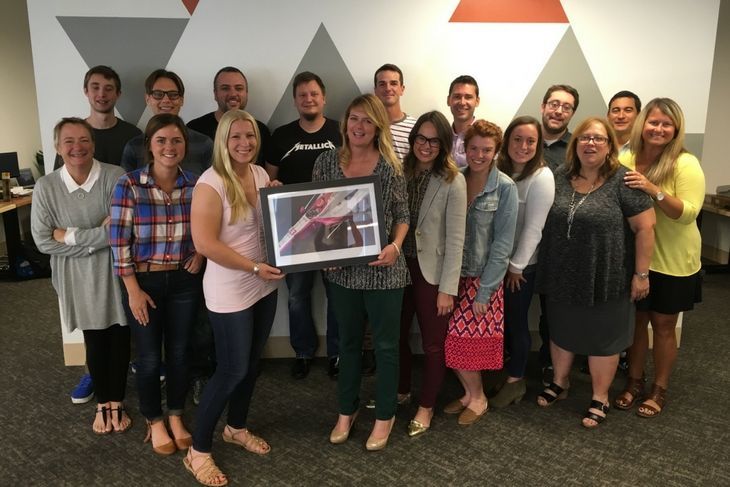 THE TEAM AT TORCHLITE FOCUSED ON DONATING THEIR EMPLOYEE TIME AS A STARTUP COMPANY PLEDGING 1% TO THE MOVEMENT.
As a two-year-old startup, Torchlite signed up to participate in the Pledge 1% program from the beginning with a focus on donating employee time. Later this summer, however, the marketing tech platform and marketplace company will roll out a new feature in its software that connects freelancers with nonprofits they are passionate about so they can contribute to campaigns through creating content pro bono or at a discounted rate.
As a signatory to the Pledge 1% movement, companies can choose to focus on one aspect like donating employee time or products and services, or they can choose to do a combination or all three — profits, products and time — or even a fourth way via company equity.
Trevor Yager, founder and CEO of TrendyMinds, says that his company chose to commit to all three when they made the pledge a little over a year ago because it was actually something they were already doing and that the Pledge 1% program helped to make it official.
Trevor Yager, Founder & CEO, TrendyMinds

“One of the things I really like about the Pledge 1% program is that they have everything organized,” Yager said. “If you need a letter to send out to your team that says how the program works or how to set it up, they already have a structure in place that makes things so much easier to run.
“We were actually already doing a lot of what we still do today on our own, so for us it was more of a validation than trying to ramp up efforts. We didn’t need to change who we are or what we were doing, but it was a matter of validating our programs and joining forces with our neighbor companies and having an even greater community impact.”
Following its first year of official participation in the movement, TrendyMinds is starting to see most of its employees get involved. According to Yager, Pledge 1% is a very flexible program structure that accommodates doing things together as a company or as individual employees.
Over the course of the year, TrendyMinds provided $220,000 worth of in-kind product and service donation to a single client event as a company (just one piece of their total), but they also incentivize their employees to volunteer on their own. For example, after volunteering 12 hours with the company, one employee earned an additional eight hours of volunteer time off, which he used to take his little brother fishing through Big Brothers Big Sisters of Central Indiana.
“The great thing about Pledge 1% is that It’s not too hard to do; they just give you everything, so especially for small companies and tech companies that have a lot going on sometimes, it can be hard to come up with a program from the ground up. This is a great way to get everything you need to give back and not have such a heavy lift to get started,” Yager said.
Even large companies can adopt the program and sign on to the Pledge 1% movement without having to abandon their established philanthropic programs or their own branding. Appirio, for example, the Indianapolis-headquartered global cloud services company, started its own internal Silver Lining program a decade ago, and also chose to sign on to the Pledge 1% program.
Steve Pruden, SVP Human Resources, Appirio

“We kept the original Appirio Silver Lining branding, which interestingly also was inspired by Benioff’s 1/1/1 model, and it has grown way beyond the basics of the Pledge 1% mantra,” said Steve Pruden, senior vice president of human resources for Appirio.
“All of our volunteer and philanthropic initiatives flow under the Silver Lining umbrella and so that’s how we brand it internally, but we also make sure we meet our commitments as a company signed on to the [Pledge 1%] movement.”
 THE PLEDGE 1% PROGRAM ALIGNS WELL WITH APPIRIO’S OWN INTERNAL SILVER LINING PROGRAM, WHICH OFFERS EMPLOYEES FLEXIBILITY TO VOLUNTEER WITH CHARITIES THEY CHOOSE.
By lining itself up with thousands of other companies, and doing so publicly, Appirio is fulfilling a broader purpose than just selling more services or generating more revenue. The Pledge 1% program helps the company identify culturally with other great companies and it’s a key to holding themselves accountable.
“Whether we are doing things like setting budgets, tracking volunteer time or looking at what types of pro bono technologies we want to offer, we always look to make sure that we are meeting or exceeding our one percent obligation, and most of the time we go beyond it,” Pruden said.
At Appirio, the volunteer hours are measured in the tens of thousands and the amount of money donated through their Pledge 1% affiliated Silver Lining program is in the millions. The company has a Silver Lining program manager based in Indianapolis and champions in every physical office, including Tokyo, Dublin, London and more, as well as in different global regions to make sure its large virtual workforce is thoughtfully engaged.
Pruden thinks the impact of the Pledge 1% movement will dramatically increase in the near term as more Indianapolis-based companies become aware of the program and choose to sign on. “If you look at the combined impact of what all of the Pledge 1% companies are doing globally with just a small one percent pledge of time, product or profits, it’s amazing,” Pruden said.
“When you take a step back and look at what Appirio has accomplished over a decade of doing this and all that we alone have been able to do, it puts it into perspective how big that impact really is when you realize that there are now thousands of companies signed on to the movement having an impact all over the world. It just makes sense that companies like ours and Salesforce and so many others that are doing well are smart to join forces to give back, and the Pledge 1% program is a great way to go about doing it.”

By Ron Miller. Originally published in TechCrunch.
If a startup founder could peer 8 years into the future and see a company that has become the symbol for disruptive culture, one that has raised over $8 billion on a valuation of $67 billion, that has a worldwide presence in hundreds of cities, millions of app downloads,12,000 full time employees and thousands more working for your service, chances are they would start it.
Every startup founder craves success, but the question is, how far are you willing to go to achieve that success. Uber is the company that generated those heady results, but it did so at a cost. After months of one scandal after another at Uber, CEO Travis Kalanick stepped down last week.
The takeaway for startup founders should be that culture matters as much, if not more, as a good idea and some funding — and you need to start thinking about this from your earliest days.
Who are you? Who? Who?
Under the leadership of Kalanick, Uber appears to have chosen ‘The Lord of The Flies’ as its cultural roadmap, and it’s a cautionary tale that startup founders everywhere need to contemplate as they build their companies. What kind of value system do you hope to cultivate? Do you want to have a no-holds barred approach that leads to bullying, harassment and grossly inappropriate behaviors, or do you want to build a legitimate meritocracy where the best ideas and the most talented people are rewarded?
It doesn’t seem like this should even be a question, but it’s something the core first group of employees need to define early on, encouraging positive internal values. It’s not something that develops by accident.
As we’ve seen, an aggressive cultural strategy can lead to a toxic work environment in which the more powerful people in the organizations (the managers and executive team) hold an inordinate amount of power over employees and that leads to the kind of gross abuses we heard about at Uber.
Let this be a lesson, kids
It would be a mistake to think that Uber stands alone as some sort of isolated case. It’s not. Last year, fast-growing human resources firm, Zenefits, which had raised over $583 million — including a whopping $500 million on a $4.5 billion valuation in 2015 — ran into serious trouble when the company was accused of selling health insurance in several states without a license and building pernicious culture.
In a matter of a few days, CEO and company founder Parker Conrad and head of sales Sam Blond resigned under a cloud of scandal. To be fair, the company has tried to move on from this, but it was yet another example for startups everywhere that culture matters.
Need further proof? There are many cases including Whitney Wolf’s sexual harassment lawsuit at Tinder that resulted in the suspension of co-founder Justin Mateen and eventually co-founder and CEO Sean Rad leaving his post (although he stayed on as a board member and president).
Each of these cases, and unfortunately, many more like them, show that if you cut corners and fail to cultivate a positive culture, it eventually catches up with you, no matter how successful you may be in the short term.
They’ve got to be carefully taught
Freada Kapor Klein
Freada Kapor Klein of Kapor Capital, who along with her husband Mitch Kapor, was an early investor in Uber, has publicly criticized the company’s culture. She says, the time to think about building a positive culture is at the earliest stages of forming the company.
“It’s almost impossible to overemphasize the importance of intentionally building a positive culture from the start. Finding time to articulate values, principles and how you want to be known is critical. There’s always too much to do, but retrofitting culture or diversity and inclusion in a big company is much harder,” Kapor Klein told TechCrunch.
“It’s almost impossible to overemphasize the importance of intentionally building a positive culture from the start.” — Freada Kapor Klein
Steve Herrod, who was an early employee at VMware and today is the managing director at venture capital firm General Catalyst, says this is a topic that is top of mind and something the partners at GC always talk about when evaluating whether to fund a startup.
“A substantial part of our investment decision, especially at Series A, goes into assessing the values and style of the founders,” Herrod told TechCrunch. “We have passed several times when we sensed a founder was cutting corners, overly exaggerating achievements, bragging too much, or indicating any form of moral ambiguity,” he said.
General Catalyst goes even further to ensure a startup is building a positive culture by having one partner who is entirely focused on team assessment and development. “[This partner] joins the lead partner in ongoing assessments of our startups with a particular eye to cultures trending negatively. We [also] have a stable of coaches and other development resources that we can bring to bear when needed,” Herrod said.
Thinking ahead
Kapor Klein says culture needs to be front and center as part of the business plan. “Companies set business goals all the
time. They use these goals to check their progress and hold themselves accountable to the metrics. If a company is not taking the same approach to culture then they’re showing you that they aren’t taking it as seriously as they take other business goals,” Kapor Klein explained.
“If these aren’t genuine concerns of the founders, there will always be a disconnect between what’s stated and what’s practiced. That gulf between words and actions is the quickest way to create distrust and cynicism,” she added.
Danny Crichton, a NYC investor in early stage companies, agrees it’s something that needs to be foundational for the company. “It’s mostly just thinking about it from the earliest possible moments. And to start with the right cultural thinking. Ultimately culture is an extension of the founder. Uber’s culture [was] Travis Kalanick,” Crichton said.
“Ultimately culture is an extension of the founder. Uber’s culture [was] Travis Kalanick,” — Danny Crichton, startup investor
Crichton says if you don’t think about it early on, it gets harder to change as you grow. “It’s very difficult to undo a negative culture. And the problem is that once culture gets baked in, it’s basically done. I think nothing will really repair it, but we’ll see,” he said.
Kapor Klein sees it not being so much about the organization as the people in charge, and the more ingrained the negative culture, the harder it’s going to be to change. “Cultures don’t spin out of control—people do. If the core culture is sound, it can be reinstilled. If the core culture caused the problems, it’s a longer, messier process of rebuilding. Sometimes we just need guardrails, sometimes we need a complete overhaul,” she said.
Taking a positive approach to culture
Salesforce CEO Marc Benioff
There are examples of highly successful companies achieving growth and building a positive internal culture. The two don’t have to be mutually exclusive.
A prime example is Salesforce, a company currently on a $10 billion run rate, which very early on decided to be as intentional about the company culture as they were about their products and how they would go to market.
“We believe that culture cannot be left to chance; it must be deliberate, measured and consistent from day one,” Cindy Robbins, Executive Vice President of Global Employee Success at Salesforce told TechCrunch.
“We believe that culture cannot be left to chance; it must be deliberate, measured and consistent from day one.” — Cindy Robbins, Executive Vice President of Global Employee Success at Salesforce
For Salesforce, it’s about putting together culture, technology and data as a formula for employee engagement, she said, and they take it even further with an integrated philanthropy model called 1-1-1. While you could dismiss all of this as PR fluff, the company has devoted thousands of hours to community service and donated or discounted software to non-profits , and according to the company website, has given more than $160 million in community grants over the years.
Further, it has attempted to eliminate the gender pay gap at Salesforce and last year hired Tony Prophet as the company’s first chief equality officer to bring equality issues to the forefront of the company. The company has also exported the 1-1-1 model through the Pledge 1% program and 2000 companies are following a similar program including Appirio, Box, DocuSign, Glassdoor, Optimizely, Twilio, Xactly, Yelp and Zuora.
Startups behaving well
Graphic: Bryce Durbin/TechCrunch
As much as the negative examples of culture get the vast amount of attention, there are plenty of people working hard to build a positive culture and a solid business.
While Salesforce is a long established company, Clef, an identity startup launched in 2013, that became part of Twilio in March, put culture at the center of its hiring process, and went so far as to create a handbook, which it then “open sourced” for others to use. Founder B Byrne put it this way when he wrote a blog post in 2015 announcing the company was open sourcing the handbook:
“Building a company is hard. Building a company that prioritizes inclusion in an industry that doesn’t is even harder. Both this handbook and our company are a long way from perfect, but this is a start. One of our values is to be better today than yesterday, and we’re excited to have help making this core part of our company better,” he wrote.
Another company trying to do it differently is Trivago, the German hotel search site, which claims to be building the company to be a meritocracy where no single person has total power over another person’s career.
“Removing workplace politics/stereotyping bias from decision making should be the focus. Individuals should not have to worry about these coming into play when it comes to their personal growth and development within the company,” Trivago CFO Axel Hefer told TechCrunch.
While Rolf Schrömgens, CEO and founder at Trivago admits that it really wasn’t something they thought about right away, as the company grew, the earliest employees began to recognize they needed a system in place to ensure a positive cultural approach, especially with a diverse staff from all over world.
“It was less an active decision that we made in the beginning, and more of a necessity that we realized over time. If you want to keep your company constantly learning, if you want your organization to stay liquid and have decisions [made] fast, if you believe in the superiority of intrinsic motivation, then you have to realize a culture of trust, respect and authenticity is the only way to go,” Schrömgens explained.
Nobody’s perfect
Trivago reports a male/female employee split of 58.2% to. 41.7% with over 50 nationalities working at the company’s Düsseldorf, Germany headquarters.
It’s worth noting that Glass Ceiling reviews of the company don’t paint quite as rosy a picture of the company’s culture as the company’s executives, especially when it comes to advancement opportunities and salary.
Still, Trivago has nearly doubled its stock price since it went public last December growing from an IPO price of $11.85 to $20.86 this week. Salesforce, which has been around since 1999 and went public in 2004, has a market cap of almost $63 billion and it’s stock price has grown steadily over the last five years from $34.28 in June 2012 to $86.82 this week, proving at least for these companies that a positive culture and positive business results can go hand in hand.
It shouldn’t be about the money though, it should be about doing the right thing by your employees, and the financial success should follow.
In fact, there is no perfect approach to culture, but we know that setting goals around compassion, diversity, charity, a willingness to share ideas, while providing mechanisms for all employees to grow and be appreciated — all of these things make for a more positive culture.
That clearly seems to be a better approach than a noxious culture. As we’ve seen repeatedly, that cultural approach eventually catches up with a company. Surely, Uber’s case (and others) should be a lesson for every startup that it’s better to start that process of building a positive culture from day one — and not have to go back and fix it or retrofit it down the road.
FEATURED IMAGE: RAWPIXEL/SHUTTERSTOCK (IMAGE HAS BEEN MODIFIED)

Hiring is hard. We make it easier.
Savvy Hires is a consulting and workforce development firm that helps companies develop Strategic Internship and onboarding programs for pipeline development.
80% of employee turnover is due to bad hiring decisions. $136.5M/ yr in the US is wasted on bad hires. The result of a poor cultural fit can cost 50-60% the person’s salary. This turnover can be attributed to poor fit, or poor on-boarding/ training tactics. Savvy Hires was created to help.
A Strategic Internship Program, when done correctly, is invaluable to a business’ recruiting strategy and bottom line. The difference between having an intern and hosting a Strategic Internship Program gets boiled down to business objectives – what are the goals for the program, and are they achieved? The most impactful goal of any program is having an intern convert to a full-time hire – studies have shown employees who were interns are 40% more loyal (have higher retention rates) than their peers who were hired at an experienced level. They also have a higher ability to work cross-functionally, and are more likely to be a strong cultural and skill-set fit, because the company and student have an opportunity to evaluate each other during the Intern Program, prior to committing to a full-time offer. Large companies know this – they employ entire teams to create and manage Strategic Internship Programs and have large hiring “classes” that stem directly from their Intern Program. But for mid-size companies who don’t have the internal resources to manage such a program, the ability to hire this way was out of reach, until now.
Enter Savvy Hires. Savvy Hires uses our 3-phase approach to create and execute our Intern to Employee Program. It starts with a deep dive in to company culture, understanding the company’s long-term growth needs (what functions are growing, where will they need talent in the future, etc.), writing job descriptions, and creating advancement paths for the positions. We then work with our client to recruit and evaluate candidates, and build and execute an Intern Program. Our Intern to Employee program usually consists of pre-internship training for Hiring Managers, creating a Mentor Program, Orientation for the students, weekly development and networking events, and a work assignment/ evaluation process. Feedback is integral to any successful program, and we measure success through bi-weekly online 360 reviews with our performance analytics software, as well as formal mid and final program reviews.
Why Pledge 1%
The Founder of Savvy Hires (Felicia Fleitman) knew from the beginning that she wanted a mission tied to her company, and that her company should “give back” to the community in some way. Not only did the opportunity emerge quickly after she launched, but it has even opened a new line of business for Savvy Hires.
It all started at a networking event Felicia attended a few days after launching Savvy Hires. The keynote speaker was Priscilla Arena, Founder of SASI (Suffolk Asperger & Autism Support & Information – www.sasiny,org), and mom of a son on the Autism Spectrum. Felicia immediately “connected” with Priscilla, mother to mother – she was trying to create a better life for her son – every parent can relate to that. Felicia was surprised to learn how challenging it was for parents with children on the spectrum to support their children in public school, find sensory-friendly activities, etc. A new mother herself, Felicia understood how hard it was to be a parent, even more-so when the “system” is working against you. Then Priscilla said something that really struck a chord: over 90% (not a typo) of people on the Autism Spectrum are unemployed or under-employed. Felicia knew she could help. Felicia began volunteering with SASI to conduct job search strategy training to their population, and is working on the candidates’ behalf to help them find jobs. The work is incredibly rewarding – “we’ve volunteered for other things before (raised money for walks, packed gift bags for fund-raising events, etc.), but this is the first time we are using our skillset and business contacts to impact so many people,” Fleitman said.
The volunteer work has also led to a new line of business. Through a connection with SASI, Savvy Hires was retained by the Bridges Program at Adelphi University. The Bridges Program is for students who have been accepted to the University who are also on the Autism Spectrum. Bridges provides an additional layer of support to ease the transition. One of the best Bridges Programs in the Country, they have two national NASPA awards: The Gold Award for the best College Student Health, Wellness, and Counseling support program in the country; and The Grand Bronze Award for the third highest rated program in all categories. They want to build out their job placement program, and hired Savvy Hires to help. “We created relationships with two employers: Northwell Health, New York State’s largest employer) and Enterprise Holdings. Working with Bridges and the employers, we were able to “tweak” the employers’ hiring practices to make them more inclusive for our students, and get the students interview/ career ready. We’ve also provided training for employer staff, and will provide job coaches through the internships as needed,” said Fleitman. The students are working in several functions, including: IT, HR, Research, Marketing, Management Training, and Customer Service.
“As more employers recognize the benefits of having inclusive hiring practices for people on the autism spectrum, I expect this line of business to grow exponentially,” Fleitman said. “And it all started with our volunteer work.”
To learn more about Savvy Hires, visit www.savvyhires.com.

Originally published on New Voice Media’s blog.
Endure24 is dubbed the Glastonbury for runners. It draws together around 3,000 weirdos, like me, from all walks of life to spend 24 hours of their lives running multiple five mile (8k) laps of a course in Wasing Park near Aldermaston which is situated just outside of Basingstoke.
The team prior to the start
When I was first asked by a friend of mine to join a team of six to take part in the event I thought, how easy could this be? Five miles is nothing these days, and I regularly run that, plus some during the evenings after work as I’m a keen runner, with ultra-marathons and all things running on the brain. How wrong could I have been! The team itself consisted of me and five friends, two of whom had partners that worked for St Michael’s Hospice in Basingstoke. One also had a family member cared for by the Hospice during her battle with terminal cancer.
The event itself included camping for the weekend and, being part of a large running club with a lot of its members taking part, meant that we met early to head down to the site and claim a large plot of land for everyone. I was already battling sleep deprivation having been up until 4:30am, and combined with trying to assemble tents and gazebos on a windy day, disaster was inevitable! Breaking a friend’s tent before he had chance to sleep in it was never part of the plan, so a
trip back to Basingstoke to pick up some new tent poles followed, after which it was time to head to registration.
The idea of this event is to run as many laps as you can in 24 hours, with only one member of the team allowed on the course each time. A yellow band is your “license” to be on the course and is handed over in well-rehearsed fashion in a pit funnel at the start/finish of each lap. We had agreed to try and run 120 miles during the event, which would equate to four laps each. We were all more than capable of running 20 miles over 24 hours but we didn’t factor in the effects of no sleep and a lack of quality food over the course of this period.
The first laps were fine and by the time we’d all completed our first lap we were ahead of our schedule and set to go further than originally thought. By the time we were on our third lap each we were all in agony. One hill added to the suffering and we subsequently booked ourselves into the on-site massage tent to try and loosen up our legs. This only worked for one more lap, after which we had to push on and endure the fatigue and pain. Running through the night was a novelty to us all and some were unfortunate enough to also have to deal with rain despite the Met Office saying there was just a 10 percent chance of precipitation.
By 6am we were down to three team members, with three pulling out due to injuries. It was time for my fifth lap by then and the guy after me said he couldn’t go any further; time to put my race pack on that I use for my ultra-training, load up with water and gels and try and run ten more miles. It was never going to be attractive at 6am in the morning but I managed to get through in one piece. I will freely admit though that these two laps saw me at my lowest point of the weekend. Thoughts of my four kids and fiancée were running through my mind and I was close to tears for no apparent reason.
Over breakfast it was clear that the team was close to breaking, we were all pushing ourselves to limits we hadn’t experienced before, were on 145 miles in total and needed one more lap to make it to our increased target of 150. I realised that I hadn’t taken many pictures around the course and decided to put in one final lap for the team (and for my memories) and ran out with just my phone for my last lap. Having captured the memories on my phone, all that was left to do was collect a medal each and take a celebratory picture! After returning home it was a bath and some well-deserved sleep.
End of the double shift and feeling tired
All grand ideas at the time, but on waking it soon became apparent that I should have kept mobile for a little longer as it took all my efforts to stand up and use those things called legs that had decided to rebel against me!
As mentioned above, we were running this event to raise money for St Michael’s Hospice in Basingstoke and, thanks to all the kind donations from friends and family, we’ve managed to raise (including gift aid) over £1,000 that I know will be welcomed and put to good use by the Hospice. If you’d like to add to this amount, for which we would all be very grateful, you can do so HERE.
Alex’s team, ’24Hr Party People’ was supported by the NewVoiceMedia Foundation who will match the funding raised. Find out more about the NewVoiceMedia Foundation.