

Today, we are thrilled to announce that Pledge 1% co-founder Salesforce.com has launched a new AppExchange Trailblazer Score to reward points to companies that are also Pledge 1% members.
The new score will be a point-based system that rewards Salesforce partners for their results and activities, including their participation in Pledge 1%. Partners that join the Pledge 1% movement will receive points towards their Trailblazer score. Full details of the Trailblazer Score metrics will be shared with Salesforce partners at this year’s Dreamforce, and the program will be effective starting on March 1, 2018.
Since our founding, Salesforce has been a terrific role model and leader for the Pledge 1% movement, creating new and innovative ways to engage their network in giving 1%. Already 192 Salesforce partners have taken the pledge. This announcement–shared onstage at today’s New York World Tour keynote–further demonstrates Salesforce’s leadership, especially when it comes to the #PledgeItForward ethos. As Pledge 1% Chief Executive Amy Lesnick explains, “The idea driving #PledgeItForward is for companies to not just take the pledge, but to invite, encourage and empower others in their ecosystem to also join and give back.” Salesforce has not just embraced Pledge 1% by integrating giving into every part of their business, but they have constantly looked to #PledgeItForward and share the ohana of giving with their wider network.
Salesforce is the first company to take their partner program to the next level by integrating Pledge 1% into their partner program. We are proud to work with the Salesforce team on this initiative, and congratulate the entire Salesforce partner community for their leadership and commitment to Pledge 1%.
For more information about the AppExchange Trailblazer Score and this announcement, click here to read the full announcement from Salesforce.
For Salesforce partners interested in getting an early start on building their score, we invite you to take the pledge here.
If you are interested in learning more about how your company can adopt this model for your partner program, please contact Lisa at lisa@pledge1percent.org.
Originally published on PR Newswire.
New business model, onboarding experience and technology tools enable ISVs to quickly build businesses for the world’s leading enterprise apps marketplace
Salesforce Ventures launches new Salesforce Platform Fund with $100 million commitment to supercharge the development of new, AI-driven solutions
NEW YORK — May 2, 2017 — Salesforce
“The convergence of AI, IoT and massive datasets has created incredible new opportunities for developers to move beyond the app—and build components, intelligent bots, data streams and more,” said Leyla Seka, executive vice president of AppExchange, Salesforce. “The new AppExchange Partner Program empowers the next generation of Salesforce ISVs with a single destination for everything they need to succeed—the training to create solutions on cutting-edge Salesforce technology and the programs to turn them into businesses with global reach.”
New Opportunities in the World’s Largest ISV Ecosystem
The Salesforce AppExchange, the world’s largest and longest-running enterprise app marketplace, is home to more than 3,000 solutions for sales, service, marketing and more that have been installed more than 4 million times. Nearly 90 percent of the Fortune 100 have already installed apps from the AppExchange.
Salesforce enables anyone to turn their idea into a business using its breakthrough training, technology and programs. Salesforce Trailhead, the online, interactive learning platform that empowers everyone to skill-up for free, educates developers at every level on how to build apps, components and more on the Salesforce Platform. With Einstein embedded into the Salesforce Platform, developers can access state-of-the-art AI technologies like machine learning and natural-language processing, making those solutions smarter than ever before. And today, Salesforce unveiled its new AppExchange Partner Program, replacing the current ISV Partner Program.
Key new features of the AppExchange Partner Program include:
New Business Model: Developers, startups and ISVs can now tap into a new pricing structure that provides enablement and support based on the partner’s AppExchange Trailblazer Score—a new, point-based system that supports partners for their growth and activities including:
- Customer success, based on AppExchange reviews and ratings;
- Product success, based on security review status and adoption of latest Salesforce technology;
- Team readiness, calculated via Trailhead trails completed and certifications gained;
- Giving back through participation in the Pledge 1% program.
Salesforce is lowering the baseline percent-net-revenue (PNR) model for all new AppExchange Partner Program partners from 25 percent to 15 percent. Existing partners are eligible for the new PNR terms upon renewal of their current contracts.
New Onboarding Experience: To accelerate time-to-market, the AppExchange Partner Program includes several new onboarding tools to streamline a partner’s journey from idea to app, including:
- Onboarding wizard enables partners to get up-and-running quickly on the AppExchange with automated guides and checklists, reducing the amount of manual data entry to a few, simple, click-through screens.
- Payment tools include support for Single Euro Payments and Automatic Clearing House (ACH), in addition to credit cards. And Salesforce will also open up API support for its Channel Order App, so partners can connect their payment systems directly to Salesforce and automate their order submission process.
- New AppExchange Partner Program dashboard provides real-time access to partners’ AppExchange Trailblazer Score and onboarding checklist progress.
New Technology Tools: With updates three times a year to the entire Salesforce Platform, partners benefit from Salesforce’s continuous innovation. The AppExchange Partner Program provides partners with the latest technology tools such as:
- Salesforce DX enables new levels of productivity, collaboration and control by helping developers deliver innovative apps faster with scratch environments, an improved integrated development environment, seamless GitHub integration and more.
- Free Heroku access allows developers, ISVs and startups to build apps in the language of their choice.
New Platform Fund Supercharges Development of New, Intelligent Solutions
To supercharge the development of new ecosystem solutions and create additional jobs worldwide, Salesforce Ventures—Salesforce’s corporate investment group—today announced a new Salesforce Platform Fund with $100 million in new funding. Fresh off the heels of the successful Salesforce Lightning Fund launch last year, which was fully deployed, the new Salesforce Platform Fund invests in entrepreneurs and companies who are building transformative apps and components on the Salesforce Platform, extending the power of Salesforce for customers.
Salesforce Partners Champion the New AppExchange Program
“MapAnything has been part of the Salesforce Partner Program for 8 years now. It has enabled us to accelerate our time to market, has giving us the ability to create amazing geo-productivity apps and connect with customers in entirely new ways,” said John Stewart, CEO, MapAnything. “Salesforce is a company that shares our vision for innovation and growth while also providing us with an easy-to-access and comprehensive program that helps us connect with an expanding customer base.”
“The Salesforce Partner Program has allowed us to build, test and bring customer feedback intelligence to the Salesforce ecosystem, and in doing so, has given us the ability to serve a whole new class of customers,” said Deepa Subramanian, CEO of Wootric. “We’re excited to partner with a company that shares our focus on customer centricity, while also providing us with a battle-tested partner program.”
By Robert Reiss. Originally published on Forbes.com.
We recently entered the 4th phase of the corporation. First, in the 1920s Alfred Sloan created the concept of the corporation with General Motors; second in the 1950s Peter Drucker codified the discipline of management; third, in the 1980s Japanese introduced team and quality. And now we are in the 4th phase — the epoch of integrating purpose and profit. The leaders of integrating purpose and profit are redefining the concept of philanthropy. Below are five leaders — all with very different industry leading models — who share their thoughts on philanthropy.
- Daryl Brewster, CEO, CECP
- Suzanne DiBianca, EVP, Corporate Relations and Chief Philanthropy Officer, Salesforce.com
- Steve Feldman, Founding CEO, Renovation Angel
- Kathleen Ruddy, CEO, St. Baldrick’s Foundation
- Dan Sullivan, CEO, Collette
Robert Reiss: Describe your philanthropic model and why it’s so important.
Daryl Brewster: While CECP has roots in philanthropy, the organization has advanced its engagement model to what CECP calls a “social strategy.” Today, CECP is a CEO-led coalition uniting 200+ of the world’s largest companies that collectively represent $7 trillion in revenues, $18.6 billion in societal investment, 13 million employees, and $15 trillion in assets under management. CECP helps companies transform their approach to deliver societal and business benefit, boost the effectiveness of their social strategies, and live the strong values stakeholders are looking for. CECP seeks to communicate the positive impact companies make as they uncover the business case and competitive advantage of community engagement, and accelerate the progress of companies by imparting best practices and making connections with relevant resources and peers.
Suzanne DiBianca: Salesforce is committed to equality and we believe philanthropy should be integrated into the fabric of a company. Since day one, we’ve been making the world a better place through our 1-1-1 model of integrated corporate philanthropy, which leverages our resources for public good: donating 1% of Salesforce’s product, equity and employee time to help nonprofits achieve their missions. Salesforce is the world’s fastest growing top five enterprise software company, and as we grow, so does our ability to give back to the community. Since 1999, Salesforce has powered technology for more than 31,000 NGOs; provided $160 million in grants; and logged two million volunteer hours. In addition, more than 1,800 companies have adopted our 1-1-1 model through Pledge 1%. Giving back early has been the best decision we ever made — it created a culture that enables us to attract and retain the best and the brightest.
Steve Feldman: Renovation Angel, an “entrepreneurial charity” established in Greenwich, CT, earns non-traditional revenue through demolition and renovation donations. Renovation Angel transforms a wasted resource, thousands of luxury kitchens headed to overcrowded landfills, into millions of dollars of new jobs and funding for other charities – feeding hungry children and job training for youth-at-risk. Since 2005, over $17 million of jobs created, over $2.2 million distributed to other non-profits, and over 29 million pounds diverted from the landfills. Renovation Angel discovered a market void in America — the recycling and repurposing of pre-owned luxury kitchens, furniture and renovation items. Donors receive a full tax deduction and free, white-glove, insured removal. Consumers can purchase “luxury bargains” at a 43,000 square foot retail showroom in Fairfield, NJ. Our donors are high-net worth property owners including members of the Forbes 400, celebrities, and sports stars. Renovation Angel is self-sustaining and does not fund-raise or accept government grants.
Kathleen Ruddy: In the U.S., more children are lost to cancer than any other disease. However, the pharmaceutical industry devotes less than 1% of its cancer budget to pediatric research, most cancer charities focus on adult cancers, and the U.S. federal cancer budget dedicates only 4% to childhood cancers. This lack of funding inspired the St. Baldrick’s Foundation employs volunteer power to engage people from all walks of life. Our best-known program involves events where volunteers shave their heads. On the surface, we shave to stand bald with kids who lose their hair during treatment. But the true goal — to cure childhood cancer — is accomplished as our shavees raise funds for lifesaving childhood cancer research. To date, funds raised total more than $200 million in life-saving childhood cancer research grants, making us the largest non-governmental funder — and proving that every person can have an impact on children’s futures.
Dan Sullivan: Collette’s philanthropic model is important because it is part of the fabric of Collette. Every employee receives four paid hours each month. Employees routinely get out into their communities to get involved directly in our mission, from feeding the homeless and spending time at food pantries to mentoring at-risk youth. We are launching impact travel programs (in both Ecuador and South Africa) to take this to the next level. Giving back to our communities at home and our communities that we travel to make the world a better place and this is a key value that the Sullivan family has as part of our core values.
Reiss: What are the global community issues that you believe CEOs should focus on most?
Sullivan: I believe CEO’s have a responsibility of leading their organization in making the world a better place. A big part of that responsibility is making the communities their company is involved a better place. At Collette we believe that education and nutrition are key areas that help the children in that community thrive. Without food children cant learn and without education they cannot become the future leaders that will make their community thrive. CEOs have a bigger role than just the bottom line, they have a responsibility to make their communities a better place.
Ruddy: Cancer is the #1 non-communicable disease among children in every country in the world. In developing countries, opportunities exist to increase survival significantly, for a relatively low financial investment. St. Baldrick’s is helping to create these opportunities by funding the training of physician-scholars to become pediatric oncologists, and improve their capacity to do good research.
Feldman: Creating jobs through new industries that are solving both economic and environmental issues. New enterprises must be a “win-win” for all stakeholders – the owners, the employees, the consumers, and the earth.
DiBianca: Any company can give back because every company has employee time, financial resources and a product or service. At Salesforce, we want to ensure that the technology revolution makes the world a more equal place. This translates into a focus on education, workforce development and the environment.
If we all just do one thing for the communities where we live and work, we can have a tremendous impact. It can be as simple as adopting a public school, volunteering your time or providing technology and services. I always tell CEOs that companies can be powerful platforms for change and that your employees will guide you on what’s important to them.
Brewster: CECP sees six key trends that should be top of mind for CEOs: Calibrating a purpose-driven workforce; shifting capital to companies committed to a sustainable future; engaging on social issues important to company stakeholders; broadening the definition of “doing good” by levering skills and assets, not just cash; connecting their core business strategy to solutions in the areas of global poverty, health, climate, and more; encouraging employees to live their passions through work through personalized engagement offerings.
… In summary, in a world of social media both the good and bad get amplified. This is the time for all great companies to explore the most important way to connect with their employees, customers, communities and shareholders – become a truly philanthropic enterprise and societal brand.
To hear commercial-free interviews with these and other CEOs go to www.ceoforum.ceo

Data is a commodity. The data collected by pharmaceutical companies from drug testing, retailers from shoppers, telephone carriers from mobile devices — all that information is valuable. What’s more, the amount of data is astronomical, as is the potential the inherent insight holds; that is, if you have the data or the ability to analyze data.
“While companies in the private sector may have the means to acquire and assess data, companies in the public sector and social organizations may struggle. Think volunteers treating children with HIV or charities dedicated to uplifting struggling communities,” says Ida Lucente, head of Marketing and Data Philanthropy Program at John Snow Labs.
John Snow Labs has helped support groups in South Africa (and around the world) treat mental illness and disease by collecting data and transforming it into actionable insight. A direct result of their work in this area is improved adherence to medical protocol and declining social stigma.
“We see data science and the use of data as a benefit to mankind,” Lucente says.
And her experience led to an epiphany: She believes in data philanthropy — companies sharing valuable private data resources to help solve community needs.
“It’s the future of corporate social responsibility,” she adds.
Data philanthropy typically happens in one of three ways: through donations of data, donating data scientists, or donating data-collecting technology to worthy causes.
Sounds straightforward, but there are intricacies to consider.
John Snow Labs prepares data for analysis. They find it, clean it, and normalize it for consumption. They figure out what the data will be used for and format it in the right way.
“Clean, optimized data sets move faster, work better,” Lucente says.
Let’s say you’re building an app that allows users to find harmful drug interactions. Between the active ingredients, licenses, and the interactions themselves, you need a lot of data. And if the app is for the public, your data set must be continually updated.
Another data-sharing challenge is deciding what data to share and with whom. For example, consider a pharmaceutical company that wants to share its findings on the side effects patients experience using their medication. On the one hand, they want other drug companies using the same ingredients to learn from them. On the other, they can’t put the data online because it could reveal sensitive patient information.
Indeed, privacy is an important issue in data philanthropy, Lucente says.
“A few years ago, there was a company that donated completely anonymized GPS information to the public in order to improve traffic. The data was well-received until someone figured out that you could use the data to track user destinations and addresses,” Lucente says. “Even if your data is completely anonymous, there’s still some risk in making it public.”
In order to avoid those risks, Lucente says companies must work with a team that understands how to handle data and maintain privacy. In other words, make certain you know who you’re giving your data to and that it’s done in a safe way.
The smart use of data can be a powerful agent for change.
“You can help healthcare communities find new therapies faster, farms grow food better, cities manage traffic more efficiently, and contribute to the betterment of the world around you,” Lucente says.
By Greg Baldwin, President of VolunteerMatch. Originally shared on LinkedIn.
For more than a decade, leading companies have been investing in making their community engagement programs more strategic. This is why so few have succeeded — until now.
In 2002, a ground-breaking article, The Competitive Advantage of Corporate Philanthropy, appeared in the Harvard Business Review. In it, Michael Porter and Mark Kramer challenged the prevailing argument at the time that philanthropy and business were inherently contradictory. Instead, they made the point, which has shaped a generation of business leaders, that companies can, and should, “…systematically apply their distinctive strengths to maximize the social and economic value created by their philanthropy.”
For over a decade now, smart companies have been innovating and evolving to align their giving practices with their business goals.
At VolunteerMatch, we’ve both benefited from and contributed to this evolution and are excited by how many companies are embracing strategic philanthropy. Companies are no longer asking whether they should align their strengths with the needs of the community, but how to do it effectively, affordably and at scale.
But as anyone who’s worked in the corporate social responsibility (CSR) space knows, this is generally easier said than done — particularly when it comes to corporate volunteering.
The problem is that successful corporate volunteer experiences must effectively align with the interests of the business, the employees, and the community — and that’s hard to do.
Too often, one or more of these interests are ignored, invariably resulting in the most common problems with corporate community engagement: low-impact, low-engagement, and low-quality volunteer experiences.
Unfortunately, these problems are the norm. Most companies struggle to find practical solutions that effectively close what we at VolunteerMatch have come to call the Engagement Gap.
The Engagement Gap
What is the Engagement Gap? And why is it such an issue?
Let me explain it this way. There are three key stakeholders in every corporate-volunteer experience, and they all bring their own unique expectations to the table:
- Companies want volunteer opportunities that match their strategy, brand, and culture.
- Employees want volunteer opportunities that match their interests, skills, and schedules.
- Nonprofits want volunteers that match their programs, priorities, and values.
While it is tempting to simplify the problem by focusing on the interests of just one or two of these stakeholders rather than all three, the consequences of that approach are predictable and problematic. Shortchanging company interests results in programs that lack leadership and resources. Shortchanging employee interests results in programs that lack traction and engagement. And shortchanging community interests results in programs that lack purpose and impact.
In their Snapshot 2015 report, titled The New Corporate DNA: Where Employee Engagement and Social Impact Converge, America’s Charities writes, “Alignment of corporate goals, employee interests, and nonprofit needs is essential. Companies can drive greater engagement but they need to align strategically to match corporate and employee interests with the genuine needs of nonprofit organizations.”
There is, of course, no one-size-fits all solution to this challenge, but the failure to build systems that effectively align these interests at scale is why so many corporate volunteer programs are either off-strategy, low-impact, or even worse — unhelpful.
Using New Technologies to Solve the Problem at Scale
After working in this field for more than a decade, we believe this isn’t a peopleproblem — it’s a system problem. It’s not that the people involved lack of training, compassion, or awareness, it is that the systems and strategies they are using to match their distinctive strengths, skills, and interests with local volunteer opportunities do not work well at scale.
VolunteerMatch has for over a decade been passionate about reducing the fragmentation and friction that undermine effective engagement, but technical limitations and old assumptions prevented us from serving thousands of companies. The fact is until last year, the VolunteerMatch Network — the web’s largest volunteer engagement service — was, for the most part, only accessible through products built by our small, but mighty, nonprofit team. We had organized the volunteer needs of more that 110,000 community based organizations but the network was closed and only available through our own products and services. By restricting access to the network in this way, we realized we were preventing tens of thousands of local community organizations and millions of employees from the possibility of connecting to make a real and meaningful difference together.
We are committed to changing that.
The work began last year with a pivotal strategic announcement that, for the first time ever, we would open our network to other like-minded third-party corporate giving platforms to make it easier for more employees, in more companies, to put their volunteer time and talent to good use.
The Courage to Change
Over the last year we’ve become allies with former adversaries, and because of that, five of the most popular corporate giving platforms now offer the VolunteerMatch Network to their corporate customers. This makes it easier for companies to align their business interests and the talents of their employees with the needs of the local community at scale. By having access to over 100,000 volunteer opportunities on any given day that span every ZIP code across the U.S., employees and employee volunteer program managers can find opportunities that match their interest and skills with a simple search. Also, because each volunteer opportunity is current and posted by a verified tax-exempt organization, companies and employees won’t waste their time trying to volunteer at an organization that doesn’t really need their help, or is a bad fit.
Long-term companies will save millions of dollars a year by avoiding the extraordinarily expensive alternative of having to organize, manage, and maintain private networks of available volunteer opportunities for their employees. They will also save nonprofits the aggravation and cost of having to duplicate and maintain their volunteer opportunities on dozens of private “gated networks.”
I’ll confess that change, as they say, is never easy. I spent many long nights worrying about all the things that could go wrong with a strategic shift of this magnitude. But we believe that everyone deserves the opportunity to make a difference and are grateful to the many allies and advisors who gave us the courage to commit to reinventing ourselves. We’re both proud and excited to see so many amazing organizations like Box, Cisco, Marketo, MGM, New Relic, Pandora, Pfizer, Robert Half, Target, VMWare and dozens more take advantage of these new solutions.
A New Vision for Corporate Community Engagement in the Digital Age
If the current political climate has taught us anything it is that our communities are fragile, underserved, and divided. Corporate community engagement programs can not overcome the challenges we face on their own, but they can make a much bigger difference than they have ever made before as new expectations and possibilities converge. Companies are getting smarter about the role purpose plays in their culture, employees are demanding more meaningful opportunities to put their interests and skills to good use, and nonprofits are adopting new technologies that scale their capacity to more effectively collaborate with volunteers.
At its best, corporate volunteering is not about t-shirts, time-off, or talking points. It’s about the opportunity every company has to strengthen their own business and culture by making a meaningful and positive contribution to their community and our society.
Milton Friedman was wrong when he wrote, “There is one and only one social responsibility of business — to use its resources and engage in activities designed to increase its profits…” He was wrong not because his logic was flawed, but because the singular pursuit of profits has now become increasingly unprofitable.
Think about it. As customers, employees, investors, managers, and communities, we expect more. We know a healthy economy is fundamental to healthy communities, but over the last 20 years expectations have shifted and fewer people are drawn to businesses that wear the profit motive as their singular reason to be.
I know there are still companies that don’t care much about their employees or their community, but it’s an increasingly risky and unfashionable strategy. Smart businesses have always put purpose first and with time we can see why that is so important culturally, economically, and strategically.
The opportunity we see in the decade ahead is not about persuading companies of their obligation to give back. It’s about building technology, systems, policies, and partnerships that more effectively align the interests of companies, employees, and communities at scale in the digital age.

By Sean Dukes, Owner and CEO of Learnsmarter. Originally published on Medium.
The first time I heard about 1:1:1, the Salesforce philanthropy model, was at Dreamforce Europe 2008. Back then, Salesforce’s visit to London was a two-day event, held at the Barbican Centre. I discovered several interesting things during those two days (including ‘Platform as a Service,’ which sowed the seed for the creation of Learnsmarter), but the 1:1:1 model really made an impression on me — especially when Marc Benioff asked all the not-for-profit customers in the audience to stand up and everyone applauded.
For those of you not familiar with the concept of 1:1:1, it’s a philanthropic model where a business gives 1% of its equity, 1% of its product, and 1% of its time to good causes. Salesforce has done this from the start, and in that time has donated over two million employee hours, hundreds of millions of dollars of product value, and over $160 million in cash grants to good causes around the world.
It’s easy to say that Salesforce can do that because they’re a big company, but smaller companies can deliver on the 1:1:1 model, too.
We were slow starters, but we’ve been steadily moving towards 1:1:1 and I’m proud that in 2016 we finally took the 1% pledge. The thing is, it’s easy to pledge, but it’s action that counts.
1% Equity
The equity bit was done quite some time ago. When we did our first small funding round, we set aside 1% of the shares for the planet and registered this at Companies House. We’ve had a couple of small raises since then and have maintained the 1% stake. It’s pretty simple: what we do is issue one new share to the planet for every 99 we issue to anyone else.
1% Product
Product is even easier and we simply offer a discount for not-for-profits. It’s a minimum of 10% and can be much higher. We can’t directly control our customer mix of course, so the exact percentage of the benefit goes up and down. It has been more than 1% and although it isn’t there right now, we certainly hope that we get back to at least that level soon.
1% Time
Time is the tricky one. I can absolutely see the benefits of sending a group of employees out to work with a charity, but the truth is that our customers would probably notice if nobody turned up for the day. The idea that there are alternatives to having everyone out of the office was introduced to me when I decided to spend the night in a cardboard box.

Trinity Winchester is a charity that works with homeless and vulnerable people in Winchester where we have our offices. I see homeless people every day and wanted to do something positive to help. The ‘Big Sleep Out’ was an easy thing to sign up for and it was even quite good fun. I’m doing it again this year if anyone wants to sponsor me!
The Solution to Our Time Problem: Micro-Volunteering
Chatting to one of the Trinity staff the morning after the Big Sleep Out, I was talking about how we’d like to help more, but that finding the time was a bit of a problem. They explained that there are plenty of ways to contribute that don’t involve a huge time commitment. This is a concept known as ‘micro-volunteering.’
Another thing Trinity does is to provide a hot meal every day to those in need. The supermarket supplies the food for free, but this needs to be delivered. You can volunteer by dropping into Sainsbury’s on your way into work, filling up with half a dozen boxes of produce and then taking these to the Trinity kitchen. If any of my staff do this twice a month and get in 45 minutes later than normal, then they’ve done a great thing and we’ve delivered on our volunteering commitment in a way that we’ll hardly even notice, and that doesn’t negatively impact on our customers.
Of course, not everyone has a car or drives into work, so having got the micro-volunteering idea into my head, I started to search around for other opportunities. These aren’t hard to find.
A Few Other Solutions If You’re Short on Time
One organization looking for help is the UN. I’d always thought that volunteering for the UN would involve traveling to a conflict zone and working with refugees or something like that. It’s a great and incredible thing to do, but not necessarily something that’s very practical for us. However, if you visit unv.org, you can also sign up to volunteer online and access a range of opportunities — there’s plenty of translation work and requests for website builders.
Searching through the options, I came across a project that was a perfect fit for us.
The Tanzania Development Trust has a project that rescues girls who are threatened by FGM and takes them to a safe house. But they have a problem: unbelievable as it sounds, in Northern Tanzania there are almost no reliable maps. The rescuers are unable to reach girls in danger because they simply don’t know how to get there.
To create more effective maps, there’s an open-source mapping project that you can sign up for at crowd2map.wordpress.com. They select an area to work on and divide it into squares, then volunteers pick an unfinished square, overlay it with a Bing map and draw in roads, buildings, and other features. People on the ground in Tanzania add in place names and then the maps are available to use. It’s a simple thing to do, but very useful. Another way to help is to donate your old phones: operatives on the ground need smartphones so that they can participate in the project. If you have phones to donate, then you can contact the trust via their website (they want old laptops, too).
Making a Difference — and Seeing It
We’ve held one team ‘mapathon’ to date, and I’m delighted if any of my staff want to do a bit of mapping for an hour or so on any given day. What’s great, apart from the fact that it’s a really good cause, is that you can donate as much or as little time as you have and you’re making a difference: more girls were rescued last year and mapping played a direct part in that.
The final thing is to make sure we meet our target. You’ve probably heard the expression ‘what gets measured gets done,’ so of course we have built an object in Salesforce and a simple dashboard to measure this.
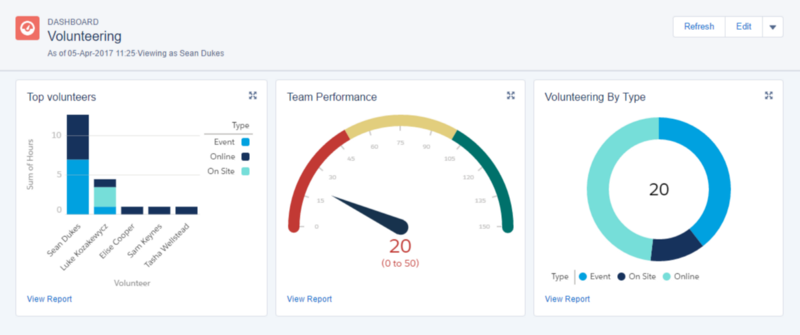
When we pledged 1%, we were signing up to an ideal without a clear idea about how we were going to deliver. Micro volunteering has given us the tool we needed to turn that aspiration into action. I’m not just proud to have pledged; I’m proud of what we are achieving too.
By Rebecca Koening. Originally published in The Chronicle of Philanthropy.
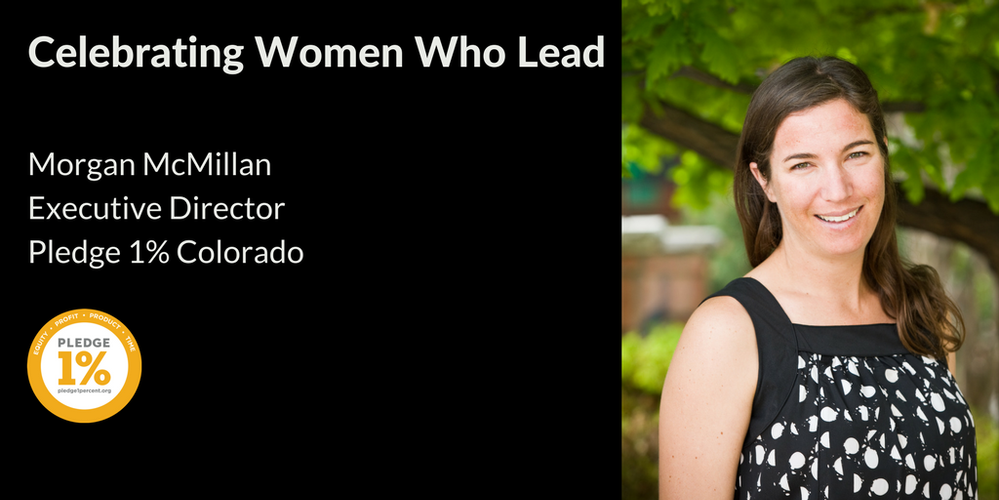
This profile is published as part of Pledge 1%’s Women Who Lead series, which celebrates women in the Pledge 1% community who are creating change within their workplace and communities.
Morgan McMillan is the Executive Director of Pledge 1% Colorado. She was hired as the first E.D. (and paid staff) for the Entrepreneurs Foundation of Colorado (EFCO) in 2012. After partnering with Salesforce, Atlassian, and Rally for Impact in 2014 to launch the global Pledge 1% platform, the EFCO board decided to rebrand and expand to Pledge 1% Colorado to better align our work with the global movement.
Read the full interview below to learn more about Morgan’s experience and what inspires her to give to her community.
Q1: What inspired you to work in this industry?
I had been working in the nonprofit sector for a decade and observed the struggle to connect nonprofits with the startup community in a meaningful way. Often participating organizations from both sides of the aisle were left feeling dissatisfied from their interactions. EFCO sought to positively impact community nonprofits in a way that aligned with startup culture. Ryan Martens’ (founder of Rally Software) passion and vision for how startups could intentionally establish a culture of giving at the earliest stages was also really inspiring! You could really see how that commitment drew employees to Rally and sparked a deep loyalty to their company.
Q2: What would you tell women who are looking to work in tech? Any advice on how they can build their career?
I respectfully acknowledge that my role is more on the periphery of technology companies so I can’t directly speak to the challenges women might face – but my experience working with Pledge 1% companies demonstrates an authentic desire by many tech companies to be inclusive of a broader workforce. Leadership matters. A company may have an HR department that values inclusion but if it isn’t shared broadly by the leadership team, the culture won’t reflect it. I’ve also seen the importance of establishing a network of support. Connecting and meeting regularly with other women in tech and the broader startup sector provides emotional support – but it’s also a great business strategy.
Q3: Is your company a Pledge 1% member or do you personally give back to your community? If so, how do you give and to what cause?
I’ve been a longtime volunteer with Intercambio Uniting Communities, a local organization that teaches English to adult immigrants and works to build cross cultural understanding.
Q4: Do you serve as a mentor? What does mentorship mean to you?
I’ve mentored people formally and informally over the years. Sometimes that looks like advice or bouncing around ideas – and sometimes it means intentionally inviting a mentee to a meeting or a network gathering. Professionally and personally I’ve realized that so much of success depends upon strength of network and that too often our networks look just like us – ethnically, economically, education level, and sometimes gender. I look for opportunities to mentor and include people who aren’t currently ‘at the table’ to expand their network – and mine, too!
Q5: What’s the best piece of advice you’ve received to help you with your career?
Your priorities shift at different times in your life. You do the best you can and try not to feel guilty about the things that get put on the backburner. (This was particularly poignant for me as I had two children after joining EFCO and while launching Pledge 1%.)
Q6: What’s the one piece of advice you would give to yourself 5 years ago?
Work to maintain focus. You will be pulled in many directions. Listen, reflect, and filter out those that don’t align with your purpose. And enjoy all the new stuff you’re about to learn!