Originally published by Robert Safian on Fast Company.
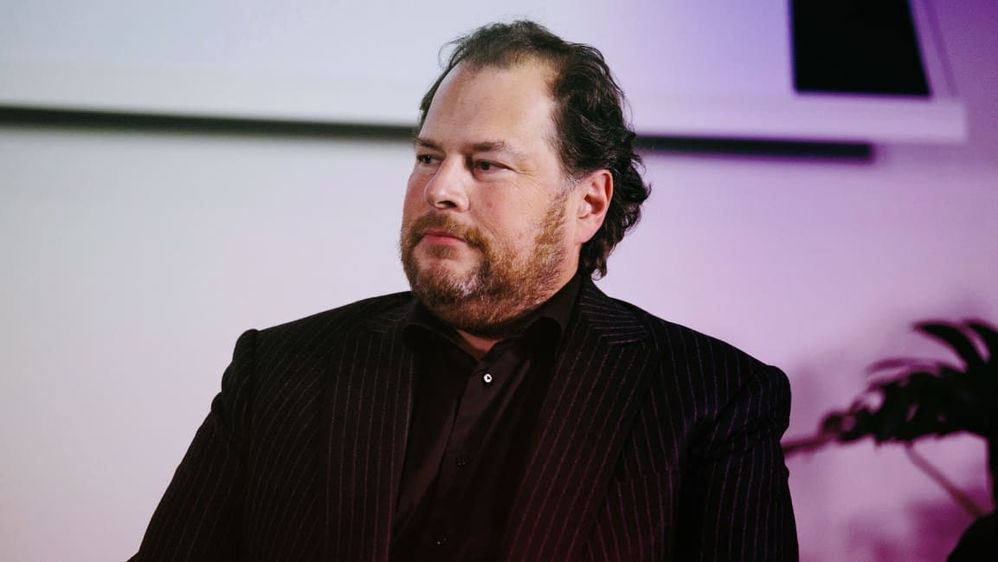
Fast Company‘s latest cover story explores the various ways values and social responsibility are having an impact at companies such as Facebook, Airbnb, and Uber. Salesforce CEO Marc Benioff has long pushed his company and employees to make a positive difference in the world. I spoke to him recently about his company’s approach.
Fast Company: You have talked about Salesforce as a company with purpose beyond profit. Can you explain that?
Marc Benioff: My goals for the company are to do well and do good. The most important thing to me is that we bring along all our stakeholders with us. We had a vision from the beginning that not only would we have a new technology model, which was the cloud, not only would we have a new business model, which was subscription, but we’d have a new philanthropic model, which is 1-1-1. [Salesforce commits 1% of its equity, employees’ time, and product to nonprofit work.] As the CEO I need to embrace all of my stakeholders, not just all of my shareholders. What I’m trying to do is maximize stakeholder value.
FC: How does doing good help bottom-line performance?
MB: Well, we’re the fastest growing software company of all time, so I hope it’s connected. [Laughs.] If you go to my Twitter page you can see the revenue chart. It’s a direct connection to our values. Not only are we building a great product but we’re building a great company that is trying to create a great world. Certainly it’s a source of great talent. People come to the company and stay because of the incredible opportunity and impact that they’re having on the world. Business is a great platform for change. When a business like Salesforce gets to scale, with 25,000 employees and customers all over the world, you have an opportunity to influence them in a positive way. I do believe we’re having that impact. You can see it in Pledge 1%, where the 1-1-1 idea has spread to thousands of companies.
FC: Does Wall Street support this idea?
MB: Wall Street is agnostic in terms of picking one philosophy or the other. But they certainly do invest and support companies that do good work. We’ve been public since 2004, you look at our chart, we’ve had a really good run, and I do connect that back to [the fact] that we’re building a great company. It is part of our differentiation. As you differentiate against an SAP or an Oracle or a Microsoft, Salesforce is indeed different.
FC: There seems to be heightened discussion and activity from corporate leaders on policy issues in recent months. Is that directly related to a new administration?
MB: I think you saw it before that. You’ve seen the rise of more activist CEOs who stand for things and represent their employees and their stakeholders in the same way a politician would represent the people who vote for them. I think CEOs have to think this way. They have to understand that they represent their stakeholders, all of them. They need to be able to speak and act on behalf of them.
When I went to school for business, we were not taught this. It was not part of my education. I was taught marketing and organizational development, that sort of thing, I certainly was not taught stakeholder management. This is something I’ve learned, honestly, since I started Salesforce.
I’ll come back to the 1-1-1. Because of 1-1-1, we got involved with so many nonprofits and NGOs. We support 30,000 of them. Many of these people I had never interacted with, and they really impacted my consciousness, how I think about the world. They are working on health care and the environment and with developing nations, areas where I have not spent that much time. Those conversations have been extremely valuable. What I realized is we can help them and support them in our work. As we’ve done that, our employees get a much higher level of satisfaction and fulfillment, knowing that they work for a company that supports that.
We give our employees the ability to have direct involvement too. One of our executives just went to set up a school in Africa. We give them four hours a month paid time off, six days a year—we’re paying them for their volunteerism. That only creates a better company. It’s quite selfish in many ways. This has probably done more for Salesforce. And that’s why I encourage other CEOs and entrepreneurs to take this on.
FC: When you first started doing this 18 years ago, it was novel. Do you feel the expectations on business leaders has changed since that time?
MB: Yes, increasingly so. I think you’ll see that continue to accelerate. There’s a shift for CEOs to be focused on all their stakeholders, not just their shareholders, and I think that will be more and more true.
FC: Are there cultural elements driving this?
MB: Absolutely. You can look to millennials, they have a desire to work for companies that have meaning. Yes, they want a company that is making money, focused on profitability and market share and all of that, but also that there is meaning to their work, that they’re actually improving the state of the world.
When I was at Oracle, I felt deeply inside myself that there was this bifurcation. I was working for this company, and that was one way of life, and there was another way of life that was nonprofit world or spiritual world, whatever you want to call it. I went on this tour of India in 1996, talking to gurus, incense wafting over us, and all of a sudden it became clear to me that there was a way to integrate all of this, that you could do both at the same time. Why do I have to be two people? Can’t I just be one person? I want to live an integrated life. I want to be an integrated leader.
A lot of people feel like they have multiple lives. They compartmentalize. I have an integrated life. I have one set of values, and I project that through all of my work. I’m not perfect, I have incongruency, but I try to work on that. This kind of integration is something we can all strive for. I know that the work I’m doing is making the world better. Salesforce helps hospitals and schools and all kinds of nonprofits. Salesforce gives guidance to our employees to get out there and volunteer. And I think that’s why we have high levels of satisfaction in our employees. And why we can attract people. We are creating an environment that gives them satisfaction in their work, not just financial gains.
FC: The trust people have in government is waning. Is trust in business leaders growing?
MB: Nothing is more important today for business than trust. The Edelman Trust Barometer says trust with CEOs, companies, government is at the lowest point in a long time. We are in a crisis of trust. CEOs get caught in this crisis of trust and it gets amplified for them. That’s why I come back to that 1-1-1 model. It brings a set of values into the company. If you do have an incongruent moment, you’re going to be able to seek forgiveness for that. I’ve had those moments myself. For those people who are only out there to make money, when you hit that incongruent moment, you don’t get air cover, you’re going to be in trouble because you didn’t create the good karma.
You have the opportunity to set up companies that do good in the world. It’s easy. There’s all this incredible energy in your company and you can unleash it for good. If you’re not unleashing it, you’re missing something. I really think people are inherently good and want to give, I think companies are inherently good and want to give. The ability to do it is relatively straightforward. All you have to do is open the door.
FC: So is this more important than meeting the expectations of Wall Street?
MB: You have to be able to do both. It’s not an either/or. Yes, you better hit your revenue and earnings goals. But there is no linear success. If you look at my stock chart, you’re going to see ups and downs, but where is it over time? From that same perspective, your company isn’t always going to be perfect, we’re human beings, there are going to be problems and challenges along the way. But when you aggregate it all up, it’s like the stock. What is your compound growth rate of your equity over the years? What is your compound growth rate of good over the lifetime of your company?
In 2008 I went to Bhutan. They don’t measure gross domestic product. They measure gross national happiness. We don’t live in Bhutan, but we can look to Bhutan for inspiration—we can have companies with more happiness and satisfaction and fulfillment but that are also able to achieve strong financial outcomes. This something every CEO can do, easily, and I’m encouraging companies to do this. It’s probably more important than any time in human history that we’re all focused on improving the state of the world.
Originally published by Tim Smith, Director of Innovation Partnerships and Pledge 1% Boston on the Boston Foundation blog.
Brendan Ciecko is the founder of Cuseum, and a proud early member of Pledge 1% Boston. Growing up in Massachusetts, he got his entrepreneurial start as a teenager and has always been dedicated to making our region more vibrant and engaging. Brendan built and scaled a successful company in the fast-paced music industry and was named one of America’s top entrepreneurs by Inc. Magazine – all before he could legally buy a drink.
In his 20s, his attention turned to museums. “Museums should be easy to access and enriching for all,” says Brendan, who is driven to help museums improve their digital engagement. As more visitors turn to their smartphones, Cuseum enables museums to offer a “digital docent” to meet this demand and improve visitor experiences. Founded in 2014, Cuseum can now be found in some of the most renowned institutions in the world, including the Museum of Fine Arts Houston, Asian Art Museum in San Francisco, and the Institute for Contemporary Art in Boston. Cuseum recently launched a new digital membership fulfillment product to help institutions save time and money as well as increase member renewals and satisfaction.
As part of its mission, Cuseum has also developed tools to help museums address accessibility and inclusion with the support of multiple languages, assisting in mitigating a common barrier for diverse populations. Additionally, Cuseum has introduced elastic pricing models that make it possible for organizations of every shape and size to take advantage of their platform.
Early backers of Cuseum include Paul English (a fellow Pledge 1% Boston member), Techstars, Boston Syndicates (BOSS) and a lineup of savvy and successful tech industry leaders and investors. As Brendan has supported various nonprofits and community initiatives throughout his life, joining Pledge 1% Boston was an easy decision.
“As entrepreneurs and problem-solvers, we have an obligation to give back and drive positive change around us” he explains. Making the decision to pledge 1% toward the common good was totally aligned with the goals and culture of Cuseum.”
Brendan is also an emerging thought leader around ways that the nonprofit community can look to the innovative models of accelerator and incubator programs. Check out his recent opinion piece in TechCrunch.
5 Fun Facts About Brendan & Cuseum:
- Brendan has a Platinum record for his work with OneRepublic.
- Cuseum’s office is filled with whimsy… including artwork by Gary Baseman and Boston artist Pat Falco.
- Brendan is a graduate of the “School of College Dropouts.”
- At the age of 19, Brendan managed an alternative hip-hop group signed to Warner Bros. Records.
- Brendan is married to his high-school sweetheart and fellow do-gooder, Elizabeth Dobrska, who is Managing Director of TUGG and a member of the Boston Foundation’s Innovation Economy Leadership Council.
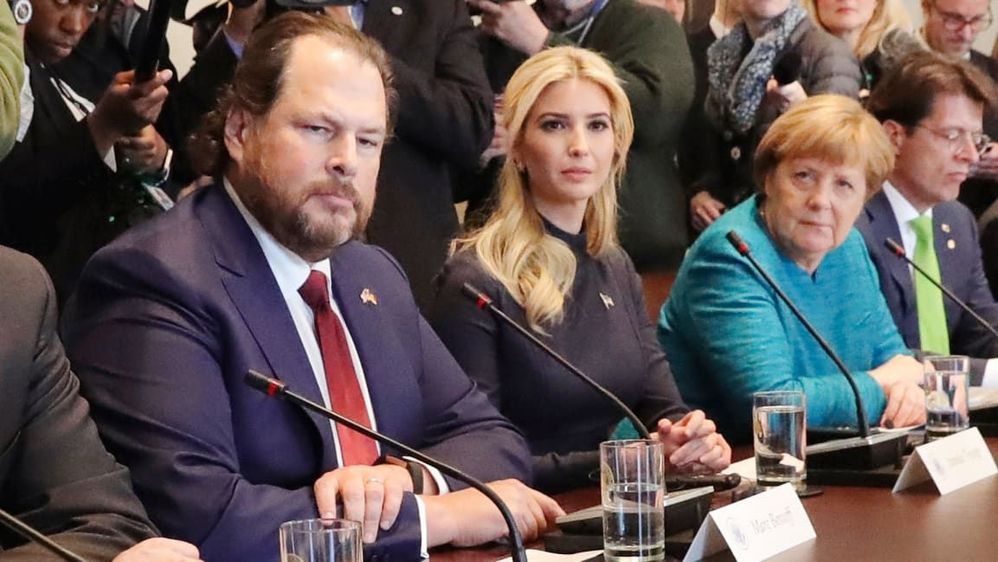
Salesforce’s Marc Benioff, left, alongside Ivanka Trump and German chancellor Angela Merkel, met with the president to discuss workforce development and gender equality. “I made my point,” the CEO says. [Photo: Michael Kappeler/picture-alliance/dpa/AP Images]
Originally published by Robert Safian on Fast Company.
In the days after Donald Trump was elected president, I found myself reaching out to chief executives of several key businesses that Fast Company has covered. The presidential campaign had convinced me that neither party’s candidate, and neither party, had a compelling vision for how our technology-driven culture could both energize our country and include all Americans. What I encouraged of these CEOs was to use their perches to fill that leadership vacuum.
There has long been debate in America about the role of the corporation. Is it a job- and wealth-producing marvel? Or is it a nefarious, rapacious beast? “Corporations aren’t to be trusted,” argues Ian Bremmer, president of global strategy firm Eurasia Group. “The presumption that America supports capitalism has never been true: The number of people who have capital and want to risk it is a tiny fraction. Most Americans just want to be treated fairly.”
What’s clear is that U.S. businesses and business leaders wield tremendous power. How they use that power will help define the future of our world. Some executives believe that the best way to exercise influence is to move into government from the private sector. Others see the spheres of influence within companies as their own points of leverage: The combined annual revenues of the 20 largest American businesses is more than $30 trillion, nearly double the gross domestic product of the United States. And these companies cross many borders. If you calibrate the number of lives that big U.S. companies touch directly—like Facebook, which has nearly 2 billion people in its user base—they have as much potential for impact as any national official.
So what might business leaders do with that influence? That question is at the heart of our cover story, which explores how executives like Mark Zuckerberg and companies from Airbnb to Uber are grappling with their roles. More and more companies are signing on to Pledge 1%, a commitment to dedicate 1% of their equity, their product, and their employees’ hours to nonprofits. CEOs like Marc Benioff, at fast-growing software provider Salesforce, are actively proselytizing that aligning a business with higher values, rather than solely pursuing maximum dollars, will actually boost financial performance in the long run. “You’ve seen the rise of more activist CEOs who stand for things,” Benioff says, “and represent their employees and their stakeholders in the same way a politician would represent the people who vote for them . . . What is your compound growth rate of good over the lifetime of your company?”
It’s possible that all of this is just a fad, and we’ll go back to a time when delivering profits and dollars to Wall Street is all that matters in the C-suite. But I hope not. Because some of the smartest people in the world run some of the most impressive, highest-impact businesses in the world. If they use those positions for something more than just making money, for making the human condition better across the globe, then anything is possible.

This piece was originally published by Robert Safian on Fast Company.
When Facebook founder and CEO Mark Zuckerberg released a nearly 5,800-word open letter on February 16—the longest single post he had ever shared on his Facebook timeline—he introduced it with this simple phrase: “I know a lot of us are thinking about how we can make the most positive impact in the world right now.”
At that moment, many other businesses, from Google to Starbucks, were publicly fighting policies proposed by President Donald Trump, most notably in the area of immigration. But Zuckerberg didn’t mention the president or politics. Instead, he posed a broader question: “Are we building the world we all want?” Facebook, he argued, had a responsibility to help people.
It was a mission statement, shared just as discussion of business leadership’s relationship to government leadership was reaching a fever pitch. Facebook itself had been stung by critiques of its role in “fake news” and “filter bubbles.” Implicit in Zuckerberg’s letter was the idea that, despite Facebook’s vacuuming up of ever-larger piles of cash, its real purpose—its reason for existence—wasn’t to make money. It was to make the world a better place.
Such moralizing from a billionaire CEO can come across as disingenuous or naive. Zuckerberg devoted most of his letter to outlining how Facebook could be instrumental in “building a global community,” which of course isn’t too far from what the company’s business imperatives would dictate. Was it all just self-serving rationalization? Is Zuckerberg—and any business leader claiming that values matter more than dollars—simply a hypocrite? This is the tension underlying a rising movement across the business landscape. From automakers such as Ford and Audi to fashion houses like Gucci and Ralph Lauren, from health care firms to consumer-packaged-goods makers, companies are increasingly seeking to align their commercial activities with larger social and cultural values—not just because it makes them look good, but because employees and customers have started to insist on it. Some efforts are clearly reactions to the political environment and the divisiveness surrounding Trump; the impact of boycotts (witness #grabyourwallet) and buycotts can’t be ignored by CEOs or investors.
A practical question looms over this phenomenon: Does business have a higher responsibility to address social values, as Zuckerberg asserts about Facebook, or should the pursuit of profitability—maximizing shareholder value above all else—be the chief purpose of a company? Quickly chasing that question is another one, supported by many acolytes of this new movement: Is it possible that embracing values can actually help profits and share prices in the long run?
These issues are roiling executive leadership at enterprises large and small, and in no place more prominently than in Silicon Valley. Which makes techland—and firms like Facebook and Uber—an ideal canvas on which to explore how values and value creation are being balanced and integrated in different ways right now. An experiment is under way in parts of corporate America to redefine the role of business in society. To get a sense of how this is playing out, and what it might portend for our future, we’ve looked at four leading tech companies with varied approaches, as well as a smaller business that’s feeling its way through the challenges. These case studies reveal just how much potential, and how much uncertainty, lies ahead.
The Zuckerberg Philosophy
Five years ago, before Facebook’s IPO, Mark Zuckerberg posted what he called a “founder’s letter” that spelled out the company’s philosophy for prospective investors. “We don’t wake up in the morning with the primary goal of making money,” Zuckerberg wrote. Instead, Facebook “was built to accomplish a social mission—to make the world more open and connected.” Among five specific values that the letter noted (including things like “Move Fast” and “Be Bold”) was this declaration: “We expect everyone at Facebook to focus every day on how to build real value for the world.”
I recently sat down with Zuckerberg to discuss this letter, and his latest one, in order to learn how his thinking might have changed over time. Facebook’s offices have grown to become a sprawling empire in Menlo Park, California, with bulldozers busily constructing new expansions. Building 20, where Zuckerberg works along with hundreds of the company’s 17,000-plus employees, features what may be the largest single-room office space in the world, a meandering wall-free topography stretching nearly a quarter mile that includes cafés, open-air meeting spaces, and an eclectic mix of colorful sculptures. Zuckerberg’s desk is in Area 3, near the midpoint of the building, one among many workstations. He greets me wearing his usual jeans and gray short-sleeve T-shirt, and we walk over to a glass-enclosed conference room just behind his desk. He may not have a traditional office, but this is where he holds product-review meetings and entertains visitors. We settle in on the couch and begin talking.
“I didn’t start Facebook as a business,” Zuckerberg says. “I built it because I wanted this thing to exist in my community. Over some number of years I came to the realization that the only way to build it out to what I wanted was if it had a good economic engine behind it.” In this way, he notes, “Facebook has always been a mission-driven company.”
The open letter Zuckerberg posted in February “wasn’t exactly a follow-up” to the founder’s letter, he says. “The founder’s letter was written for shareholders buying into the IPO to understand how the company operated.” The new letter “had a different goal, less about how we work and more about what we’re going to do.” What’s changed dramatically since 2012, according to Zuckerberg, is the rising skepticism about global connectivity. “When we were getting started in 2004, the idea of connecting the world was not really a controversial idea. . . . People thought that this was good,” he says. “But in the last few years, that has shifted, right? And it’s not just the U.S. It’s also across Europe and Asia. Folks who have been left behind by globalization are making their voices louder.” Zuckerberg explains, “I feel like someone needs to be making the case for why connecting people is good, and we are one of the organizations that I think should be doing that.”
As he talks about these things, Zuckerberg looks directly at me, rarely blinking. His focus is acute. I mention several of the ways that some corporations express their values—Starbucks committing to hiring refugees, for instance, or others that engage in charitable giving. But Zuckerberg isn’t steering Facebook toward external social action or philanthropy. “I think the core operation of what you do should be aimed at making the change that you want,” he replies. “A lot of companies do nice things with small parts of their resources. I would hope that our core mission is the main thing we want to accomplish: making the world more open and connected. Almost all of our resources go toward that.
“When I want to do stuff like invest in education and science and immigration reform and criminal justice reform,” he goes on, “I do that through a different organization, through the Chan Zuckerberg Initiative.” (He and his wife, Priscilla Chan, created CZI to make good on their pledge to give away 99% of their Facebook shares during their lifetime.) “It’s not that people [at Facebook] don’t believe in those kinds of things. I just think building social infrastructure for a global community [is Facebook’s] mission.” Within that mission, Facebook has created tools that enable charitable fundraising as well as societal support (like its Safety Check feature, which has helped people find each other during crises).
There is often skepticism when companies claim to be values- or mission-based, because near-term financial results seem to take precedence over other purported corporate values. When I ask Zuckerberg about this, he doesn’t acknowledge any disconnect between satisfying a higher mission and meeting financial goals. “People want business leaders—and all leaders—to be authentic and stand for things,” he says.
Then Zuckerberg brings up the fake-news controversy that hit Facebook in the past year—the contention that the company wasn’t vigilant in removing inaccurate, politically motivated posts by fictional news outlets because they generated ad revenue. His voice rises in intensity. “One of the most frustrating things is when people assume that we don’t do something because it will cost us money. Take, for example, some of the debates going on now around the news industry and misinformation. I mean, there’s definitely a strain of criticism [asserting] that Facebook [lets] people share misinformation because it will make [us] more money. And that really is just not true at all.”
The underlying value that drives Facebook’s content decisions, Zuckerberg says, is freedom of speech. “I believe more strongly than ever that giving the most voice to the most people will be this positive force in society,” he says. “Often when you make decisions that aren’t exactly what people want, they think you’re doing it for some underhanded business reason. But a lot of these things are more values-backed than people may realize.”
Zuckerberg does recognize that there may sometimes be unintended consequences to Facebook’s actions. “It’s a work in progress,” he admits. “At each point you uncover new issues that you need to solve to get to the next level. . . . It’s not like they are problems that exist because there’s some kind of underlying, nefarious motivation that led to them. I mean, certainly giving people a voice leads to more diversity of opinions, which if you don’t manage can lead to more fragmentation over time, but I think this is kind of the right order of operations. You know, you give people a voice and then you figure out what the implications of that are, and then you work on those things.”
When I ask whether Facebook has design flaws that might undercut its values and mission, he agrees in principle, but offers a clarification. “I think it’s fair to call them flaws, because every system is imperfect. But [thinking of it as] a work in progress is probably a more realistic framing. I mean, it’s not wrong to say that it has flaws, but I wonder if that’s an overly negative framing—not just of Facebook, but of any business or system. You got here by doing certain things, and the world is changing around you, and you need to adapt to keep going forward.”
Zuckerberg offers an example—not something momentous like Trump’s election (he studiously avoids political topics) but rather a more mundane area: clickbait, which at one point generated lots of user complaints. “Our algorithms at that time were not specifically trained to be able to detect what clickbait was,’’ he says. “The key was to make [tools] so the community could tell us what was clickbait, and we could factor that into the product. Now, it’s not gone 100%, but it’s a much smaller problem. And when I think about things today, whether it’s information diversity or misinformation or building common ground, these are the next things that need to get worked on.”
I then pose a moral question: Do successful businesses like Facebook, which have disproportionately benefited from the advent of new technology, have any special responsibility to help people being left behind by technology’s march? Zuckerberg looks away and pauses for several seconds, gathering his thoughts. “I think yes,” he finally says, “but there’s a lot in what you just said.” He continues, “A lot of the current discussion and antiglobalization movement is because, for many years and decades, people only talked about the good of connecting the world and didn’t acknowledge that some people would get left behind. I think it is this massively positive thing overall, but it may have been oversold. We have a responsibility to make sure it works for everyone.
“The thing that’s tricky,” he says, “is that I believe a lot of the issues we’re currently seeing around the world are not only economic questions. They’re social questions of meaning and purpose and dignity and being a part of something bigger than yourself. Certainly the economic part is very big. But I also think that regardless of how well you’re doing economically, you’re going to have issues in your life and you’re going to need a social support structure around you.” That’s why he is so committed to Facebook’s quest to build community.
Zuckerberg’s approach is a consistent and disciplined one: If everything the company does is predicated on the goal of connecting people, and if that goal is a higher-order priority than moneymaking or reacting to near-term political shifts or anything else, then long-term progress along that vector is what matters most. But it also makes him and his enterprise vulnerable: Any shortcomings in any part of the business reflect back on the whole and leave Facebook open to criticism. Zuckerberg clearly has a conscience (he’s not happy with how fake-news outlets manipulated his service), and he is devoted to constant improvement. Yet that won’t stop charges of hypocrisy. His challenge is to keep using complaints as motivation to make Facebook better, rather than getting defensive or pulling back.
As I walked out of Building 20, I found myself returning to a few sentences Zuckerberg had shared early on in our talk. He asserted that in the future, all businesses will increasingly need to tap into values and mission—that both consumers and employees will demand it. “Especially with folks who are millennials, that is going to be the default,” he told me. “When I started Facebook, there were a lot of questions around, Is this a reasonable way to build a company? And then when more millennials started graduating from college and we went to recruit them, it became very clear that they wanted to work somewhere that wasn’t just about building a business, but that was about doing something bigger in the world.”
His strategy for linking values and commerce through Facebook’s core activity is one approach to meeting that goal. There are more intricate ones too, as I soon discovered.
The Cult Of The Ohana
“I love to work at the intersection of capitalism, technology, and social justice.” Suzanne DiBianca, who was named “most talkative” in her high school graduating class, is animatedly telling me a story about how altruism and financial success go hand in hand at Salesforce, where she has worked for the past 17 years and serves as chief philanthropy officer. We’re chatting in an office on the 25th floor of Salesforce East, one of the company’s multiple HQ buildings in downtown San Francisco. DiBianca’s desk is in an interior space—as are all private offices in the building—but as you look past the adjacent workstations and out the windows, you can see the looming, still-under-construction Salesforce Tower, which is now the tallest structure in the city (it will open in 2018). The 25,000-person company is already San Francisco’s largest tech employer, with much future growth obviously in the works.
 Suzanne DiBianca [Photo: Chloe Aftel, Groomer: Rebecca Butz]
DiBianca, who helped launch the nonprofit foundation now known as Salesforce.org, begins by describing how one of the hundreds of volunteering activities that it supports also benefits the larger Salesforce community. “Every week kids walk down [to our office] from Chinatown at lunchtime, and people here will listen to them read aloud,” DiBianca says. “If you spend your lunch hour working with the children, you’ll come back with gratitude, with perspective on the world, inspired, and turned on. If you spend that hour out at lunch with a colleague, venting about what’s not working the way you want, you’re going to come back deflated.”
Like Facebook, Salesforce has long considered itself a vehicle for positive change in the world. But rather than point primarily to the core profit-making operation of the company, as Zuckerberg does for Facebook, Salesforce expresses its larger purpose first through philanthropy and the volunteering activities of its workforce. Yet this altruism, Salesforce execs contend, is indelibly linked to the business’s finances. As DiBianca puts it, “there is no distinction” between the company’s drive for growth and its social impact. “When you have people living their values every day, you’re going to create a heightened sense of teamwork, and a great company.”
Salesforce has, from its inception, been an unusual business. CEO Marc Benioff launched the company in 1999 around novel ideas that are now seen as gospel: that enterprise software could be delivered over the internet and as a subscription service. He also wanted to make philanthropy an integral part of the culture and, working with DiBianca, developed what they call a 1-1-1 model, which refers to giving away 1% of Salesforce’s products, of its employees’ time, and of its resources. (An initial 1% equity grant anchors the foundation’s funding.) Salesforce.org has bestowed more than $160 million in grants, organized more than 2 million employee volunteer hours, and shared low- and no-cost technology with more than 31,000 nonprofits and educational institutions. New hires at Salesforce participate in community activities such as sorting goods for a food bank as part of their orientation, and 80% of employees volunteer in their communities. (They get seven days per year of “volunteer time off” to take part in activities such as coaching Little League, building schools, and assisting at health clinics.) The company’s annual Dreamforce conference, which gathers more than 170,000 customers and partners, also integrates volunteer efforts.

Elizabeth Pinkham [Photo: Chloe Aftel, Groomer: Rebecca Butz]
This is all part of what Benioff calls the company’s “Ohana,” a concept based on the Hawaiian word for “family.” On a tour of the company’s HQ, Elizabeth Pinkham, who oversees Salesforce’s buildings and offices around the world, explains how the decor and layout are being designed to evoke the Ohana, including quiet meditation “wellness” corners where cell phones and laptops are discouraged. Thirty Buddhist monks were invited to join last year’s Dreamforce gathering and, says Pinkham, ended up being star attractions. “The Salesforce Ohana is a deep-seated support system we nurture inside our company,” an in-house blog explains. It can all sound a bit out there for a $60 billion seller of enterprise software. But fostering values has always been the point for Benioff. “I know that the work I’m doing is making the world better,” says the CEO. “Salesforce helps hospitals and schools and all kinds of nonprofits. Salesforce gives guidance to our employees to get out there and volunteer. And I think that’s why we have high levels of satisfaction in our employees and why we can attract people. We are creating an environment that gives them satisfaction in their work, not just financial gains.”
Salesforce.org may be “the heart and soul of the company,” in the words of Ebony Frelix—who runs its philanthropy programs, grants, and volunteering—but the Ohana reaches into Salesforce’s operational culture, too. Cindy Robbins, who oversees human resources, recalls how after she was promoted to her current post, she was surprised to discover that the company had never gathered data on how much female employees were paid compared to men in similar jobs. She went to Benioff. “I explained to him that we couldn’t lift up the hood on this and, if we found something, simply put it down again,” she says. “This could cost us real money to address. He said to go for it.”

Salesforce’s Ebony Frelix steers the company’s philanthropy and volunteering efforts. [Photo: Chloe Aftel, Groomer: Rebecca Butz]
The pay-gap study did indeed discover discrepancies (for some men as well as women, according to the company). Robbins is proud of how they responded: Salesforce instituted salary adjustments for 6% of its workforce, at an annualized cost of $3 million, she says. This January, Benioff said the company would implement another round of salary adjustments, with a similar cost, to align employees who had joined as part of acquisitions. “Some things we’ll do well and some things we’ll learn from,” Robbins says. “You have to be very intentional about working at it.”

Cindy Robbins [Photo: Chloe Aftel, Groomer: Rebecca Butz]
Tony Prophet, who joined Salesforce as its first-ever chief equality officer late last year, points to a different example of the company putting its dollars at risk in support of its values. In 2015, Indiana’s then-governor, Mike Pence, signed the so-called Religious Freedom Restoration Act, which would likely have opened the door to discrimination against LGBTQ people. Employees at Salesforce’s Indianapolis office objected to the law and raised the situation with Benioff. The CEO then publicly threatened to greatly reduce its investment in Indiana (the company had maintained a significant presence in the state since buying local software developer ExactTarget in 2013). He tweeted that he was canceling programs that would require employees and customers to travel to Indiana, and promised relocation packages to workers who might want transfers. The law was eventually amended to protect LGBTQ rights, and Indianapolis remains the second-largest Salesforce office.

Tony Prophet [Photo: Chloe Aftel, Groomer: Rebecca Butz]
Salesforce has been criticized for not always following through on its values. For example, in the past some African-American employees have suggested that their concerns weren’t taken seriously enough by the company. A recent study in the academic journal Sage, focusing on corporate responsibility, reports that “the threat of hypocrisy is amplified for firms with stronger reputations” and that some companies choose to downplay their achievements to avoid tighter scrutiny of areas where they may be less proficient. The Salesforce leadership team seems undeterred by those risks. “We’re an institution in society, and we have a responsibility to do the right thing,” Prophet says. Plus, he argues, it helps the bottom line: “Over the long arc of time, when you do the right thing for the planet, it will be good for you as a business. People will want to work for that company; you’ll have a magnetic brand that resonates. It creates loyalty and affinity.”
While not every company will warm to Benioff’s program of Ohana, more and more are embracing his model of philanthropic engagement. “Trust in business is higher than trust in any other institution,” says DiBianca. How companies deploy that trust, she says, is critical. “I’m super optimistic about next-generation companies.” She’s referring to the growing number of businesses that have signed on to something called Pledge 1%, a commitment to mirror the 1-1-1 system that Salesforce pioneered. In two and a half years, the number of businesses committed has climbed to 1,600, from education upstart General Assembly to Australian software juggernaut Atlassian. “There’s all this incredible energy in [most companies] and you can unleash it for good,” says Benioff. “If you’re not unleashing it, you’re missing something. The ability to do it is relatively straightforward. All you have to do is open the door.”

Jonathan Mildenhall, Airbnb’s CMO, knows his company needs to foster trust and openness in order to succeed. [Photo: ioulex; Groomer: Eliza Desch]
The Airbnb Advantage
Are you a giver or a taker? That’s the question at the heart of Wharton professor Adam Grant’s best-selling book, Give and Take. Grant shows through empirical studies and anecdotes that “givers” (helping, cooperative, sharing individuals) are the most valuable employees within organizations, despite societal norms and corporate-reward systems that habitually favor individual-achievement-focused “takers” (who tend to rise quickly but ultimately fall).
When Grant is out talking about his book, he is invariably asked whether entire companies can be viewed as givers or takers. “Sure,” he says. “You can see what the values and norms [of a company] are internally . . . and the way it interacts in the world.” All this is “much more salient” today, he says, because “company behavior and claims are way more visible than before.” Plus, he adds, with “the drop in trust of government,” the role of the corporation in driving culture “is much bigger than it used to be.”
Givers, explains Grant, earn what psychologist Edwin Hollander called “idiosyncrasy credits”: By being helpful to others, they accrue trust that allows them to sometimes break from expected behavior. A company with “giver” attributes—“What can I do for you?” versus “What can you do for me?”—may get the benefit of the doubt in difficult moments. “Other companies are constantly skating on thin ice,” observes Grant (who works with businesses such as Facebook to help assess and improve their culture). “When the dots connect, people say, ‘Oh, that’s why I hate my job,’ or, ‘That’s why I love my company.’ ”
This paradigm offers a compelling lens for examining two tech-innovation siblings: Uber and Airbnb. Both are anchors of the sharing economy, both have had to challenge local laws to elbow their way in, and both have reached multibillion-dollar valuations while remaining privately owned. Their headquarters are based just a mile from each other in San Francisco’s South of Market district, and it might be natural to look at them as twins. But only one of them is perceived as a giver.
Uber has had a painful 2017. CEO Travis Kalanick has been embroiled in turmoil, first over his decision to join and then drop out of President Trump’s business advisory council, then due to allegations of gender bias and harassment at his company, all of which has inspired a wave of #DeleteUber protests. While there are many reasons for this crescendo of snafus, it is also true that Uber’s store of “credits” was low before these events unfolded. The ruthlessness that allowed Uber to build dominant market share and disrupt transportation as we know it also imbued its brand with an aura of by-any-means-necessary selfishness. The unflattering video that surfaced this year of Kalanick berating an Uber driver only reinforced those prevailing sentiments.
Airbnb has had its moments of trouble, too, in its confrontations with local regulators and around allegations of racial discrimination by its community of hosts. Yet Airbnb CEO Brian Chesky has largely avoided any cloud of resentment (helped, certainly, by Airbnb’s eventual efforts to address the discrimination challenges). What separates these two companies can be illuminated by considering two recent occurrences: When Uber tried to support immigration demonstrations in New York–area airports by holding its prices down, it was swiftly denounced for undercutting striking taxis—it got no benefit of the doubt for what it claimed were altruistic motivations. Meanwhile, when Airbnb aired its “Accept” ad during the Super Bowl, it could have been pilloried for exploiting pro-immigration sentiment for its own business purposes. That critique never got traction.
I recently visited Airbnb’s headquarters, a beautifully rebuilt warehouse with a bright, open atrium and playfully designed studiolike work spaces. I met with Jonathan Mildenhall, Airbnb’s chief marketing officer, who was animated about a new internal study he’d undertaken with partners at ad agency TBWAChiatDay titled “The Business Case for Creating an Iconic Brand.” The premise is that tech companies (with the notable exception of Apple) undervalue and underinvest in brand building, limiting their growth and impact. Mildenhall hoped to use the study to convince Airbnb’s internal stakeholders—CEO Chesky, other executives, the board of directors—that an ongoing commitment to enhancing the brand was a worthwhile investment.
Mildenhall is a charismatic, stylish Brit who came to Airbnb from Coca-Cola, where, among other things, he oversaw the diversity-celebrating “It’s Beautiful” Coke ad that originally aired in 2014 and also ran during this year’s Super Bowl. Mildenhall’s aspirations for Airbnb are ambitious: If Coke was the iconic brand of the 1980s, Nike defined the 1990s, and Apple ruled the 2000s, then his goal is to make Airbnb the brand of this decade. “I’ve got three years,” he says.
The study, which has been packaged into a colorful, graphics-heavy 73-page booklet, enumerates how brands can enhance asset valuations, push customer growth, provide pricing support, attract talent and partners, inspire employees, and “drive loyalty beyond reason,” as the booklet puts it. It is a rational, pragmatic pitch for building emotional appeal.
While Mildenhall, as a marketer, discusses all of this in terms of brand, it could just as logically be framed around values. (A central component in the study is “standing for higher-order values.”) Airbnb’s values revolve around “belonging”—its core product requires trust and openness to succeed, whether for hosts offering up their homes or for guests willing to stay with strangers. While Uber might, in the long run, replace its drivers with self-driving cars, Airbnb is inextricably reliant on people.
Airbnb’s “Accept” Super Bowl ad, Mildenhall says, was not a strategically developed campaign—it came organically out of the company’s values. Members of the marketing team had originally put it together for Airbnb’s own website, using pictures of employees and their family members and spending around $85,000 on production. When they showed it to Mildenhall, the Super Bowl was six days away. Could this work as a commercial during the game? He asked them to cut the video down from 60 to 30 seconds, which they did in 45 minutes. When Mildenhall presented Chesky with the idea of deploying it for the world’s biggest media event (Fox still had an open slot), Chesky’s only hesitation was whether an ad without additional initiatives behind it would come across as mere hype. So the day it aired, Airbnb announced a goal to provide short-term housing to 100,000 people in need over five years. It also committed to a $4 million donation to the International Rescue Committee, which helps refugees around the globe.
Uber’s challenge, aside from its CEO’s need to rehabilitate his own reputation, is that it hasn’t convincingly linked its core business operation to a larger social purpose. While ride-sharing can be seen as a conduit to having fewer vehicles on the road, cutting down on traffic and carbon emissions, it is Uber’s competitor Lyft that has owned that narrative—plus a more empathetic brand ethos to go with it. (Lyft scored points by making a big donation to the ACLU right after Uber’s travel ban–protest fiasco.) Behaving less ruthlessly may have hampered Lyft’s business growth, but the company has earned generosity credits that seem to be increasingly difficult for Uber to accrue.

“So many companies think of values as a check-the-box: ‘Okay, we need a value statement,’” says Zendesk’s Anne Raimondi. “They end up with things that are generic and watered down.” [Photo: ioulex; Groomer: Eliza Desch]
Where Value Begins
Anne Raimondi’s office is not particularly impressive. Zendesk’s head of marketing works in a small, windowless square that’s adjacent to a few rows of open-plan workstations. It’s certainly a comfortable place: Her company, which is best known for customer-service software, offers the type of decor typical of a certain kind of San Francisco–area workplace, with blond wood, communal work areas, and a loftlike vibe. Yet compared to the jaw-dropping environs of places like Facebook and Airbnb, it seems rather modest.
But within this relatively unspectacular locale, Raimondi—who is not a boldface name in the business community—illuminates a key aspect of running values-driven businesses better than any other executive I’ve spoken with. She talks about “stress testing” values—the idea that moments of conflict are when we learn what is really most important to us.
Raimondi got an early lesson in the integration of values and enterprise when she worked at eBay for founder Pierre Omidyar in the early 2000s. “He was super thoughtful on how an open, honest environment brings out the best in people,” she says. “He believes that people are basically good and that everyone has something to contribute.” And that fit smoothly with eBay’s business model of “a marketplace where people could trust—buying items from someone you don’t know,” she adds.
Since then, Raimondi has occasionally acted as an informal adviser to startups, helping them to construct their own values statements. “Culture is a living, breathing thing that evolves,” she says. “Culture becomes a reflection of values at each stage of an enterprise. They manifest themselves differently.”
The most effective values, she says, are useful in building strategy. “So many companies think of this as a check-the-box: ‘Okay, we need a values statement,’ ” she says. “They end up with things that are generic and watered down.” (Adam Grant echoes this point: “The research shows that most corporate values are the same—excellence, integrity, teamwork, and so on.”)
Among the values statements at Zendesk is “Keep It Beautifully Simple.” “That worked when we had one product, but as we move upmarket and take on more complex problems, it doesn’t capture enough,” Raimondi says. “So we’re discussing how to evolve.” Raimondi doesn’t see this as a weakness; instead, it’s a reality. “What are the different perspectives at different stages, and how do you use your values to make difficult decisions?”
What defines a business is not the words that a CEO or human resources department trot out, but rather the way the organization actually behaves. “If no executives are in the room,” Raimondi says, “how does everyone hold each other accountable? How do we challenge and make each other better?” Or as Grant says, company values “are lived, not just talked.”
Today, we are at a moment of stress-testing for business, exemplified by both Trump administration policies and reactions to them, but extending to more broad proportions. As trust in government and other institutions has suffered, businesses are expected to play an ever-larger role in leading culture, in the U.S. and around the globe. How business leaders tap that power—and express their values—will play a critical role in the evolution of our world.
Grant says that what ultimately differentiates givers from takers is our inner motivations, our intentions. Kalanick’s intention at Uber is murky; wouldn’t his business model be more efficient if every driver were replaced by an autonomous vehicle? Chesky’s intention at Airbnb is clearer: He really does want people to accept each other; that will, after all, push his business forward. The intentions at Salesforce are obvious: It believes philanthropy will help its Ohana both spiritually and financially.
As for Zuckerberg, there’s no question that his intention to connect the world is genuine. And if that makes him, his employees, and his shareholders a ton of money, what’s wrong with that? “In running a company like this, you’re never going to get everything perfect,” he says, “but every day you can come in and try to make people’s lives better. And if you repeat that process for a long period of time, the value compounds, and you can make a very big impact.”
Business has long been ruled by the short-term demands of Wall Street investors: quarterly earnings results, a rising share price. But when you think about it, that’s really a taker’s attitude. And maybe that’s starting to change.
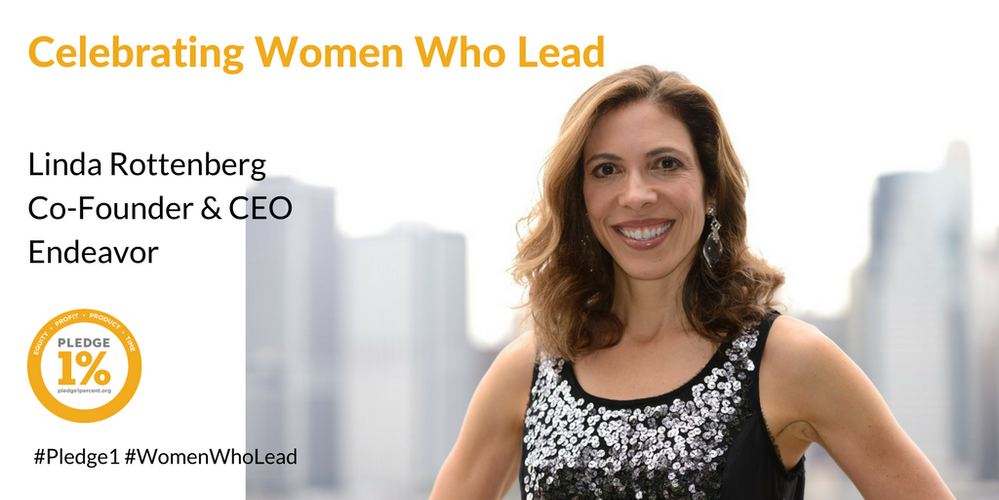
This profile is published as part of Pledge 1%’s Women Who Lead series, which celebrates women in the Pledge 1% community who are creating change within their workplace and communities.
Named one of “America’s Best Leaders” by U.S. News and one of TIME’s 100 “Innovators for the 21st century,” Linda Rottenberg is among the foremost experts on entrepreneurship, corporate innovation, and leadership. Dubbed the “Entrepreneur Whisperer,” Rottenberg has won acclaim for her pioneering work, with profiles in the Wall Street Journal, Forbes, The Economist, and appearances on GMA, The Today Show, Morning Joe, and more. For years, Rottenberg was known as “La Chica Loca” (the crazy girl) for insisting that scalable entrepreneurs existed in emerging and growth markets.
As co-founder and CEO of Endeavor, Rottenberg has led the global entrepreneurship movement for two decades. Headquartered in New York, with 50 offices worldwide, Endeavor rigorously selects, mentors, and co-invests in innovators with the greatest potential to grow their businesses and move the needle of their economies. Currently, the 1,500 Endeavor Entrepreneurs, screened from over 50,000 candidates, provide nearly 700,000 jobs and generate $10 billion in annual revenues. Today, Rottenberg also leads Endeavor Catalyst LP Funds I and II, rules-based funds that invest in Endeavor Entrepreneurs.
Rottenberg is the author of the New York Times bestseller, CRAZY IS A COMPLIMENT: The Power of Zigging When Everyone Else Zags. Additionally, Rottenberg serves on the boards of ZAYO (NYSE: ZAYO), the world’s leading bandwidth infrastructure group, and Olo, a premier online ordering platform. She is a member of Young Presidents Organization (YPO) and served on the entrepreneurship steering committee of the World Economic Forum.
A graduate of Harvard University and Yale Law School, Linda Rottenberg lives in Brooklyn with her husband, author and New York Times columnist Bruce Feiler, and their identical twin daughters.
Read the full interview below to learn more.
What inspired you to work in this industry?
The idea for Endeavor was born—of all places—in the back of a Buenos Aires taxicab! My driver, I learned, had a PhD in Engineering, but could not find any other job. When I suggested that he become an entrepreneur, he looked at me dumbfounded—“A what?” he had never heard of the term, so foreign was the concept there of someone successfully launching and running a new venture, outside the purview of government cronies and private business tycoons. I did some digging and found that there was a pervasive donut hole in investment for entrepreneurs that neither qualified for microfinance nor private equity funding.
I connected with an old friend, Peter Kellner, and at my parents’ kitchen table we started mapping out our vision for an organization that would help for-profit entrepreneurs in emerging markets get started and go to scale. Twenty years later, that hazy vision is now a global network of over 1,400 entrepreneurs leading 900 companies that have collectively created half a million jobs and generated $8 billion in annual revenues.
Is your company a Pledge 1% member or do you personally give back to your community? If so, how do you give and to what cause?
Endeavor is thrilled to be part of Pledge 1%’s Escrow UP initiative, alongside other great organizations working on entrepreneurship. Likewise, “paying it forward” is truly at the heart of Endeavor’s mission, and many of our entrepreneurs become Endeavor mentors or board members, multiplying their impact by inspiring future generations of founders within their local ecosystems and around the world to innovate and take risks.
Do you serve as a mentor? What does mentorship mean to you?
Yes. Running an organization “of, for, and by entrepreneurs,” I can’t presume to support and mentor high-impact companies if I’m not one myself! As such, at Endeavor we’re hyper-conscious to practice what we preach on thinking big, taking risks, doing the unexpected and disrupting the status quo. The idea behind Endeavor was always to nurture people with big ideas and big dreams, starting with my own team.
I want people to know that they don’t need a hoodie or a Silicon Valley zip code or a rolodex of impressive contacts to be an entrepreneur. The most important thing entrepreneurs can do for their businesses is to surround themselves with a circle of mentors who can offer a rotating mixture of tough love, wise counsel, fresh insight and clear direction. In a survey we conducted, our entrepreneurs overwhelmingly found that the most valuable contribution to their success was not financial investment but rather mentor capital. As one put it, “There’s lots of money out there, and it’s all worth the same. But there’s not a lot of good advice.”
What’s the best piece of advice you’ve received to help you with your career?
The best piece of advice I ever received came from a 5 year old – my daughter! With sage wisdom, she pulled me aside just as I was leaving for a business trip to caution, “Remember, you can be an entrepreneur for a short time, but you’re a mommy forever.” Since that day, the business trips have lessened and thankfully so have the schoolings from my children!
What’s the one piece of advice you would give to yourself 5 years ago?
“Go big AND go home!” For years, I, like many others, had adopted the mantra “Go big OR go home,” a rallying cry I delivered to myself, to our entrepreneurs and to our staff. If we were to keep growing we had to keep pushing.
In 2004, I was pregnant with identical twin daughters but I was determined not to let this slow me down. I kept up my demanding work travel schedule, setting off for Mexico, Chile and South Africa, until my doctor had to impose a mandatory no-fly zone and three months of bedrest. It worked—the girls arrived, healthy and happy, at 38 weeks—and I walked away with a valuable lesson: to go forward, sometimes you have to take a step back; to go big, you have to go home.

Originally published on FinExtra.
Today The Upside Foundation, a national charity that makes it easy for early-stage or high-growth Canadian companies to give back in a meaningful way, announced the launch of their campaign, 150×150: Turn Equity Into Charity.
The campaign aims to grow the number of companies who have pledged to give back to 150, as we celebrate Canada’s 150th birthday. Canadian startups who make the pledge will donate a small portion of their equity to The Upside Foundation (typically in the form of stock options), which are converted to cash upon a liquidity event and donated to the charity of the company’s choosing. The Upside Foundation is also announcing several prominent Canadian startups who have taken the Upside pledge, including Wattpad, the Toronto-based entertainment company for original stories, as the first company to kick-off the 150×150 challenge.
“The Upside Foundation provides an easy solution for both early-stage startups and high-growth companies who want to give back but don’t necessarily have the time or money,” said Rob Antoniades, Board Chair and Co-founder of The Upside Foundation. “Through this national campaign, we hope to empower 150 Canadian startups to take the pledge to donate a portion of their equity and help build a stronger future for Canada.”
The Upside Foundation is partnered with Pledge 1%, a global movement founded by the Salesforce Foundation and others to inspire companies around the world about the benefits of early stage corporate philanthropy. Through Pledge 1%, over 1800 companies have donated one per cent of their equity, people or product to charity. In Canada, over 75 companies have already taken the Upside pledge, including Hubba, which raised Series B in funding in December 2016. New members include Wattpad, Wealthsimple, and Overbond, with additional members to be announced leading up to Canada’s 150th birthday.
“At Wattpad, we believe startups aren’t just about profits, they’re about giving back to communities, at home and abroad. We’ve already made a remarkable impact on millions of people’s lives around the world. Today, we pledge to join the 150×150 campaign to demonstrate our continued commitment to positive social impact,” said Allen Lau, Wattpad co-founder and CEO. “Whether you’re in the early stages or a well-established start-up nearing exit, it always makes sense to support charities that serve your users and mean something to your team. If you haven’t already joined the Upside Foundation, what are you waiting for? Join the 150×150 campaign today!”
Any Canadian startup or private high-growth company can take the Upside pledge by committing stock options or warrants that will be converted to cash at the time of an exit or IPO, and donated to a registered Canadian charity.
“I’ve always believed in giving back to the community,” said Vuk Magdelinic, CEO of Overbond. “I’m proud that we have now found a way to make Overbond’s success mean that charities in the community will win alongside us.”
To date, there have been two exits from the Upside network, including BlueCat Networks, which sold for $400 million in February 2017; BlueCat CEO, Michael Harris donated the proceeds from a portion of his stock options to the Enbridge® Ride to Conquer Cancer® benefiting the Princess Margaret Cancer Centre. The first company to exit was Understoodit, who was acquired by EventMobi in 2013 and donated their equity proceeds to the East York Learning Experience and Mentoring Junior Kids Organization. The Upside Foundation is led by a coast to coast Board of Directors and Advisory Board of industry leaders and partners with leading incubators, accelerators and investors – creating a supportive community for members to be a part of.
“People work at startups because they want to effect change, and the Upside Foundation enables startup employees to have a meaningful impact on their community,” said Mike Katchen, founder and CEO of Wealthsimple. “Our team is proud to join the 150×150 challenge.”
How Companies Can Take the Pledge
The Upside Foundation encourages Canadian companies to join those who have already taken the pledge.
1. Companies will need to fill out the online pledge form found on The Upside Foundation’s website and a representative will be in touch.
2. Once the pledge form is received, companies will receive detailed instructions on how to contribute from an ESOP (employee stock ownership plan) or a simple legal form, with flexibility depending on the stage of the company.

Originally published on the Upside Foundation blog.
From the Upside Foundation Team:
Today we are excited to announce the launch of 150×150: Turn Equity Into Charity, our campaign to double our membership to 150 companies as we celebrate Canada’s 150th Birthday. We are also announcing several prominent Canadian startups who have taken the Upside pledge, including Wattpad, Wealthsimple and Overbond, as well as our second exit resulting in funds going to charity.
“The Upside Foundation provides an easy solution for both early-stage startups and high-growth companies who want to give back but don’t necessarily have the time or money,” said Rob Antoniades, Board Chair and Co-founder of The Upside Foundation. “Through this national campaign, we hope to empower 150 Canadian startups to take the pledge to donate a portion of their equity and help build a stronger future for Canada.”
Wattpad, the Toronto-based entertainment company for original stories, is the first company to kick off the 150×150 challenge.
“At Wattpad, we believe startups aren’t just about profits, they’re about giving back to communities, at home and abroad. We’ve already made a remarkable impact on millions of people’s lives around the world. Today, we pledge to join the 150×150 campaign to demonstrate our continued commitment to positive social impact,” said Allen Lau, Wattpad co-founder and CEO. “Whether you’re in the early stages or a well-established start-up nearing exit, it always makes sense to support charities that serve your users and mean something to your team. If you haven’t already joined the Upside Foundation, what are you waiting for? Join the 150×150 campaign today!”
Over 75 companies have already pledged to give back with the Upside Foundation. Recently, we had our second exit when BlueCat was acquired for $400 million. BlueCat CEO, Michael Harris, had previously pledged to donate proceeds from a portion of his own stock options to the Upside Foundation. The funds have been distributed to the Enbridge® Ride to Conquer Cancer® benefiting the Princess Margaret Cancer Centre, a 200-kilometre cycling trip which Michael is participating in- read more here.
We’re looking forward to working with our members, partners and supporters to grow the number of companies who have committed to giving back to communities in Canada to 150. Stay tuned for campaign updates over the coming months, including new members, events, and opportunities to join the movement.
Vuk Magdelinic, co-founder and CEO of Overbond, a primary bond issuance platform, said, “I’ve always believed in giving back to the community, and I’m proud that we have now found a way to make Overbond’s success mean that charities in the community will win alongside us.”
Any Canadian startup or private high-growth company can take the Upside pledge by committing stock options or warrants that will be converted to cash at the time of an exit or IPO, and donated to a registered Canadian charity.
“People work at startups because they want to effect change, and the Upside Foundation enables startup employees to have a meaningful impact on their community,” said Mike Katchen, founder and CEO of Wealthsimple. “Our team is proud to join the 150×150 challenge.”
How Companies Can Join the 150×150 Challenge
The Upside Foundation encourages Canadian companies to join those who have already taken the pledge.
- Companies fill out the online pledge form and a representative will be in touch.
- Once the pledge form is received, companies will receive detailed instructions on how to contribute from an ESOP (employee stock ownership plan) or a simple legal form, with flexibility depending on the stage of the company.
Others looking to get involved with the Upside Foundation and our 150×150 campaign are invited to check out www.upsidefoundation.ca/150×150/ or reach out at info@upsidefoundation.ca to connect with us.
ABOUT WATTPAD
Wattpad, the global multiplatform entertainment company for original stories, transforms how the world discovers, creates, and engages with stories. Since 2006, it has offered a completely social experience where people everywhere can participate and collaborate on content through comments, messages, and multimedia. Today, Wattpad connects a community of over 45 million people around the world through serialized stories about the things they love. As home to millions of fresh voices and fans who share culturally relevant stories based on local trends and current events, Wattpad has unique pop culture insights in virtually every market around the world. Wattpad Studios co-produces stories for film, television, digital, and print, to radically transform the way the entertainment industry sources and produces content. Wattpad Brand Solutions offers new and integrated ways for brands to build deep engagement with consumers. The company is proudly based in Toronto, Canada.
ABOUT WEALTHSIMPLE
Wealthsimple is a new kind of financial advisor — one that’s intuitive, affordable, and human. They provide world-class, long-term investment management without the high fees and account minimums associated with traditional investment managers. They invest your money in a globally diversified portfolio of low-cost index funds modeled after the same Nobel Prize-winning research used by the world’s savviest investors.
ABOUT OVERBOND
Overbond is transforming how global investment banks, institutional investors, corporations and governments connect and access the primary fixed income market. Overbond’s fully-digital platform for primary bond issuance eliminates inefficiencies, provides higher transparency, optimal price discovery, and investor diversification for all counterparties in the primary bond market.
ABOUT THE UPSIDE FOUNDATION
The Upside Foundation of Canada is a registered charity. The Foundation provides an innovative corporate philanthropy platform to help Canadian startups and high-growth companies “Share the Upside”. Since startups’ cash is scarce, as is time, the Foundation makes charitable giving quick, easy and cash-free.
The model is powerful: Earlier-stage and high growth private companies pledge stock options or warrants to the Upside Foundation. When the company has a liquidity event (e.g., IPO, acquisition), the Foundation monetizes the options and donates the proceeds to registered Canadian charities selected by the donors (and approved by the Foundation).

Originally published by Julia Frers-Karno, March 28, 2017 on the Yoobi for Business blog.
School Supply drives are growing more and more popular each year, they are such an incredible way to support kids who would otherwise start their school year off without the supplies they need to succeed. However, while most school supply drives are well-intentioned, they often have shortcomings – leaving it up to the donor to go out and purchase random items, which often results in oversupply of some things while failing to provide other critical items.
This year, Pledge 1% member Yoobi wants to eliminate the challenge of putting on a backpack drive with our a turn-key program that not only makes it simple to donate, but ensures all kids get the supplies they need.
INTRODUCING THE ALL NEW YOOBI BACKPACK DRIVE BUNDLE
With the purchase of this essential bundle, you can now easily donate all the supplies kids need for school. The best part is, through Yoobi’s One for You. One for Me. program, Yoobi will donate an additional school supply item for every item purchased, effectively DOUBLING THE IMPACT of any school supply drive. Pretty cool, huh?
WHAT GOES INSIDE?
Yoobi has built out this incredible backpack bundle with awesome essentials that will help kids start their year out right! Each backpack bundle contains the following items:

*Actual items in the Backpack Drive Bundle may vary from what’s pictured based on availability.
- BACKPACK
- 1” BINDER
- 8 TAB DIVIDERS
- POCKET FOLDER
- 2 PENCILS, 6 PACK
- COLORED PENCILS, 10 PACK
- HIGHLIGHTER
- GLUE STICK, 3 PACK
- PENCIL SHARPENER
- 12 “RULER
- ERASER, 2 PACK
- THIN WASHABLE MARKERS, 5 PACK
- PENCIL CASE
HANDS ON APPROACH:
One of the best parts of Yoobi’s Backpack Program, is that your employees can be involved. For example, they’ll ship all the supplies to your office, and your employees can work together to stuff each of the backpacks with the school supplies. Once you’re done with the packing party, have your employees join when you go to a school or organization to make the actual donation. There’s nothing like being hands-on when it comes to giving experiences. For some ideas, watch how we give here!
To learn more about Yoobi’s backpack program, please visit:
https://www.yoobiforbusiness.com/pages/backpack-drives or connect directly with our Yoobi reps at business@yoobi.com
Make today a good day to give.

This profile is published as part of Pledge 1%’s Women Who Lead series, which celebrates women in the Pledge 1% community who are creating change within their workplace and communities.
The Upside Foundation of Canada enables Canadian startups to give back by donating equity to charities. Members of the Upside Foundation form a community of entrepreneurs across Canada, with opportunities for connection and collaboration with like-minded peers, investors and influencers.
The Upside Foundation is led by three co-founders, Janie Goldstein, Mark Skapinker, and Rob Antoniades, and one staff member, Jennifer Couldrey. Janie and Jen comprise the management duo for the organization.
Janie Goldstein is the Executive Director and has been working pro-bono for the Foundation since its inception. Janie leads the organization’s strategic direction and partnerships. Both Janie and Jen built their careers working for boutique consulting firms which were later acquired by Deloitte (different ones!). Janie’s background also includes technical marketing, Venture Capital, and independent business strategy consulting. Janie has spent considerable time working on philanthropic endeavours, including as current Chair of the Governance Committee of the Board of Directors of Bialik Hebrew Day School. She is the mother of three children in grades 6, 8 and 9, and proud that they are already committed to charitable giving. “I have lofty goals for Upside. I think we can get a high percentage of our startups pledging options and it could become the way we do business in Canada,” she said. “Ideally, philanthropy will become one of the many things that define Canadians and how we work. We’re making it easy for startups to share a small percentage of their upsides. Canada needs this.”
Jen Couldrey is the Foundation Manager of the Upside Foundation, and has been running the Foundation on a day-to-day basis since May 2016. As Foundation Manager she leads business development, member engagement, partnership management, and marketing & communications. Jen has focused her career on the intersection of business and social impact, having worked in Corporate Social Responsibility consulting, as well as with a Kenyan microenterprise focused on women’s economic empowerment and community health. “I have always believed in using business and entrepreneurship as tools to solve the world’s greatest challenges. It’s exciting to live in a world that is advancing so quickly and to be surrounded by the startups leading us into that future, but there are also consequences to innovation. I believe we have a responsibility to funnel some of that new wealth creation back into the community to ensure no one is left behind in the 21st century economy. I love that I have the opportunity to help this community make a huge positive impact for Canada.”
The Upside Foundation is the Canadian partner for the Pledge 1% movement, and is pleased to work closely with the dynamic team on this fast growing global movement.