By Anais Stickland. Originally published in the Chronicle of Philanthropy.
Pledge 1%
Amy Lesnick, founder and managing partner at Crowdkick Strategies, a consultancy, and former head of social innovation at the international crowdfunding website Indiegogo, was named chief executive of Pledge 1%, which encourages businesses and individuals to pledge 1 percent of equity, product, or employee time to their communities.
The effort has also joined Tides as a special strategic program to expand its global reach. Pledge 1% was created in 2014 by software companies Atlassian and Rally, the nonprofit Salesforce.org, and the Entrepreneurs Foundation of Colorado, part of the Community Foundation Serving Boulder County. Since its launch, Pledge 1% has enlisted more than 700 companies to its cause.
Change.org Foundation
Sara El-Amine, executive director of Organizing for Action, was appointed founding executive director.
Choral Arts Society of Washington
Tad Czyzewski, business and development director for Washington Revels, has been named executive director.
Jonas Family Fund
Darlene Curley, executive director of the Jonas Center for Nursing and Veterans Healthcare, was appointed to an additional position, chief executive.
New Profit
Marco Davis, former deputy director of the White House Initiative on Educational Excellence for Hispanics, was named partner.
Pro Bono Institute
Eve Runyon, project director of Corporate Pro Bono, will become chief executive.
Sempervirens Fund
Sara Barth, deputy vice president for conservation at the Wilderness Society, will be executive director.
Trust for the National Mall
Catherine Townsend, an independent consultant and former executive director of the DC Public Education Fund, was appointed president.
Upstart Co-Lab
Laura Callanan, an independent consultant and former senior deputy chairman of the National Endowment for the Arts, will lead Upstart Co-Lab, a collaboration that connects artists, impact investors, and social entrepreneurs.
Other notable changes:
Sue Davies, associate vice president for development at Montclair State University, will be senior vice president and chief development officer for the United Way of New York City.
Loren Harris, director of the W.K. Kellogg Foundation in Battle Creek, Mich., will be vice president for programs at the Nathan Cummings Foundation.
Departures:
Neal Cuthbert, vice president for program at the McKnight Foundation, has retired after more than 25 years of service.
Jed Bernstein, president of Lincoln Center for the Performing Arts, abruptly resigned.
Send an email to people@philanthropy.com.
San Francisco, April 12, 2016—Pledge 1%, a corporate philanthropy movement dedicated to making the community a key stakeholder in every business, today announced that Amy Lesnick has joined the organization as its first chief executive and president. Pledge 1% also announced today that it has joined Tides as a special strategic initiative to expand its global reach.
Pledge 1% was launched in 2014 by leaders in corporate philanthropy from Atlassian, Rally, Salesforce, and the Entrepreneurs Foundation of Colorado, a program of The Community Foundation. Since its launch, more than 700 companies in more than 20 countries—including Glassdoor, NewVoiceMedia, PopSugar, Twilio, and Yelp—have joined the Pledge 1% movement and committed to making the community a key stakeholder in their businesses. With the addition of Amy Lesnick and by joining Tides as a special strategic initiative, Pledge 1% enters its next phase of growth as it scales to reach more companies around the globe.
Lesnick is a technology industry veteran and a recognized leader in social innovation. Prior to joining Pledge 1%, Lesnick spent two years leading cause-related world-wide growth at Indiegogo. Before Indiegogo, Lesnick served as CEO of Full Circle Fund for six years. Lesnick co-founded and instructed the Strategic Philanthropy course at Berkeley’s Haas School of Business, regularly advises foundations on the integration of technology and social change and serves as a mentor at Stanford’s StartX Accelerator. She has been named to the San Francisco Business Times Most Influential Women in Bay Area Business List.
Comments on the news:
- “I’m incredibly excited to lead the Pledge 1% team,” said Amy Lesnick, chief executive and president, Pledge 1%. “Together, we can change the status quo—ensuring philanthropy is baked into the DNA of every company from the beginning and giving back is endorsed and encouraged by successful entrepreneurs, industry leaders and investors alike.”
- “CEOs and entrepreneurs are realizing that to build a great company, you need to include giving back at the core,” said Suzanne DiBianca, EVP and chief philanthropy officer, Salesforce. “We’re thrilled to have Amy Lesnick at the helm of Pledge 1% during a critical moment for corporate philanthropy.”
- “Pledge 1% can change the face of corporate philanthropy and shape the culture of companies that take the pledge,” said Scott Farquhar, co-founder and co-CEO of Atlassian. “Everyone benefits when a company builds giving back into its DNA. It’s one of the best decisions we ever made.”
- “Pledge 1% is a movement full of immense possibilities that will be unleashed with new leadership,” said Ryan Martens, co-founder and CEO, EFCO, and co-founder and CTO, Rally, now part of CA Technologies. “Amy is a strategic, inspirational and experienced leader who can build on our early momentum and help us to transform Pledge 1% participants into engaged ambassadors.”
- “At Tides, we know impact doesn’t happen when we act alone,” said Kriss Deiglmeier, CEO of Tides. “Pledge 1% is an example of the kind of cross-sector work that is critical if we want to achieve social change goals.”
Pledge 1% is also joining Tides, a San Francisco-based foundation and social enterprise committed to accelerating social change, as a special strategic initiative. Pledge 1% will be leveraging Tides’ broad domestic and international reach, corporate philanthropy expertise, and experience in scaling social ventures as it continues to grow.
About Pledge 1% Pledge 1% is a movement spearheaded by Atlassian, Salesforce.org and Tides to accelerate the integration of philanthropy into businesses around the world. Pledge 1% encourages and challenges individuals and companies to pledge 1% of equity, product and employee time for their communities, because pledging a small portion of future success can have a huge impact on tomorrow. Pledge 1% offers companies turnkey tools and best practices, making it accessible for any company to incorporate philanthropy into their business model. To learn more or to take the pledge, please visit www.pledge1percent.org.
By Shana Franti. Originally published on the Salesforce blog.
Pledge 1% is a corporate philanthropy movement spearheaded by Salesforce.org, Atlassian, and Rally for Impact and Tides dedicated to making the world a better place. It encourages and challenges individuals and companies to pledge 1% of time, equity, product or profit to improve their communities — because pledging a small portion of future success today can have a huge impact tomorrow.
Today, as we kick off Salesforce World Tour Melbourne, we’re thrilled to celebrate the incredible Pledge 1% members in Australia and New Zealand. We’ve had an unbelievable year — since our local launch last year, 80 Australian and New Zealand companies have taken the pledge.
And we’re just getting started
Here are just a few of the local companies that are leading the way and making the community a key stakeholder in their business:
· Ansarada has pledged 1% of equity, 1% of time and 1% of product.
· Arxxus has pledged 1% of time.
· Blackbird Ventures has pledged 1% of profit and 1% of time.
· BrickX has pledged 1% of equity, 1% of time and 1% of product.
· Campaign Monitor has pledged 1% of time.
· Culture Amp has pledged 1% of equity, 1% of time and 1% of product.
· eWay has pledged 1% of equity, 1% of time and 1% of product.
· Goodcompany has pledged 1% of time and 1% of product.
· Hit 100 has pledged 1% of equity, 1% of time and 1% of product.
· Hoist has pledged 1% of time and 1% of profit.
· Industrie IT has pledged 1% of equity, 1% of time and 1% of product.
· Ivy College has pledged 1% of equity, 1% of time and 1% of product.
· Pozible has pledged 1% of equity and 1% of time.
· Premonition has pledged 1% of time and 1% of product.
· Propeller Aerobotics has pledged 1% of equity, 1% of time, 1% of product and 1% of profit.
· Safety Culture has pledged 1% of equity and 1% of product.
· Wilson Asset Management Group has pledged 1% of profit and 1% of time.
“The business of business is not business. The business of business is improving the state of the world. “ – Marc Benioff
Did you know that companies that integrate corporate citizenship into their businesses have 2.3 times the employee retention and an increase of 29 per cent in new hire commitment than companies that do not? Employees want to work with an organisation that matches their social values and gives back. This is of particular importance to Millennials with Deloitte finding six out of 10 Millennial employees say that a “sense of purpose” is part of the reason that they chose to work for their current employers.
Will you pledge 1%?
It’s easy to get started. The Pledge 1% website details how companies can pledge 1% of their employee’s time, equity, product or profit. By providing a turnkey solution featuring tools, best practices and relevant information, the website is intended to make it easy for any company or person to incorporate philanthropy into their business model from the beginning.
Thinking about building giving back into your company culture? Join the movement today at www.pledge1percent.org.
By Melanie May. Originally published on UK Fundraising.
A corporate philanthropy movement which assists companies in donating 1% of their product, equity, profit, or employee time to help communities around the world, launched in the UK this month.
Pledge 1% is spearheaded by Atlassian, Entrepreneurs Foundation of Colorado, Rally for Impact, Salesforce.org and Tides and aims to help organisations integrate philanthropy into their businesses. It launched in the US in 2014.
More than 25 UK companies have signed up so far, including NewVoiceMedia, Quibit, and GoSquared. Pledge 1% hopes to secure 50 new UK pledges and 1,000 new pledges globally in 2016.
Charlotte Finn, vice president EMEA, Salesforce.org said:
“Pledge 1% is a great example of the power that business has to effect positive change.”
Companies can find out more about how Pledge 1% works, as well as take the pledge online at http://www.pledge1percent.org/.
Originally published on City Philanthropy.
The American movement for businesses to Pledge 1% of their equity, product and employee time for community benefit has arrived in the UK. Building a movement of corporate philanthropy the Pledge 1% campaign is dedicated to making the community a key stakeholder in every business and integrating philanthropy into business globally.
Twenty-five companies have joined the UK Pledge 1% including, Salesforce, Sage Group Plc and NewVoiceMedia. The consortium of organisations behind Pledge 1% wants to see philanthropic leadership and a culture of giving throughout business. They believe the Pledge 1% model is flexible enough to suit every business. The companies who have Pledged 1% are attracting and retaining top talent – especially among millennial employees – highly successfully. Their research shows corporate citizenship is a powerful recruitment and retention tool; Pledge 1% companies have 2.3 times the employee retention rate and an increase of 29% in new hire commitment compared to those who are not. They also highlight how this delivers a business competitive edge. A giving culture is also a great attracter for millennials: according to Deloitte’s 2015 Millennial Survey, six out of 10 millennial employees say that a “sense of purpose” is part of the reason that they chose to work for their current employers.
If you want to join the Pledge 1% in the UK find out more here: www.pledge1percent.org
By Miguel Milano, President of Salesforce in EMEA. Originally published on The Huffington Post.
The over-arching theme of the World Economic Forum (WEF) meeting at Davos this year was the Fourth Industrial Revolution. According to Professor Klaus Schwab – founder and Chief Executive of the WEF – we’re on the cusp of this revolution, where technology will have enormous ramifications not just on the economy, but on all aspects of our lives.
This idea has really resonated – since then, through all the news about oil prices, tech shares and financial uncertainties, it’s continued to gain traction among business and political figures as well as economists.
And the idea of this impending revolution is gaining traction because Schwab is absolutely correct.
If you think about it, innovations like cloud computing, social media, mobile tech, data science and the Internet of Things are already transforming virtually every aspect of life: from entertainment and shopping, to transport, agriculture, banking, and healthcare through to human interaction itself. We’re also seeing breakthroughs in areas like artificial intelligence, quantum computing, robotics and genetics, but their impact – which is predicted to be massive – is yet to be fully felt. We truly are riding the crest of a wave of digital transformation.
With all this change come challenges too. Remarkable innovation doesn’t just create huge economic opportunity, it can also turn lives upside down and create enormous inequality. For example, it is likely that machine intelligence and robotics will replace some jobs that exist today. And those who are already digitally marginalised could easily become even more so. The elderly, for example, are set to benefit the most from digital healthcare, but as it stands in the UK, they have the lowest chance of being able to access it.
We have long talked about the issue of the digital divide here in the UK. As the Fourth Industrial Revolution takes hold, for me, the key to its success is ensuring that it reduces, rather than exacerbates this divide, and that all of us are swept up in positive change.
And it’s the tech industry, which has so much to gain from this Fourth Industrial Revolution, that has a pivotal part to play in ensuring its benefits are felt across society.
Fortunately the wheels have been set in motion. One example of how the industry is stepping up is the Pledge 1% initiative that was recently launched in the UK. Twenty-eight UK entrepreneurs have joined 592 of their international peers in committing one percent of their equity, product, and employee time to their communities. A high percentage of these entrepreneurs are from tech companies. These individuals are not just donating money, they’re actually empowering communities with technology and their technology know-how.
In fact, countless NGOs are today benefitting from technology that they have been given – or that has been created or customized for them by volunteers.
The Polaris Project – dedicated to combating modern-day slavery – is a great example. Data aggregation is enabling Polaris to improve both the speed and the quality of its response to human trafficking situations. It does this by using the type of technology digital marketers do when they create a single view of their customer. Except in this instance, with a little customisation, it’s allowing case management, hotline and policy teams to track data together. The result? Faster response times to help those who are in desperate need of it.
Or take a look at Sanergy, where technology is enabling great change in poorer communities. The charity, focused on communities in Kenya, addresses three issues that are rife in slums the world over: sanitation, compromised female safety and high unemployment. Cloud-based technology empowers operators to weigh, record and sell waste as organic fertilizer or renewable energy (both of which are in huge demand in East Africa), to predict when toilets are going to need removing and when and where new projects should be launched.
I am continually amazed by the number of technology influencers that I meet – from academics and inventors, to business people and bloggers – who express an interest in applying their skills to ensure technology is indeed making the world a better place. And I sincerely hope they do get involved. I am convinced that when future generations look back on the Fourth Industrial Revolution, we will be judged not only on the ingenuity of the innovation, but how we worked to ensure it benefitted everyone in our communities.
Originally published on the Salesforce blog.
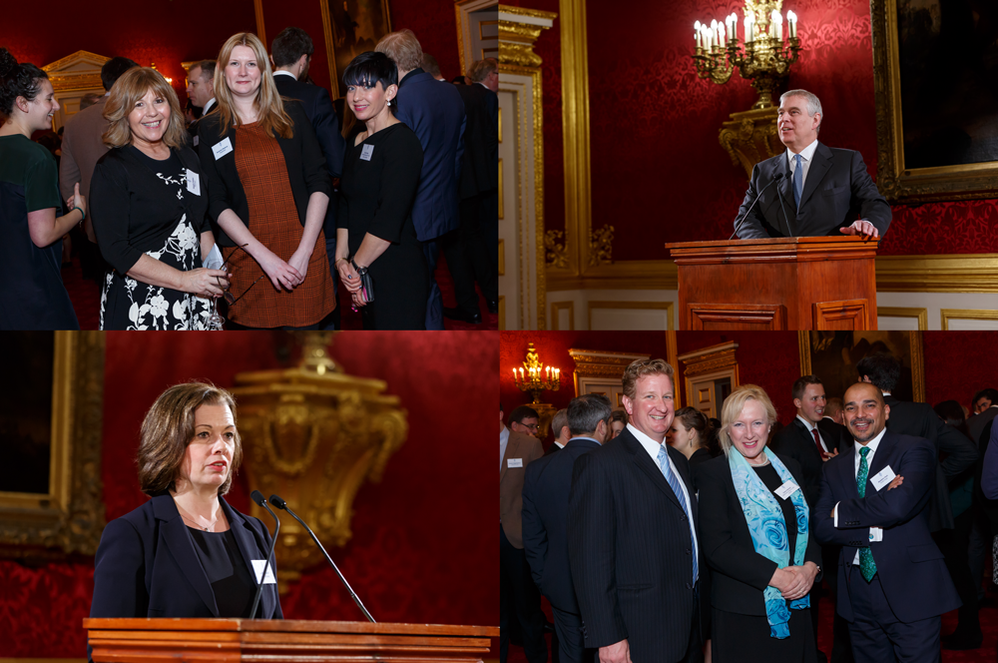
Yesterday, Pledge 1% launched in the UK. The event, hosted at St James’s Palace by The Duke of York welcomed 150+ professionals and businesses passionate about corporate philanthropy and keen to make giving-back a core part of their company culture. “By participating in Pledge 1%, you will be acting as an accelerant for a number of different people and a number of different streams of activity. The most significant one will be acting as an accelerant to your own entrepreneurial business,” said HRH The Duke of York.
We’re pleased to announce that more than 25 companies in the UK took the Pledge at launch, including NewVoiceMedia, Qubit, Sage Group Plc, Idio, CloudShift Group, GoSquared and Adaptavist.
Graham Cooke, co-founder and CEO, Qubit says: “We are delighted to be one of the first UK companies to support the Pledge 1% movement. Donating equity, time, and product fits with our goal of being a socially responsible company. We’re fully committed to fulfilling our pledge, and as we grow, giving back more and more to the local and global community we’re part of.”
608,100 new business started in the UK in 2015, an increase of 4.6% year-over-year. Salesforce.org recognizes the potential power for the growing number of UK companies to create a lasting impact in the world and looks forward to supporting them in doing this, through Pledge 1%.
“Salesforce.org is dedicated to changing the way companies think about corporate philanthropy,” said Charlotte Finn, vice president EMEA, Salesforce.org. “Pledge 1% is a great example of the power that business has to effect positive change.”
In its first year, Pledge 1% hopes to secure 50 new UK pledges and 1,000 new pledges globally in 2016.
What is Pledge 1%
Pledge 1% is an effort spearheaded by Atlassian, Entrepreneurs Foundation of Colorado, Rally for Impact, Salesforce.org and Tides to accelerate their shared vision around integrating philanthropy into businesses around the world. Pledge 1% is dedicated to making the community a key stakeholder in every business and provides the tools and best practices to empower companies to dedicate 1 percent of employee time, equity, product or profit to improve communities around the world — making it easy for companies of all sizes to incorporate philanthropy into their business models.
Why Pledge?
Companies and their employees today want to be civically minded and aligned with a social mission that prioritises having a positive impact on the world. In Salesforce’s case, when employees are asked why they chose Salesforce over the myriad opportunities in tech, they most often cite the company’s focus on giving back. Taking the 1% pledge helps companies and individuals demonstrate their philanthropic intent and hold themselves accountable for turning a pledge into action.
Thinking about building giving back into your company culture? Pledge 1% can help. Take the pledge today at www.pledge1percent.org.
By Marc Benioff. Originally published on The Huffington Post.
Every day I am reminded that we are living in the most exciting and transformative era in history. In my 35-plus years in the technology industry I’ve never experienced so much innovation, and at such an incredibly rapid pace. Tectonic changes sparked by cloud, social, mobile, data science and Internet of Things technologies are transforming every industry, from transportation and entertainment to shopping and financial services.
In addition, breakthroughs in artificial intelligence, quantum computing, robotics, clean energy, genetic engineering and other fields have the potential to profoundly reshape manufacturing, agriculture, medicine and more. Business leaders everywhere are trying to keep up with this immense wave of digital transformation.
It’s also a time when every business leader needs to consider how these digital technology breakthroughs are going to impact not just their companies, but their communities, the planet and society as a whole. These amazing innovations not only create phenomenal opportunities for economic growth, but also serious societal challenges as well. Vast numbers of jobs will be replaced by machine intelligence and robots. The increasing capabilities of artificial intelligence and genetic engineering have the potential to get beyond the control of their creators.
As a society, we are entering uncharted territory—a new world in which governments, business leaders, the scientific community and citizens need to work together to define the paths that direct these technologies at improving the human condition and minimizing the risks.
As Professor Klaus Schwab, founder and Executive Chairman of the World Economic Forum, states in his new book, The Fourth Industrial Revolution, “Unless public- and private-sector leaders assure citizens that they are executing credible strategies to improve people’s’ lives, social unrest, mass migration, and violent extremism could intensify, thus creating risks for countries at all stages of development.”
It’s my belief that businesses are the greatest platforms for change and can have an enormous impact on improving the state of the world. As business leaders we are in positions of influence, and responsible for more than just shareholders.
We are accountable for the well being of an extended community of employees, customers and partners, as well as our fellow beings on this planet we inhabit.
This belief was further solidified for me during a meeting last year in Geneva with Peter Maurer, president of the International Committee of the Red Cross (ICRC). We were discussing the tragic, unprecedented situation of one million migrants seeking refuge in Europe, and how he and the ICRC are dedicated to helping these displaced people. While he was talking, I noticed a picture on the wall of a man who I had never seen before. It was Swiss businessman Jean Henri Dunant, who I subsequently learned had the initial vision for the ICRC and was the first recipient of the Nobel Peace Prize.
Dunant’s vision for the Red Cross grew out his experience witnessing the aftermath of the Battle of Solferino in Italy during the summer of 1859. The French Army under Napoleon III and the Sardinian Army under Victor Emmanuel II had defeated the Austrian Army of Franz Joseph I. There were more than 20,000 warriors on the field dead, dying or wounded. Dunant applied his entrepreneurial and business skills to rally the local townspeople to get the wounded off the battlefield and into a stable situation. He also organized the funding for supplies and building temporary hospitals.
Following his return to Geneva, Dunant was inspired to create an organization dedicated to improving the quality of medical services on the battlefield, which led to the founding of the ICRC in 1863. Today, the ICRC continues its efforts to relieve suffering around the world, with more than 12,000 staff working in 80 countries around the world.
Dunant made a shift that I believe many business leaders want to make—applying his leadership, resources and relationships in a more humanitarian way. Only with compassion and generosity can we address the difficult challenges ahead, from the rising tide of inequality to global warming.
At my company, Salesforce, we baked philanthropy into our business model from day one, leveraging one percent of our technology, people, and resources to help nonprofits around the world achieve their missions. So far, we’ve provided more than $100 million in grants, our employees have logged more than 1.1 million volunteer hours and we’ve given products to more than 27,000 organizations. Following our example, more than 550 companies have signed up for Pledge 1%, committing one percent of their equity, product, and employee time to their communities.
As businesses we can be financially successful, and at the same time we can make the world a better place for everyone.
As business leaders, we can collaborate with our customers, employees, partners, communities, governments and institutions to create cultures of trust that put the wellbeing of our people and planet first. We can engage in corporate philanthropy with the same focus and dedication as other business investments. We can rethink our educational systems to train the workforce of tomorrow. We can work together to ensure that this technology revolution serves humanity to its fullest potential and benefits the all citizens, not just a chosen few.
Going forward, business leaders, not just government leaders, will be judged by whether they succeed in directing the wave of exponential technology innovation to making the world a better place. As another Nobel Peace Prize winner, Martin Luther King Jr. said, “Life’s most persistent and urgent question is: What are you doing for others?”
Marc Benioff is the Chairman and CEO of Salesforce
Originally posted: January 18, 2016