Originally published in the Independent Ireland.
Suzanne DiBianca is at the pointy end of making companies less evil. There’s a real push – particularly in the technology sector – to use the wealth created by companies for something better than just buying Ferraris.
She heads up the Salesforce Foundation and was one of the first employees at Marc Benioff’s massive software and cloud services company.
“We use the 1-1-1 model,” she tells me. This means that 1pc of the company’s people/time-equity-product are devoted to philanthropy and doing good. It’s also on a major drive to encourage young girls to view technology as a potential career.
The Salesforce Foundation gave away $20m in grants last year with another $30m coming this year. About 50pc goes to its staff to fund their own volunteering and schemes to help people, with the remainder split between education programmes and direct grants to groups such as Mary Moloney’s Coderdojo in Ireland which got $200,000 to promote technology to kids. Citywise is another Irish beneficiary. “We’re trying to create a revolution by democratising philanthropy,” New Jersey born DiBianca tells me.
One of the key thrusts and one of the dominant themes of the Dreamforce conference in San Francisco last week is about encouraging women in technology. “We’re focused on encouraging girls,” she says. “We have 50pc girls in all our projects. It’s not that we don’t love boys, it’s just that were trying to catch girls before they fall off.
“Preteen girls who don’t have exposure to tech, engineering or science tend to avoid those sectors as careers later in life. It’s a struggle to attract them. We’re trying to capture them. Minecraft has been great. I showed my daughter how it was built and she thought it was cool. Historically technology has been a boys club and we’re trying to change that. We’re building a pipeline,” she suggests.
The Salesforce foundation has 26,000 “customers” around the world with the majority of them – about 80pc – having budgets of under $1m. DiBianca says that it doesn’t just hand over money to these organisations. “We kind of wrap ourselves around them,” she suggests. This means that the skills and resources of a big company like Salesforce can be used to help.
Corporate philanthropy and the whole corporate and social responsibility seems to make sense for companies. “We call it a secondary or tertiary value. First and foremost it’s about talent. We get more rounded people because of this,” she tells me. One of the top sales guys in the company went off to build a school in Africa on his time off. “He could have just bought a Lamborghini,” she says. “We attract high performance people who want to make a difference.”
This is particularly noticeable in the executive and developer ranks of the company. Attracting high end talent is one of the key challenges in Silicon Valley and in the major tech centres of the world. Any company can pay buckets of money and shovel out stock options but increasingly people are looking for something with a little more soul. They want to give something back.
“In the Great Places to Work survey, we came third in the UK. One of the key things attracting people was the foundation and the ability to volunteer. We’re finding the same thing in Ireland,” she says.
Volunteering is a major thing for Salesforce staff. Last year the Irish Foundation alone chipped in 13,000 hours of employee time to help good causes. Last June they donated 1,500 hours over just one week, as part of their 15th birthday celebrations. Globally, Salesforce staff have given one million hours.
DiBianca is also arm twisting other big global firms to agree to give away 1pc of their equity to philanthropy. This has the potential to completely transform the giving and philanthropic sector and reduces the need for state intervention. There isn’t much of that in the US anyway, which is one reason why the foundation has just divvied up $14m to local Californian schools. “I’m also focussed on it from the equity side. I’m involved in a thing called Pledge 1pc. This year we’re trying to get 500 companies around the world. It’s not just a Salesforce thing.”
Ebay initially rolled out a scheme and DiBianca is trying to improve on the programme. “It’s much harder with late stage companies. You have to be creative. The late stage privates are hard because the equity pie is already carved out, so you have to be creative in how you do it. I think it’ll be a 10 year game,” she says. Companies like Google are committed with new additions coming through all the time such as Twilio and Docusign last week. There are now 400 big companies around the world who are committed to the scheme. “Workday, the cloud based HR company and Yelp, they did the equity set-aside before their IPOs and now they have $120m in their foundations. That’s pretty cool,” she says.
The first conversation with an Irish company about giving over 1pc has also just taken place. It’s unnamed. I mention Stripe and the Collison brothers. “Stripe. Yes, Stripe,” she says. “We’ll have to get them to do something.”

By David Swan. Published in the Australian.
Global cloud computing firm Salesforce may be a $US10 billion tech behemoth but its head of start-up relations Ludo Ulrich says his door is always open to Australian start-ups, as the company looks to tighten its relationship with entrepreneurs Down Under.
Mr Ulrich, who previously served as chief development officer at Startup Weekend, said Australian start-ups have “no excuse” when it comes to being world leaders.
“With the culture that you have, infused with the start-up accelators and incubators, there’s no reason why you can’t build a leader in Australia,” he said in an interview at Dreamforce, Salesforce’s annual conference in San Francisco.
“Atlassian is a great example. The ingredients are all there, and at Salesforce we want to have a contribution to that, and help contribute to the ecosystem.”
Mr Ulrich said when he visited Australia earlier this year to announce Salesforce’s partnership with local peak body StartupAUS, he found many of the country’s companies had the right level of maturity and ambition, and the “right vocabulary” to compete on the global stage.
“What they really need to do is think of the company they want to become, versus the company they are today,” he said.
“Australian companies need to truly have that global vision, and an Asian ambition. It sets you up well for challenges you’re going to have, and it means you choose technology and tools that can grow with you.
“You need to act like a 500 person company even if you only have five.”
Salesforce’s partnership with StartupAUS will see Australian start-ups gain access to Salesforce technology and local and global executives at the company’s events. Salesforce also said it would help develop Australia’s fledgling policy and regulatory environment for start-ups.
Mr Ulrich also said giving back was a non-negotiable for start-ups even in their extreme early stages, and that Atlassian had led the way with regards to a healthy company culture of philanthropy and corporate social responsibility.
“When I talk to founders, a lot of them say yeah I’m convinced, but I’m so busy,” he said. “I know how hard it is to create a company. So we try to remove the friction as much as possible, the same way we remove the friction to adopt some of our technologies.”
He said Salesforce’s Pledge 1% program, in which companies donate one per cent of their time, equity and product to make an impact on the community, was a “no brainier” no matter how small a company is.
“It’s not even a question,” Mr Ulrich said. “Giving back is core to what I do and it should be core to the start-up ecosystem around the world.”
He described Salesforce, which has run a “Startup Summit” mini-conference in conjunction with Dreamforce, as a “16 year-old start-up” largely due to its entrepreneurial spirit, innovative DNA, strong customer focus and its “extremely charismatic founder”, Marc Benioff.
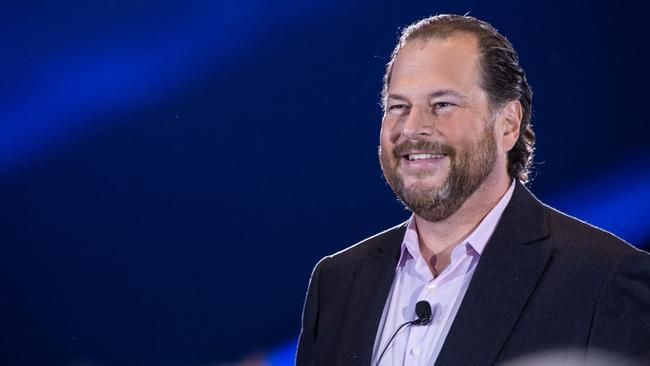
Salesforce founder Marc Benioff at Dreamforce 2015.
“It’s good to see all this energy all around the world,” Mr Ulrich said.
“You can see it and smell it here at Dreamforce.
“One thing that’s been proven is that it’s entrepreneurs that are fuelling most of the economy and job creation going on. And we’re well positioned to be the right partner, we want to be their unfair advantage.”
* David Swan travelled to San Francisco as a guest of Salesforce.
By Kye White. Originally published in StartUpSmart.
The Pledge 1% philanthropy program, created by Salesforce and supported by the likes of Atlassian, is well on the way of meeting the goal it set late last year of signing up 500 companies by December.
The program sees participating companies volunteer to divert 1% equity, 1% employee time or 1% of product to charitable causes. Companies can pledge all three if they wish. With about three months until its self-imposed deadline, more than 350 startups and companies have taken the pledge, and promised to donate at least 1% equity, time, or product.
Atlassian’s co-founder Scott Farquar says taking the pledge early on in Atlassian’s life is one of the best decisions he’s ever made. Salesforce Foundation VP of philanthropy and engagement Ebony Frelix says there’s no reason early-stage startups can’t take part, and given the scalability of the model, make a real impact.
“A startup with just two founders can say this year, we’re going to give 1% of our time. A couple of hours, it’s so doable. It might seem like it’s just 1%. But 1% is really a lot. And the thing is when companies do it from the beginning, as you grow you’ll continue to give back,” she says.
“No matter how big or small you are, it’s committing to do something in the communities where we live and work.”
Salesforce co-founder Marc Benioff has been vocal about philanthropy, saying it needs to be about more than just cash telling Bloomberg’s Emily Chang recently “money alone isn’t going to solve anybody’s problems”.
Thanks to the pledge 1% program, 25,000 not-for-profit organisations and higher education institutions using Salesforce’s products either for free or a discounted rate. Salesforce employees are also given six days of paid leave per year for volunteering.
To-date Salesforce employees have volunteered for a total of more than 1.1 million hours. Once an employee donates the full six days, they’re given a $1000 grant to give to a cause of their choice. Salesforce will also match donations from employees up to $5000 per year.
Not only does the pledge benefit the not-for-profits and community more broadly, Frelix says its win-win for the companies that take the pledge, making it easier for them to hire and retain employees while doing good.
“For example an organisation I donated to last year, not only did they get my time, but they also got a $1000 champion grant, I personally donated $5000 and the company matched that $5000. So that’s $11,000 to a not-for-profit,” she says.
“I don’t want to give up those benefits. I’m attached to the organisations I’ve donated to year-over-year, what happens if my $11,000 goes away? I think about that.
“It pays its own rewards, because you feel good, you want to do more, you want to show up to work because you have this amazing company that allows you to feel good about yourself.”
Frelix stresses the importance of donated time, particularly when it’s coming from startups.
“All that startup energy and mojo. There’s a certain, I don’t know what about startups. That energy, excitement and passion that they bring. Imagine matching that passion with volunteering.
“We try and wrap our arms around organisations. The power is in our people.”
If you’d like to take part, head over to www.pledge1percent.org.

By Ken Yeung. Originally published on VentureBeat.
Telecommunications API provider Twilio has committed itself to setting aside 1 percent of its equity to be used to support its nonprofit foundation, Twilio.org, over the next decade. This could generate more than $10 million for the organization.
The move comes as part of the 1% pledge that was started in 2014 by Atlassian, the Entrepreneurs Foundation of Colorado, Rally Software, and the Salesforce Foundation as a means to accelerate philanthropy within businesses around the world. But it’s not just a financial transaction. The pledge includes 1 percent of employees’ time and the company’s product as well — the 1/1/1 pledge that has been heavily touted by Salesforce chief executive Marc Benioff.
Twilio’s pledge has it joining a slew of technology companies, including Weebly, Box, DemandBase, DocuSign, Galvanize, General Assembly, Lookout, Oracle, Optimizely, TechStars, Udemy, Yelp, and dozens of others.
As mentioned earlier, Twilio’s investment will be going to Twilio.org, a foundation that the company established in 2013 to provide nonprofits with access to the company’s cloud telephony APIs. Programs that have benefited from Twilio.org include Code for America, the Polaris Project and Thorn, the American Red Cross, Doctors Without Borders, and many others.
“We founded Twilio.org to provide nonprofits with the best communication technology to solve social problems,” Twilio chief executive Jeff Lawson said in a statement. “Our objective is to enable them to send a billion messages for good. By joining Pledge 1%, we will substantially accelerate our investment in that goal. We can’t wait to see what our nonprofit partners will build.”
Today’s announcement is timed to come as Salesforce hosts its annual Dreamforce customer conference in San Francisco. Salesforce’s Benioff has certainly made it a point throughout this three-day event to promote philanthropy and giving back.
By David Callahan. Originally published on Inside Philanthropy.
If you’re attuned to either corporate philanthropy or the tech industry, you’ll know that the Bay Area tech firm, Salesforce, is unusually committed to doing good in the world along with making a profit.
Maybe you’ve heard of the “1+1+1” model of philanthropy that founder Marc Benioff embraced when he started Salesforce in 1999—namely, that the company would donate 1 percent of its earnings, 1 percent of its products, and 1 percent of employee time to charitable causes. Or maybe you know that Benioff himself has been a major leader lately in pushing the tech industry to do more philanthropy. Along with his wife, Lynne, he’s given over $200 million to local hospitals and has worked in the past year to rally tech leaders behind anti-poverty work.
That’s pretty much what I knew when I got on the phone recently with the president of the Salesforce Foundation, Suzanne DiBianca. What I learned from her, though, is that the company’s philanthropy’s goes further—and is more interesting—than the basic facts suggest.
Before getting into the details, let me make this general point: Corporate philanthropy has become really interesting lately. Sure, plenty of companies still just mail it in, with pedestrian giving programs and, even worse, giving that seems brazenly hypocritical—like, say, junk food companies donating to fight obesity. But the overall trend is toward more sophisticated corporate philanthropy at a larger scale, as well as grantmaking that prioritizes low-income communities. Recent data even suggests that corporate funders give more to such communities than private foundations.
To be sure, all this largesse is a drop in the bucket compared to the vast profits companies have reaped lately, in part by aggressive cost cutting that has driven down wages for many Americans workers. But the new corporate philanthropy does seem to indicate that more business leaders now see a need to tack in a socially responsible direction—back toward an earlier model of postwar capitalism whereby CEOs felt beholden to many stakeholders, not just to shareholders fixated on quarterly earnings.
Salesforce is a leader in this new era, one with significant influence, and it’s worth taking a close look at how it does its philanthropy—especially right now, given what’s cooking at the Salesforce Foundation. Here are a few things to know about this pioneering corporate funder.
Philanthropy Is “Baked In”
At most companies, philanthropy is an afterthought—you know, the thing a business does once it’s making big money. But at Salesforce, giving was “baked in” to the company from day one, says DiBianca, who’s been leading the Salesforce Foundation since it began.
Before Benioff created Salesforce, he had worked at Oracle for many years, and done well—well enough that, during the 1990s, he thought about leaving business and turning his attention to philanthropy. But in 1997, he got excited about the idea of combining his two greatest interests. Benioff has written: “There’s no reason why your business, your personal philanthropy and your corporate philanthropy can’t be integrated. On the contrary: If you can get all the wood behind one arrow, that’s how you’re going to increase your impact.”
With Salesforce, Benioff imagined a new kind of company resting on a three-legged stool. It would operate with a new technology model (cloud-based software), a new revenue model (subscriptions), and a new philanthropy model (1+1+1). The formula has proven to be a winner: Salesforce, which Forbes has repeatedly ranked as “the world’s most innovative company,” recently ascended to the ranks of Fortune 500 firms.
Now, in terms of its philanthropic goals, Salesforce is hardly unique in giving through several familiar channels—employee time, in-kind donations, and grants. But it’s been unusually ambitious in regard to each of the channels—and in maximizing the synergies between them.
Most notably, Benioff’s decision to set aside 1 percent of equity, pre-IPO, for philanthropy was an unusual move, and ensured dedicated resources for giving in the company’s early days. Salesforce went public in 2004, and that equity slice fueled its giving in subsequent years. (Now grants are funded out of general revenue.) One can argue whether 1 percent equity is the best formula for corporate giving, and how meaningful it is over the long term if a company gives that money away early on, as Salesforce did. But the symbolic value of a pre-IPO 1 percent commitment is huge—speaking volumes about the overall moral purpose of a company.
The way that Salesforce makes donations of its products is also unusual, and has been a boon to the nonprofits. Pretty much every sizeable nonprofit needs the kind of customer relationship management software that Salesforce makes, and the company has given free or deeply discounted products to over 25,000 nonprofits. Through its Power of Us program, the company offers 10 licenses of Salesforce for free to any eligible nonprofit organization, and sells additional licenses at an 80 percent discount. In turn, it takes the money earned from nonprofit sales and invests it “back into sector-specific product enhancements, new training, programs, and grants expansion,” as Benioff has described it. In other words, Salesforce’s model of product donations basically operates like an in-house social enterprise. Interesting, right?
As for employee volunteer time, Salesforce gives employees six paid days a year to dedicate to volunteering, and 80 percent of employees volunteer in some way—a rate three times that of most corporations. DiBianca says the company also provides matching grants for employee donations, as well as making $1,000 available for any employee to give to a nonprofit of their choice, once they’ve completed at least 40 hours of volunteering. She describes the company’s overall goal here as nurturing “citizen philanthropists,” and talks about how employees don’t just give during their time at Salesforce, but “take these values with them when they leave.”
Salesforce has 16,000 employees, and getting to know them can be a smart move for nonprofits. If you get a bunch of Salesforce people excited about your organization, they can direct significant funds your way. DiBianca cites the example of Playworks, a group that promotes recess and play for school kids. It’s a favorite of Salesforce employees and, as a result, has cumulatively received hundreds of thousands of dollars in support.
The Salesforce Foundation looks for opportunities to hook up its employees to causes that tap knowledge of technology and STEM subjects as part of a broader strategy of aligning Salesforce’s philanthropy with its expertise. That’s often meant providing tech training to youth in schools and at the company itself. Of course, the motive here is not only philanthropic. Like many tech leaders, Benioff has spoken with alarm about America’s weakness in training the STEM workers of tomorrow. And Salesforce is just one of many companies that gives attention to STEM education in its philanthropy.
A Big Bet on Local Schools
The Salesforce Foundation has long given grants to a wide range of organizations, but a few years ago it decided it wanted to double down on one overriding priority, and it chose improving San Francisco’s schools. After meeting with the mayor and superintendent of the San Francisco Unified School District (SFUSD), Salesforce settled on an even narrower focus: improving middle schools. “We decided this was a place to make a big bet,” DiBianca says.
What’s more, Salesforce decided to channel its support directly to SFUSD—a notable choice at a time that many funders take a dismissive view of public systems, and instead back charters and educational nonprofits. Indeed, it was precisely because so few funders help public systems that Salesforce saw an opportunity. “Nobody is doing it,” DiBianca says, calling the state of public education “abominable.”
Salesforce started with a $3.5 million gift to SFUSD in 2013. Then, in 2014, it gave $5 million. DiBianca says the foundation will probably give even more this year. Much of this grant support has gone to fund infrastructure and technology improvements, an area where the school district is particularly weak. But the foundation has also made $100,000 available to each middle school principal, through an innovation fund, to spend as they see fit. News of this fund was greeted with wonder by principals, and even tears in some cases. After years of budget cuts and tight restrictions on funding, nobody had ever given them a bunch of money to spend freely.
To DiBianca, though, the most exciting thing about Salesforce’s big bet on the schools is that so many employees are getting involved, through volunteering and mentoring. Salesforce has 5000 employees in San Francisco, who live all over the city, and DiBianca says they have adopted every middle school in the city, putting in time and energy to help students.
Lately, the Salesforce Foundation has been ramping up a new effort to train local youth for tech jobs. Salesforce was among the local employers that pushed successfully to get SFUSD to create a computer science curriculum, with the goal of ensuring that more kids acquire the kinds of skills that employers really need. Meanwhile, Salesforce has been a leader in efforts to connect more youth directly to local tech companies through mentoring and other opportunities. DiBianca says there are some 22,000 tech companies in San Francisco, yet most high school students have never set foot in a downtown office and gotten a first-hand glimpse of how this world works.
Salesforce isn’t the only tech company that’s doing more to expand the horizons and opportunities for local youth. Other companies have also been stepping up lately, such as LinkedIn, Zynga, and Google. DiBianca says that the rising debate over economic inequality in the Bay Area—and nationally—“has been a catalyst” for more philanthropic activism in the tech community, which has come under heavy fire for fueling income stratification in the region.
In turn, no leader in the tech world has worked harder to seize this moment than Marc Benioff, who led an urgent push last year to get tech companies to commit $10 million to the Tipping Point Community, a group that fights poverty in the Bay Area.
Building a Movement
The new generation of tech philanthropists has often been criticized as brash upstarts so intent on disrupting philanthropy that they’re ignoring a century of valuable lessons and insights. I’ve argued in the past, though, that these stereotypes aren’t fair given the diverse array of funders emerging from this world.
Maybe the most accurate way to think about tech philanthropy is that it often combines new and old approaches, and what Salesforce is doing is a case in point. Yes, the company has been innovative in its giving, and Benioff has talked explicitly about disrupting corporate philanthropy, but in many ways, Salesforce’s charitable role is very familiar. It conjures up an earlier era of corporate responsibility, in which companies saw the communities in which they operated as important stakeholders. That ethos came under siege starting in the 1980s, as a harsh new focus on the bottom line rose to dominance, but now is making a major comeback—thanks in part to a mountain of new research on the benefits of social responsibility, but also thanks to the rise of CEOs like Benioff that really care, at a personal level, about giving back. Benioff’s own giving, I should add, is quite traditional, with its primary focus on meeting local healthcare needs.
Salesforce is well aware of its leadership role, and it’s keen on sustaining that role. Most notably, in 2014, Benioff and Scott Faquhar, co-founder of Atlassian, teamed up to lead a push to get 500 companies to pledge to follow a 1+1+1 model of corporate philanthropy.
DiBianca says that the focus of the push is on pre-IPO companies, including those still in the start-up phase. The earlier this commitment gets baked into companies, she says, the more likely it is to really take root—and that’s especially true of the pledge to give 1 percent of equity, which is a big step for any start-up.
To push the 1 percent pledge effort, DiBianca has been working with venture capital firms, incubators, and others who are nurturing a new generation of entrepreneurs. The angel investor Ron Conway, who sits on the board of the Salesforce Foundation, recently appeared at an event in New York to promote the 1 percent pledge among startups in the city.
So far, over 300 companies have taken the pledge, and DiBianca is optimistic about getting to the goal of 500—and sparking a movement that helps remake corporate philanthropy. “This can be a game changer,” she says.
By Brad Feld. Originally published on FeldThoughts.
At Foundry Group, we have a deeply held belief that we benefit from our local community (Boulder, in our case) and that we have a responsibility, as we have success, to give back to our local community.
My partner Seth Levine just had an excellent OpEd in the Boulder Daily Camera explaining this. It’s titled Entrepreneurs can give back, by giving early to EFCO. In it he explains more about Entrepreneurs Foundation of Colorado (EFCO) and Pledge 1%, two organizations we have helped create.
Seth also describes our recent gift of $300,000, via EFCO, to Boulder-based non-profits, to fill a gap in funding from Foothills United Way that happened recently.
“The Community Foundation Serving Boulder County announced last week it will grant an additional $300,000 to local Boulder County nonprofits this summer in response to a 62 percent cut in funding from Foothills United Way. The grants will be funded by Foundry through our membership in the Entrepreneurs Foundation of Colorado (EFCO).”
While many people view Boulder as a wealthy town, we have our share of people struggling to make ends meet. In fact, as Seth highlights in his OpEd:
“We hope this money will impact the thousands of local families and individuals who struggle to make ends meet in what is viewed by many as a wealthy, prosperous community. In fact, Boulder County has higher poverty rates than Colorado as a whole, and more than 9,000 children in our community live below the poverty level (defined as just over $24,000 per year for a family of four.)”
Amy and I contribute personally to several of the non-profits that this funding will go to. But, with EFCO, many more people can help. This gift is from Foundry Group and involved all the people (11 of them) who work for Foundry Group, not just the four partners. And, when you go to the EFCO page and see the list of the other 70+ or so companies that are members, you start to get a sense as to the power of the startup community in giving back to the broader community.
To date, Boulder-based startups such as Rally Software, Gnip, Revolv, Mocavo, DocPopcorn, Techstars, and Filtrbox have joined Foundry Group in distributing more than $3.5 million to Colorado community nonprofits since 2007 at the point of exit — when companies are either acquired or go public.
If you are a founder of a company and subscribe to the #GiveFirst motto that is so central to the Boulder startup community, give me a shout if you want to get plugged into EFCO (if you are in Colorado) or Pledge 1% (if you are anywhere else in the world).
By Nicole Wallace. Originally published on Chronicle of Philanthropy.
Jim Fruchterman, who leads Benetech, a nonprofit in the heart of Silicon Valley that uses technology for social good, knows how to get tech donors to give.
They love it when he talks about a Benetech program called Bookshare and how he explains that…
To read the full article, visit: https://www.philanthropy.com/article/Silicon-Valley-vs/230497
By David Swan. Originally published in The Australian.
Atlassian co-founder and chief executive Scott Farquhar has revealed plans to enable all start-ups to give away 1 per cent of their company to charity and is approaching Tony Abbott’s working group on business partnerships for support.
Mr Farquhar said that while many start-ups were keen to donate 1 per cent of their equity, they put it off because the equity was worth little as no tax breaks were available and the philanthropy therefore never eventuated.
His idea would enable staff to donate shares into a trust structure, in a system not unlike superannuation, in which staff would donate shares from day one and then receive a tax deduction once those shares were distributed.
Mr Farquhar, whose software firm Atlassian is valued at $US3.3 billion ($4bn), described the move as a “world first for corporate philanthropy.”
“The government I know is looking at ways of increasing philanthropy; the Prime Minister’s Community Business Partnerships working group is looking for ideas and I’ll be chatting with them and with Philanthropy Australia,” he told The Australian. “At the moment you don’t donate shares that are worth nothing, because you get no tax deduction, but with this scheme we’d get people like the Macquarie Bank and all sorts of start-ups interested.” Mr Farquhar pointed to recent changes in Employee Share Scheme arrangements as being a sign the government was now taking start-ups seriously.
The changes to Employee Share Schemes announced late last year mean workers will no longer have to pay tax when they receive stock options but only when they’re sold, provided the shares are held for at least three years.
“With these changes everyone will now be handing out stock to staff, and now would be a great time to hand out stock to charities at the same time or put it in a trust,” he said.
Atlassian has a ‘Pledge 1 per cent’ program, which sees it divert 1 per cent of equity, 1 per cent of product, 1 per cent of profit and 1 per cent of employee time to charitable causes.
Mr Farquhar said Pledge 1 per cent had already helped more than 250,000 children in the developing world get access to education through a partnership with the Room to Read foundation, while Atlassian staff also get paid leave days to volunteer. He said most early-stage start-ups didn’t take time to think about philanthropy or what they want their corporate values to be.
“In the first year you need to decide what kind of company you want to be and that comes down to culture and what you want to be known for,” he said.
He said that since initiating the program Atlassian had seen significant benefits internally, with a high number of new recruits listing corporate philanthropy as an important attribute in a technology firm. “People say it’s a big reason they join us,” he said. “Australia has generally donated less than the US across almost every metric and I’d love to see the next generations of Australians coming through having a better rating in corporate philanthropy levels.”
Atlassian’s Pledge 1 per cent program is based largely on a similar initiative from US tech giant Salesforce which pioneered the “1-1-1” philanthropic model.
Salesforce Foundation president Suzanne DiBianca told The Australian later-stage companies had a responsibility to integrate some form of philanthropy no matter how late they were. “It’s not just about start-ups it’s about the later-stage companies too, a couple have missed and they’ve been big misses,” she said.
“Facebook was a big miss for example in their IPO process. I’ve got the list of 20 that are going to likely IPO next year, and we’re highly focused on them. Docusign, Pinterest, for example. Google didn’t do it until pretty later stage. It’s really never too late.”
Mr Farquhar said that while 1 per cent sounded small, in reality it was a meaningful contribution.
“When you aggregate it up it’s a very large amount,” he said. “If you add it up across all start-ups, that’s not small, but you can still give it away without even thinking about it. If you made it 10 per cent, that’s a very different conversation, and across the world you’d have a different adoption rate.”
SALESFORCE WORLD TOUR TORONTO—May 14, 2015—Salesforce, the Customer Success Platform and world’s #1 CRM company, today announced it is joining forces with the Canadian startup ecosystem. Salesforce also announced a new partnership with Communitech, an innovation centre that provides mentorship, training and resources to help high potential startups scale into profitable technology companies.
Comments on the News
- “We’re thrilled to join forces with the Canadian tech startup ecosystem to accelerate innovation,” said Ludovic Ulrich, director startup relations, Salesforce. “The tech startup sector is a critical part of the Canadian economy and we’re proud to provide the technology, tools and expertise entrepreneurs need to take their businesses into the future.”
- “Salesforce is an ideal partner for Communitech and the Rev program,” said Iain Klugman, CEO, Communitech. “With their industry leading technology and expertise, Salesforce can provide the mentorship, training and resources that will help our companies scale quickly.”
- “Many early-stage companies want to make civic engagement part of their business, but it can be challenging for them to establish a framework,” said Suzanne DiBianca, president, Salesforce Foundation. “In partnership with Canada’s Upside Foundation, we’re helping private Canadian companies build an integrated philanthropy model early on that will have a significant social impact on Canadian communities today and into the future.”
Salesforce and Communitech Fuel Technology Entrepreneurship in Canada
Salesforce for Startups to Accelerate Growth of the Canadian Startup Ecosystem
- Build: As part of the program, startups will have access to the Salesforce1 Platform, enabling them to quickly build any kind of app at scale.
- Grow: Salesforce for Startups provides access to curated content and tools to help startups delight customers and grow.
- Give Back: Startups are encouraged to integrate philanthropy into the fabric of their company from the very beginning.
Canadian Companies of All Sizes Join the Pledge 1% Program
About Salesforce World Tour Toronto
Connect with Salesforce
- Follow @Salesforce on Twitter and join the conversation
- Follow Salesforce Canada on its blog
- Follow @salesforcestart on Twitter for all the latest on Salesforce for Startups
- Take the pledge today, visit www.pledge1percent.org
About Communitech
About Salesforce