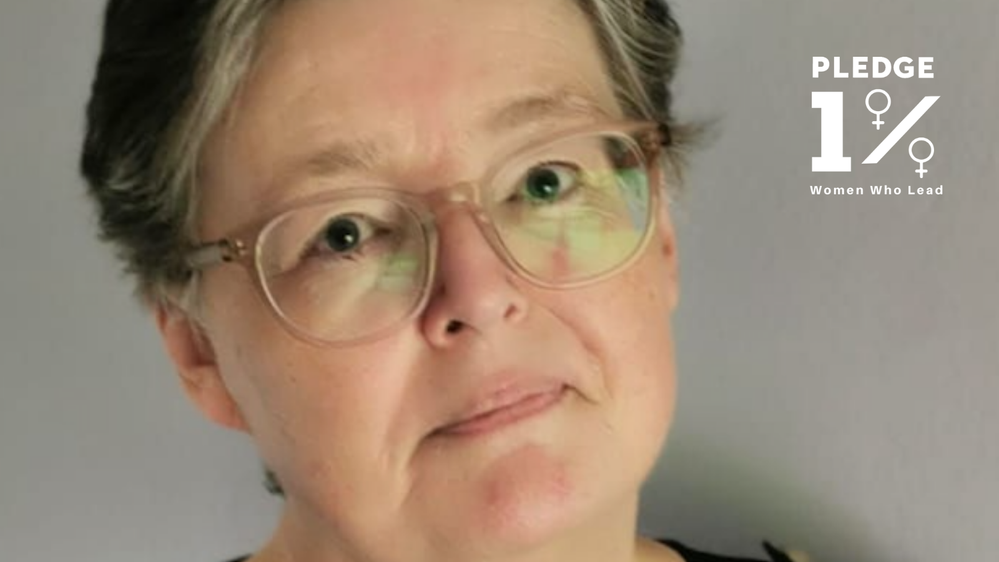
Pledge 1%’s #WomenWhoLead series celebrates female leaders who are paving the way for the next generation. While our featured leaders come from a variety of backgrounds and industries, they are united in their efforts to promote equality for all women in the workplace. We’ve asked them to share a bit about their journey to success, as well as lessons they’ve learned along the way.
What is your name and title?
Lone Andersen, Partner at Step Forward Partners.
Briefly (1-2 sentences) describe your current role.
I am the APAC Managing Partner of a niche consultancy company focused on Treasury, Risk and Wealth Management. We help financial institutions and corporate treasurers with their software projects from selection through execution to production support. We are a small company with no plans to grow too big – our focus is on quality services delivered by a group of very senior industry experts. Our team are all people we know and have worked with both in FinTech as well as in financial institutions. Everyone here is a veteran of the banking and software business. Our aim is to be the go-to company, in our niche market, when a bank embarks on a project. Either in the selection process, the delivery process or indeed both.
How did you get here? Please share any quick stories from past work experiences.
I worked 16 years in private banking then moved to work for financial software vendors utilising my banking knowledge to create a great career. Coming from private banking where you really have to listen and believe in what your customer is telling you, I entered a very different world where it was all about delivery and quick turnaround. I moved up the echelons and took over services sales and support management for Europe and Latin America. Then Head of Services for APAC at Misys followed by Head of Operations Risk Division APAC at Thomson Reuters. Then global head of Customer Engagement at Finastra followed by global head of Partner Engagement. End of 2019 it was time for a change and a well-deserved rest. Right in the middle of this Covid-19 hit and the rest period extended through the lockdown till Zsolt, our founding Partner here at Step Forward Partners, whom I have known and worked with since 2009, called saying how about building the business in APAC. There is a time to work for big corporates and then there is a time to work for yourself – so here I am making the coffee, building the brand and marketing, the services and customer base and I am loving every minute of it.
In your opinion, what’s the #1 decision or move you’ve made that has helped advance your career?
That has to be the decision to move from banking to FinTech. Not that I couldn’t have made a long term career in banking but I love what I do, just about every day on the job has been interesting in some form or other, the people I have met all over the world, the challenges and learnings it has thrown me over the years.
What is the most important lesson you’ve learned this past year?
Letting people do things at their own pace. Before Covid-19 the general expectation was that things were to happen overnight, people (including me) worked all hours of the day and at weekends. I wanted and delivered things in the now. With the lockdown we all suddenly had this extra time on our hands from not travelling. Learning to use that gift of extra time meaningfully has been very valuable.
What’s the number one challenge you face as a woman in your industry?
I see this differently – I don’t think there is one challenge that is fixed because I am woman, certainly not in the FinTech industry. There are still cultures where, even today, it is a challenge for women in general – Japan for example has been in the news for this recently. As a child in the early 60’s I remember being in Moscow and seeing women who were road workers, builders and stevedores on the river, so very different from the west where women traditionally stayed in the home. I was very privileged that my parents never ever doubted that I could do and become anything I wanted. So from home, I didn’t grow up with the mindset that as a woman I was inferior or different in any way – which has shaped how I am and how I comport myself. You have to believe in yourself firmly and show the world that you do, then the question of gender becomes irrelevant.
To break free from thinking of women as somehow inferior or less deserving we need to start long before a girl enters the workforce. The question I always pose is why are parents not consistently educating their children (boys and girls) about the truth that there is equal opportunity for everyone. To break free women need to develop an inner strength to rise above this and they need this from home – from their mothers, their grandmothers, aunts, uncles, fathers. Many already have but there is still lots of work to do.
Do you have any mentors? What does mentorship mean to you?
Yes, I have a group of people whose opinions I really value and who have been great idea-sparring partners over the years. I am a mentor to quite a few people and I especially enjoy taking up mentorship of young people just starting out. I believe that all successful people need to pay it forward and help others on their path. We need to listen to them, give them our learned wisdom and never forget that we can also learn from them.
What advice do you have for women who are just starting their career?
There is so much to say but let me keep it to 4 points.
- You do not have to decide today exactly where you want to go or what you want to do. Gain some experience first and by the time you have worked a couple of jobs, you will be in a much better position to decide on a long-term career strategy.
- Listen and learn from others but form your own opinions and learn to formulate and express them in a compelling argument and you will do well.
- Do not be afraid to change your mind, when you do, do make sure you have thought it out well and are able to articulate the change so others understand your thinking.
- Finding the market or niche you like and can thrive in is key, so don’t be afraid to switch if you feel the need.
What is one thing companies can do, big or small, to help create an environment that advances women into leadership positions?
Make 100% sure you walk the talk at all levels in your organisation. Lip-service is the biggest killer of good intentions. I have seen so many instances where the head of the company is super focused on providing opportunities for women, offering flexible working conditions etc. Only to have it all undermined by the next level(s) down who don’t think it’s important, don’t believe in it, or don’t have/make the time to address it. These nay-sayers are women as well as men, so not just a discrimination thing.
When did your company join Pledge 1%? What does your impact program mean to you?
We are brand new to Pledge 1% and have pledged our 1% to UNICEF this year. I didn’t make that choice but it was an inspired one, which I wholeheartedly support. Throughout his career, my father worked for various UN entities as well as the World Bank and was stationed all over the developing world. When there were UNICEF projects in those locations my mom would do volunteer work with UNICEF, so this pledge has a very personal meaning for me.
What do you like to do outside of the office? Any interesting (or unique) habits or interests?
In my spare time I and a group of like-minded women run a small company, coaching people for job interviews and helping them with career planning. Whether this is someone interviewing for their first internship, an important new role in a different business, jumping to a C-level job or they just want to talk about career options we can help. We are a diverse group of women (not intentionally only women) who have all worked in big jobs around the world and seen and felt what success is like.
Are you reading/listening to anything interesting at the moment? Please share your most recent favorite book or podcast!
I have just finished reading The Myth of Multitasking by Dave Crenshaw. A book with a simple but powerful message about how to become more efficient and productive in your day-to-day work and life at home. Well worth the read, I find myself planning my day and working differently and the benefits in productivity are truly gratifying.
What’s been the one (or two!) things that have helped you navigate this past year? Any tips or tricks to dealing with remote work?
My granddaughter first and foremost – I have had the privilege of spending all that non-travel time with her. She is 2 years old and just delightful. For 7 years I have been in global roles based out of Asia and not worked out of a fixed office. So I was already working from home and the change was not a problem for me. Though I have missed the travel, even dreamed of airplane food for goodness sake. Frankly I think you are more productive when working from home but there is a danger that you could slack off conversely you can also do far too much. So set some goals and work practices and stick to them. You must build-in some down time or you will reach burn-out very quicky. The one positive thing coming out of these lockdowns, is that people working from home are no longer viewed as lazy and slackers. This will drive a much better work experience for many people. The offices of the past will very quickly disappear.
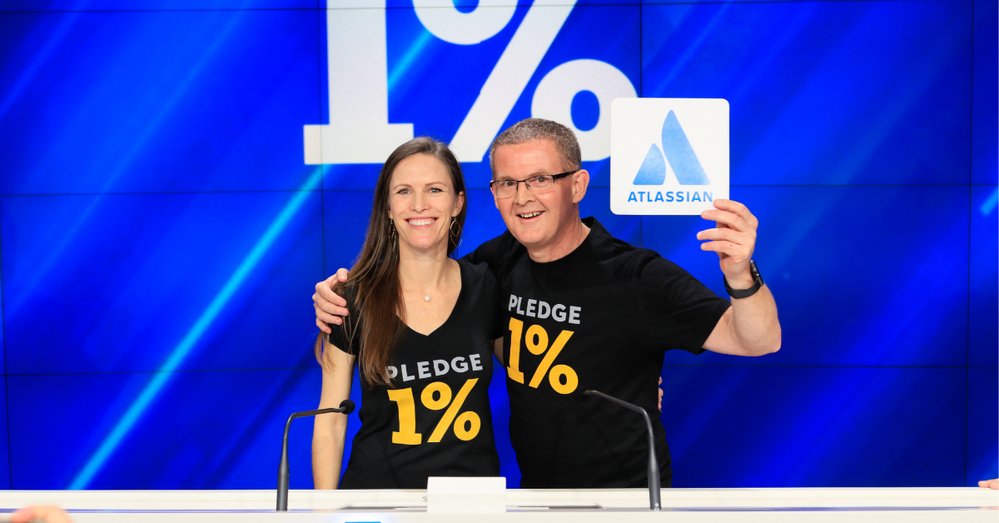
Originally published at Philanthropy Australia. Written by Mark Reading, Head of Foundation, Atlassian Foundation.
The non-profit Pledge 1% movement has prepared detailed guidance on ways for USA-based members to implement their equity pledges. There has been no equivalent guidance in Australia, until now.
Startup founders want to have an impact on the world around them. They are fixated on disrupting established industries in a way that makes life better for customers. They’re often also focused on wanting to make a philanthropic commitment related to social or environmental causes.
Businesses doing good in the world is also important to employees across industry sectors and in both large and small companies. In Atlassian’s 2020 Return on Action report, 69 percent of Australian workers said businesses should be just as concerned with their societal impact as their financial performance.
In 2014, Atlassian co-founded Pledge 1%, a non-profit that helps startups globally bake philanthropy into their business model.
Pledge 1% participants can choose to pledge 1% of equity, profit, time, product, or a combination of all four. As they grow, so does their contribution to society.
Pledging equity is feasible for all companies, but it is particularly relevant for startups, who are interested in giving back but may have low or even no profit.
Australian equity pledges have in the past been made via a public statement.
There’s been good intent, but no legal substance to validate this deep commitment to making a difference. A change in circumstances could mean that a well-intended pledge never translates into non-profit funding.
That is why the Atlassian Foundation partnered with PwC Australia, Herbert Smith Freehills and Australian Philanthropic Services, who each provided pro bono support, to create a Deed of Equity Gift. The Deed provides a clear legal pathway for founders to formalise their pledge of equity to their chosen non-profits, clearly demonstrating their commitment to employees, customers and other stakeholders.
At its core, the Deed legally commits founders to donate the nominated shares to an Australian Deductible Gift Recipient (DGR) entity in the event of a liquidity event occurring within 10 years of signing the Deed.
There was a slight concern that executing the Deed may give rise to adverse tax consequences – perhaps triggering an upfront tax bill or denying the donor a tax deduction for the gift. Consequently, the first person to execute the Deed, Andrew Herbert, the founder of data analytics and artificial intelligence startup, Cangler obtained from the Australian Taxation Office (ATO) a Private Binding Ruling (PBR). The redacted PBR, which can be accessed via the ATO’s Legal Database included confirmation that based on his particular facts and circumstances, there would be no unexpected tax consequences.
While founders should obtain independent tax advice for their own circumstances, the template Deed of Equity Gift and the redacted PBR allow founders and philanthropic shareholders to follow a process to confirm their tax position and focus on their impact for our communities.
The Pledge 1% movement has over 12,0000 members globally and more than 1,500 members in Australia. To date, the founders of more than 100 Australian companies have taken an equity pledge. Successful Australian companies whose founders have taken an equity pledge include Atlassian, Canva, CashRewards, CultureAmp, Mathspace and SafetyCulture.
Atlassian’s co-founders, Mike Cannon-Brookes and Scott Farquhar pledged 1% of equity, profit, time and product almost 20 years ago. As Atlassian’s business has grown, the Atlassian Foundation has been able to make a positive impact on causes around the world, particularly the education of youth from marginalised communities. Scott and Mike’s pledge has enabled the Atlassian Foundation to pass A$50 million in donations earlier this year and to have an asset base exceeding A$200 million.
For additional information, or to download a copy of the template Deed of Equity Gift, please refer here.
If you’re a founder interested in executing the Deed, feel free to contact me: mreading@atlassian.com. I’d be delighted to provide any support you need.
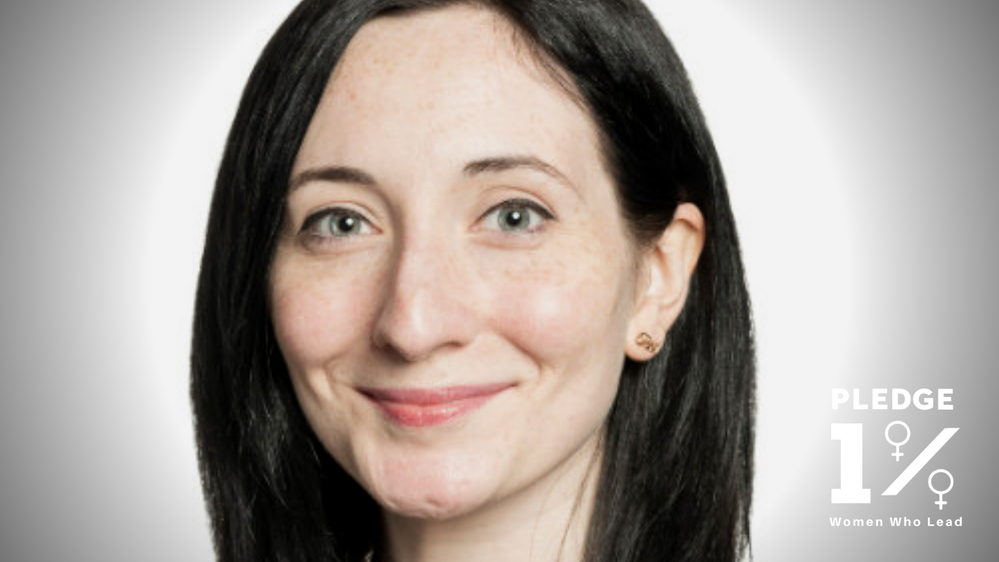
Pledge 1%’s #WomenWhoLead series celebrates female leaders who are paving the way for the next generation. While our featured leaders come from a variety of backgrounds and industries, they are united in their efforts to promote equality for all women in the workplace. We’ve asked them to share a bit about their journey to success, as well as lessons they’ve learned along the way.
What is your name and title?
Jiordan Castle, Director of Marketing at Atrium.
Briefly (1-2 sentences) describe your current role.
I do marketing for a technology consulting services company focused on AI and machine learning… which means I get to ensure we’re telling great stories, supporting our customers and partners in meaningful ways, and getting our name out in the ecosystem!
How did you get here? Please share any quick stories from past work experiences.
I’ve worked for a number of Salesforce partners over the years in a full-time capacity and ultimately started my own brand and content strategy business in 2020. I ended up being offered this position with Atrium after they’d been my biggest client for several months! I’m also a professional writer outside of my corporate role, which has informed many of my relationships along the way.
In your opinion, what’s the #1 decision or move you’ve made that has helped advance your career?
In a lot of ways, getting my MFA in poetry has actually bolstered my corporate career in marketing. Creativity isn’t for any one industry; it’s for all of them. And learning how to inject creativity in unexpected ways into more traditional roles or ventures has helped me stand out and support others around me.
What is the most important lesson you’ve learned this past year?
Leave room for error and leave room for change! Both allow for growth.
What’s the number one challenge you face as a woman in your industry?
It can be lonely, sometimes being the only person who looks like me in a meeting with several others. That can feel like an echo chamber if you don’t push outside of yourself and talk about that exact issue with others at your company.
Do you have any mentors? What does mentorship mean to you?
I do! Most of my managers have been wonderful, thoughtful, completely different thinkers – and I can (and do!) call on many of them to be a sounding board, to offer specific guidance, or simply to learn more about their path (the good, the bad, and the confusing!). Mentorship, to me, means providing guidance from a combination of heart and experience.
What advice do you have for women who are just starting their career?
How much time do you have?! If I had to narrow it down, I’d say… find a few people you can be yourself with at the company and ask them what you deem stupid questions (honestly) so that you can grow more comfortable with people in higher positions, partners, customers, etc. Trust your own instincts, but let the data – the truth without emotion – be a close guide as you get going at the beginning of your career.
What is one thing companies can do, big or small, to help create an environment that advances women into leadership positions?
Set up mentoring programs, certainly, but also simply: be explicit about your efforts to bring women to the forefront, to the top. Make your hiring intentions clear. You’ll get more raised hands and applications if you make it known that this is intentional, purposeful, and important to the business.
What is one thing you hope to accomplish in the next year?
I hope we see marketing influence a lot of pipeline! That’s vague, but basically, I hope to help more people see what marketing means to a bottom line – that creativity pays off.
Is there a cause that is particularly close to you? If so, why this cause and how did you get involved?
There are a lot of women- and minority-led groups I’m passionate about, but one I’m particularly HOPING to get involved with in the future is Girls Write Now. (I’m a writer! This is how I can help others hone their skills.)
When did your company join Pledge 1%? What does your impact program mean to you?
We joined in 2020, but I’ve worked with Pledge 1% at other companies in the past and I love that we can not only help make a difference but learn from other companies who are leading the way in dedicating time and resources to organizations most in need.
What do you like to do outside of the office? Any interesting (or unique) habits or interests?
I have a published poetry chapbook out in the world and I’m working on my first full-length book!
Are you reading/listening to anything interesting at the moment? Please share your most recent favorite book or podcast!
A book I loved recently that everyone should read is “For Black Girls Like Me.” I also love the now-ended (I think?!) podcast “The History of Fun.”
What’s been the one (or two!) things that have helped you navigate this past year? Any tips or tricks to dealing with remote work?
Yoga, my dog, my husband… a lot of coffee and a lot of reading to get me outside of myself and into new worlds, new ideas. Logging off at a certain time and not returning.
Originally published in IT Wire. Written by Alex Zaharov-Reutt.
Aussie Broadband has announced it has joined Pledge 1%, a global movement that encourages businesses to be a force for good.
Community Impact Manager, Caroline Kennon said Pledge 1% is simply about committing company resources to help improve communities.
“At Aussie Broadband, we’re in business to change the game. This includes how we, as a company, can make a positive impact on our community – both locally and nationally. This isn’t motivated by needing to tick boxes or big-noting ourselves – it stems from our value of being good to people and our strong Board and Senior Leadership Team commitment to community service,” said Kennon.
Pledge 1% participants have the freedom to pledge any combination of product, equity, profit, or time to whatever charity or cause they choose. Aussie Broadband is pledging up to 1% of staff time, driven largely through its generous 3 days of paid community service leave, and 1% Profit (EBITDA) through a combination of donations and sponsored internet connections.
One of the organisations that Aussie Broadband supports by providing broadband services is the Perth Observatory.
Matt Woods from the Observatory says Aussie has helped live stream astronomical events like the total lunar eclipse not only Australia, but to the world.
“We us use our Aussie Broadband connection not only for our day-to-day operations, but also to send back data on space junk from one of our telescopes to the US,” said Woods.
“It also allows us to store thousands of glass plates off-site on servers so they can be used for research and not lost for time. Students and researchers from around the world use our R-COP telescope for their research and studies. Aussie Broadband is allowing the observatory not only to be a gateway for Perth but for everyone around the world.”
Co-Founder and CEO of HoMie Clothing, Nick Pearce also thanked Aussie Broadband for its help.
“We’re an organisation that supports young people affected by homelessness and hardship to equip them with skills and experiences to help them prepare for their future.
“We’re super grateful to Aussie Broadband for their support in providing us internet access to facilitate our thriving e-commerce business,” Pearce said.
Pledge 1% Chief Executive Amy Lesnick said that as a global community, member companies are coming together to share ideas, tackle common challenges, amplify each other’s efforts, and to encourage their teams and partner ecosystems to do whatever they can to help in this immense time of need.
“This level of collaboration has the potential to drive significant social impact, unlocking millions in funding, product donations, and talent to support frontline workers and to address increasingly critical issues around racial injustice, mental health, small business viability, and education.
“Together, we are a force for good.”
More about Aussie Broadband’s Community Impact initiatives is here.
More about how Aussie is making an impact via Pledge 1% is in the video below:
Originally published at The Australian Financial Review. Written by Natasha Gillezeau.
Atlassian has signed on to a new deed of equity, created by its charitable foundation, which it is hoping other companies will also sign, to make it legally enforceable to make good on public pledges of donations.
The Australian tech giant co-founded the Pledge 1% movement in 2014, with the idea being that participating companies agree to donate 1 per cent of their equity, profits, time and/or products to non government organisations.
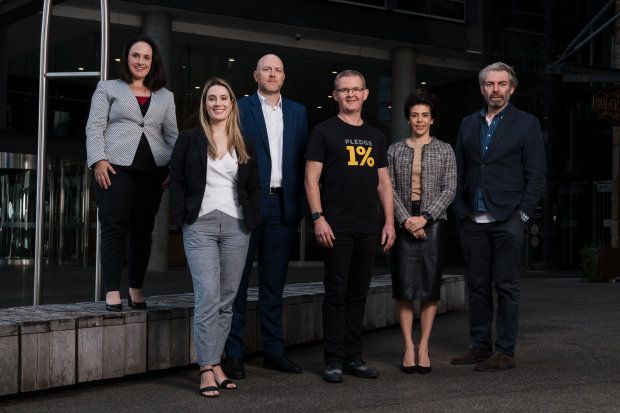
 Myra Beal and Elizabeth Henderson of Herbert Smith Freehills, Jonathan Malone of PwC, Mark Reading from the Atlassian Foundation, Sonia Kew from PwC and Peter Dunne from Herbert Smith Freehills have all been instrumental in developing the legal deed to enforce payment of corporate charitable pledges. (James Brickwood)Until now, such pledges were not legally enforceable in Australia, but this new deed of equity changes this, and if implemented gives such promises greater weight.
Atlassian Foundation head Mark Reading worked together with his former employer, PwC, Herbert Smith Freehills, and Australian Philanthropic Services to help work out what legal instrument would work best for Pledge 1%-ers, and also to check that formalising this corporate giving would not inadvertently trigger additional tax obligations. Typically, charitable gifts are tax deductible.
Under the deed, start-ups and companies must pick what charity they want to donate their pledges to. The need to donate the gift is triggered by any major liquidity event, like an initial public offering, that happens within 10 years of signing the deed.
Atlassian Foundation head Mark Reading described the Pledge 1% movement as a “simple framework for baking social impact into the DNA of an organisation,” but said until now, the movement has lacked “real incentives” to get founders to follow through on donating their equity.
Atlassian co-founder Scott Farquhar hired Mr Reading to lead the philanthropic branch of his company about five years ago.
Mr Reading said his passion for corporate social responsibility was not motivated by any particular faith or philosophy, but rather, his early experiences growing up in a lower middle-class Sydney household and seeing the power of education and opportunity to change lives for the better.
“I personally think all businesses have a responsibility to be positive contributors to society,” he said.
“If all you’re focused on is returns to shareholders – with all due respect to Milton Friedman – I think you’re failing as a company.
“But clearly there are all sorts of business benefits as well – these are secondary – but there are other benefits in having a very clear, positive purpose underpinning what you do as an organisation.”
Cangler steps forward
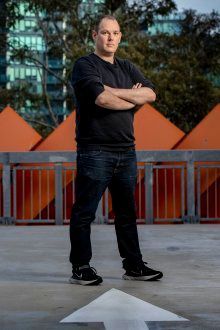 Andrew Herbert, founder of data analytics and artificial intelligence start-up Cangler, is the first to execute the deed. (Arsineh Houspian)
Andrew Herbert, who is the founder of data analytics and artificial intelligence start-up Cangler, is the first to execute the deed.“I found the Pledge 1% movement from doing some Googling, and I thought it was awesome,” he said.“I really wanted Cangler to be a ‘giving’ company, the idea being that we don’t exist as a traditional company to generate profit for shareholders, but rather, I wanted the community to be shareholders, so that our success is everyones’ success.”
Mr Herbert said he had a privileged upbringing, but that various volunteering efforts and losing a close friend to suicide exposed him to social issues that he could not ignore.
He said he found too much cognitive dissonance between focusing on profit margins in his corporate day jobs, and finding sleeping bags for people in his volunteering work by night.
He decided to find a way of merging his work and interests closer together.
Three years ago, Mr Herbert quit his job in Melbourne and moved to Germany. He wanted to develop a way of applying his technology skills to help solve problems like poverty, disease, and climate change.
On Cangler, one example of this in action is an open platform community for health scientists to progress their research by enabling them to better collaborate and share data sets, kind of like how Wikipedia works, but for treatments and cures to tough diseases.
Pledge 1%’s #WomenWhoLead series celebrates female leaders who are paving the way for the next generation. While our featured leaders come from a variety of backgrounds and industries, they are united in their efforts to promote equality for all women in the workplace. We’ve asked them to share a bit about their journey to success, as well as lessons they’ve learned along the way.
What is your name and title?
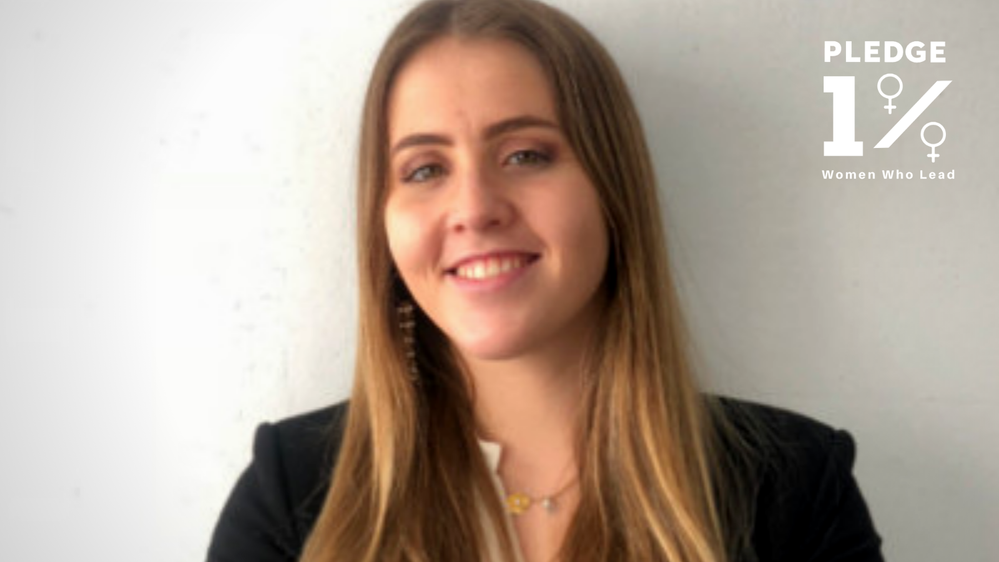
Bárbara Corvacho, Salesforce Consultant at cynqed.
Briefly (1-2 sentences) describe your current role.
I’m a Salesforce Consultant. Basically, I help companies reach their full potential with the help of Salesforce.
How did you get here? Please share any quick stories from past work experiences.
Despite being young, I already have different work experiences in very different companies. Soon as I finished my bachelor’s degree, I went to live in Prague and worked there. Then, came back to Portugal, worked in one of the biggest Portuguese companies, moved to a Big4 and then joined a start-up. All of this in 5 years.
In your opinion, what’s the #1 decision or move you’ve made that has helped advance your career?
Never settle. Don’t settle for a job you don’t like, a job that gives you a zero percent chance of growing or a job that doesn’t suit you. And the same goes for the company you work in. It is very important to be aligned with the company’s values and policies. Nothing worse than waking up and dreading to go to work because you don’t like it there.
What is the most important lesson you’ve learned this past year?
It’s really important to be in a job that you like and a company where you can be yourself and speak your mind. Working for a company that I had to change so I could fit in was one of the worst experiences I had in my life.
What’s the number one challenge you face as a woman in your industry?
There is a lack of representation of women in the tech industry. Tech is mostly a male-dominated company, whether we’re talking about the workforce or the executive ranks.
Do you have any mentors? What does mentorship mean to you?
I had one mentor that made me realise there is nothing wrong with speaking my mind and saying what needs to be said. And that was one of the best advice I’ve gotten so far.
What advice do you have for women who are just starting their career?
Be bold and fierce. Don’t be afraid to stand out and speak your mind. And don’t apologise for having your own opinion and sticking to it. Speak with assertiveness. In the work place, women speak in a different manner compared to men so they can be considered friendly — don’t do it. You can be both friendly and assertive. Do not let people belittle you and think less of you for being a woman.
What is one thing companies can do, big or small, to help create an environment that advances women into leadership positions?
Create an environment where women feel comfortable. Give the same opportunities to men and women, the same salary. Once, my mentor told me that women don’t ask for pay raises, they simply find a new job thus, avoiding the confrontation. While men, even if they aren’t qualified, they ask for a raise. It is important to have the same openness to men and women. Let women lead, assign a female mentor to the women that just joined your team so they can share experiences and advice. Give women an opportunity.
What is one thing you hope to accomplish in the next year?
I want to raise awareness of mental health issues within my company. Together with a teammate, I’m working on a plan where we will have different team activities each month, with a different topic but mainly related to mental and physical health.
Is there a cause that is particularly close to you? If so, why this cause and how did you get involved?
I don’t have a particular cause close to me. However, if I had to choose one I’d say the LGBTQIA+ rights since it still shocks me regarding the prejudice felt by the community.
When did your company join Pledge 1%? What does your impact program mean to you?
My company joined Pledge 1% last year. I’m very proud to be a part of a company that cares so much and is willing to donate a part of their time to non-profit organisations. I’ve done some volunteering work whilst I was studying and everyone should do it. People should open their eyes to the difficulties other people live with and try to help. We shouldn’t turn a blind eye.
What do you like to do outside of the office? Any interesting (or unique) habits or interests?
I love to bake. Last year, in the pandemic I created an Instagram page @Happeameals_ where I share all my recipes and I sell cakes. Apart from baking, I try to travel as much as I can.
Are you reading/listening to anything interesting at the moment? Please share your most recent favorite book or podcast!
I love detective novels, so for anyone who likes them, I suggest reading the whole series by Camilla Läckberg and Jo Nesbo. Last year, I also read “The Colour Purple” and “I Know Why the Caged Birds Sing” and I believe anyone should read them to really understand what it was like to be a woman of colour in the United States. And lastly, Homegoing by Yaa Gyasi was one of the best books I’ve read. It portraits the life of slaves and the repercussion throughout the generations.
What’s been the one (or two!) things that have helped you navigate this past year? Any tips or tricks to dealing with remote work?
Don’t focus just on your work. When you don’t have anything else to do for work, just close your laptop and enjoy your time. Find a hobby so you can be entertained. Take breaks, do your lunch break entirely without always checking your email. Call your loved ones in your breaks, enjoy the company of your family and/or pets.
Originally published in PRWeb.com.
Shipshape Solutions Inc., a company with a vision for every home to be safe, reliable and efficient, today announced the establishment of the Shipshape Foundation and a corresponding grant of 2% of the company’s founding equity to the foundation. In addition to the equity grant, Shipshape pledged 2% of its product and 2% of its time to further its philanthropic mission.
“Shipshape was founded with the belief that the business of business is to build a better world,” according to Alexander Linn, Founder and CEO of Shipshape who, prior to founding Shipshape, worked at Salesforce as a Lead Solution Engineer on the Einstein Analytics & AI Platform. Shipshape’s 2-2-2 model was inspired by the 1-1-1 model pioneered by Marc Benioff and Salesforce. “Thanks to the leadership of Marc Benioff at Salesforce, we can do more so we decided to double the 1-1-1 model.”
Shipshape is in business to connect homeowners to service providers to help them save time, money and energy using technology. Shipshape aims to promote economic development and sustainability with every solution it sells. Its 2-2-2 model is designed to instill hyper alignment between the company, its stakeholders and the community.
“Technology is driving structural inequality into our economy. It is incumbent on us as entrepreneurs to design business models that drive equality and sustainable economic development. Otherwise, technology will become bad for mankind,” said Alexander Linn.
The Shipshape Foundation provides need-based grants to help low-income homeowners access home improvements that lead to safer, more reliable and more efficient homes. “Every day we meet homeowners that need our help. After just a short time with the company, I realized that the opportunity for us to make a difference in the world is huge, so I jumped at the opportunity to be involved in the Shipshape Foundation,” said Elexa Ruth, Director of the Shipshape Foundation.
With this announcement, Shipshape joins the Pledge 1% movement, a global philanthropic organization encouraging companies to give 1% of either their equity, employee time, profit and/or products to good causes. Through Pledge 1%, Shipshape joins a network of more than 12,000 companies in 100+ countries that have committed to philanthropic efforts.
About Shipshape Foundation
The Shipshape Foundation is a not-for-profit organization that owns 2% of the initial founding equity of Shipshape Solutions Inc. The foundation was formed by Shipshape Founder Alexander Linn to help low-income homeowners by providing need-based grants for home improvement projects that will reduce the carbon footprint and financial risks associated with ownership of their homes.
About Shipshape Solutions Inc.
Shipshape is on a mission to make homes smart enough to take care of themselves. Shipshape believes every home should be safe, reliable, efficient and well maintained. The company operates a first of its kind proprietary smart home predictive maintenance platform that offers solutions to homeowners to reduce the costs of home maintenance and operations. The Shipshape platform integrates an ecosystem of smart home hardware to enable advanced analytics and recommend actions that will reduce risks and improve system performance. Shipshape’s software platform unlocks the value of sensor data to enable a whole new era of the smart home.
Shipshape is based in Austin, TX. For more information, visit http://www.shipshape.ai.
About Pledge 1%
Pledge 1% is a global movement that encourages and empowers companies of all sizes and stages to donate 1% of their staff time, product, profit, and/or equity to a charity of their choosing. It provides a simple, flexible, and scalable model to integrate giving back into the DNA of all companies, especially startups. Already thousands of companies around the world have taken the pledge, and dozens of VCs, incubators and conferences have joined to push the movement forward.

Originally published on Protocol. Written by Biz Carson.
SPACs may have been the hottest IPO trend in the last year, but now a bunch of investors are hoping to make another aspect of going public just as cool: corporate philanthropy.
The blockbuster IPOs of companies like Coinbase and UiPath came with a pledge to set aside shares of the company for charity. This week, over 40 investors, including folks like Benchmark’s Peter Fenton and SV Angel’s Ron Conway, joined Pledge 1% as boardroom allies to help their portfolio companies follow the same path.
- UiPath’s CEO Daniel Dines heard about Pledge 1% during a Forbes event when he was talking to other CEOs who had gone through the process, like those from PagerDuty and Atlassian. The company had already engaged in some philanthropic activities through a nascent foundation, but when UiPath went public, it set aside nearly 3 million shares to be reserved for philanthropy as part of its new pledge.
- “When you look at the long list of amazing companies that are part of Pledge 1%, Salesforce included, this isn’t a new unproven approach to charity,” said UiPath CMO Bobby Patrick. “It’s actually quite well-proven, and in our view, this is what every up-and-coming tech company should be doing as a normal course of business.”
Companies need support to become effective in their philanthropy, said Amy Lesnick, CEO of Pledge 1%.
- “We really see a time that’s not so far away when setting aside equity for your philanthropy is really just as common as setting it aside for your employees. It’s just what people do,” she said. “To make that happen you need standards, you need an ecosystem of support and you need to make it easy.”
- Recruiting VCs to evangelize corporate giving is just the start. UiPath board member and CapitalG partner Laela Sturdy had often fielded questions from founders about how they should be giving, but it wasn’t until UiPath that she realized Pledge 1% had a playbook ready to go. “I’ve brought it up proactively with so many founders I work with and they’re just relieved,” she said.
It’s just one way the tech industry is trying to use its power and newfound wealth for good.
- When Airbnb went public, hundreds of Airbnb employees signed a pledge to donate proceeds of the IPO to charity. “So much of the conversation around tech company IPOs focuses on how the newfound wealth will be used for consumption,” Janet Frishberg, a recruiter for Airbnb from 2013 to 2019, told me at the time. “I was wondering if we could change that conversation and have at least part of the focus be on how we can give these newfound resources to help others and help our local communities and also help the world.”
- Investors are playing other roles too. Bloomberg Beta’s Roy Bahat also helps run a program through Stanford that’s meant to educate early startup employees on how to manage their wealth in an impactful way.
It’s not only good for the world, but it’s also just good for business, said Accel’s Rich Wong, who sits on UiPath’s board.
- The tech industry used to see itself as a niche upstart, but that’s changed. Companies who have seen this tremendous growth have a responsibility to give back, he said. “We have an obligation as a community to our communities,” Wong told me.
- There’s also a competitive advantage when it comes to hiring: “In the battle for the best talents, they want to work for a company that has a mission and has a heart, that’s not just about value maximization,” Wong said.
- UiPath agrees: “Not only is this at the heart of how our founder thinks, but our employees and our new employees coming to work for us, they want to work for a company that gives back,” Patrick said. “They care about the environment and social responsibility, and investors now care about corporate governance and ESG.”
Today, we are excited to announce that Pledge 1% has been named a Top 50 Finalist for the 2021 Classy Awards!
Classy, online fundraising software for nonprofits, launched the Classy Awards in 2009 to recognize the achievements of nonprofits and social enterprises operating in our communities and around the world, and to shine a spotlight on the new strategies, creative thinking, and ideas that move the needle on some of the biggest issues our world faces today. We’re proud to share that our Pledge 1% Equity Program has been recognized for its contribution to creating a new normal where companies leverage liquidity events to commit 1% of equity to future social impact.
The unprecedented social, health & economic challenges of the world cannot be addressed by governments & nonprofits alone. Pledge 1% aims to facilitate the essential role of high-growth companies in being part of the solution, starting with CEOs, venture capitalists & board members who can unlock business assets for social good. If every company pledges 1% of equity, there could be radically new resources available to help organizations around the world address today’s most pressing challenges.
We are already seeing many companies that are looking for ways to give back but lack the profit or resources to do so. Our equity program is changing both systems and structures by creating (1) tools & resources designed by legal & industry experts to help companies—no matter their size or stage—formalize their equity pledge in advance of a liquidity event, and (2) the Boardroom Allies program launched to accelerate this trend by helping top VCs & investors publicly show their support for portfolio companies who commit to a social impact program.
The social sector at large experienced immense challenges in 2020 to drive their missions forward, but in just 5 years, we are proud to have achieved 12,000+ member companies in over 100 countries. Currently, we have recorded nearly $1Billion in new philanthropy generated from Pledge 1% equity pledges alone.
This year, 13 Classy Awards will be distributed across four categories: Social Innovation, Adapt & Overcome, Lifetime Achievement, and People’s Choice. You can vote for Pledge 1% in the People’s Choice category here. Voting is open until June 25, 2021. Winners will be announced on September 28.
For more information on the Classy Awards, visit www.classyawards.org.
About Pledge 1%: Pledge 1% is a global movement that inspires, educates, and empowers every entrepreneur, company, and employee to be a force for good. Over 12,000 members in 100 countries around the world have used Pledge 1%’s flexible framework to ignite billions of dollars and hundreds of thousands of volunteer hours in new philanthropy. To learn more about Pledge 1%, and how your company can get involved, visit pledge1percent.org.