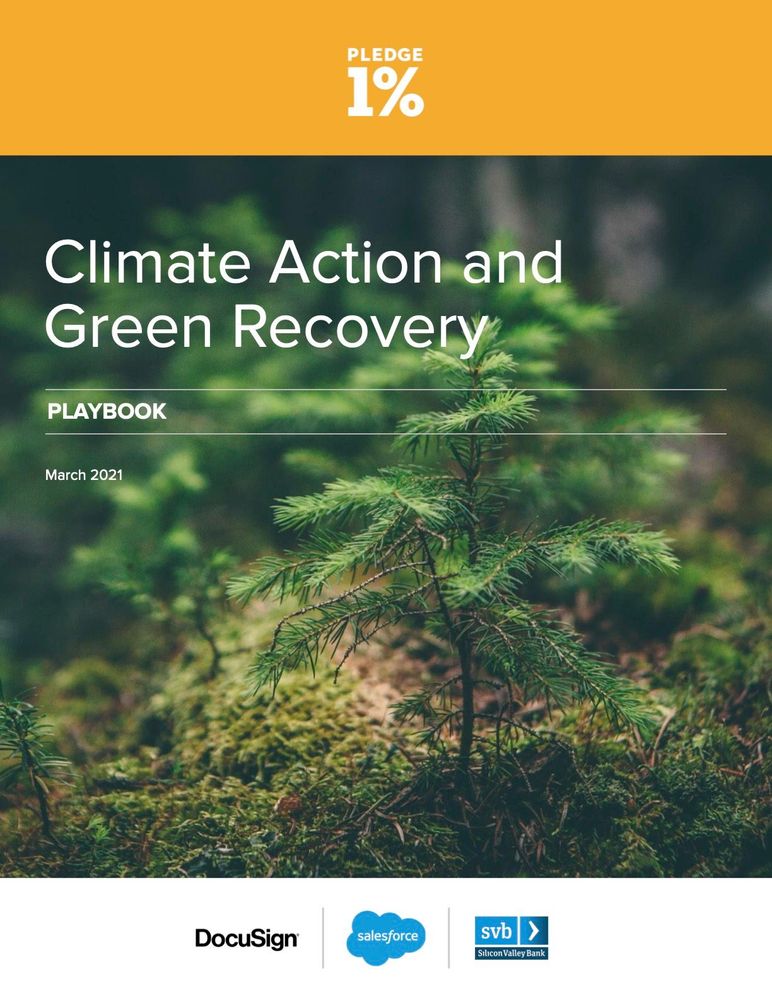
To celebrate the launch of our Climate Action & Green Recovery Playbook, Pledge 1% members joined DocuSign, Salesforce and Silicon Valley Bank to discuss their experience building and maintaining successful sustainability programs. In case you missed it, below is an overview of the discussion.
You can download our Climate Action & Green Recovery Playbook here.
In addition to the immeasurable effects of COVID-19, this past year we experienced record breaking wildfires, hurricanes, freezes, and flooding — and a toll on human life and resources that will only continue to climb. We now have the scientific data to understand the devastation that climate change can cause; and for most of us, this devastation will occur during our lifetime or the lifetimes of our children.
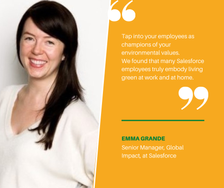
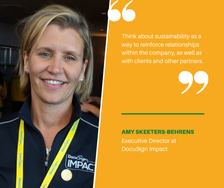
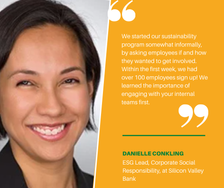
At Pledge 1%, we are committed to protecting the planet. We organized a special members event to explore the top questions and challenges we are facing, and to discuss ways companies can be a part of the solution. We were delighted to share ideas from our members and learn from environmental champions and guest speakers Amy Skeeters-Behrens from DocuSign, Emma Grande from Salesforce, and Danielle Conkling from Silicon Valley Bank.
Here are our 3 top takeaways from the event:
- Engage with the communities where your employees live and work. Research how you can get involved with local stakeholders that are working to protect the environment.
- Start with your employees! Many members share that their employees have expressed interest in getting involved with sustainability efforts. Send a company-wide poll to brainstorm ways for your company to get involved in protecting the planet.
- Take stock of what your company is uniquely positioned to offer, and build a program around that. Leverage your existing talent and assets to help you grow your sustainability program.
Missed the event? That’s OK – you can watch the recording here:

Pledge 1%’s #WomenWhoLead series celebrates female leaders who are paving the way for the next generation. While our featured leaders come from a variety of backgrounds and industries, they are united in their efforts to promote equality for all women in the workplace. We’ve asked them to share a bit about their journey to success, as well as lessons they’ve learned along the way.
What is your name and title?
Chekesha Van Putten, Founder & CEO at Castango.
Briefly (1-2 sentences) describe your current role.
I am the Founder and CEO of Castango.com, an online job marketplace connecting talent with jobs nationwide.
How did you get here? Please share any quick stories from past work experiences.
I spent the early part of my career working in front of the camera as a professional spokesmodel, actress and dancer appearing in movies such as Austin Powers, American Beauty and Batman & Robin. I was also in commercial campaigns for Pepsi, Ross, Taco Bell and a Los Angeles Laker girl and choreographer for 2 years. Based on my experience in the industry, I saw how technology could streamline the casting process. I built Castango to create greater accessibility and more opportunities for talent to find work online nationwide.
In your opinion, what’s the #1 decision or move you’ve made that has helped advance your career?
Moving to Las Vegas was the greatest decision I made to advance my career. Originally from Los Angeles California, the move to Nevada brought with it great opportunity. I graduated from the Score Institute for Entrepreneurs through the Small Business Association where I found mentors to help me get started. Tony Hsieh, the late founder of Zappos, was also investing and developing the downtown area to attract the tech community at the time. I was able to gain access to resources that helped me build out my team and platform.
What is the most important lesson you’ve learned this past year?
Creativity is the mother of invention. I also learned that staying in tune with what is going on in the world and providing a solution is essential. Being a tech based company, we have always been focused on the future of work. However, this year we accelerated our mission and learned that you must pivot when necessary.
What’s the number one challenge you face as a woman in your industry?
Raising capital is definitely a challenge as a woman in the tech industry. Sadly only 3% of women receive venture capital funding. This number is even lower for women of color. It is still an uphill battle, but we are making great strides as more female focused funds are coming into play and women are taking on leadership roles.
Do you have any mentors? What does mentorship mean to you?
I would not be where I am today without the many mentors in my life. As a young professional, I remember being afraid to ask for help. I made a commitment to surround myself with people who had experience and were willing to help advise me this time around. Two minds are better than one, and I am grateful for the many people that have helped get me to where I am today.
What advice do you have for women who are just starting their career?
There is so much pressure early in your career to figure things out and reach your goals. It’s important to remember that it’s the journey not the destination, and that you have time! If you are always focused on the future, you will miss the moment and that is where greatness is built. One day, one relationship, one milestone at a time.
What is one thing companies can do, big or small, to help create an environment that advances women into leadership positions?
The first step is for companies to realize the inequities that exist and evaluate where they are and where they want to be. From there, they can make a commitment to diversify and level the playing field.
What is one thing you hope to accomplish in the next year?
In the next year, I hope to build more brand partnerships and further expand our marketplace to create more job opportunities for women and people of color.
Is there a cause that is particularly close to you? If so, why this cause and how did you get involved?
I currently sit on the Board of the Junior League of Las Vegas, which is an organization that promotes volunteerism, and develops the potential of women while improving the community. I wanted to find a way to give back to my community on a consistent basis. The Junior League has allowed me to not only do meaningful work with a variety of local non-profits, but also develop leadership skills to continue to grow as a leader in my community.
What do you like to do outside of the office? Any interesting (or unique) habits or interests?
Outside of the office, I love to dance, cook, hike the red rock mountains and travel.
Are you reading/listening to anything interesting at the moment? Please share your most recent favorite book or podcast!
I am obsessed with Podcasts from Wait What Productions including Masters of Scale and most recently Meditative Story. It’s inspirational hearing the stories of other people overcoming challenges and finding success.
What’s been the one (or two!) things that have helped you navigate this past year? Any tips or tricks to dealing with remote work?
One of the most important things that I do to manage remote work is to get fresh air. When you are bound to your home & computer, going outside is a luxury. Whether it’s a brisk walk in the morning, afternoon run, or weekend hike, getting fresh air and oxygen in your lungs is a great way to manage this new lifestyle.

Pledge 1%’s #WomenWhoLead series celebrates female leaders who are paving the way for the next generation. While our featured leaders come from a variety of backgrounds and industries, they are united in their efforts to promote equality for all women in the workplace. We’ve asked them to share a bit about their journey to success, as well as lessons they’ve learned along the way.
What is your name and title?
Gabriela Crego, Social Impact Leader at Rock Content.
Briefly (1-2 sentences) describe your current role.
I am responsible for Rock.org, the social impact initiative at Rock Content. I created the program in 2019, and since then we have been doing our best to make education resources available for everyone in Brazil. We run a program called Rock’n’Grow an online development program that provides scholarships to Rock University courses. These courses are focused on developing relevant skills needed in the job market in four main areas: digital marketing, social media, sales and customer success.
How did you get here? Please share any quick stories from past work experiences.
I graduated with a degree in Production Engineering, but decided to take a more nontraditional path. Together with two friends, I founded a nonprofit called Naação in Belo Horizonte, Brazil. The main goal was to leverage the impact of social leaders by sharing knowledge regarding financial suitability. To offset my low salary as a nonprofit leader, I decided to accepted an offer to work part time at the sales team at Rock Content. After 6 months working there, there was a huge opportunity to bring these two worlds together. The task was to create a social impact program within the company, from the ground up. Convincing the leadership team of the importance of this program was crucial to our execution.
In your opinion, what’s the #1 decision or move you’ve made that has helped advance your career?
It is hard for me to say my number one decision. I believe a path of right and wrong decisions have helped me get where I am today.
What is the most important lesson you’ve learned this past year?
Remain optimistic, and learn to adapt and move quickly. To get through all of the challenges we faced last last year, we had to exhibit bravery. We had to think fast and bring different solutions. This was especially true as we were working with underrepresented students, many of whom did not have access to the digital world.
I also learned to focus on what make our team strong, and to never forget the core values and culture.
Do you have any mentors? What does mentorship mean to you?
Not yet, but I always have that top of mind. It’s something I plan to cultivate this year.
What advice do you have for women who are just starting their career?
Believe in yourself, trust your voice, and remain true to your values – then, go for it!
What is one thing you hope to accomplish in the next year?
Expand our program beyond Brazil and make it a global initiative.
Is there a cause that is particularly close to you? If so, why this cause and how did you get involved?
Education and equal opportunities for everyone.
When did your company join Pledge 1%? What does your impact program mean to you?
We joined when we first created our social impact program, but more effectively in 2020. Pledge 1% was a huge opportunity for us to exchange knowledge with people working in the same area – facing similar challenges. It has been an amazing learning experience, and supported us with tools and resources to help us build.
What do you like to do outside of the office? Any interesting (or unique) habits or interests?
I have a dream to travel around in a trailer. So, I spent some time researching, and started building my own.
Are you reading/listening to anything interesting at the moment? Please share your most recent favorite book or podcast!
At the moment I’ve studying about ESG, so I follow a podcast called ESG agenda and news from Capital Reset (an independent Brazilian journal).
What’s been the one (or two!) things that have helped you navigate this past year? Any tips or tricks to dealing with remote work?
I created an office outside my bedroom. That way I ensure I don’t spend 24 hours a day in the same room.

Pledge 1%’s #WomenWhoLead series celebrates female leaders who are paving the way for the next generation. While our featured leaders come from a variety of backgrounds and industries, they are united in their efforts to promote equality for all women in the workplace. We’ve asked them to share a bit about their journey to success, as well as lessons they’ve learned along the way.
What is your name and title?
Sneha Sheth, Chief Delivery Officer at Addteq.
Briefly (1-2 sentences) describe your current role.
I work as the Chief Delivery Officer at Addteq and I am a supporter of Pledge 1% and the Room2Read NJ/Princeton chapter. I have been a part of the Atlassian Community for the past 7+ years, with two Atlassian certifications under my belt. I spend the majority of my time talking to enterprises about the challenges of collaboration and building great software. In my current role, I lead the delivery of services and software for our customers.
Prior to being a part of the executive team at Addteq, I worked with several clients to deliver DevOps projects. The scope of those projects ranged from assessment for best practices and implementation, to providing extensive training. Around the same time, I also played the role of a project manager – with the primary goal being to keep the various project status healthy and motivating the team to achieve their deliverables within the agreed timeline.
In your opinion, what’s the #1 decision or move you’ve made that has helped advance your career?
Not giving up any and working smart (hard) has kept me going through the years.
What is the most important lesson you’ve learned this past year?
Staying at home in the past year has made me realize that there is nothing is more important than your health and family. Life is fragile.
Do you have any mentors? What does mentorship mean to you?
I have had several mentors through the different stages of my life. Mentorship for me is not just guiding me, but also inspiring and motivating me as an individual. Somebody who makes me realize my true potential as a person and makes me a better human is my ideal mentor.
What advice do you have for women who are just starting their career?
Stay strong, determined and passionate. No matter how difficult the circumstances may be, you are capable of achieving everything you dream of!
What is one thing companies can do, big or small, to help create an environment that advances women into leadership positions?
The biggest motivation from any organization for an individual would be appreciation and recognition.
When did your company join Pledge 1%? What does your impact program mean to you?
I have been working with Addteq since 2013, and we joined the Pledge 1% program in 2015. I have always wanted to help the economically challenged. My grandfather used to tell me always help whenever you can. This mantra has been embedded in my heart. Doesn’t matter how small or large the help is – even a small contribution from each person in this world can make a very big difference.
What do you like to do outside of the office? Any interesting (or unique) habits or interests?
When not at work I like to read books, spend time with and cook for my family, and make DIY arts and crafts artifacts to decorate my house or gift my loved ones.

Pledge 1%’s #WomenWhoLead series celebrates female leaders who are paving the way for the next generation. While our featured leaders come from a variety of backgrounds and industries, they are united in their efforts to promote equality for all women in the workplace. We’ve asked them to share a bit about their journey to success, as well as lessons they’ve learned along the way.
What is your name and title?
Caitlyn Child, Sr. Director of Sales at Fireclay Tile.
Briefly (1-2 sentences) describe your current role.
I develop and implement the sales strategy for our organization to help us dominate the high end tile market. I also drive sales and growth, to help create opportunities for personal and professional development within our team.
How did you get here? Please share any quick stories from past work experiences.
I studied art and architecture at the University of Oregon and spent the first years out of college working multiple jobs in art museums and running a volunteer program through Americorps. This lead me into a decade long career creating meaningful development plans and spearheading advocacy groups for adults with developmental disabilities. I went back to school to focus on Universal Design – blending my passion for architecture and design with social justice causes.
While learning more about the industry, I discovered a company that was equally passionate about social justice causes and was introduced to the world of sales. I started at Fireclay Tile as a sales rep and quickly moved into management. In that role, I grew our commercial channel and eventually took on a sales strategy role.
In your opinion, what’s the #1 decision or move you’ve made that has helped advance your career?
For me, being willing to jump in to an organization big or small and learn every aspect has been critical. Also, being willing to open myself up to experiences outside of my job description – whether changing lightbulbs, mentoring team members from other departments, or taking on special projects.
What is the most important lesson you’ve learned this past year?
Take and encourage time off, even if you feel like you don’t “deserve it” while already working modified hours. Mental health is critical during this time. It is important to check in and give yourself time for respite. When you have a team who has limited hours to work while juggling parenting, care providing, personal obligations and work, it is vital to identify the most critical functions and how to make those most successful. The best thing you can do as a leader is adapt.
What’s the number one challenge you face as a woman in your industry?
Understanding that you can be a badass leader in your industry while setting boundaries around work life balance. It is important to set the tone and lead by example for your team and peers.
Do you have any mentors? What does mentorship mean to you?
My greatest mentor is Sarah Noack, Brokerage Director at UCP Connections. She embodies all the qualities of a great mentor. For me, that means someone who sees the value you add to the table even if you haven’t discovered it yet. The most beneficial thing mentors can do is to listen to your objectives and help you develop them further by sharing resources and experiences. They need to be bright and open – not only sharing their wins, but also their learned opportunities.
What advice do you have for women who are just starting their career?
Be willing to lean into what you don’t know, rather than remaining dependent on what you do know.
What is one thing companies can do, big or small, to help create an environment that advances women into leadership positions?
A leadership team should always learn from their teammates who are in entry to mid-level positions. These employees are innovating approaches in their job functions. Creating mentorship and cross training opportunities is also key. Forget about what is on someone’s resume and past experiences, and focus on their ability to take ownership of their actions and be personally invested in your company.
What is one thing you hope to accomplish in the next year?
Next year, I have a very aggressive goal to double our business. However, the task I am most excited to accomplish is identifying opportunities of growth and development for my growing organization.
Is there a cause that is particularly close to you? If so, why this cause and how did you get involved?
The Oregon Coalition Against Domestic and Sexual Violence is a great advocacy group fighting the sex trafficking industry. Over my decade long career as a social worker, I served many vulnerable populations that were being targeted and experienced abuse. Having support and resources is critical to help save lives.
When did your company join Pledge 1%? What does your impact program mean to you?
Fireclay Tile has always been focused on opening our industry’s eyes around how much waste is created in the building industry. Our Founder, Paul Burns, used to dumpster dive to find recyclable packing materials. We were finally able to achieve our B-Corp status in 2015; and in 2017 we relaunched our glazed brick collection pledging to give back 1% to conservation efforts for National Parks. We continue to find ways we can do more – not just for different sustainability initiatives, but also social justice causes that are important to our team members.
What do you like to do outside of the office? Any interesting (or unique) habits or interests?
I love botany and learning about different ecology systems. I am part of the Oregon Native Plant Society and am currently transforming my yard into a bee paradise.
Are you reading/listening to anything interesting at the moment? Please share your most recent favorite book or podcast!
I just finished Entangled Life by Merlin Sheldrake. It speaks to the world of fungi and how interconnected it is with our ecology. It is definitely one of those books that you can’t wait to put on your sweats and get back into.
What’s been the one (or two!) things that have helped you navigate this past year? Any tips or tricks to dealing with remote work?
As my team has adapted to remote work, we have become very efficient. It has been super important for me to pick up the phone and call people and not get left behind the Zoom screen. It is also important to keep that sense of connectedness – it is easy to fall into your own silo while working remote. Take the time to check in with folks. I guarantee you will discover you need it too!

Pledge 1%’s #WomenWhoLead series celebrates female leaders who are paving the way for the next generation. While our featured leaders come from a variety of backgrounds and industries, they are united in their efforts to promote equality for all women in the workplace. We’ve asked them to share a bit about their journey to success, as well as lessons they’ve learned along the way.
What is your name and title?
Phylicia Jones, Sr. Director, Talent & Organization Development at PagerDuty.
Briefly (1-2 sentences) describe your current role.
At PagerDuty, my role is to rethink, invest, and develop systems, people, and processes to help employees experience career making moments. I work to elevate the employee experience for everyone. While my title is Sr. Director, Talent Development, I care deeply about people doing the hard work that moves them forward.
How did you get here? Please share any quick stories from past work experiences.
I contribute a lot of my career journey to being a Girl Scout growing up, and playing team sports. These two pivotal experiences showed and taught me how to win and lose, how to be selfless, how to generate energy and pass it to someone else, how to be on a team, how to play on a team, and how to work as a team. It exposed me to what leadership looked like for women. When I look at my career moments assisting students as an Academic Center Supervisor at UC Berkeley, being a Human Capital consultant at Deloitte Consulting, and building talent programs at Veeva & PagerDuty, my team and the clients/customers I served taught me how to make my career about solving problems and caring about the people you are solving problems for.
In your opinion, what’s the #1 decision or move you’ve made that has helped advance your career?
When I was in undergrad at UC Berkeley, I applied to the Haas Business School and got accepted. What changed my trajectory was deciding to decline the offer and switch my major to American Studies – following my passion. The heart I put into my thesis helped me land the job at Deloitte in their Human Capital Practice. From this, I knew what it felt like to follow my passion vs. following the status quo and being unapologetic about it. It is very important to me that my career always ignite a fire in me – to make an impact and a difference in my mind and heart. If it doesn’t, I shouldn’t be doing it.
What is the most important lesson you’ve learned this past year?
“If you want a seat at the table, bring a folding chair; and if you don’t want to use your voice, move away from the table.” I share this idea of a “table” as a metaphor to describe taking risks by using my voice (saying what no one else will). Especially, when I may not look like everyone else in the room. Just because that may be the case does not mean I don’t belong in the room.
Early in my career, I would be afraid to speak up in the rooms I found myself in. Not today. The past year, I found myself in many “Zoom rooms”. I had to consciously remind myself that I was meant to be there. Since we can’t physically occupy spaces right now, using my voice in ways to call people in, admit my mistakes, or seek to understand is how I’ve been able to connect with others to move forward together – even when we are physically separated.
What’s the number one challenge you face as a woman in your industry?
I am a Black woman in tech teaching others how to be leaders. I did not have my first exposure to Black educators/teachers until I was in college. So being in tech with my job, I know that I might be someone’s first Black teacher ever in their life. I always think about that each time I stand on a stage – either entering the front of a classroom or leading a virtual session.
This is why I believe Black women make history every day. Resiliency is something we learn and need to have from a very early age as we face challenges everyday in comparison to our non-Black counterparts. Every day is a challenge, but I am always ready for it.
Do you have any mentors? What does mentorship mean to you?
Of course! Today, my 3 mentors are my first manager when I was a summer intern, the first CFO I worked for, and my manager who gave me my first Talent Development gig. These three mentors are people who know me and have taught me that mentorship is a bond that includes brutally honest truth telling. The mentoring relationship includes an unspoken agreement between two people who challenge your thinking, so that you can always become a better version of yourself.
What advice do you have for women who are just starting their career?
Grow your character everyday, and don’t chase titles. Find the work that fuels your energy and let your focus flow towards that. That will build your character and legacy more than a title. If you don’t, someone will easily tell you who you are supposed to be. If you want to have a career that means something, don’t waste your time pretending to do something you don’t love. Find the work you care about that serves a cause bigger than you. Then, do the work that advances that cause for the long-game vs. the short term.
What is one thing companies can do, big or small, to help create an environment that advances women into leadership positions?
Pay attention to it, and set goals and metrics around it. Companies need to hold people accountable to think about it and create a system to advance women. The companies who are leading the way are not just striving and measuring it. They are thinking of ways to advance women who represent URP/BIPOC and promoting women into roles not traditionally held by them.
What is one thing you hope to accomplish in the next year?
I don’t necessarily look to accomplish something tangible each year, I just try to become a better version of myself. This year is about discovery, and expanding my impact and thinking. I have committed, using my PagerDuty volunteer time (VTO), to give back and deliver a leadership development experience for a non-profit management team at Beyond Emancipation over the course of 8 weeks in my Oakland community. I am also participating as a Founding Fellow for On Deck Course Creators to help find new and transformative ways to build impactful learning courses. Finally, I am involved in Dialogue’s 6 month Collective on the Future of Work. I am hoping these three investments will both inspire me and help me discover what my next career moment should be.
Is there a cause that is particularly close to you? If so, why this cause and how did you get involved?
In 2011, I lost my oldest sister to Lupus. This unexpected moment of loss changed how I view and see life. In 2012, my family and I started Team JMJ (Jervonya Monique Jones) to honor her legacy. Each year, we kickoff fundraising in May (Lupus Awareness Month) and walk for the San Francisco Chapter in October for the Lupus Foundation of America (LFA) in her memory. Over the past 9 years (going on 10), we have been one of the top teams and raised over $100,000 to help fund research working to find a cure for Lupus.
When did your company join Pledge 1%? What does your impact program mean to you?
PagerDuty joined Pledge 1% in September 2017, which was shortly before I joined the company. To me, this program reinforces that in tech we have the privilege and means to create societal change and address the gaps in education, equality, equity, and the economy. It also helps keep these issues top of mind as I not only try to improve the work that I do, but think of ways my knowledge and experience can impact the world and community around me. It’s the Girl Scout in me that instilled this “volunteer for life” mentality. PagerDuty gives me the time and space to leave this earth better for the next generation.
What do you like to do outside of the office? Any interesting (or unique) habits or interests?
I am a fitness enthusiast and enjoy my Bar Method and Ride Oakland Spin Communities, which are both women owned and operated businesses in Oakland helping other women strengthen their bodies through movement. I have been an active member for over 7+ years and this is what I do before and after my work day. I also pride myself on being a good cook, Auntie, and reader. I support the arts by seeing local plays and musicals (I can’t wait for them to come back). When I travel, you can usually find me on a food tour or taking a cooking class.
Are you reading/listening to anything interesting at the moment? Please share your most recent favorite book or podcast!
I love listening to and reading books, that’s my mind-jam! I am currently reading Adam Grant’s Think Again for work and for my book club we are reading Queenie by Candice Carty-Williams.
What’s been the one (or two!) things that have helped you navigate this past year? Any tips or tricks to dealing with remote work?
Protect your time and your team’s time by setting, communicating, and agreeing to boundaries. Make it okay to subtract vs. add to people experience or life by constantly iterating and experimenting with simple changes and simplified processes.

Originally published on michaelmanagement.com. Written by Thomas Michael.
 MMC Cares is the corporate social responsibility (CSR) program of the Michael Management Corporation, an online SAP education leader and live SAP access services. We started this program in 2020 in response to the many social injustices we have seen in the news. In fact, I had the idea for a CSR program a while back – I felt the urge to use our limited, although powerful resources to make the world just a little bit better.
Our Mission
We fully recognize that not everybody has access or opportunity to use our world-class SAP training. Therefore, we launched MMC Cares with the goal to do social good and address social issues. We will provide at least $100,000 per year in full and partial scholarships to deserving individuals and students from around the world.
Additionally, we wanted to take advantage of our large community of expert SAP instructors to provide free training sessions to the public throughout each year. And finally, we believe charity starts at home – thus, we offer our employees paid time off to do their own charity work. Each employee gets 1 hour per week (or half a day each month) to work on the causes that matter to them most – all while getting paid.
United Nations & Partnerships
We aligned our goals along with the United Nations’ Sustainable Development Goals, specifically Quality Education and Decent Work & Economic Growth.
 Ensure inclusive and quality education for all and promote lifelong learning.
How we support this:
Helping individuals unlock their potential by providing them with quality education and closing the skills divide.
Why we do this:
- There are many barriers to educational opportunities in low-income communities.
- There is a large racial disparity in our educational system, further impeding opportunities for building critical employment skills.
- Education is a passport to greater personal financial health.
 Promote inclusive and sustainable economic growth, employment and decent work for all
How we support this:
Providing a pathway to prosperity by helping individuals acquire the knowledge needed for employment and financial empowerment.
Why we do this:
- Help narrow the gap of financial security among the lower-income community.
- COVID-19 has magnified the issue of financial security, creating the need for individuals to learn new skills
- SAP skills are in high demand; 87% of fortune 2000 companies use SAP software to run their business.
We will continue to donate our products, money, and time to support these goals and make a positive impact as a good corporate citizen. In addition, we seek to partner with national organizations and support nonprofits to further their missions of empowering individuals to improve or restart their careers.
After the initial launch of MMC Cares, I wanted to find a way to multiply the impact of our CSR initiatives. That’s when we hired Amelia Avery-Bradley as our new Director of Corporate Social Responsibility. Amelia is a mission-driven leader committed to social justice and inclusion and over a decade of experience with CSR programs. Amelia will lead MMC Cares to fulfill our mission to make the world a better place.
The 1% Pledge
Our first order of business was to join the 1% Pledge – a global movement of 12,000+ companies of all sizes to encourage them to donate 1% of their profits, product, and staff time to charities of their choosing. The collective charitable impact of these companies exceeds half a billion dollars each year.
Companies like Salesforce, Docusign, TechCrunch, and 1000s of others have already pledged their support, and we are proud to be part of this group now.
Our Impact
We are happy with our initial success and the social impact we have made in 2020. We were able to achieve the following milestones in our mission already:
- We awarded $102,900 in scholarships to individuals.
- We provided 5,000 meals to the Food Bank of New York City.
- We made cash donations to the ACLU, Alliance for Justice, and Food Bank of New York City.
We are excited about the new year and the goals we have set for ourselves. The Michael Management team, together with our 100s of expert SAP instructors, will impact the lives of 1000s of SAP learners around the globe.
With gratitude,
Thomas Michael
Chief Executive Officer
Michael Management Corporation

Originally posted on dayofshecurity.com
Our fifth conference will include more participants than ever before, all of whom are aspiring to develop their careers in cybersecurity. With 50+ women educators and speakers, all subject matter experts in their fields, and over 700+ women in attendance, this event will have a huge and immediate impact on the cybersecurity skills shortage. See our new and improved Speaker Tracks for submission ideas and info on what to expect from the Day of Shecurity Conference 2021.
The HopIn platform will be used to produce this year’s event and we hope you love their format as much as we do. The sponsors who make this event possible will have Virtual Booths, where they can share more about their open jobs, highlight their programs and offerings, and get to know our attendees. If you have attended any prior Day of Shecurity events, you may recognize some of our popular training and educational sessions, as well as talks from the cybersecurity industries’ leading women, career development content, and more. Attendees will come away from this event with knowledge about the career possibilities in cybersecurity, hands-on experience with the tools, techniques, and platforms used in the industry, knowledge, and access to hundreds of open security jobs, and they will get to meet companies that are committed to cybersecurity hiring and increasing inclusion.
Our Call for Sponsors is now open, and our Call for Proposals and registration both open on February 2, 2021. We hope you will spread the news and get involved!
See you online,
-The Day of Shecurity Team
dayofshecurity.com

Originally published on bcorporation.net
As the gap between haves and have nots grows and the climate crisis accelerates, business leaders can seize the opportunity to address economic disparity and take climate action by adopting a model for a new economy — stakeholder capitalism — and pursuing benefit corporation status to embed their company’s purpose and ensure a positive legacy.
Through the legal structure of benefit corporations, businesses can expand their focus beyond shareholder primacy, the tenet of traditional capitalism that demands profits for shareholders be the sole focus of a corporation, and instead consider the impact of corporate actions on a number of stakeholders: workers, customers, community, environment, and shareholders. Yes, the bottom line remains important, but the business also must deliver value to this broader group and take responsibility for the negative impacts it creates. By using business as a force for good, benefit corporations uplift the people who contribute to their success and protect the environment for future generations.
The community of Certified B Corporations — more than 3,500 businesses around the world, including Patagonia, Ben & Jerry’s, Allbirds, and Beautycounter — are leading the way by tackling pressing global challenges and building a new economy led by stakeholder capitalism. To help other business leaders navigate the journey to adopt benefit corporation status as a requirement of B Corp Certification, B Lab is releasing a new downloadable resource, the Board Playbook, to lay out the process and demystify the risks. This article shares highlights and testimonials from the playbook.
“Only when stakeholder governance becomes normative and institutional will this be accessible for the companies with limited resources but unlimited passion to serve their communities and their workers,” says Andy Fyfe, Growth Catalyst, B Lab U.S. & Canada. “This playbook levels the playing field as the most practical guide to date for companies to adopt the highest form of stakeholder governance.”
In the playbook’s introductory letter, Allbirds Co-Founder Joey Zwillinger shares why the company pursued benefit corporation status and how that decision has shaped and will drive the business for the long term:
“Adopting this governance framework has legal tradeoffs. On one hand, it provides broader latitude to executives to act on behalf of public beneficiaries in addition to shareholders. On the other hand, it also creates liabilities for companies and its executives such that investors can hold the company accountable to achieving the public benefits it has chartered in its governance documents. This is flexibility and accountability. Great leaders should have both, but it takes courage and a sense of responsibility for what the executive’s role is in the world.”
 A New Way of Doing Business
To help business leaders navigate the journey to adopt benefit corporation status as a requirement of B Corp Certification, B Lab U.S. & Canada is releasing a new downloadable resource, the Board Playbook, to lay out the process and demystify the risks.
Operating with Purpose and Transparency
By law, benefit corporations have the same protections and permissions as other for-profit corporations but have a higher level of transparency, accountability, and purpose. This means benefit corporations must account for the negative impacts of their operations on all stakeholders rather than maximizing wealth for shareholders and imposing costs on others.
In the last decade, benefit corporation statutes have been enacted in 39 states in the U.S. The movement is growing internationally as well: In 2020, the first Canadian benefit corporation law became effective in British Columbia, adding to prior adoption in the United States, Italy, Colombia, Peru, and Ecuador.
https://blab-mktg-bcorporation-production.s3.amazonaws.com/BCorp_benefitcorp.png

The more than 10,000 benefit corporations are changing the purpose of business by leaving behind shareholder primacy. Here are a few ways these leaders are demonstrating that responsible business can be successful business:
- Lemonade, an innovative insurance broker backed by SoftBank, Sequoia and other venture capital funds, completed the most successful IPO of 2020, raising 139% on its first day of trading (after pricing above the underwriters’ range).“This isn’t just ‘do good’ stuff, it’s about aligning interests. So I don’t make money by denying your claims, and you’ll think twice before embellishing your claims, and hopefully we’ll turn what is today a two-player game, a conflicted relationship between two players, into a trilateral relationship by involving nonprofits as well. … It’s allowed us to climb the ranks to be the number one most trusted and loved brand in insurance, and we’ve only been in the market for three years.” — Lemonade CEO Daniel Schreiber
- Vital Farms, which markets pasture-raised eggs and butter, followed suit in 2020 with an IPO earning a market cap of $1.3 billion at close while receiving a valuation of $136 million just two years earlier.“I was always looking for the exit. Instead of looking to get rich, I realized I could build a company where I was focused on employees, customers, shareholders, and the environment. It’s so much more fun than focusing on profit.” — Vital Farms Founder Matt O’Hayer
- Veeva Systems, a provider of cloud-based software products with a $40 billion market cap, is the first publicly traded company to adopt benefit corporation status — receiving 99% approval from its shareholders in January 2021.“We met with our top 20 investors, other influencers, and proxy advisory firms. For a significant cross-section of investors — especially those that are more ESG-focused, that have been thinking about multi-stakeholderism or writing about the importance of purpose — I would describe the reaction as almost pent-up demand. There was almost a sense of relief — finally someone’s doing this. That was a pretty significant proportion of the shareholders that we spoke to.” — Veeva Systems Senior Vice President and General Counsel Josh Faddis
A Compelling Case for Benefit Corporations
Benefit corporations will have growing relevance for the future, as more people prefer jobs with purpose and stability. This legal status gives prospective and current employees confidence that the company is legally committed to its mission and long-term legacy.
As benefit corporations, public companies can attract investors with a longer-term perspective and build management credibility by making decisions with extended positive impact. They can avoid short-term pressures from shareholders because directors must make decisions based on building shared and durable value for all stakeholders, rather than just trying to increase the current share price.
As more large companies and investors realize that the pursuit of shareholder profits lies at the root of many systemic challenges — health, economic, and racial equity among them — businesses that are accountable to balancing interests across all stakeholders have greater flexibility to adapt and survive during difficult times.
The benefit corporation structure also gives directors additional options and protections under the law, when making decisions rather than defaulting to the option that creates the most value for shareholders.
The final sections of the playbook include information about the legal aspects of the certification process, produced in partnership with Freshfields, an international law firm; and a “tough questions” section, produced in partnership with Mayer Brown LLP, a global law firm advising the world’s leading companies and financial institutions, including public benefit companies on Environmental, Social, and Corporate Governance (ESG) and other socially minded matters.
Pamela L. Marcogliese, a partner at Freshfields, says the playbook is a timely resource for businesses developing or deepening their stakeholder framework.
“Now, more than ever, companies are focused on a wide range of ESG issues, driven by concerns from their stakeholders, including their employees, their customers, members of their communities, and their stockholders,” she says. “B Corp Certification, and eventual conversion to a public benefit corporation, crystallizes a company’s commitment to these important constituencies.”
Stephanie Hurst, an associate with Mayer Brown, says clients pursuing ESG-related matters, including becoming a B Corp or benefit corporation, have many questions about how the market may view that change and whether it could increase their personal liability.
“In the fast-evolving ESG landscape, with many areas of first impression, these considerations can be multifaceted and, at times, feel overwhelming,” she says. “We think that the Board Playbook, the initiative spearheaded by B Lab, is an excellent resource for companies seeking B Corp Certification or benefit corporation status that provides practical insights and guidance to address the key considerations, and we are happy to have collaborated with B Lab on this important project.”
A New Way of Doing Business
To help business leaders navigate the journey to adopt benefit corporation status as a requirement of B Corp Certification, B Lab U.S. & Canada is releasing a new downloadable resource, the Board Playbook, to lay out the process and demystify the risks.