With Congress’s recent passage of what’s being informally called the “Big Beautiful Bill”(H.R.1)— a piece of legislation that reshapes corporate tax policy and charitable giving incentives — CSR and corporate philanthropy leaders are reevaluating how to meet their social impact goals without compromising financial efficiency. One powerful tool rising to the top of the strategic toolkit is the Donor-Advised Fund (DAF). Already well known among larger corporate philanthropy teams, DAFs offer companies a compliant and flexible way to give — while also navigating around new limitations introduced by the bill.
What’s in the “Big Beautiful Bill”—and Why It Matters
While we won’t go into details here, three key implications of the bill for corporate giving:
- Tighter caps on charitable deductions for both individual and corporate donors (starting in 2026, corporations will only be entitled to deduct
- charitable contributions to qualified charities that exceed 1% of their taxable income. Many large corporations may not have taxable income, but if you have taxable income, this will apply to your company).
- Stricter timelines and reporting requirements for private foundations and direct giving programs.
- Reduced flexibility for multi-year commitments, grant carryovers, and general operating support.
In short, the legislation could make it harder for corporations to maintain consistent, flexible funding for the nonprofits they support—unless they adjust their approach.
Enter the Donor-Advised Fund (DAF)
A Donor-Advised Fund (DAF) allows a corporation to make a charitable contribution to a sponsoring organization (see a list of providers at the end of this article), receive an immediate tax deduction, and then recommend grants to nonprofits from that fund over time.
Key benefits:
- Immediate deduction: Contribute now, deduct now—even if grants are made later.
- Strategic timing: Decouple the timing of your tax planning from your giving cycles.
- Administrative ease: Simplify record keeping and avoid complex foundation reporting.
- Increased flexibility: Respond more quickly to urgent needs or changing CSR priorities.
3 Strategic Ways to Use a DAF Under the New Legislation
1. Pre-Fund Future Giving
If deduction caps are expected to tighten further, front-load your CSR contributions into a DAF during favorable tax years. This secures the deduction now while giving your team time to allocate funds thoughtfully in the years ahead
2. Simplify Compliance
Private foundations and direct corporate grant programs may face more oversight or reduced flexibility under the new bill. A DAF offers a streamlined, lower-maintenance alternative that still allows your company to remain an engaged and intentional giver —without increasing compliance burdens.
3. Enhance Agility and Responsiveness
A DAF empowers CSR teams to act quickly when crises arise—natural disasters, humanitarian needs, or emerging community challenges—without needing to wait for the next budget cycle or tax window. You already have pre-allocated, pre-approved funds ready to go.
Using a DAF to ensure impact dollars for the long term
Using a DAF responsibly demonstrates fiscal prudence and a long-term commitment to social impact. To ensure transparency and trust:
- Work with a respected DAF sponsor.
- Publish an annual giving strategy or impact report.
- Ensure funds are actively deployed—not warehoused indefinitely.
A well-managed DAF can be a way to make giving more sustainable in a changing regulatory environment.
Considering a DAF?
Explore Your Options
There are many reputable organizations that sponsor DAFs for corporations of all sizes. Companies often work with community foundations or financial institution-sponsored DAFs. We encourage you to explore providers that align with your company’s values, administrative needs, and impact goals. And, given possible tax and compliance implications, always be sure to involve your financial and legal teams in any decision.
Not all DAFs are the same – each comes with its own set of fees, services, and areas of expertise. It’s worth investing the time to research providers to understand how they can support your specific philanthropic goals.
Sample questions to ask DAF providers:
- What services do you offer for corporate donors? (e.g., employee matching, volunteer grants, CSR strategy support)
- Can we customize our giving program and branding? (e.g., branded giving portal, co-branded reports)
- What are the fees and minimums for corporate accounts?
- Can we contribute complex assets (e.g., stock, IP, crypto)?
- Do you support international grant making and compliance?
- What reporting and impact measurement tools are available?
- How quickly can we distribute grants and to whom? (e.g., restrictions, turnaround times)
- What level of advisory or strategy support do you provide?
- What happens to unspent funds—how are they invested?
The “Big Beautiful Bill” may change how your company gives — but not why you give. Impact programs remain a vital channel for companies to support communities, advance equity, and respond to global challenges. Tools like Donor-Advised Funds allow you to stay focused on impact while adapting to evolving policy. Now is the time to evaluate whether a DAF fits into your broader giving strategy—especially if you aim to maximize year-end tax benefits, plan for multi-year commitments, or insulate your giving from political and economic uncertainty.
A quick guide for CSR leaders helping nonprofits embrace responsible innovation.
Used wisely, AI can be a superpower for social good—helping doctors catch disease earlier, getting food to people who need it faster, streamlining disaster response, and letting nonprofits stretch every dollar and hour further. No wonder more and more companies are looking to help nonprofits boost data quality, level up AI literacy, and even co-create their own AI intelligent tools.
But used frivolously AI can suck up enough energy to power a small city—just to create what your dog might look like as a human being (guilty). So for companies that genuinely want to harness AI for social good, the question is: how do we build tools that help people without wrecking the planet in the process?
One way is to upskill your tech volunteers on ethical and sustainable AI practices. They should know how to build smart and clean. Here are some specific strategies for limiting the environmental impact of AI tools that might help a nonprofit use or build:
1. Just Because You Can Use AI Doesn’t Mean You Should
AI is a powerful tool (like a chainsaw—amazing when needed, dangerous when misused, and wildly unnecessary for slicing bread). And sometimes, the best solution is… a spreadsheet. Or a hotline. Or a human being using their humanity and common sense. One of the best things corporate volunteers can do to help a nonprofit is to ask:
- Is this problem best solved with AI? Will AI significantly outperform existing methods?
- Does the nonprofit actually have enough clean, ethical, useful data to make it a worthwhile investment?
- AI is only as good as the data it’s trained on. Help nonprofits assess whether their data is clean, complete, consent-based, and relevant. Otherwise, have them start with building better data practices.
- Could the AI unintentionally create new risks—such as bias, surveillance, or excessive emissions?
2. Keep It Lean and Green
Not all AI models have the same environmental cost. A large language model with billions of parameters can emit as much carbon as five cars over their lifetime just from training. But smaller, more efficient models can be equally effective—and far less damaging. Your volunteers can encourage environmentally mindful approaches including:
- Using pre-trained or open-source models
- Fine-tuning pre-trained models, not reinventing the neural wheel
- Running models locally or on green cloud infrastructure
- Using tools like CodeCarbon to track emissions
3. Design With the People You’re Trying to Help
Sustainability isn’t just about energy—it’s also about equity. AI tools should be designed with—and for—the communities they aim to serve. Encourage the nonprofits you work with to co-design. Get feedback. Respect cultural context. And don’t scrape data without consent.
Best practices for ethical design:
- Ensure diverse representation in data and design teams
- Involve impacted communities early and often
- Prioritize transparency and explainability
- Avoid extractive data practices and surveillance
4. Measure Emissions and Set Limits
Encourage the nonprofits you work with to track the energy usage and emissions from any AI projects (tools like CodeCarbon can help) and set internal guardrails for what’s acceptable.
This past Spring, Salesforce, in collaboration with Hugging Face, Cohere, and Carnegie Mellon University, launched the AI Energy Score, a tool for benchmarking the energy efficiency of AI models. This score aims to provide a standardized, transparent way to measure and compare the energy consumption of different AI models, enabling developers and organizations to make informed decisions about model selection and deployment.
They use this score to measure the energy efficiency of the projects that come out of there Salesforce Accelerator — Agents for Impact program.
5. Fund “Green” Cloud Providers
Encourage nonprofits to choose cloud services that run on renewable energy and have a strong sustainability commitment (e.g., Google Cloud, Microsoft Azure, AWS with sustainability pledges). Or better yet, provide funding specifically for those services.
6. Know When to Review or Sunset an AI Baby
Not every AI project is meant to live forever. Sometimes the most responsible thing you can do is… let it go. Encourage your nonprofit partners to decommission models that aren’t truly serving their purpose anymore. Or that cost more carbon than they’re worth. Or were, let’s be honest, a little overhyped to begin with. Some companies and nonprofits started with some AI experiments to test things out. Don’t let those applications limp along.
Make sure to:
- Continuously audit environmental and social impact
- Track unintended consequences
- Know when to retire or redesign tools that no longer serve their purpose—or that cost too much environmentally
Balance Is Possible
When designed thoughtfully, AI can do both—powering progress without pollution. As technical experts, make sure your employee volunteers understand the trade-offs so that they can best serve their nonprofit partners.
Cheat sheet for your AI volunteers. If you’re building—or investing in—AI for good, make sure it’s:
✅ Necessary
✅ Efficient
✅ Ethical
✅ Designed with community
✅ Planet-friendly
And if they’re not sure, ask. Organizations like Climate Change AI, AI for Good, and CodeCarbon.
At Passion Fruit Partners, giving back is not a one-time event. It is an annual tradition rooted in purpose, and acting as a reminder to why they exist.
As a small team of 25 nonprofit professionals and Salesforce experts, Passion Fruit Partners joined the Pledge 1% movement to formalise what was already in their culture: donating time and resources to the communities they care about.
Each year, the team participates in a company-wide day of service, volunteering their time across various cities in Canada and supporting nonprofits that align with their mission. This year, their focus was on food security, reducing food waste, and providing hands-on community care.
On a single day, team members across five Canadian provinces volunteered with local nonprofit organizations, reinforcing that a small, values-led company can deliver a powerful, lasting impact.
Beyond these donations, Passion Fruit Partners also contributes 1% of annual revenue through an employee-directed giving program. Staff choose the causes closest to their hearts, ensuring the company’s impact extends year-round and reflects the team’s values.
A Canada-Wide Day of Volunteering
Through their Pledge 1% commitment, the team at Passion Fruit Partners spent the day immersed in community service. They supported local food-focused organisations that are responding to real and growing needs across the country.
Toronto: Sorting 2,775 lbs of Potatoes with Second Harvest
In Toronto, team members volunteered with Second Harvest, Canada’s largest food rescue organisation. They helped sort and pack more than 2,775 pounds of surplus potatoes. The produce was boxed up and sent to food banks and community groups to support families in need. The team worked on-site, checking quality, lifting crates, and ensuring that the food was safe and ready for delivery.

Calgary: Raising Funds for Holiday Cheer
In Calgary, one team member volunteered at the Calgary Stampede to raise funds for The Magic of Christmas. This volunteer-led nonprofit delivers gifts and meals to families, seniors, and shelters during the festive season. By selling Kinsmen Lottery tickets, she helped raise $10,000 to support this mission. The funds will contribute to supplies, gift deliveries, and transport across the city.
Vancouver: Frontline Support at the Greater Vancouver Food Bank
The Vancouver team supported the Greater Vancouver Food Bank, which provides nutritious food to individuals and families across four cities. Volunteers helped distribute food, packed special hampers for seniors, and coordinated safe and efficient parking for those accessing services. Every role contributed to a smooth, respectful experience for the community.
Nova Scotia: Tech Tools for a Local Food Bank
On the East Coast, one teammate volunteered solo at the Berwick Food Bank. He digitised their inventory tracking process, introduced Google Forms for food shipment recording, and set up reporting tools in Google Sheets. He also coordinated a faster internet connection so staff could work more efficiently. The updates helped the organisation modernise key parts of their day-to-day work.
Winnipeg: Rescuing Food and Reducing Waste
In Winnipeg, two team members volunteered with Food Rescue. They sorted and prepared surplus food collected from suppliers, ensuring that it reached shelters, food banks, and community fridges. The work helped reduce waste and increase food access for families across the region.
Supporting Missions Beyond the Day
Volunteering was only one part of this year’s impact. Passion Fruit Partners also made financial donations to each organisation that their team supported. These donations helped sustain vital services, scale successful programs, and support operational costs long after the team’s volunteer day had ended.
- Second Harvest: Funding for national food rescue infrastructure and distribution
- The Magic of Christmas: Resources for gift delivery, food hampers, and outreach
- Greater Vancouver Food Bank: Contributions to support nutrition programs and food distribution
- Berwick Food Bank: Financial support for tech upgrades, supplies, and general operations
- Food Rescue: Funding to expand surplus food recovery and reduce food waste across Manitoba
A Tradition That Inspires Action
Passion Fruit Partners proves that a small team can drive wide-reaching impact. Their annual Pledge 1% day of service is more than a team-building activity. It is a reflection of who they are and the values they bring into their work all year round.
PFP’s giving does not stop at volunteering. Through their employee-directed giving program, the company commits 1% of its annual revenue to nonprofits chosen by staff. This model ensures that every team member has a voice in where funds are directed, further embedding purpose into their culture.
— Passion Fruit Partners Co-Founder, Ben Haggith
If you are a small business considering joining Pledge 1%, this story is your invitation. Purpose does not require scale. Just heart, time, and a willingness to show up.
Member Stories

Today’s political and economic climate is putting more of the spotlight on companies: how they operate, how they hire, where they work, and how they give. This is requiring many business leaders to rethink how they show up for their customers, employees, shareholders, and customers in today’s climate.
For many, past strategies for sustainability, ESG, DEI, and other corporate impact initiatives are no longer resonating, but these commitments have become increasingly important, even if expressed in new ways.
Despite the changes happening around us, there is a evolution happening within corporate impact and outside of the spotlight that is redefining how companies – their teams, products, and assets – can make a positive difference in today’s constantly changing and increasingly uncertain world. This is creating new pathways for companies to grow and is providing business leadership with a remarkable opportunity to lead with their beliefs, values, and vision for the future.
- The lexicon of sustained impact
- Digging deeper into our values
- Continuing commitments to communities in need
- Redefining what it means to lead
- Strategies to do good while doing business
- Re-envisioning, not retreating
We first convened leaders of the Pledge 1% community in March 2025 to understand their perspectives, challenges, and responses to the political and economic changes following the US election. This same group of companies met again in June 2025 to further discuss how they have adapted their impact strategies and continued to support their ecosystem of partners, employees, shareholders, and customers in today’s climate.

During these convenings, we learned that there are a number of driving forces causing companies to reevaluate and revise their corporate impact programs. These include (among others):
- Changes in political tone and climate: Executive orders from the current administration that are targeting DEI programs in federal agencies and encouraging private sector rollbacks and are putting at risk many government contracts.
- Economic uncertainty: Changing decisions around global tariffs, US trade agreements, and other economic policies are heavily impacting investor decisions and determining how US-based corporations operate.
- Reputational concerns and stakeholder pressure: In an increasingly polarized environment, companies are balancing demands for corporate impact leadership with the need to avoid politicized backlash—making strategic positioning more critical than ever.
- Regulatory uncertainty: Delays in ESG-related disclosure rules in the US and EU have introduced ambiguity, prompting companies to take pause in releasing reports as they closely track peer activity and regulatory developments.
These conditions are constantly evolving, and yet one force has remained constant: companies’ unwavering commitment to make a difference.
Based on current news and research, as well as feedback and ideas shared during convenings with Pledge 1% Builders, we explore a few key strategies that businesses are adopting to continue to have a positive social impact in our increasingly challenging world.
We recognize that current events are impacting this space daily, but so are business leaders, who are choosing to lead with their values. While no one can be certain of what the future holds, we can share key learnings and strategies that are helping companies be a positive force for change.
The lexicon of sustained impact
Diversity. Inclusion. Sustainability. Social good. Terms like these are being questioned and even removed from the current lexicon, but that does not mean the values are being deprioritized. In fact, many companies are doubling down on how they engage different customers and employees; they are just using different terminology and strategies to do so.
Many companies are doing this by broadening their impact themes to:
- Include more widely recognized social causes and actions, which benefit different demographics of beneficiaries across communities
- Use words like “belonging” and “equality” to celebrate their values
- Focus on “employee well-being” and “employee experience”
- Launch new internal “Inclusion Groups” or “Employee Communities”
- Reframing their ESG goals under their sustainability interests and business goals
- Among other things
The data overwhelmingly shows that businesses are better when they pay attention to diversity and inclusion – when they prioritize strategies to reach different customers, employees, and stakeholder groups. Sustained commitment, rooted in purpose, not performance, has become a practical approach for many—allowing companies to protect impact efforts while minimizing external risk.
The words have changed. Our actions have not.
Digging deeper into our values
There is a myth that corporate impact has taken a backseat. It has not. The increased political pressures and scrutiny around corporate social initiatives has instead resulted in many companies integrating these values even deeper into their core operations. This is enabling companies to strengthen (not suppress) their corporate impact strategies and to ensure that their programs are sustainable, secure, and resilient to future challenges.
A new emphasis on “inclusive growth,” for instance, is providing companies with more opportunities to incorporate values like diversity, inclusion, and sustainability into every aspect of their business and to develop new strategies to meaningfully engage employees and customers across different communities. This includes consolidating DEI functions into broader HR or “people experience” teams, or reassessing how diversity goals should be embedded into performance metrics.
To ignore social diversity is to ignore our reality – something most companies cannot afford to do. Instead, many companies are restructuring their operations and goals to stay even more relevant, responsive, and representative of the communities they employ and serve. This is both good for business and good for the world.
Continuing commitments to communities in need
In a time when government aid is getting cut and traditional civil society infrastructure is struggling, corporate giving has not stopped. Companies are stepping up in new and creative ways to more effectively distribute financial resources back to the customers and communities they care about.
For some companies, this involves tightening grantmaking criteria—especially for nonprofit partners whose missions are explicitly aligned with identity-based causes. In some cases, legal teams are now reviewing grantee language to ensure that terms like “equity” or “anti-racism” do not pose reputational or compliance risks for the company. Organizations are reframing programs in more general terms like “future workforce development” or “community empowerment.” This is enabling many companies to continue their commitment to diverse organizations, despite increased public scrutiny around certain social causes.
Redefining what it means to lead
People around the world are looking for stronger leaders; for clarity, for consistency, for hope. Today’s business leaders have an incredible opportunity to redefine what it means (and what it takes) to lead, starting with their corporate culture.
Employees are navigating an uncertain economy, a shrinking job market, new foreign and domestic policies, and unprecedented changes at home and in the office. This is being felt across industries and generations, with some corporate impact leaders reporting that Gen Z employees are more likely to treat work as a job—not a community hub or moral platform. As one individual put it: “We used to think that workplaces were becoming the new third space. Now people are asking, ‘Why should I go above and beyond for a job that might cut me tomorrow?’”
In an era where workplace dynamics and employee expectations are evolving, a strong corporate culture can make all of the difference when it comes to engaging teams and promoting a healthy bottom line. Today’s business leaders are using this moment to define their culture and stand out to employees, customers, and shareholders alike. Employee engagement and community giving programs are proving to be successful strategies to boost morale and foster connections across teams and customers. These activities are driving employee retention, ethical decision-making, performance, and long-term business success. At a time when the world is feeling more and more polarized, companies can uniquely provide their teams with a positive space to collaborate, learn, and thrive.
Strategies to do good while doing business
The good news?
Companies are still giving, and corporate impact leaders are finding new ways to integrate their impact programs into the core of their operations. This is ultimately leading to stronger, more sustainable programs that could transform how companies shape our world for the better.
Now is the time to lead.
Businesses large and small — and across every industry — have an opportunity to lead by example and leverage their assets – their team, profits, products, equity, brand, and more – to do good.
The strategies outlined below are being shared to help all types of businesses maximize their ability to serve their customers, teams, and communities in today’s environment. Every business – large or small – can make a difference and collectively, we can form a movement that redefines corporate leadership for generations to come. We hope these strategies will help your organization realize their ability to lead in this moment, and join us and thousands of others in redefining how companies can positively shape our world, all while navigating today’s evolving dialogue, risks, and political changes:
Integrate Impact Values into Core Business Functions
In today’s climate, employees and consumers alike are prioritizing brands that align with their values. Data repeatedly shows that companies integrating impact goals into their business and operations are recruiting and retaining better talent, creating stronger brand positioning with customers, and maintaining a healthier bottom line.
By integrating company values into all aspects of your core business functions, you can seamlessly work towards your impact goals while building stronger teams and connecting your product and services to purpose—a win-win for you and your stakeholders.
Invest In & Celebrate Your Communities by Adopting Issue- or Place-Based Approaches
Reframing your impact narrative by focusing on the communities that are important to you as a business can engage consumers and investors, and open the doors for you to drive equity outcomes. This could be your city, state, or town, or a new market you are looking to expand into. You could also focus on broadly resonant themes like mental health, education, food insecurity.
Build Cross-Functional Accountability
Restructuring your impact program offers a great opportunity to think about internal ownership and how your broader team can champion and be a part of your impact goals. Consider integrating impact KPIs into different departments, or establishing internal councils or committees that allow for shared ownership models to drive impact decisions. This can be a great way to promote cross-functional collaboration – all while proactively managing risk.
Strengthen Internal Measurement and Materiality
Use data, materiality assessments, and internal dashboards to inform decisions around your community investments and/or internal policies and programs. You can use this moment to connect your impact goals to business KPIs and to more deeply understand their impact on your financial, marketing, hiring, and other organizational outcomes.
Partner Strategically and Engage Employees Authentically
The best news about enhancing your impact program? You never have to do it alone! There are many third-party intermediaries and platforms to help drive your funding, employee giving, product donations, and broader program delivery.
This includes solutions to help streamline employee engagement, including pro bono giving and matching funds.
Ultimately, your impact program offers an incredible opportunity to engage your team (virtual or remote). You can always tap into your talent for guidance and ideas about the issues that matter to them the most. By including them in your planning process, and by offering VTO days, employee volunteer events, you can significantly strengthen your internal culture and provide hope and purpose for your employees, especially in these times of uncertainty. These can lead to increased employee retention, productivity, and workplace satisfaction. Use your impact program to show up for your team, so they will continue to show up for you.
Re-envisioning, not retreating
Corporate leaders are standing at a critical juncture. They are being compelled to address new language, restrictions, and pressures around how their business impacts the world. At the same time, many are continuing to leverage their talent and resources to innovate and create new opportunities for corporate philanthropy.
Companies are stepping up in new and more integrated ways. They are positioning, measuring, and aligning their impact programs with their business goals, and the companies that are succeeding – that are attracting customers, engaging team members, and meeting stakeholder expectations – are the businesses that are adapting without sacrificing their culture and values.
Re-envisioning your corporate impact goals and initiatives in today’s environment demands nuance, strategy, and discretion. It is also sparking more creativity and leadership around approaches that will ensure long-term corporate impact for years to come.
Pledge 1% can help you navigate the trends in corporate impact by providing you with a flexible framework and practical resources to build, sustain, and continually evolve your impact program.
You can join the movement for free and access more examples and tools at www.pledge1percent.org.
Original article here
Author: PagerDuty
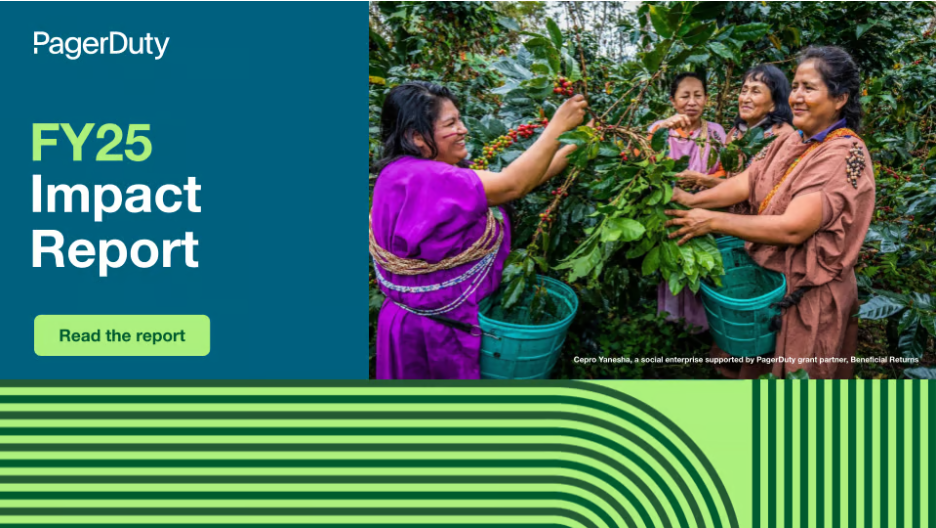
At PagerDuty, we demonstrate our global impact through sustainable practices, inclusive policies, and responsible operations. I’m proud to share our FY25 Impact Report, which highlights the meaningful progress we’ve made during the past year in service of our employees, customers, communities, and the planet.
Our purpose – empowering teams with the time and efficiency to build the future—guides every facet of our business. Through the power of our AI-powered PagerDuty Operations Cloud, we’re helping mission-driven organizations respond faster, work smarter, and stretch limited resources further, so they can focus on what matters most: their mission.
Powering Positive Change Through Technology
In FY25, 585 impact customers—nonprofits, healthcare providers, educational institutions, and B Corps—relied on PagerDuty to scale their reach and improve their operational resilience. This cohort grew 22% over the previous year.
From crisis helplines and food banks to organizations working on climate tech and renewable energy, our customers are using the Operations Cloud to respond to life-saving calls faster, manage systems more effectively, and increase their capacity for good. We supported these organizations with $2.2 million in product discounts and donations and pro bono services from our employee volunteers, earning a 90 Net Promoter Score (NPS) from our partners and grantees.
Our Impact Pricing and Technical Pro Bono programs are making it easier for mission-critical teams to adopt enterprise-grade solutions. We’re not just delivering software—we’re delivering time, efficiency, and trust when it matters most.
Our People, Driving Impact
One of the most inspiring aspects of my job is witnessing the commitment of PagerDuty employees to giving back. In FY25, 83% of our employees volunteered or donated to causes they care about. Through our Employee Impact program—which includes 20 hours of paid volunteer time off and 1:1 donation matching—they contributed over 9,000 hours of service and generated $123,800 in matched donations.
From mentoring youth to supporting mental health, climate action, and food security, our teams leaned into our values and showed up as changemakers in the communities we serve.
Investing in a More Sustainable Future
This year, we deepened our commitment to climate responsibility. Our climate targets were officially validated by the Science Based Targets initiative, and we achieved 100% renewable electricity sourcing ahead of schedule. We’ve also reduced our Scope 1 and 2 emissions by 90%, demonstrating that sustainable operations are not only possible—they’re achievable.
At the same time, we expanded our philanthropic investments, deploying $1.27 million through our Impact Fund to support crisis response, healthcare access, food security, and climate resilience. We also hosted our first-ever Impact Accelerator gathering, where grantees came together to share insights, explore new use cases, and deepen connections.
A Culture of Accountability and Integrity
Underpinning all of our efforts is a strong governance model designed to align our business with our values. From data privacy and ethics to employee development and responsible business practices, our Global Impact program is a company-wide effort supported by our Board, executive sponsors, and passionate internal advocates.
We continue to lead with purpose, build trust with our stakeholders, and scale impact through thoughtful collaboration.
Looking Ahead
Every milestone in this year’s report reflects the values of our people, customers, and partners who believe in doing business the right way—with compassion, responsibility, and a long-term perspective.
As we look to the future, our goal is simple: to transform critical work so all teams—especially those doing mission-driven work—can deliver on their promises, delight their stakeholders, and build a better world.
I invite you to read the full FY25 Impact Report and visit our Impact Hub to see the stories, data, and partnerships behind this year’s progress. Thank you for being part of the journey.
With gratitude,
Debbie O’Brien
Chief Communications Officer and VP of Global Impact, PagerDuty

Author: Ripple
Original article here
The 2024 Ripple Impact Report marks our commitment to leveraging blockchain to drive meaningful change and foster economic mobility around the globe. In 2024, we launched bolder partnerships, funded more innovative solutions and empowered our employees to make a bigger difference.
This report highlights our most impactful moments, illustrating how we’re using technology to connect communities and unlock potential on a global scale. We’re proud to deploy our people, products, and resources to accelerate financial inclusion, broaden blockchain and crypto research, and give back locally.
Impact by the Numbers
-
- $200M+ donated since 2018
- $21M in grants distributed in 2024
- 95% of carbon removals secured to achieve net zero by 2030
- 60 global university partners
-
- 1,500+ blockchain research papers and technical projects funded
- 80% employee participation in giving and volunteering programs
Impact Finance
Expanding financial services globally remained a priority for Ripple Impact in 2024 with new pilots and solutions built on XRP Ledger and leveraging the Ripple USD (RLUSD) stablecoin. We launched the Unlocking Opportunity initiative with Mercy Corps Ventures, a new humanitarian aid partnership with the International Rescue Committee and funded critical research with the Lab for Inclusive Fintech at UC Berkeley.
Blockchain Research and Innovation
Ripple’s University Blockchain Research Initiative (UBRI) continued to expand its global network, now supporting 60 leading universities worldwide. In 2024, UBRI welcomed four new partners and distributed $5.7M in funding.
Sustainability and Carbon Markets
Ripple made continued progress toward achieving net zero as a company by or before 2030 and invested in proven nature-based carbon removal methodologies.
Employee Impact
In 2024, Ripple employees made a greater impact than ever, with 80% participating in volunteering and giving programs. From mentoring job seekers in New York to packing reclaimed food in London and supporting young students in Bangalore, employees found meaningful ways to give back.
Global Philanthropy
Ripple provided funding to over 70 universities and nonprofits last year. We joined the Pledge 1% movement and when disasters struck, Ripple provided XRP and cash donations to relief organizations like World Central Kitchen. In 2024, we gave $21M in grants, totaling over $200M in donations since 2018.
We are grateful to our partners and employees who made all of the progress and milestones in our 2024 Ripple Impact Report possible. We remain committed to leveraging our technology, resources, and network to create lasting, meaningful change.
Read the full Ripple Impact Report to learn more.
Original article here.
Authors: Dr. Mahreen Khan and Dr. Khue Tran
There’s something powerful about giving back. Whether it’s helping a colleague, mentoring someone new, or dedicating time to a cause you care about, acts of service don’t just benefit others – they benefit those doing the giving, too.
At Atlassian, this philosophy is part of our ethos. Atlassian supports a culture of giving back by providing employees with 40 hours of paid leave to volunteer every year; encouraging team volunteering at our in-person team events; and embedding volunteer work into many teams’ Objectives and Key Results (OKRs). The visibility of these efforts, whether highlighted in company Town Halls or public tracking of team volunteering hours, reinforces how deeply this is woven into the fabric of the company.
And these initiatives work. Since June 2024, 3,252 Atlassians have volunteered through the Atlassian Foundation, contributing an incredible 26,891 hours total. That’s an average of 8 hours of volunteering per person!
And while these numbers are impressive, the real story lies in how volunteering is improving engagement, satisfaction, and even team performance. So, what does the research say about giving back?
Why volunteering makes us happier (and better) at work
It improves job satisfaction and loyalty
We conducted research internally at Atlassian by connecting survey data with volunteering data. Our research demonstrates that Atlassians who volunteer are less likely to want to seek jobs elsewhere and are more likely to believe Atlassian is a great place to work. When employees feel they are a part of something bigger, they develop a stronger connection to their workplace.
Our findings align with other research on corporate social responsibility (CSR) – companies that invest in social impact don’t just do good for the world; they also foster happier, more engaged employees.
It strengthens team connections
Volunteering isn’t just about individual growth – it helps our teams too. Atlassians who volunteer report feeling more excited about their work and feel more connected to their teams.
Why does this happen? Many Atlassians don’t volunteer solo – they volunteer together with their teams (especially at our in-person togetherness events!) Shared experiences, especially those outside of daily work tasks, create deeper bonds and increase trust. This is especially important in remote and hybrid environments, where organic moments of connection are harder to come by.
It creates a ripple effect
One of our most fascinating findings? Volunteering is contagious. People are significantly more likely to volunteer when their managers and team members are also volunteering.
This makes sense – when leaders prioritize giving back, it signals that it’s valued, creating a culture where more people feel inspired to participate. In fact, teams are even more likely to volunteer when their goals (e.g., their OKRs) explicitly support it.
Making giving back a part of work life
The more we give, the more we all gain. Companies that embed social impact into their culture aren’t just helping communities – they’re building workplaces where people feel inspired, engaged, and truly connected.
So, if you’ve never volunteered, now might be the perfect time to start. Not only will you be making a difference in the world, but you might just find it makes a difference in your work, your team, and your own sense of fulfillment.
Here’s where to start
The Atlassian Foundation has created a guide to help create volunteering opportunities in your workplace. Our volunteering campaign guide provides insights into how we create energy and a little friendly competition around volunteering.
Author: Vera Solutions
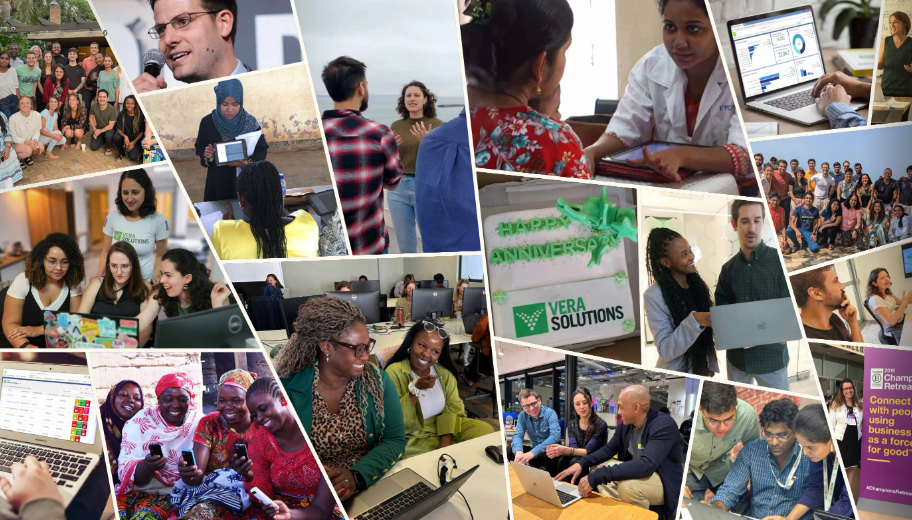
Vera Solutions is pleased to share their Impact Report, which highlights their journey as a B Corp and impact-driven social enterprise. The report offers a comprehensive glimpse into the milestones, partnerships, and innovations that have defined their work since 2010.
Explore the full report to discover how Vera Solutions has been transforming the social sector through data-driven technology solutions.

Original article here
Author: Deloitte
Corporate philanthropy has long been held to the standards of both business and traditional philanthropy. Too often, it falls short in both, and ends up marginal for corporations and marginal for philanthropy. But there’s now an opening for a new corporate philanthropy model to emerge—one that is uniquely its own.
Shifting the philanthropy strategy
A new era of opportunity in corporate philanthropy
Corporate philanthropy is caught between two paradigms.
It’s expected to deliver quick, measurable returns on investment as a business would—even when it’s addressing challenges where progress is hard to quantify. And it’s also expected to succeed by the standards of a traditional philanthropic foundation, but without the deep financial pockets and singular focus on charity. At the same time, corporate philanthropy is being asked to do more than ever before. The world’s disparities and injustices have become harder to ignore. The first few years of this decade have already seen a global pandemic, a widespread reckoning on racial justice, and climate-related disasters. Those shifts spurred greater social consciousness that has led consumers, employees, and the public to push organizations to make philanthropy a bigger priority.
These circumstances have made it difficult for corporate philanthropy to reach its potential. Difficult, but not impossible. To meet today’s challenges, corporate philanthropy can move beyond the paradigms that limit it, towards a uniquely new model.
“It’s up to companies to tear away the sediment of old ways of creating social good.”
-John Brothers, president of the T. Rowe Price Foundation.
Understanding the “Edges” of corporate philanthropy
Finding a new way forward starts with finding the “Edges,” critical frontiers of philanthropic practice that are particularly well-aligned to broader shifts in society. Exploring these Edges can help the organization discover more equitable and effective approaches to corporate giving, including:
- Rethinking corporate philanthropy’s role
How corporate philanthropy leaders are moving beyond just grantmaking to rethink the ways they add value - Balancing power
How corporate philanthropies are navigating the inherent power dynamics in the ways they approach their work - Acting with others
How corporate philanthropies are expanding impact via collaboration within and beyond the private sector - Creative funding mechanisms
How corporate philanthropies are allocating and disbursing funds in new ways
By experimenting along these Edges, pioneering corporate philanthropy leaders have already begun to discover new ways to shape and grow their impact. Their experiences serve as an invitation for everyone to reimagine their giving strategies and a model for how organizations can use their strengths to address society’s biggest challenges.