Kicking off our two-part series on Employee Engagement, this session highlighted the opportunities for engagement strategies in the new hybrid work environment, as well as critical initiatives to foster community and support employees remotely. Read the recap below and access the session resources here.
The continued uncertainty around in-person gatherings has improved our tactics of virtual employee engagement, leading to strategic shifts in our Pledge 1% programs around volunteering, giving, and awareness campaigns. Whether your social impact teams are organized within the Marketing, Corporate Affairs, or People departments in your company, successful programs need to adapt to the hybrid environment as we face the challenges of the post-pandemic workplace.
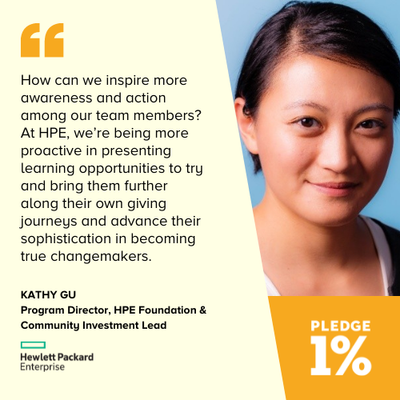
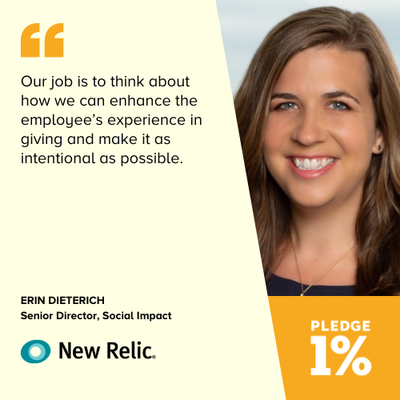
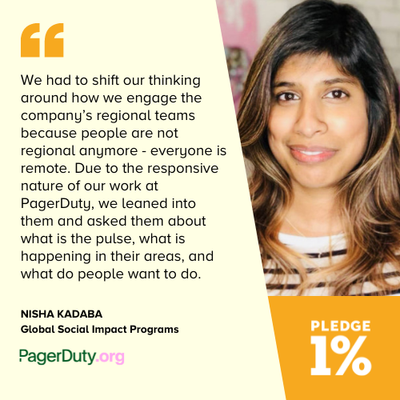
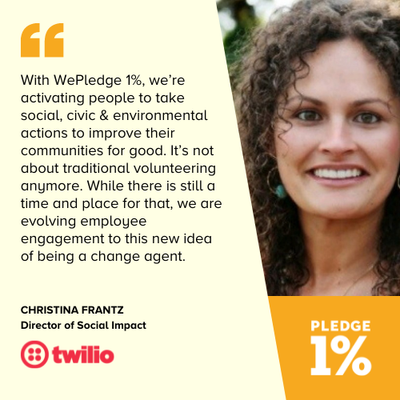
In this session, Pledge 1% Chief Executive, Amy Lesnick spoke with Erin Dieterich of New Relic, Kathy Gu of Hewlett Packard Enterprise, and Nisha Kadaba of PagerDuty about the integration of the new work environment into their social impact programs over the last 18 months. We also heard from Christina Frantz, Director of Social Impact at Twilio, who shared an update about the next WePledge 1% cohort starting in February 2022.
Here are our 4 takeaways from the event:
1. Human interaction should be at the center of employee engagement.
Getting people to connect with their coworkers and local communities should be at the heart of employee engagement. With hybrid workplaces on the rise, traditional ideas about volunteering, employee giving, and community connections are changing towards “learning and doing” where employees are brought together to learn the simple actions they can do in their own lives to make a difference.
2. Reflecting on feedback is essential to combat engagement fatigue.
Companies are finding a correlation between people who participate in their social impact programs and their retention. As employees continue to face uncertainty on a global scale, the engagement strategies implemented to employees as well as new hires need to be accessible. Tools like Benevity help make it easy for employees to track their impact, choose which partners they want to volunteer or donate, and open doors to participate in causes with their colleagues.
3.Expanding employee engagement across borders has never been easier than today.
Enhancing the VTO (Volunteer Time-Off) policy includes meeting employees where they’re at, given the resources and interests within their local community. Being more flexible and open-ended about where employees spend their time volunteering is a huge first step in breaking the barrier to engagement, as companies are starting to include peaceful demonstration and voting as ways to participate in corporate citizenship.
4.Employees are change agents waiting to be empowered.
Companies should provide the tools and resources for employees to engage. Activating employees to become a more central part of your organization’s social impact strategy is a journey best shared with like-minded people who want to create impact, collectively. Twilio has open-sourced their WePledge 1% approach and has partnered with Pledge 1% to guide small groups in developing employee impact programs.
Event Roundup – Pledge 1% ESG Summer Series on ESG Trends & Innovation Workshop (Part One)
As part of our summer learning series on ESG, this initial session outlined the broad strokes of the ESG movement and how it pertains to – and adds value – to organizations committed to a better future. Read the recap below and access the workshop resources here.
ESG (which stands for Environmental, Social, and Corporate Governance) has been quickly adopted by some of the most influential and disruptive companies in the world. In particular, ESG has become associated with investor expectations and approaches to evaluating sustainable businesses. ESG doesn’t just improve the world. It’s good for business and helps with driving access to capital, increasing business efficiency, giving the ‘purpose-driven brand’ competitive advantage, employing risk management, and attracting and retaining top talent.
There is a wide variety of terminology used to represent ESG, but it’s important that companies focus on issues that are relevant to their team and investors, and that their ESG goals and terms are defined in a way that key stakeholders can understand.
To help us get an even clearer understanding of these terms, Kelly Gallo of BSR, Danielle Conkling of Silicon Valley Bank, and Corrie Conrad of Box facilitated a special workshop for Pledge 1% members. Here are three takeaways to help companies get started from the event:
Step 1: Articulate Purpose
To close potential sustainability value and exceptions gaps, company leaders should take steps to integrate sustainability into their purpose and strategic plan. Ask yourself how your chosen ESGs are reflective of what your company wants moving forward. Share this plan with all stakeholders, so everyone involved understands how companies with sustainable businesses drive success.
Step 2: Identify and Strategize on Material ESG Issues
Conducting a business-specific materiality assessment can help companies manage their social and environmental impacts and identify the top issues they need to manage, even with limited dedicated resources. Organize interviews with investors and ask direct questions to figure out what issues are important to your business and society at large.
Step 3: Communicate Your ESG Approach
Companies accessing public capital markets should aim to provide ESG data that is robust and actionable to investors. Set a baseline for decision-useful information and start a landing page that links to existing material you may already have on your work towards a more sustainable future.
To learn more, watch the full recording of the conversation below. Don’t forget to watch the next three sessions in our ESG Summer Series:
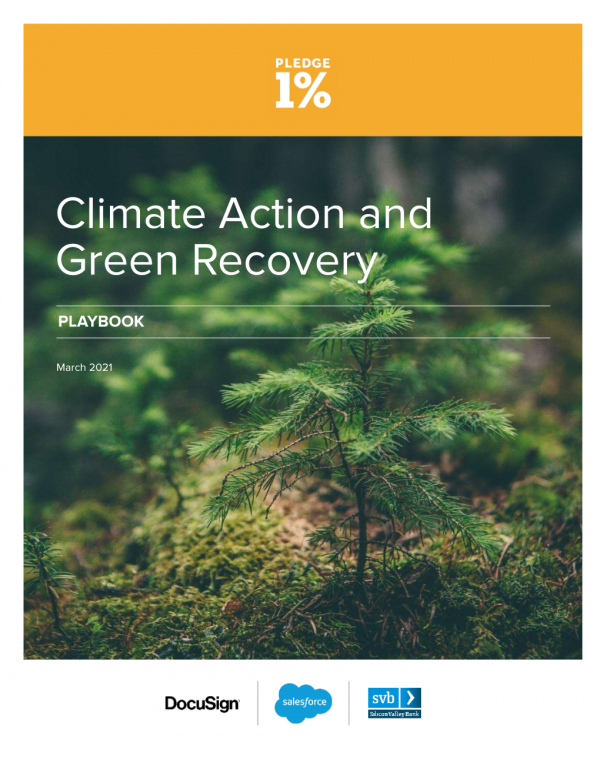
Every year to celebrate Earth Day, we post tips and challenges in encouraging you to make your #PledgetoPreserve! This year, we are excited to work with a number of our members on collecting and sharing 22 tips and strategies for you, your teams, your customers, and your families to protect the planet. You can read the tips below or download our complete Climate Action & Green Recovery Playbook, co-written by Salesforce, DocuSign, and Silicon Valley Bank, to build environmentally-friendly practices into your business operations!
Here are 22 ways for you to rethink your environmental impact whether you’re at home or at work:
Reduce energy use by adjusting your thermostat. Did you know you can save 10% by dialing your thermostat back for just 8 hours? You can also experiment with your refrigerator temperature.
Unplug devices when not in use.Products that are plugged in may still suck up energy. Avoid “vampire energy” loss and remember to unplug when you leave the room.
Opt for energy efficient bulbs.Look for labels that tell you the product is energy efficient, such as EPEAT certified and ENERGY STAR in the US.
Repair leaky faucets: Small leaks are often overlooked and can lead to massive amounts of wasted water, a higher water bill, and potential property damage.
Update your showerhead: Low-flow showerheads reduce water and are easy to install. Newer designs that add pressure make it so that you may not even notice a difference.
Buy local, in season food.Support sustainable farms and fisheries that utilize sustainable farming systems. These products are often noted with an indicator but don’t be afraid to ask your local grocer for suggestions as well!
Plant a tree!The original act of protecting the planet. Find a tree species native to your region that you like, then visit your local nursery to purchase and plant your own tree seedlings!
Grow an herb garden–indoor or outdoor.Growing your own herbs is an easy and fun way to directly connect with your food and to save money while sprucing up your meals. Plus, herb gardens can be grown indoors and take up minimal space.
BYO whenever you can.Reduce your footprint by bringing your own bags when grocery shopping, reusable utensils for takeout, etc.
Invest in a DIY project.Save some money while protecting the environment by opting to build your own product vs. buying something new. The DIY Network is a great resource.
Educate yourself. There are a number of free resources that you and your teams can take advantage of to better educate yourself on the effects of climate change and what you can do as an organization to mitigate it. Check out this module from Salesforce: Create a Sustainable Future
Plan activities around themes for the week. It’s easier to uphold your commitments when they sound memorable. Try going for Meatless Mondays, Waste Less Wednesdays or Forest Fridays.
Volunteer in a cleanup program.Go solo, invite a friend or bring your entire team along!Barrel Bag invites individuals and businesses to conduct a quick community cleanup in support of Earth Day. Collect litter in your neighborhood, the beach, or a hiking trail where they aren’t supposed to be. Apps like Litterati collect data on discarded trash and are user-friendly!
Lessen food waste. Practice home-cooking responsibly by planning your meals ahead. If you can’t avoid food delivery, skip the utensils and leave a note asking for the least amount of packaging possible!
Learn how to compost. Your food waste shouldn’t end up in landfills which release methane gas. Throwing it in a compost bin will not only save the planet but also your wallet!
Fix and recycle items worth saving. Be creative and look for solutions instead of buying something new! Check out this list of Earth Day activities to do with kids.
Use cold water when doing your laundry. The enzymes in cold water detergent are designed to clean better in cold water. Also, reducing your loads to twice weekly can save up to 500 pounds of carbon dioxide each year.
Watch documentaries about environmental issues. Switch your usual movie night to something more educational. Some of the most groundbreaking nature films and television series can be viewed online.
Go digital. Move away from printed documents where possible. Learn how technology can help the planet by improving your digital skills for the workplace.
Shift your purchases to local vendors.Not only is it an important way to keep money circulating within the local economy, but it also helps reduce the amount of carbon emissions from transport and shipping.
Pick out rarely used items from your household or garage for resale.Protect the environment from generating more waste when others may find your items useful! Why not make a few bucks while you’re at it? Take a photo, send it to close friends, or upload it on your favorite online marketplace.
Join advocacy groups or follow their pages.Sharing is caring! Learning from practitioners is also useful in fostering climate-friendly habits.
For more tips, tools, and advice from our members, visit our Twitter page or follow the hashtag #PledgetoPreserve from now until Earth Day (April 22)!
Originally posted: April 14th, 2021
Written by Julie Maples. Originally published onLinkedIn.com
Today, FYRFLY Venture Partners officially joined Coach K’s Dream Team. No, Philipp Stauffer and I have not been drafted to play basketball for Duke. Rather, we are making a significant donation to the V Foundation for Cancer Research Endowment, which enables the organization to mobilize 100% of direct donations towards finding cures for cancer. In doing so, we have fulfilled part of our commitment to Pledge 1%, a global movement to build philanthropy into the DNA of companies.
We are sharing this news because we want more founders and investors to Pledge 1%.
Today, humanity faces a once-in-a-generation challenge. Unemployment, civil strife, food insecurity, and the grief of losing loved ones to COVID-19 have stricken too many communities. However, 2020 has been a boom year for technology startups, an unusually high number of which are going public. The many liquidity events of 2020 have given entrepreneurs and investors the opportunity to make a difference at this crucial juncture in history.
If you’ve been graced by fortune this year, I encourage you to Pledge 1%. How you fulfill your pledge is a personal decision. I’d like to share why FYRFLY pledged and how that led us to Coach K’s Dream Team.
When Philipp and I founded FYRFLY in 2015, we didn’t see ourselves as an “impact” fund, but wanted to make philanthropy a core of our identity and mission anyway. We took our lead from Salesforce founder Marc Benioff, whose 1-1-1 philanthropy model was gaining traction through Pledge 1%. Philipp and I committed to donate 1% of our carried interest, 1% of our time, and 1% of our product to charity. Many of our portfolio companies have also adopted these practices, which have become a crucial part of their brand identity and success. We encourage our founders to focus on issues that have impacted their lives.
So, why did cancer become one of FYRFLY’s main areas of support? And why The V Foundation?
Founded by the legendary college basketball coach and commentator Jimmy Valvano, who passed away from cancer in 1993, the V Foundation is on a mission to cure cancer. Coach K (aka Mike Krzyzewski), a dear friend of Jimmy’s, is leading the charge to sustain the V Foundation in these chaotic economic times.
My father produced the first Excellence in Sports Performance Yearly (ESPY) Awards in 1993. Jimmy V received the Arthur Ashe Courage and Humanitarian Award that day. During his acceptance speech, Jimmy announced that, with ESPN’s support, he was launching the Jimmy V Foundation for Cancer Research and stated his famous edict: “Don’t give up…Don’t ever give up!”®
Nearing the end of his life, Jimmy did not give up. Instead, he asked the audience for research funding. “It may not save my life. It may save my children’s lives. It may save someone you love,” said Jimmy.
I lost my mother to cancer at a young age and connected deeply to Jimmy’s cause. Philipp lost his mother to cancer as well. Worldwide, more than 9.5 million people will die of cancer in 2020. It is the second leading cause of death globally. But thanks to world-class research funded by The V Foundation and other nonprofits, we have drastically better treatments for cancer today than we did in Jimmy’s day. Now more than ever, there is HOPE for cures.
Today, I am the chairwoman and co-founder of The V Foundation Wine Celebration, which has raised over $118 million for cancer research. When I founded the event, I wanted to give my time and effort. Yet being a part of “The V Team” and serving alongside Coach K and other esteemed members, I’ve learned that sharing a mission to change lives has given me far more in return.
Pledge 1% was one of the most important decisions FYRFLY Venture Partners has made. It has defined the spirit of our work, reminding us always to consider the impact of our investments and our advice to founders. Indeed, we believe that ‘Impact’ Investing is the Only Kind Left.
In joining Coach K’s Dream Team and being explicit about our Pledge 1% commitment, we are proud to honor our mothers, Jimmy V, and our mission at FYRFLY Venture Partners to align commercial success with the common good.
If curing cancer is a cause dear to your heart, join us on Coach K’s Dream Team. Either way, Pledge 1%, pick causes that fill you with passion, and use your resources to do good. Your leadership and support matter.
Originally posted: October 27th, 2020
Written by Pledge 1% and Andy Fyfe, Manager of B Corp Growth and Activation for B Lab U.S. & Canada. Originally published onbthechange.com
As a global community, we continue to face insurmountable challenges — from the pandemic to recent protests calling for racial justice to increased urgency surrounding climate change and more. This is only proving how companies can be on the frontlines, leveraging their time, talent, and resources to build solutions. Now more than ever, companies are seeking opportunities to build their social impact programs and ensure that they are equipped to tackle the biggest issues of the day.
However, for many companies — both early- and late-stage— donating time, money and resources can be difficult. Pledging equity is an easy and effective way for companies to play an active role in addressing these issues without having to worry about immediate upfront costs.
In the last four years, Pledge 1% members have ignited more than $500 million in new philanthropy by pledging equity.
What’s more, today’s investors, customers and employees are seeking organizations that are committed to creating positive change in their communities. In the war for talent and customers, a company that prioritizes social impact differentiates itself from competitors.
“In the first quarter of 2020, companies identified as having strong environmental, social and corporate governance principles outperformed traditional offerings, in part due to their lower exposure to the energy sector as oil prices crashed. The results come amid debate that ‘shareholder primacy’ is nearing its end as ‘stakeholder capitalism,’ where equal value to all stakeholders including customers, employees and suppliers takes hold,” explains Jon Hale of Morningstar. “It’s very simple, really — companies truly focused on the well-being of their workers and customers are able to make the right decisions more quickly in a major crisis like this one.”
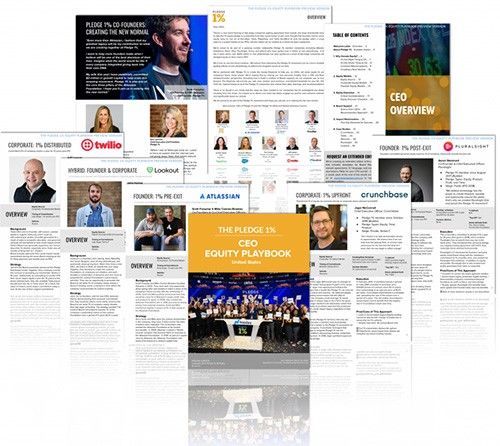
In collaboration with top CEOs from a variety of industries, Pledge 1% has published a new, comprehensive CEO Equity Playbook, which outlines how companies of any size can set aside equity to fund social impact initiatives. This invaluable resource includes tips on how to garner board support, examples of the different types of equity models, and case studies from leaders such as Twilio, Crunchbase, and more.
“You can’t expect others to step up to make the change you desire,” says Pledge 1% Chief Executive Amy Lesnick. “Pledging equity gives you the reins and allows your company to be a key part of that change. It can help ensure your impact in the long run, helping you build a company culture and legacy that promotes a cohesive, inclusive environment for all.”
A new impact economy is being built, one where businesses prioritize and consider their impact on all the stakeholders they impact — including communities, workers, customers, and the environment. Download this free report to learn how the stakeholder model as practiced by B Corps is gaining global traction and validation.
In addition to Pledge 1%’s resources, B Lab has stewarded a community of Certified B Corporations proving that profit and mission do not need to be tradeoffs. Behind the certification, every B Corp has amended its legal charter to be accountable to all its stakeholders, not just its shareholders. Just how Pledge 1% has paved the way for fast-growing companies to embed equity for social impact, a wave of B Corps around the world are proving that doing good as a business is not a trend but the future.
Beyond company leadership, though, if we seek an inclusive and equitable economic system for all people and the planet, we need to make sweeping changes to policy. It is not simply individual actors that must change, but rather the system itself that must evolve so that extractive profits are no longer available to companies and investors. This month B Lab U.S. & Canada released its first policy white paper: From Shareholder Primacy to Stakeholder Capitalism.
“The disconnect between the needs of citizen-shareholders and the behavior of corporations has led to growing inequality and fueled an environmental emergency. We don’t need more evidence than what we’re seeing right now. And so we can no longer ask leaders to lead in a system with misaligned incentives and a culture with contrary norms. To see the systems change we seek we must shift culture and policy. That is what both Pledge 1% and B Lab are accomplishing.” Andy Fyfe, Manager of B Corp Growth and Activation for B Lab U.S. & Canada
Earlier this year Lemonade, an insurance company that is a B Corp and benefit corporation, in its S1 clearly stated that its fiduciary duty is expanded beyond just the financial return to its shareholders but to the well-being of stakeholders— unprecedented in a IPO.
“We believe values add value. Lemonade is a public benefit corporation, meaning that while we are about profit maximization over the long run, that is not all we are about. Our business decisions consider the greater good, and the value we are looking to create is measured in many currencies, money being but one of them. In any event, we reject the dichotomy between doing well and doing right.” Lemonade S1 (p. 117)
Today’s issues will not be solved by governments or nonprofits alone. Setting aside a portion of company equity today will ensure the business has a lasting impact tomorrow. Additionally, sharing program initiatives and best practices for how to create sustainable impact programs will help us all as we work to move forward together. Both B Lab and Pledge 1% are providing tools and frameworks to help companies of all sizes and stages navigate today’s issues and set themselves up for long-term impact.
B The Change gathers and shares the voices from within the movement of people using business as a force for good and the community of Certified B Corporations. The opinions expressed do not necessarily reflect those of the nonprofit B Lab.
Originally posted: October 13th, 2020
[July 29, 2020] We are entering a new era of corporate giving. Now, more than ever before, top talent and customers want to work for and with companies whose values are aligned with their own. Companies that have implemented one or more of the Pledge 1% commitments (donating 1% of employee time, product, equity or profit) are at the forefront of this growing trend and are creating a new normal for businesses to leverage their impact for good.
With today’s unprecedented social, health, and economic challenges, it’s clear that companies have an important and essential role to play in being part of the solution. One way companies of all sizes and stages are securing their social impact work for years to come is by pledging equity. By setting aside equity for social impact, companies can demonstrate their long-term commitment to these values, differentiate their company from competitors, and sustainably fund their social impact work for years to come. In the last 3 years alone, top companies that set aside equity for social impact have ignited over $250 million in new philanthropy via their IPOs.
Pledging equity is especially valuable for startups that are interested in giving back, but have yet to see profit. It is also increasingly becoming the norm for top late-stage companies. In fact, many of today’s most successful companies, including Docusign, PagerDuty, Pluralsight, Sendgrid, Slack, Twilio, Upwork, and Zuora have pledged equity on the road to IPO.
We are also seeing tremendous support from the VC community, as individual investors from top venture capital firms, including Accel, Bain Capital, Benchmark, Bessemer Venture Partners, Foundry Group, Index Ventures, Jackson Square Ventures, Khosla Ventures, Mayfield Fund, Salesforce Ventures, Sequoia Capital, SV Angel, Techstars have supported their portfolio company CEOs in educating other Board members and setting aside equity for social impact.
“There’s never been a more important time for companies to leverage their assets to be a force for good. Setting aside equity now for social impact, ensures that companies will have the resources they need to tackle the most pressing issues in our future,” said Amy Lesnick, Chief Executive of Pledge 1%. “Pledging equity is increasingly becoming the new normal for successful companies who understand that this is not only good for the world, it’s also good for business as employees and customers expect them to do more than simply generate growth and profit.”
The new Pledge 1% CEO Equity Playbook and Companion Guide for CFOs and GCs was designed in collaboration with top CEOs and thought leaders to help companies of all sizes pledge equity. Contents include equity donation models for founders, corporate case studies, and more. The Companion Guide was created for CFOs and GCs to help their companies formalize the equity pledge, and contains legal templates and tools.
Today’s issues will not be resolved by governments and nonprofits alone. The companies who set aside equity for philanthropy pre-liquidity have been able to fund efforts around COVID-19 relief, social justice, economic development, and other global challenges. Download the Playbook to learn how you can pledge equity today for impact tomorrow.
– Small businesses are well-positioned to make a difference within their communities in ways that fit with their local focus or mission. We discuss a few ways that a small business can identify causes that fit with their mission and/or community focus through different forms of giving.
– To demonstrate their commitments and join communities of like-minded business owners, small businesses can join organizations focused on social change.
– We discuss how we determinedProfVal’s focus on educational programs throughProfval.org.
Your business is probably a small business:Most U.S. businesses (99.7%) are small business,[i]thoughsmallmay be bigger than you imagined. According to the Small Business Association (SBA), a small food business can have over $40 million in revenue while a small telecommunications reseller can have up to 1,500 employees[ii]. But when most people think of a small business, they imagine the 95% of businesses that have 9 employees or less.[iii]
Whichever definition of small you use, however, small businesses represent hubs of innovation that generate the majority of new jobs created in the U.S.[iv]and are well-positioned to make an impact within their communities in ways that fit with their mission or local focus. So how can your small business make a difference?
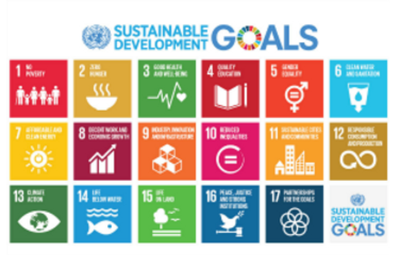
Small businesses can make a world of difference:There are many ways that your small business can create a big impact in the areas that matter to you. One approach that many businesses use is to look at the UN Sustainable Development Goals (SDGs). Built on decades of research and signed onto by all UN member states, the SDGs seek to make the world a better place through global, local, and people action[v]. Given the depth of these goals, there is a high probability that the social impact you seek to make aligns to one of the 17 SDGs, which happen to be color-coded.
“Entrepreneurs are like artists and can use the SDGs as their color palette to decide how they’d like to impact the world. Choose 1 or a few SDGs to focus on and build your entire business around that”.
Along these lines, Mr. Distante is an SDG evangelist and serial entrepreneur. “At Vanderbilt Financial Group and ImpactU.Film, we focus on “Partnership for the Goals” (SDG 17) because we share the stories for these impactful entrepreneurs through film and use that to connect them to capital and investors who believe in the mission of their businesses.” ImpactU.Film’s interesting and effectively produced documentaries have been shared with entrepreneurs and students across the U.S.
Small and large businesses can demonstrate their social impact to the SDGs by making an official commitment to the framework. This involves annual reporting, integrating the SDGs within your business, and making a financial commitment to the UN SDGs which, at the time of this writing, ranges from$1250 to $20,000 depending on the size of your business.
Some socially responsible businesses may incorporate elements of the SDGs into their businesses, but in an informal way. The Long Island-basedTazzetto, seeks to systematically incorporate sustainability into their products and café operations. Chief Operating OfficerVincent Arenarecently told me that “All of our products are either reusable, biodegradable, recyclable, or edible (our edible andtasty coffee cup)”.Mr. Arena also volunteers as Director of Climate Action Campaigns and Sustainable Development Programs at United Nations Association of Long Island. Through these activities, Tazetto unofficially engages in UN SDG goals related to clean water (SDG #6) and responsible consumption and production (SDG #12).
Accordingly, the UN SDGs offer a full framework for businesses of all sizes to make a difference. Another way to give back, however, is through Pledge 1%.
Pledge to give equity, time, product, or profit:As an alternative or supplement to the UN SDGs, some businesses make public commitments of their intent to make a difference through other external platforms. One good way of making your public commitment for social change is throughPledge 1%.Pledge 1% is a global movement that inspires, educates, and empowers every entrepreneur, company, and employee to be a force for good. Already, over 10,000 socially minded companies have made giving commitments through Pledge 1%. Pledge 1% asks companies to commit to giving back in one of or more of the following four categories[i]:
Equityof a company, of a founder, or a combination of both.
Timethrough volunteering, training of others, or providing advice.
Productthrough giving away services, tech products, or tangible goods.
Profitthough giving to organizations that matter to you and fit with your mission.
“We are proud to work with Profval on growing the Pledge 1% community and are excited to see another innovative company take the pledge and encourage other companies and leaders to do so as well,”
How did ProfVal use this approach to build social impact into our business?For us, there was never a question about whether ProfVal would give back. Accordingly, we gauge ProfVal’s success along two core dimensions: i) our ability to deliver high-quality services to our clients built upon an architecture of research, and ii) our educational investments into the local, national, and international communities that we and our clients represent.
Our focus on education is likely unsurprising. We are a purpose-driven andprofessor-foundedcompany. I became a professor in part because of the joy I experienced while volunteering at the high school I graduated from. After earning my PhD and becoming a professor, I have long viewed the production of new knowledge through research related to social responsibility[vii][viii][ix]and teaching as important ways of making the world a better place. Like the professors we work with through ProfVal.com, I believe that education has a transformative effect on people’s lives.
This idea is not novel. In 1848, the pioneering American educator Horace Mann stated:
“Education beyond all other devices of human origin, is a great equalizer of the conditions of men—the balance wheel of the social machinery.”
Unfortunately, however, education—and therefore opportunity—is unequally distributed. In fact, the educational attainment of economically disadvantaged students lags years behind children from wealthy families.[x]Differences in educational attainment along lines of wealth, race, gender, and other social and economic factors ultimately perpetuate inequality for future generations. Consistent with the approach we described earlier, education relates to one of the UN’s SDG goals (#4: Quality Education).
Following the approach that we suggested above, we made a commitment throughPledge 1%to formally demonstrate our commitment to integrating our social purpose into our business. Based on our commitment, we i) donate part of our profits to nonprofits that make a difference in education, ii) if our company is ever sold, part of the equity will be given to educational nonprofits, and iii) we provide discounts to clients that are registered nonprofits. Additionally, we match qualifying donations made by our clients to educational nonprofits through our giving site,profval.org.
In these ways, we have followed the giving approach that we suggest in this document. Our approach may not be the right one for you, but we hope it can help you to find an approach that fits for your company’s mission and/or local focus. Keep in mind that you or your company can make a difference in ways that matter to you.
ProfVal, LLC(profval.com) is a purpose-driven, professor-founded, and ethically-grounded provider of Expert Opinion Letters that can be used to support employment-based visas (H-1B, L1, EB, O). ProfVal is dedicated to helping clients through services built based on an architecture of research. ProfVal is dedicated to helping our communities through our giving site,profval.org.
Zachary Johnson, Ph.D.is the founder of ProfVal, LLC. He has over a decade of experience as a professor, academic researcher, academic program developer, and leader in academics. Through consulting engagements through ProfVal and otherwise, he has worked with members of the Fortune 500, startups, and nonprofits.
Stephen Distanteis an entrepreneur and filmmaker. He is the Chairman & Founder of Vanderbilt Financial Group, a financial institution that provides state of the art technology along with socially responsible investment strategies that allow customers to align their investments with their social values. He is also a documentary filmmaker who shares stories of Entrepreneurs who use their businesses to make a difference in the world through the lens of the UN SDGs (Sustainable Development Goals). His films are created to Inspire, Educate and Celebrate fellow entrepreneurs for us all to consider our gift of entrepreneurship for good.www.ImpactU.Film.
Vincent Arenaseeks to solve systematic problems with sustainable and value-centered design. He is the Chief Operating Officer ofTazetto Coffee, which is a pioneering a new café concept that perfectly blends authentic Italian coffees, food products, and traditions with a focus on sustainability and innovation. He is also the Director of Climate Action Campaigns and Sustainable Development Programs with the United Nations Association of Long Island.http://www.vincentarena.com
Pledge 1%(https://pledge1percent.org/) is a “global movement to create a new normal in which giving back is integrated into the DNA of companies of all sizes. Pledge 1% encourages and challenges individuals and companies to Pledge 1% of equity, profit, product, and/or employee time for their communities” (https://pledge1percent.org/overview.html).
[vii]Johnson, Zachary, Huifang Mao, Sarah Lefebvre, and Jaishankar Ganesh (2019), “Good Guys Can Finish First: How Brand Reputation Affects Extension Evaluations,”Journal of Consumer Psychology29(4), 565–83.(link)
[viii]Johnson, Zachary, Yun Jung, Lee, and Minoo Talebi Ashoori (2018), “Brand Associations: The Value of Ability Versus Social Responsibility Depends on Consumer Goals,”Journal of Brand Management25(1), 27–37(link)
[ix]Johnson, Zachary, Minoo Talebi, and Yun Yung Lee (2018), “Self-Reporting of CSR Policies and Impact: When Your Company Harms, Do You Self-Disclose?”Corporate Reputation Review21(4), 153–64.(link)
Written by Sarah Goff-Dupont. Originally published on theAtlassian blog.
If 1 in 10 companies shared a business practice in common, would you sit up and take note? If the number moved to 1 in 5, would you think seriously about following suit? What about 1 in 4?
That’s exactly the trajectory of one of the hottest employer trends: paid time off to volunteer (also knows as “volunteer time off”, or “VTO”).
According to the 2018 Employee Benefits Report issued by the Society for HR Management, nearly 1 in 4 companies and non-profits in the U.S. are using VTO to parlay corporate social responsibility into a competitive advantage. So what do these savvy organizations know that the other 3 in 4 don’t?
What is VTO and why is it trending?
Volunteer time off (VTO) is employer-sponsored paid time to do volunteer work in your community. Participating employers typically grant between 8 and 40 hours of VTO per year.
Less than ten years ago, VTO was rare, with roughly 15% of employers offering it in 2009 and only about 1% planning to offer it soon. Over the past decade, however, companies have started to take social responsibility seriously, seeking to counteract all manner of negative externalities from displacement of long-time urban residents to pollution to the spread of fake news.
At the same time, Millennials have surged into the workforce and overtaken Gen Xas the most populous age group in the U.S. labor market. Contrary to their reputation for self-centeredness, this generation has a strong sense of purpose and cares deeply about issues of social justice. Factor in yet a third trend, the global war for talent, and the equation suddenly becomes clear.
A 10,000-watt spotlight on corporate social responsibility + the need to attract young, socially-conscious workers in an increasingly competitive hiring environment = an explosion in VTO’s popularity.
That’s all well and good. But what if a company doesn’t have an image problem and isn’t on a hiring spree – would VTO still make good business sense? The answer is a resounding “yes”.
Recruit, engage, retain, repeat
The “selfie generation” isn’t as selfish as they’re often portrayed. According to studies released in 2015 and 2016, 80% of Millennials make charitable contributions, 70% volunteer at least once a year, and 37% spend at least ten hours annually volunteering. Their reputation for being fickle, however, has a stronger basis in fact. The 2016 study showed that 1 in 4 would leave their job after less than a year if a new opportunity arose elsewhere. In a 2-year timeframe, the number goes up to almost 1 in 2.
The recruiting challenge for employers, then, is to meet these purpose-filled candidates where they are and channel all that energy into work they find meaningful. “It doesn’t have to be hard,” says Jeremy Kreitler, CEO of Gliffy, a San Francisco-based software company that runs multiple philanthropic programs internally. “When people talk about what they like most about working at Gliffy, they mention the volunteering and the fact that we give 5% of our profits to charity.”
When coupled with a compelling, bullshit-free mission, VTO is one of the best ways to speak their language. Indeed, 60% of Millennials report choosing (and sticking with) their current employer because they feel a sense of purpose there.
I want to do more with my career than just help somebody make money. VTO is what made me feel comfortable leaving my job in non-profit for a role in the corporate sector. I feel I can do just as much (if not more) good this way. – Claire Cook, marketer (also, dog-lover and Millennial)
It’s not just about courting Millennials, however. The workforce still contains a handful of Boomers and scads of Gen X’ers who don’t just want to make a living, but make a difference while they’re at it. Many have scars from the toxic, burn-you-out corporate cultures that dominated the ’80s, ’90s, and early 2000s, and are thoughtful about the kind of work environment they step into. Turns out, volunteerism is widely regarded as a boost to a company’s reputation as a great place to work.
“Lots of people say they were attracted to the company by our culture of ‘being the change you seek’ and the chance to make a difference that extends beyond our products”, says Jessica Hyman, a member of Atlassian’s talent team. She’s also noticed employees shaping their jobs with an eye toward social impact once they’re in the door. “Most people use their VTO. And we never struggle to fill the seats on the Atlassian Foundation’s employee council.”
Kreitler sees a similar pattern at Gliffy, where they organize dedicated volunteer days with local non-profits that are open to all employees. “The company organized days make volunteering accessible to employees, and stimulate more people to participate,” he says. And ever since they focused these days on organizations that help deal with homelessness (an employee-driven decision), participation is trending upward.
It doesn’t have to be hard. – Jeremy Kreitler, Gliffy CEO
As if employee engagement wasn’t enough, 65% of HR executives point out that VTO is also an investment in workforce development. Volunteering helps cultivate the soft skills that are increasingly important for knowledge workers: collaboration, empathy, adaptability, leadership, and public speaking (to name a few). As repetitive tasks become automated, such skills will be absolutely vital in the creative and analytical jobs still held by humans.
Think globally, invest locally
Despite VTO’s rising popularity, it’s hardly the only way for companies to help employees make a positive impact. Organizations like Pledge 1% encourage companies to invest a small slice of their profits, product, equity, and/or employee time back into the community. To date, over 5000 companies have signed on.
Thousands of other companies are investing in social impact in more focused ways.
Charitable giving – Many companies, Atlassian and Gliffy among them, choose one cause they want to support, then dedicate a small portion of their profits to cash contributions.
Donation matching – 18% of companies match employee’s charitable donations, up to a certain amount (typically $500-1000 annually).
Donation via payroll deduction – Giving is easy when it happens before the money even hits your bank account. For example, Atlassian employees have the option to donate a dollar a day to Room To Read, which is automatically deducted from their paychecks.
Dedicated volunteer days – Many companies opt to organize one-off volunteer days with local food shelves, schools, or organizations like Habitat For Humanity. This works great at the department and team level, too.
Whether a company tests the waters slowly or dives right in by taking the 1% pledge, it’s important to proceed thoughtfully. Employees view programs like VTO as a cherished benefit, making them hard to take back once a precedent has been set. That said, delaying this kind of investment only makes it harder to get started.
Pledging to give back 1% is really easy in the early days of a company because 1% of nearly nothing is nothing. – Scott Farquhar, Atlassian and Pledge 1% co-founder
Besides: the race to recruit and retain top talent isn’t easing up any time soon. Nor is the increased scrutiny on corporations. Corporate transparency is on the rise, driven by inside whistleblowers, citizen journalism on social media, as well as companies’ own desire to open up and make who they are on the inside a part of their external branding.
As the #DeleteUber movement reminded us, customers care about what goes on inside a company’s walls. The organizations poised to thrive in this new era are those who think not just about their shareholders, but also their employee and community stakeholders.
. . .
For more information on sustainable corporate social responsibility and philanthropy programs, check out Pledge 1%. Thousands of companies have already taken the pledge – will you be next?
Although we have a huge amount of data, still we are not able to fully address the needs of underrepresented and underserved populations around the world. Issue that the United Nations have been trying to solve with their recent creation of the 17 Sustainable Development Goals for the overall growth of the climate, people, and the planet. In order to achieve these targets, public institutions and private companies need to get actively involved and collaborate. As access to proper technology, data, and appropriate analysis become critical tasks at this stage, the concept of data philanthropy comes also into action. The next step should be that private companies start collaborating together so that they can donate data and create efficient resources to solve global challenges.
Unlimited flow of data:
Stats reveal that we produce almost 2.5 quintillion data bytes every day and the amount is further increasing exponentially. This huge amount of data can assist in finding appropriate solutions to social issues. Studies reveal that only 0.5% data out of this amount is available for analysis throughout the world. It means we still have many opportunities to fully explore this incredible digital universe in a profitable and impactful manner.
Whyare wenot finding right solutions to rise?
It’s a well-known fact that private companies around the world possess the majority of essential data and they utilize it to just drive efficient business decisions. However, the same data can be utilized to serve many other purposes as well.
Let us take a simple example. In 2013 Orange Telecom launched its Data 4 Development challenge where researchers were supposed to collect anonymized data over mobile networks in Senegal. As a result, they collected details on where people were traveling during variable weather conditions, holidays and work days throughout the year. After this, they analyzed public health datasets and were able to collect information about patterns related to malaria infections with population migrations. With these details, researchers found some insights about when outbreaks can occur in society so that local service providers can take preventive actions on time.
Now, if we suppose that only 1% of data out of al the privately owned 10 Billion Terabytes was made accessible to researchers, then they would be able to make great changes in the society.
Howcan tech companieshelp?
Tech companies are capable enough to power up this data philanthropy movement by simply developing new techniques to generate important missing data, donating data or even better, donate the time or the skills to analyze data for social good. For example, stats reveal that almost 350 million people all around the world could be absent from the essential public census data and it directly leads to 25% boost in the global poverty. The best idea to fill this technology gap is to initiate collaborative movement among various international institutions and tech companies so that much better solutions to social issues can be developed.
Data philanthropy gaining momentum
If the exponential rate of data production continues to rise, we may not have to wait too much longer before data philanthropy is something that every company will consider as part of their corporate social responsibility (CSR).
For example at John Snow Labs we’ve partnered last year with London’s SHM Foundation to help with Project Khuluma –a mobile phone support group initiative to address the mental health and wellbeing needs of HIV positive adolescents in South Africa.
Tackling mental health is a major global health challenge. Nearly 75% of the 450 million people worldwide with a mental illness live in the developing world, and 85% of these people have no access to treatment. The social and economic costs are enormous.
This was all part of a much wider Data Philanthropy Program, which is part of our company’s mission and culture, allowing us to make a positive impact while using our domain expertise for social good.
More awareness about data philanthropy is urgently required for humanitarian purposes and our hope is to help as many nonprofits projects, organisations and social issues as possible.
In order to collect more details, you can read the brilliant article written by Matt Stempeck on the Harvard Business Review. Here we have mentioned few aspects to initiate this campaign:
Go through inventory data, technology and services and identify what is easier or harder to share publically.
Make analysis about who can take benefits from this data movement or who will face harm.
Start active conversations with organizations such as Data 4 SDGs or U.N. Global Pulse to find possible options to collaborate.
Find ways to distribute data and services. It is believed that long-term collaborations can be more fruitful for public organizations.
Make efforts to improve privacy by simply anonymizing you Big Data.
Follow Open Access Terms for publishing new research results so that researchers can easily get new information.
It doesn’t matter whether you are planning to donate technology, tools, analytics skills or big data for the Data Philanthropy movement, because all efforts in this direction will provide valuable insights into the future of our culture, environment and planet. We don’t have the scarcity of information or intelligence; all that is required is collaboration to lead some positive changes in society.