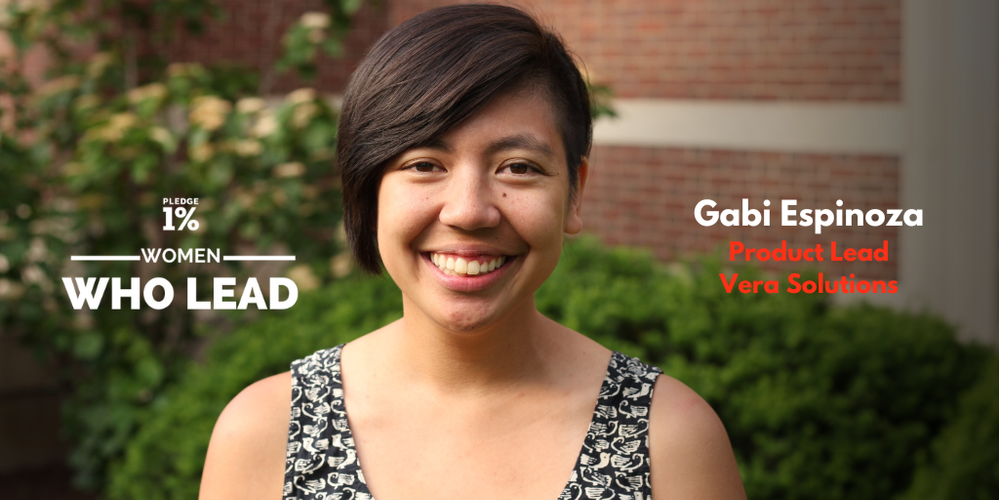
Gabriella (Gabi) Espinoza
Product Lead, Vera Solutions
Mumbai, India / Seattle, USA
If you could describe yourself in one word, what would that be and why?
Open. Whether it’s my mindset or my metaphorical door, I believe it’s crucial to create a space in which my teammates can feel comfortable to honestly share whatever is on their mind. My primary goal in leadership is to ensure my teammates feel empowered to navigate whatever challenge they face and to share whatever feedback they have.
Pledge 1% provides a framework for businesses to do good. Do you think it’s important for today’s corporate leaders to prioritize social impact? If so, why?
I think it’s absolutely important for corporate leaders to prioritize social (and, for that matter, environmental) impact. We have enough data now to fully understand the repercussions of business on both people and environment, whether from the supply chain, energy consumption, etc. With that knowledge, it’s imperative to continuously improve the role that business plays in society and in the environment.
What’s the best piece of advice you’ve ever received?
When I was early in my career doing admin at a nonprofit and feeling like I was falling behind my former university classmates, my manager comforted me by telling me that even she was still figuring her life out. Something clicked for me immediately to stop comparing myself with where my peers are at, and to simply forge ahead with what I want to achieve in life.
This year’s International Women’s Day themes are focused on investing in women and inspiring inclusion. What can we do to make today’s workplaces more equitable and inclusive for women?
First, we need greater intersectionality in DEI initiatives. By that, I mean we to increase visibility for women of color, transgender and nonbinary women, women from historically disenfranchised communities, and so forth. As Maya Angelou famously said, “The truth is, no one of us can be free until everybody is free.” It is every woman’s responsibility to work towards the equity and inclusion for all other women.
Second, I think it’s important to not ignore the role that men have to play in driving equity and inclusion. They also have the responsibility for making space for women to contribute and participate at the workplace, where women may otherwise not be present. Whether that’s actively sponsoring women to have a seat at the table or simply examining one’s own implicit biases, all of it helps to drive us towards greater equity and inclusion.
What advice do you have for women who are just starting their career?
Whatever you think you deserve in your career, you probably deserve more. I personally have struggled with low expectations of myself despite being a generally high-achieving person. It took a lot of mentorship and external validation before I fully started to comprehend what I deserve – and then to be able to actually ask for that.
“So whatever you think you deserve, wherever you think you’re at – be bold and ask for it.”
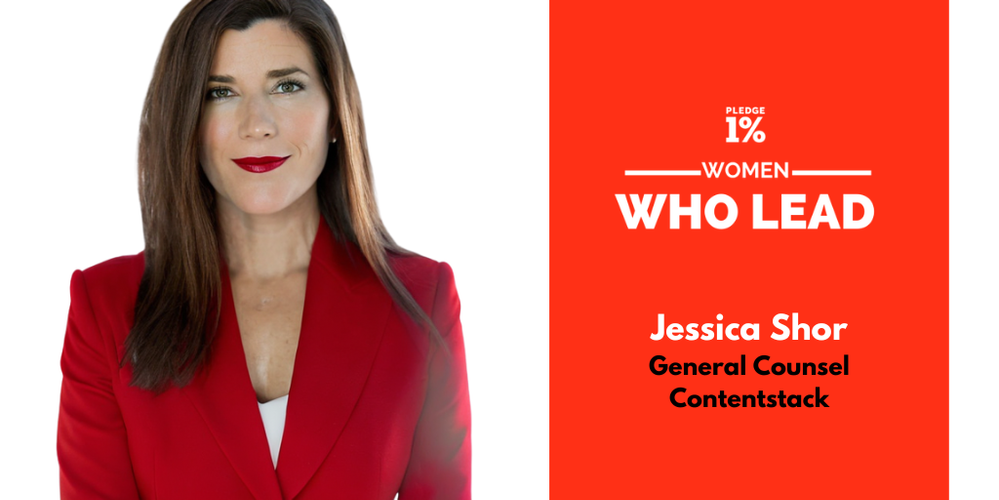
Jessica Shor
General Counsel, Contentstack
Golden, USA
If you could describe yourself in one word, what would that be and why?
Tenacious. I don’t believe in giving up or failure if it’s at all in my control. I also love solving problems even when they are outside of my “lane”. I once had a competitors offices raided by the Czechia police for theft of our IP. For me it comes down to fairness and equality, and I believe taking competitive information isn’t fair.
Pledge 1% provides a framework for businesses to do good. Do you think it’s important for today’s corporate leaders to prioritize social impact? If so, why?
Absolutely. I believe it’s critical for all individuals and organizations to do their part for equality, especially in our society today where we are so divided.
“Giving back and showing employees, customers and prospective employees that social impact is a critical part of who we are as an organization helps us keep growing our incredible culture and support our community.”
Do you give back to the community with your team and work? If so, what does this look like?
100%. For me, I live in Colorado and we have a group of employees here across different departments. We try to get together once a month and volunteer. We usually go to food for thought where we pack lunches for kids who might not otherwise have food for the weekend. It’s a great and easy way for us to come together and give back, especially in a remote environment. It’s nice to be able to get together.
What’s the best piece of advice you’ve ever received?
If someone is willing to give you feedback, it means they care so thank them.
This year’s International Women’s Day themes are focused on investing in women and inspiring inclusion. What can we do to make today’s workplaces more equitable and inclusive for women?
I’m the executive leader for our women’s ERG and I’m bringing in an amazing speaker and friend to talk to women about financial independence, negotiating for themselves and the value of equity.
What advice do you have for women who are just starting their career?
Always advocate for yourself. Decisions are made about you in rooms you aren’t in so you need to be your biggest champion.
What are you looking forward to this year? Are there any goals (personal or professional), activities, or experiences you are excited about?
Being more mindful with my time, body and family.
Pledge 1%’s #WomenWhoLead series celebrates female leaders who are paving the way for the next generation. While our featured leaders come from a variety of backgrounds and industries, they are united in their efforts to promote equality for all women in the workplace. We’ve asked them to share a bit about their journey to success, as well as lessons they’ve learned along the way.
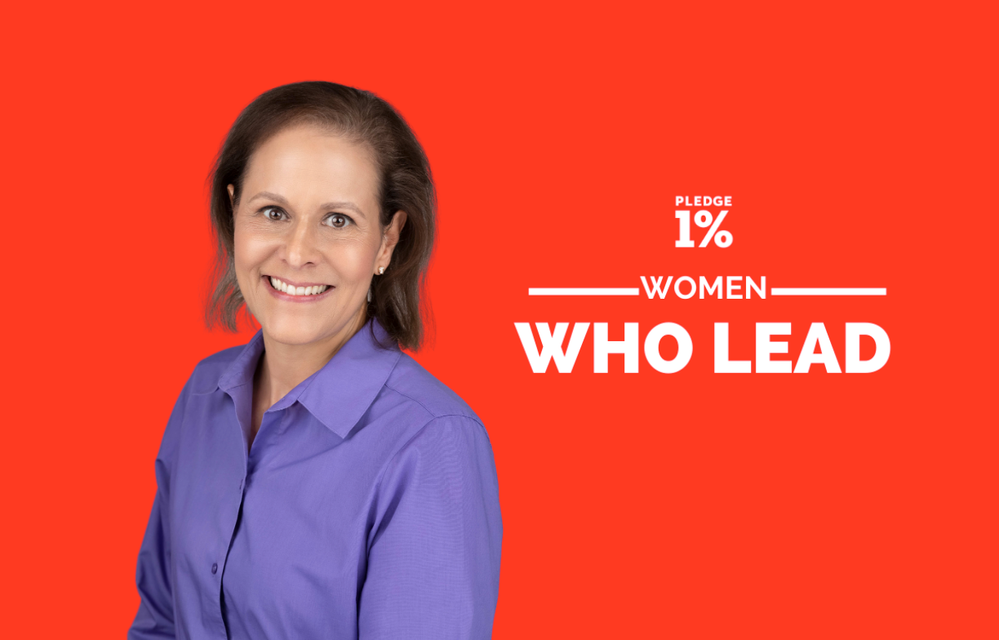
Jennifer Devening
Founder and CEO, YourHealth
Austin, Texas USA
What is your current role? Briefly describe in 1-2 sentences.
Besides overall management of YourHealth, I am an active Cancer Curator. I spend time talking with newly diagnosed breast cancer patients. I arm them with knowledge based on my 10-year battle, what I have learned from others who came before, and how to get through this life-changing event.
This year’s International Women’s Day theme is “Embrace Equity.” What does this mean to you? How can we build workplaces that are more equitable and inclusive?
Through my company YourHealth we embrace this every day by giving people, not just women, the ability to control and summarize their most critical health needs before an emergency happens. Our platform is consented based and you decide who to share your health information with. You are in control regardless of race or color, consumer, employee, or medical professional. Workplaces need to focus on better tools to make healthcare easier to manage.
Do you have any mentors or role models who have helped you on your personal journey?
Yes, my co-founder. He was a long-time mentor and advisor to me throughout my career in Silicon Valley and Austin. He was my litmus test for starting YourHealth. If I could convince him of my idea, I wouldn’t have started YourHealth.
What’s the best piece of advice you ever received?
Two things. In business, subscribe to the rule of 3. Always have an a, b, and c plan ready and pay that forward to your teams. Secondly, appreciate good health and find joy for yourself every day.
The past few years have brought many new and unprecedented challenges. What keeps you motivated or inspires you to stay optimistic?
That I am here 10 years later after being diagnosed with a chronic disease. As the rapper Pitbull says, “Every day above ground is a good day”. My passion is for changing healthcare so people/patients have control over their own health and wellness information. After all, isn’t healthcare supposed to be about the patient first?
Pledge 1% helps companies of all sizes and stages leverage their assets for social good. Why do you think it’s important that companies prioritize social impact? Do you have any specific stories or examples from your work or colleagues you can share?
Good health is not a given and from a young age we need to be taught how to keep and nurture it better. My inspiration for YourHealth came out of the untenable shock of how hard it is for any type of patient to consolidate medical records, medications, scans, etc. In any digital manner so that is with you 24/7 and when you need it the most. Healthcare is antiqued on every level.
If you could describe yourself in one word what would that be and why?
Tenacious.
Do you have any unique or useful life hacks to help get through your day?
The minute I think of something I have to get down, I write it down on Evernote. It is available to me digitally 24/7 and on all my devices. It keeps me on track and I am less likely to forget a detail.
Do you have any go-to apps or tools use love to use?
Yes. Evernote and Trello. Evernote keeps me organized and on task with my life, personally and professionally and Trello helps my colleagues and I navigate tasks from start to finish for all disciplines.
What are you looking forward to this year? Are there any goals (personal or professional), activities, or experiences you are excited about?
Yes. Grow my company and get YourHealth in the hands of as many people as I can, regardless of socio-economic status. Our first subscription is free to all. I want to be known for giving people control over their own health data, not providers or payers.
Pledge 1%’s #WomenWhoLead series celebrates female leaders who are paving the way for the next generation. While our featured leaders come from a variety of backgrounds and industries, they are united in their efforts to promote equality for all women in the workplace. We’ve asked them to share a bit about their journey to success, as well as lessons they’ve learned along the way.
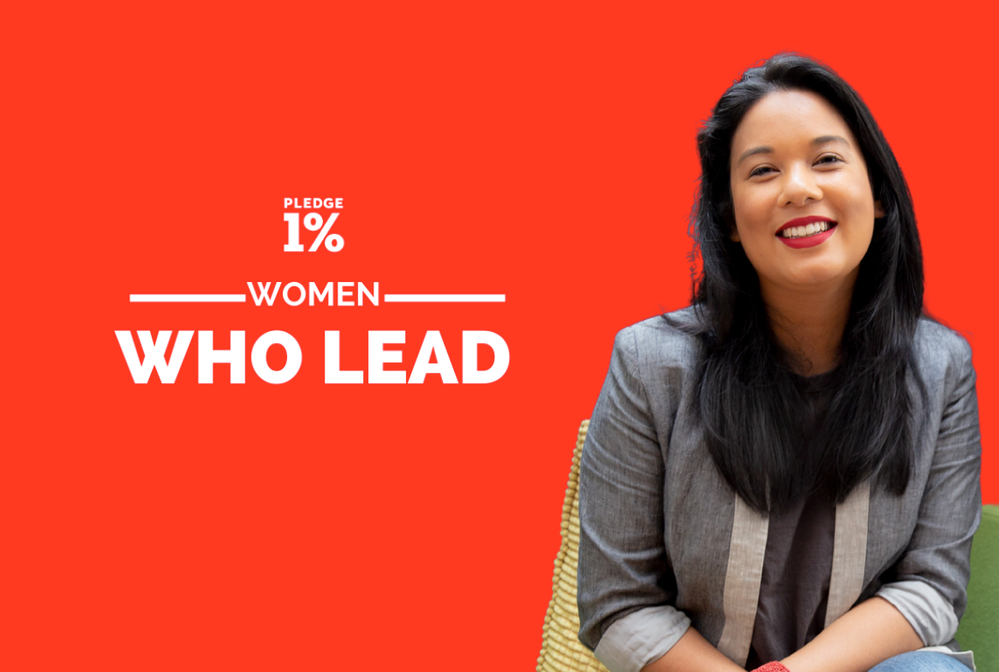
Amra Naidoo
General Partner, Accelerating Asia
Singapore / Thailand
What is your current role? Briefly describe in 1-2 sentences.
I serve as a general partner of Accelerating Asia, which is an early-stage venture capital firm focused on Asia Pacific.
This year’s International Women’s Day theme is “Embrace Equity.” What does this mean to you? How can we build workplaces that are more equitable and inclusive?
I think that equity means creating equal access to opportunities, while inclusion means creating spaces that are thoughtfully designed to enable equity. But how equity and inclusion are created should be ever-evolving. At the moment, in the startup and investment space, there are so many activities that are just noise and virtue signaling. There are so many mentor programs or networking events for women, or pitch events to get feedback on their startups. In order to really make a difference, I think we need to have a real conversation about the state of the ecosystem and put our money where our mouths are.
Case in point, I was recently considering attending a large conference for women fund managers where you could apply for the opportunity to pitch to investors for feedback. You would never see something like this at a typical investor conference where attendees are predominantly male – which given the nature of the industry, most attendees are. While I appreciate the effort by the conference organizers to create a platform for women to showcase their funds, I’m tired of feedback, tired of mentors, and tired of meaningless awards. I’m tired of being recognized as an “inspiring” female fund manager when female fund managers are considered a category of their own.
At this point, I believe that equity and inclusion means moving past labels. We should no longer call attention to the gender of a particular entrepreneur or investor, in much the same way we don’t label any other professional by their age, sexual orientation, or some other random personal attribute. Special programs to address under-representation are different from being labeled and bound by that label in your work. Excellence in any investing – or any kind of business activity – should not be bound by gender. If we want to build ecosystems, industries, and workplaces that are more equitable and inclusive, we need to do more than signal.
Do you have any mentors or role models who have helped you on your personal journey?
I don’t really believe in the whole mentor-mentee relationship for my personal life because I’ve always felt like there is a power dynamic and transactional nature of that kind of relationship. I also don’t think I’ve taken a very typical route in my career or personal journey and at each point in my life, I’ve needed or wanted different things. So I prefer to approach my relationships with people from a place of curiosity and pick and choose aspects of their lives or how they’ve dealt with certain situations as a framework for me to adapt to my own personal life. I really believe in surrounding myself with people who are doing interesting or different things and I actively seek these people out when I’m trying to learn something or solve a problem. They don’t need to be in the same industry as me, or at the same stage in their career, but I find energy in being around people who are truly passionate about their craft/ work/ life. I find that you can learn more from people who are not in your area with how they manage their work and their lives by potentially bringing across systems and ideas and adapting them to your own situation.
What’s the best piece of advice you ever received?
Your difference is your strength. Ten years ago, this kind of blanket statement would come across as any other general aphorism for self-empowerment. More research has shown that this idea is verifiably true: Organizations derive significant competitive advantage from being diverse. More diverse organizations perform better than less diverse organizations. On an individual level, people should celebrate what makes them different because this is what gives them an edge: They will recognize opportunities that others don’t, and view challenges from a different perspective. While I mostly speak from a professional lens, the idea that your differences are your strengths also applies to your personal life.
The past few years have brought many new and unprecedented challenges. What keeps you motivated or inspires you to stay optimistic?
Like many investors, we regularly back startups in business hubs like Singapore. Unlike other investors, we also make a concerted effort to back startups in emerging markets, including everywhere from Bangladesh to the Philippines. While there are undoubtedly more challenges in these markets – such as a still-developing business ecosystem and growing infrastructure – there are also many more rewards. Compared to a place like Singapore, a startup in an emerging market can more easily create exponential impact. That’s because their solution will not be merely an improvement over others as it would be in a developed market – it will often be leaps and bounds ahead of the legacy solution. With enough of this innovation, an emerging market rich with startups can leap ahead of its counterparts. We’ve seen this with Indonesia, we are seeing this with Vietnam, and we hope to see this in more emerging markets around the world. It’s easy to stay optimistic in this scenario: We’re not just investing in startups – we’re investing in the future of a country or region.
Pledge 1% helps companies of all sizes and stages leverage their assets for social good. Why do you think it’s important that companies prioritize social impact? Do you have any specific stories or examples from your work or colleagues you can share?
At Accelerating Asia, we believe that entrepreneurs are humanity’s greatest catalysts for positive change.
That statement is on our website and our collaterals, but it is one we really believe in and we try to live up to on a day-to-day basis as investors. We seek to support entrepreneurs, especially those who hail from underserved markets, such as Indonesia, Thailand, the Philippines, Myanmar, Bangladesh, and Pakistan.
Due to the nature of these markets, the entrepreneurs here are not just making a shiny app – they’re devising solutions that address major challenges in their country, including everything from transportation and healthcare to agriculture and small business. These solutions drive their citizens and economies forward.
Every company in Accelerating Asia’s portfolio addresses at least one sustainable development goal of the United Nations, and most address multiple SDGs. This alignment toward social impact is important because it ensures entrepreneurs remain user-centric in how they develop their products and services.
This user-centricity is evident in a cross-spectrum of our startups, who have not only enjoyed enormous business success, but who have clearly made a difference in their communities. In Bangladesh, iFarmer is extending finance to small farmers who would otherwise not have access to capital to grow their farms. In the Philippines, Beam and Go is making it easier for overseas foreign workers (OFWs) to provide key goods to their loved ones back home. In Thailand, Easy Rice is digitizing the quality assessment of staple food to improve sustainability in the supply chain. These are just three examples of why startups should prioritize social impact: Because these solutions are highly tailored to their end users, they put themselves in the best position to succeed and affect positive change.
If you could describe yourself in one word what would that be and why?
Determined. This word came to mind for three reasons: I am determined to guide the many brilliant founders in our portfolio as best I can; I am determined to produce winning investments for the limited partners who invest alongside us; and I am determined for our portfolio to affect change in Asia Pacific and beyond.
Do you have any unique or useful life hacks to help get through your day?
After experiencing burnout early in my career, which took a long time to recover from, I have two rules when I’m planning my day. First, I always fit in some kind of exercise. I used to do this 6 times a week. Since having a baby 3 months ago, I obviously had to take a break so I am working back up to this.
Second, despite the hustle culture prevalent in the startup world, I find energy in balance. I make it a point to spend time with my friends and family as well as get alone time. By setting aside this personal time, there is a palpable difference over the course of a day. I am more creative, productive, and fulfilled.
Because this work-life balance has been so beneficial to me, I try to promote this culture at Accelerating Asia. Our team members can take time off whenever they need, and we help them stay truly offline with an official calendar (so no one pings them when they should be rejuvenating). I would encourage others in my field to incorporate similar practices for themselves and their organizations if they can.
Do you have any go-to apps or tools use love to use?
Rather than name a flashy, new app, I would like to cite an old favorite: Google Apps, and in particular, Calendar. I am religious when it comes to scheduling not only professional activities, but also personal ones: I block off time with family and friends and even workout sessions with different color codes. This may seem like a small touch, but it really makes a difference in ensuring I live a balanced life. During a normal workday, it’s not enough to rely on good intentions to go to the gym or spend time with your loved ones. When things get busy at work, it will be easy to skip out on these personal activities. Scheduling them in advance keeps me committed and prevents ad hoc interruptions that may arise. So when I return to work from my “me” time, I am more energized than ever.
What are you looking forward to this year? Are there any goals (personal or professional), activities, or experiences you are excited about?
I’ve been off work for several months now due to maternity leave. I’m of course excited to get back full-time, and deal with the challenges of now attending to three babies: my dog, my newborn, and my first baby (in a manner of speaking), Accelerating Asia.
Personally, I’m looking forward to getting back into the gym and carving out me-time and learning how to balance the changes at home and continuing to grow Accelerating Asia. My return at Accelerating Asia also comes at a major crossroads. Our portfolio of more than sixty plus startups has collectively reached major revenue, growth, and valuation milestones, and our team that supports them has grown exponentially as well. When I return, I expect to be able to perform less operational work and focus on the bigger picture of becoming the best early stage venture capital firm in Asia Pacific. When promising young founders in the region need support, I want our name to be top of mind. This is of course a bold ambition given the many excellent investors operating here – I’m excited to work on the initiatives and programs that I think could bring us to this next level.
Pledge 1%’s #WomenWhoLead series celebrates female leaders who are paving the way for the next generation. While our featured leaders come from a variety of backgrounds and industries, they are united in their efforts to promote equality for all women in the workplace. We’ve asked them to share a bit about their journey to success, as well as lessons they’ve learned along the way.
Francesca Vietor
California State Parks Commissioner, State of California
San Francisco, CA
What is your current role? Briefly describe in 1-2 sentences.
The State of California has 280 parks and is widely considered to have the highest quality park system in the world. As a member of the State Parks Commission, I develop policies and recommendations to improve and protect our park system–my role includes expanding access and increasing diversity in our parks.
This year’s International Women’s Day theme is “Embrace Equity.” What does this mean to you? How can we build workplaces that are more equitable and inclusive?
In addition to my role promoting equity as a State Parks Commissioner, I also work to advance environmental equity through grant-making and community building at the San Francisco Foundation, where I have worked for twelve years to build a more inclusive and equitable Bay Area.
Do you have any mentors or role models who have helped you on your personal journey?
Wangari Maathai, Dorothea Lang, Mary Oliver, Michelle Obama
What’s the best piece of advice you ever received?
Lead from behind.
The past few years have brought many new and unprecedented challenges. What keeps you motivated or inspires you to stay optimistic?
The beauty and resilience of nature.
Pledge 1% helps companies of all sizes and stages leverage their assets for social good. Why do you think it’s important that companies prioritize social impact? Do you have any specific stories or examples from your work or colleagues you can share?
Many companies have been able to grow and thrive because, and in spite of, destructive practices, from exploiting and destroying our natural resources to unfair labor and human rights practices. It’s time to give back!
If you could describe yourself in one word what would that be and why?
Enthusiastic. I am amused and curious about everything.
Do you have any unique or useful life hacks to help get through your day?
Morning nature walks every day.
Do you have any go-to apps or tools use love to use?
Love hiking with the Relive app and taking a selfie with my friends midway. Also getting ready to launch my parks challenge on OuterSpatial!
What are you looking forward to this year? Are there any goals (personal or professional), activities, or experiences you are excited about?
I made a public commitment to visit all 280 of our state parks so that I can not only learn about the issues our parks face but also experience the awe and joy that parks inspire.
Pledge 1%’s #WomenWhoLead series celebrates female leaders who are paving the way for the next generation. While our featured leaders come from a variety of backgrounds and industries, they are united in their efforts to promote equality for all women in the workplace. We’ve asked them to share a bit about their journey to success, as well as lessons they’ve learned along the way.
Natasa Marinkovic
Vice President of Marketing, Atrium
Sanford, Florida, United States
What is your current role? Briefly describe in 1-2 sentences.
I am responsible for leading Atrium’s marketing strategy by working across all departments to align marketing efforts with overall business goals while building and maintaining our brand image and driving customer acquisition and engagement.
This year’s International Women’s Day theme is “Embrace Equity.” What does this mean to you? How can we build workplaces that are more equitable and inclusive?
To me embracing equity means not only acknowledging that different circumstances lead to different outcomes and opportunities for people, but also being part of driving change. For most businesses the easiest place to start is providing diversity and inclusion training to create more awareness about unconscious bias and educating on the difference between equity vs equality. That awareness alone often inspires inclusion councils that want to drive change and from there the main goal should be to support and enable them to do so.
Do you have any mentors or role models who have helped you on your personal journey?
I’ve been lucky enough to have many mentors and role models and I’ve been blessed to have leaders who allowed me to take on various roles and carve out a career path for myself based on my interests as opposed to boxing me into a standard career path. This experience has clarified that I am very passionate about marketing and the previous sales and business development experience has made me a better marketer.
What’s the best piece of advice you ever received?
Growth happens with every mistake you make, whether you realize it at the time or not.
The past few years have brought many new and unprecedented challenges. What keeps you motivated or inspires you to stay optimistic?
What really inspires me as we navigate change is the resilience that is born from it. Seeing people come together for support, to innovate, and find new ways to solve problems keeps me motivated. What specifically keeps me optimistic is the small acts of kindness that you can find in the midst of any terrible situation or headline. You just have to look for them.
Pledge 1% helps companies of all sizes and stages leverage their assets for social good. Why do you think it’s important that companies prioritize social impact? Do you have any specific stories or examples from your work or colleagues you can share?
Companies have a platform that individuals don’t necessarily have. They can contribute to the sustainable development of their communities and the world by leveraging that platform to create awareness and opportunities for individuals to come together and create change.
There’s one story in particular that comes to mind for me. Recently, Atrium worked with Housing Development Alliance, Inc. (HDA) to improve their Salesforce infrastructure in order to better support their response to flash flooding in Kentucky that caused damage to over 2,000 homes and businesses in late July. You can read the full story on Atrium’s website: https://atrium.ai/resources/how-hda-quickly-supported-flood-victims-with-improved-salesforce-infrastructure/
If you could describe yourself in one word what would that be and why?
Open-minded. I want to always be open to trying new things, taking on new challenges, and also be a safe space for those around me. In order to do those things, I have to be open-minded.
What are you looking forward to this year? Are there any goals (personal or professional), activities, or experiences you are excited about?
Watching my daughter transition from infant to toddler has been delightful! She’s got such a fun personality and I can’t wait to see what she’ll be into as she starts exploring more of the world. In caring for her, I have been gifted the opportunity to view the world with a fresh perspective and it has allowed me to appreciate the small things in life, like stopping to smell the roses. I’m excited for more of that this year!
Pledge 1%’s #WomenWhoLead series celebrates female leaders who are paving the way for the next generation. While our featured leaders come from a variety of backgrounds and industries, they are united in their efforts to promote equality for all women in the workplace. We’ve asked them to share a bit about their journey to success, as well as lessons they’ve learned along the way.
Renee Barker
Director of Nonprofit Outreach, LiquiDonate
Nashville, Tennessee, U.S.
What is your current role? Briefly describe in 1-2 sentences.
I connect nonprofits to our platform to receive free donations from businesses and individuals in their community. My team ensures our product serves the needs of organizations and schools who need free goods so that their funds can be used to fulfill their missions.
This year’s International Women’s Day theme is “Embrace Equity.” What does this mean to you? How can we build workplaces that are more equitable and inclusive?
Equity starts with empowerment — we need to build workplaces that meet employee needs and contribute to their wellbeing. Workplaces benefit greatly from having a variety of perspectives from a diverse group of people, but those perspectives cannot be realized without a focus on the individual to make sure they have positive experiences at work. To build these spaces, workplaces should invest in training, mentorship, fair pay, and authenticity with their teams.
Do you have any mentors or role models who have helped you on your personal journey?
I appreciate being a part of a network of folks in my city that meet monthly to learn about new sustainability topics and environmental initiatives in my state. It is so helpful to learn from everyone involved, from new grads that are inspired to begin their careers to retirees that share their experiences and how they have witnessed changes (for the better in many cases!). It is helpful to see that everyone is on a journey, and that there are people who can help you along your way.
What’s the best piece of advice you ever received?
The strength of being adaptable — the world is constantly changing and we see new information and new challenges to overcome. It is important to be adaptable to stay resilient in your personal and professional journey.
The past few years have brought many new and unprecedented challenges. What keeps you motivated or inspires you to stay optimistic?
It may be easy to fall into doom-scrolling, but it is also easy to find stories of so many people trying to make the world better for others. I stay inspired by keeping in touch with people that I see doing innovative and interesting projects.
Pledge 1% helps companies of all sizes and stages leverage their assets for social good. Why do you think it’s important that companies prioritize social impact? Do you have any specific stories or examples from your work or colleagues you can share?
People want to work for companies that take opportunities to have a positive social impact. No matter the focus or size of a company, there are always opportunities to better your people and community. When companies prioritize social causes as a part of doing business, that impact can scale and be a force that really addresses injustices in our society.
If you could describe yourself in one word what would that be and why?
Resourceful – I enjoy researching and finding new ways to overcome challenges
Do you have any unique or useful life hacks to help get through your day?
Not very unique, but taking time to play with my cat and dog brings a lot of enjoyment to my day.
Do you have any go-to apps or tools use love to use?
Slack — staying chatty on slack with each other outside of solely work conversations helps connect. I love seeing all of the outdoorsy photos of our team enjoying nature around the world.
What are you looking forward to this year? Are there any goals (personal or professional), activities, or experiences you are excited about?
I am very excited to complete my first full year at LiquiDonate — we have high ambitions to grow our marketplace and offerings, and I am excited to bring our resource to nonprofits around the world.
Pledge 1%’s #WomenWhoLead series celebrates female leaders who are paving the way for the next generation. While our featured leaders come from a variety of backgrounds and industries, they are united in their efforts to promote equality for all women in the workplace. We’ve asked them to share a bit about their journey to success, as well as lessons they’ve learned along the way.
Jennifer Jeronimo
CEO, Gaingels
Brooklyn, NY, USA
What is your current role? Briefly describe in 1-2 sentences.
I am the CEO of Gaingels Inc. Gaingels Inc is one of the most active venture networks supporting diversity, equity and inclusion
This year’s International Women’s Day theme is “Embrace Equity.” What does this mean to you? How can we build workplaces that are more equitable and inclusive?
For me, embracing equity is enthusiastically and intentionally creating opportunities for all people to be successful where and when you can. Creating a more inclusive and equitable environment within the workplace starts with understanding the different needs of the people and groups in your organization. By understanding those differences, you can provide the right feedback, tools and resources they need to be successful. Inclusivity should also be part of the company’s culture, and something regularly talked about and reviewed. The most inclusive companies are the ones that acknowledge what could be done better. Creating an inclusive environment takes constant nurturing.
Do you have any mentors or role models who have helped you on your personal journey?
I am lucky to have many mentors and sponsors in my life including former managers, colleagues, professors, and friends. For me, the most impactful relationships are the ones that have come organically as those mentors are the most honest with me. A mentor that helps you see your blind spots is just as important as one who cheers you on. I also believe that you can learn from everyone around you. Some of the best lessons I have learned are from people completely different from me, and not necessarily mentors.
What’s the best piece of advice you ever received?
You must create space for yourself to grow. Years ago, my manager gave me advice that I still apply today. She explained if I couldn’t figure out how to better manage my time, I would have hit my ceiling. It was at that moment that I realized I must be evolving the way I work to take on more. Working a 14-hour day meant I could not take on the next big project. I learned I needed to better delegate, find tools that gave me the information I needed to make better and faster decisions and to decide the things I needed to let go of.
The past few years have brought many new and unprecedented challenges. What keeps you motivated or inspires you to stay optimistic?
I know it sounds cliché, but I do what I love so I don’t need to be motivated. My own personal journey has made me realize my happiness can only be created by me and the best use of my time is to work on things in my control. Each day, I remind myself of all the things I am grateful for and that challenges are the breeding ground for growth. We love the wins and the accolades, but those only come at the hands of the challenges we had faced and overcame.
Pledge 1% helps companies of all sizes and stages leverage their assets for social good. Why do you think it’s important that companies prioritize social impact? Do you have any specific stories or examples from your work or colleagues you can share?
Today, we can see the results inadequate social policies, regulations, and corporate practices has had on our environment and society. Now, information on this impact is at our fingertips and just a google (or chatbot) search away. Armed with this information, companies are being asked by their customers to think about their impact to greater society. By taking the 1% pledge companies can show their commitment to causes important to their customers and community. In addition, the 1% pledge can benefit non-profit organizations with financial assistance, expertise and exposure they need to be continue the work they do.
Here at Gaingels, we request the companies we invest consider taking the 1% pledge as part of our Gaingels letter.
If you could describe yourself in one word what would that be and why?
Resilient. I have learned through experience things often do not go as planned. The people who are most successful are the ones who can manage through them successfully.
Do you have any unique or useful life hacks to help get through your day?
• 2-minute meditation before big meetings or events
• remembering to ask myself often- is this something I can control or do something about in a meaningful way? It helps me from worrying about things unnecessarily.
• Having a list of intentions for each day- the days I don’t are like the wild west!
Do you have any go-to apps or tools use love to use?
I have a few good meditation apps I use regularly. I still love writing in my daily journal my tasks and intentions.
What are you looking forward to this year? Are there any goals (personal or professional), activities, or experiences you are excited about?
Working on initiatives that speaks to my passion of helping women get seats at the table, either through their network, investing, or the work they do personally and professionally.
Pledge 1%’s #WomenWhoLead series celebrates female leaders who are paving the way for the next generation. While our featured leaders come from a variety of backgrounds and industries, they are united in their efforts to promote equality for all women in the workplace. We’ve asked them to share a bit about their journey to success, as well as lessons they’ve learned along the way.
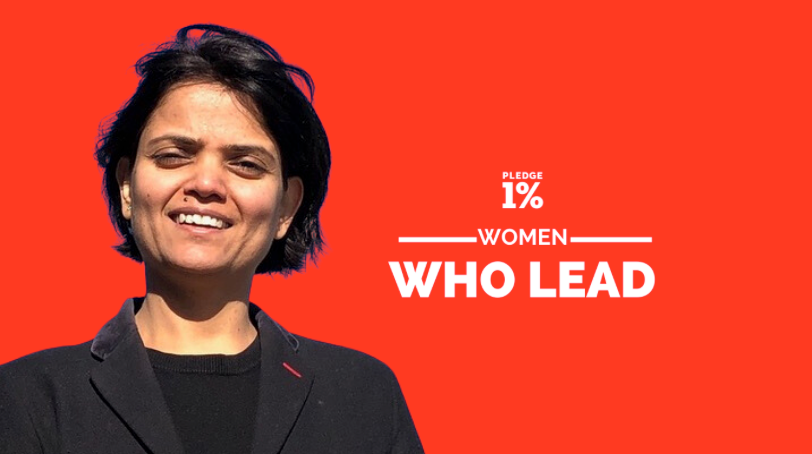
Shilpa Sharma
Co-founder and CEO, Flyte
Toronto, Ontario, Canada
What is your current role? Briefly describe in 1-2 sentences.
I’m the co-founder and CEO of Flyte. I oversee the entire business management including business development, investor discussions, hiring and product planning. At Flyte, we stand for equality and mental health so building the right culture and communicating with employees are my top priorities.
This year’s International Women’s Day theme is “Embrace Equity.” What does this mean to you? How can we build workplaces that are more equitable and inclusive?
Being a female entrepreneur myself and having worked in male dominated workplaces, I have experienced the value of gender equality and inclusivity first-hand. I strongly believe in maintaining balance at the workplace so people can leverage each other’s perspectives and approaches for greater good.
We can build equitable and inclusive workplace by:
1) Communicating the vision: Every employee should know the business vision and how they can collaborate with each other to achieve that
2) Building inclusive culture: Leaders should build and communicate right culture in the company so their employees treat each other with respect
3) Adopting clear hiring process: Leaders should focus on hiring individuals based on their capabilities and perspective
Do you have any mentors or role models who have helped you on your personal journey?
Based on the stage of my personal journey, I have received mentorship from experienced professionals that helped me navigate through challenging situations. The one thing I learned through my journey, one should always celebrate success, be it small or big!
What’s the best piece of advice you ever received?
Surround yourself with people who are invested in your growth and well-being
The past few years have brought many new and unprecedented challenges. What keeps you motivated or inspires you to stay optimistic?
Past few years have been challenging for so many people and we all adopted new ways of doing things including learning new technologies to support remote work.
The one thing that keeps me motivated is the passion for what I am doing. In addition to building my own business and helping our customers achieve their revenue growth through Flyte innovative technology, I helped many early stage startups through mentorship and guidance.
Recently I started mentoring women in sales & marketing through the Women in Revenue community. The President of the Women in Revenue community appreciated the effort and invited me to join their Speaker Bureau where I will further contribute through speaker sessions and webinars.
Pledge 1% helps companies of all sizes and stages leverage their assets for social good. Why do you think it’s important that companies prioritize social impact? Do you have any specific stories or examples from your work or colleagues you can share?
As an entrepreneur, you have a responsibility to contribute towards society and bring a positive change.
Today we are facing so many challenges, be it changing climate, mental health issues, access to healthcare, education, jobs etc. Companies should prioritize social impact and contribute towards building a better future for our next generation.
A lot of challenges can be solved by giving access to education and opportunities to everyone. Making people self-sufficient is the biggest gift. We promote education initiatives through our engagements with non-profit organizations.
If you could describe yourself in one word what would that be and why?
Innovative! My innovative thinking and creative ways of doing things helped our business bring innovative technology to market. Customers loved our AI powered solution and referred us to their colleagues.
Do you have any unique or useful life hacks to help get through your day?
Celebrating success and staying calm during challenging situations have been my hacks to be productive throughout the day.
Do you have any go-to apps or tools use love to use?
LinkediIn, Health, Zoom.
What are you looking forward to this year? Are there any goals (personal or professional), activities, or experiences you are excited about?
Growing business with high profitability in mind. Personally, looking forward to expanding my network further through conferences & community engagements.