This piece is shared as part of Pledge 1%’s #GivingTuesdayNow campaign, which highlights how Pledge 1% members and the business community are coming together as a force for good to combat COVID-19.
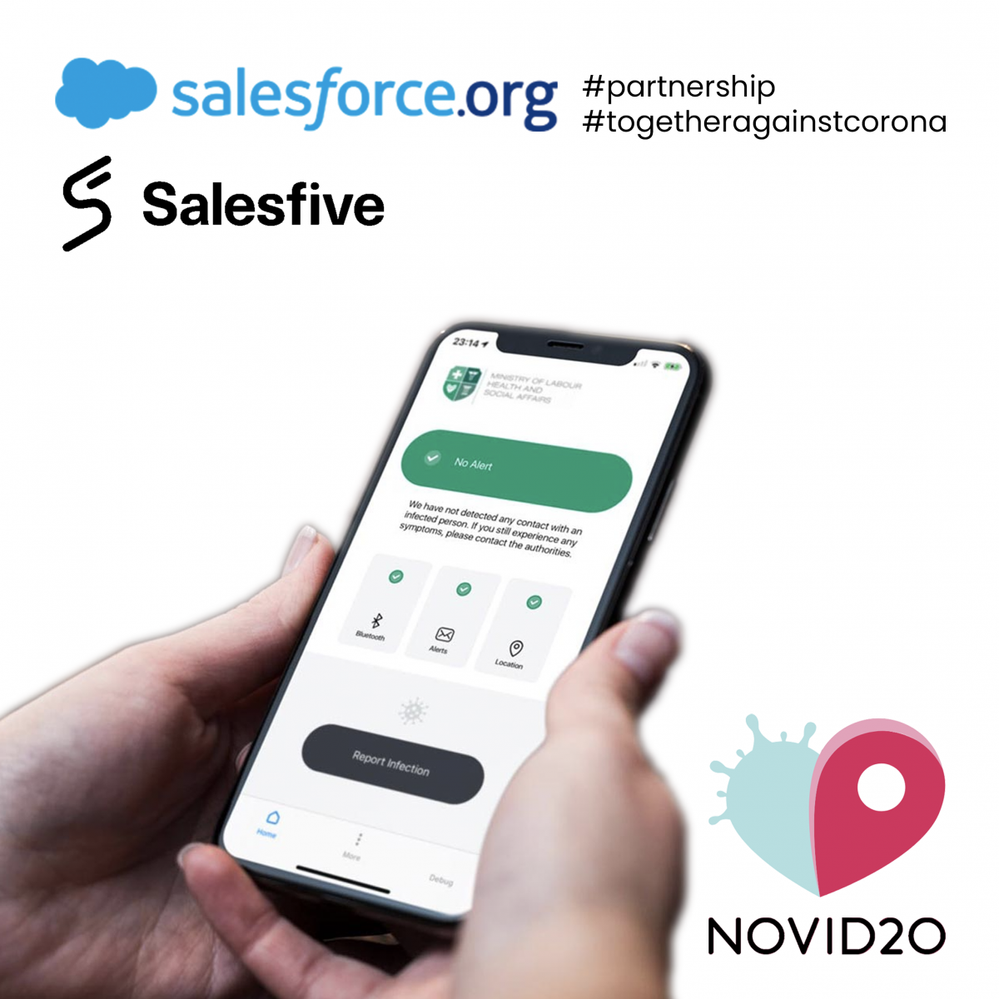
A Salesforce implementation within a few days: Salesfive accepted that challenge and mastered that implementation successfully thanks to a great team spirit with NOVID20.
The non-profit organization NOVID20.org was founded in March 2020 and develops tech-solutions to interrupt infection chains of COVID19. Designed by over 80 volunteers of digital-experts, developers, data protection experts, entrepreneurs, health experts and medical doctors they launched their App-solutions complying with European personal data protection laws (GDPR) and ethics.
This technology could significantly contribute towards slowing down the spread of the virus, end lockdowns, unlock the economy and move to selective health measures.
NOVID20 now uses Salesforce for its global approach.
Salesfive implemented Sales Cloud to give NOVID20 the best way to manage their relations in more than 40 countries. Now they can track all activities between countries’ authorities, organizations, corporate partners, supporters and even other market players.
They are managing:
- Leads – to record every person N20 talked or persons who would like to get in touch with
- Contacts – qualified leads, to record persons that are related to accounts
- Opportunities – to record project progress (negotiation phase etc.)
- Accounts – to manage supporters, authorities, and every sort of company they work with
- Reports – to get an overview on their achievements and what is still to do in the following days to weeks
- Daily tasks – easily visible through a chatter overview, where also other employees can be asked for support.
- After implementing the company’s own emails, it is perfectly possible to work together on projects – with physical distance and a global approach.
We are happy with this partnership and are excited for what this collaboration brings up next.
Originally posted: May 5th, 2020
Today marks Earth Day’s 50th anniversary! While we can’t participate in some of the more traditional ways this year, we’ve put together 50 ways you can give back from the safety of your own home. There is only one Earth, let’s do our part to help preserve it!
- Ditch single use plastic containers! Store leftovers and takeout in reusable, washable containers.
- Hang your laundry instead of putting it in the dryer to save energy.
- Turn off your lights when you leave the room. You can have a big impact doing this while working from home!
- Switch to paperless billing. There are many benefits to doing this and Pledge 1% member DocuSign has a number of tools and resources to help you get started. Learn more about the DocuSign for Forests Initiative and see how they’ve preserved over 2.5 million trees to date.
- Feeling stir crazy in your house? Go through your closet, set aside what you no longer need, and donate items to your local Goodwill.
- Order a reusable coffee cup from your favorite local cafe. While we currently can’t go out for coffee, we can use this time investing in sustainable kitchenware and supporting local businesses!
- Unplug! Take a break from your devices to save power. This is a win-win: its good for you and for the planet!
- Think about how you can empower your customer and client network to reduce their carbon footprint. Pledge 1% member Flexport, for example, is working with Carbonfund.org to offer their clients a carbon offset program. Read more about their efforts here.
- Go vegetarian once a week. Encourage your team to get involved and start a Meatless Monday recipe swap. It’s something you can use to rally your teams and connect them while we work from home.
- Take care of your houseplants. As we shelter in place, now is the perfect time to give some love to your houseplants. Share your photos and tips with your team or neighbors, and see how together you can make the world a little greener.
- Plant a tree from the comfort of your own home by donating to The Nature Conservancy’s One Billion Tree Project. Your donation will go directly towards planting trees in deforested areas.
- Buy locally. By supporting local small businesses, you can also reduce the amount of fossil fuel required to transport imported goods.
- Take a moment to look out your window and reflect on just how awesome our planet is.
- Recycle old electronics. When thrown away in landfills, electronics erode and leave behind corrosive, toxic substances. Stores like Best Buy accept products free of charge and may even offer a gift card!
- Track your carbon footprint using this easy, online tool from The Nature Conservancy. It may even inspire you and your team to walk or bike more when possible.
- As you walk to the store or take your short breaks outside, keep an eye out for any litter and help pick up trash around your neighborhood.
- Join a bike-sharing program so you’ll be ready to ride to the office once we start commuting again!
- Join your local Climate Reality Chapter. Climate Reality will connect you with engaged activists just like you to help bring change to your community. Learn more here.
- Educate yourself! Listen to a climate change podcast, like America Adapts. Host and climate change adaptation expert Doug Parsons talks to scientists, journalists, activists and policymakers about the challenges of adapting to climate change. They also discuss actions you can take to help slow down the process.
- Educate your kids. There are great tools geared towards educating kids about climate change. Check out NASA’s website for activities or download the book 10 Things I Can To Help My World.
- As you plan ahead for your next corporate event, consider going swag-less for you and your vendors. This will significantly reduce waste. Salesforce did this at last year’s Dreamforce. You can read more about their sustainability initiatives here.
- Replace paper towels with old cloth rags. As a bonus this will help with the TP shortage!
- Join a library and rent ebooks instead of buying new books. You can also donate books to your local Little Free Library. People are in need of materials to read while we shelter in place, and many have now converted to Little Free Pantries.
- Recycle batteries. Collect what you have around the house and get more information from your local drop-off station.
- Print double sided and make sure you only print the pages you need.
- Get your news digitally vs. newspaper delivery.
- Reuse wrapping paper and cut down on your paper and plastic consumption.
- Conserve water by taking shorter showers and turning off the faucet when you brush your teeth.
- Cooking from home more? Learn which types of fish are most sustainable and choose your fish wisely.
- Take part in EarthDay.org’s Daily Challenge, which includes 22 ideas of how you can help.
- Take notes on your computer vs. paper.
- When ordering takeout, skip the utensils and use your own at home.
- Try composting! Reduce food waste and transform food scraps and lawn clippings into fresh, nutrient-rich soil for your plants. It’s a great project to start for home! Here is a quick how-to guide from the EPA.
- We can’t visit our beautiful national parks this Earth Day, but we can thank park staff. Post on social media or send a thank you note to your favorite park’s team to acknowledge all that they do to preserve our planet.
- Get your hands dirty and start an indoor or outdoor garden. Welcome the spring season by planting native plants, fruits, and vegetables. Many herbs can be easily grown inside!
- Create an art project using just materials from outside. Leaves, pine cones, get creative! Allow yourself to appreciate the outdoors while you are indoors.
- Build a birdhouse and create an oasis for your local neighborhood bird friends. Here are some quick and easy guidelines from the Humane Society.
- Create a list of sustainability goals or small changes you can implement in your daily life to reduce your overall impact.
- Share your commitment to #SDG13 by posting how you are taking climate action!
- Learn how to recycle properly! We love this easy to read guide.
- Reduce food waste and time spent at the grocery store by writing out a list. Planning out meals in advance means you can hit the supermarket knowing you’re buying everything you need.
- Buy bulk products. Food packaging waste accounts for nearly two thirds of total packing waste in the US. Buy bulk quantities of shelf stable foods (pasta, cereal, rice, nuts) – all things that are good to stock up on during quarantine!
- If paper is a must, look for recycled paper products or use the back of an old note or printout.
- Drive slower! Reduced speeds means less fuel. Be kind to your tank, environment and wallet.
- Buy used furniture, books and other items that help reduce your carbon footprint.
- Help save the bees! Backyard beekeeping is a wonderful way to make sure these important species thrive. Bugs not your thing? Many communities have local beekeepers you can buy products from.
- Connect with zoos, aquariums and other animal protection agencies. Many already have conservation initiatives underway and are a great resource for you to understand how to best save our planet’s animals and their habitats.
- Adjust your temperature and save over 10% on your energy usage over the year. Be sure to remember to turn off the heat/AC when you leave home.
- Reduce the amount of junk mail you receive. The Huffington Post has a detailed list of how to reduce that pesky mail here.
- Switch from lighters to matches. The majority of lighters these days are disposable, and that plastic adds up. Choose paper matches instead, which are made from recycled paper.
Originally posted: April 22nd, 2020
As originally published on Puppet.com
One of our core values at Puppet is “Community powered. Empowering community.” With our open source roots, we’ve always had strong ties to our community of users who help us innovate much more rapidly than we could on our own. But our responsibility extends beyond our own technical community to the communities in which we live and work. As leaders in our space, we can make an even bigger difference through our philanthropy initiatives which foster diversity and inclusivity, encourage employee volunteerism, and provide greater access to technology.
Just a few months ago, we launched the Innovation Lab at Puppet in partnership with PIE (Portland Incubator Experiment) to help empower entrepreneurs and foster community within Portland’s startup community. The Innovation Lab at Puppet provides a co-working space at no charge for entrepreneurs at Puppet’s headquarters. In launching the program, we prioritized companies founded by people from systemically underrepresented populations in entrepreneurship, including women and members of the LGBTQ+, black and Latinx communities. Not only do these amazing entrepreneurs gain access to our space, they also have access to Puppet employees who have expertise across multiple disciplines, including marketing, product management, sales, engineering and more. Today we have 32 start-ups engaged with us, 40 Puppet mentors, and we are the beta customer for a couple of the startups as well. We are very fortunate to be able to share our space and knowledge with the next wave of innovators and to learn from them in the process.
Diversity and inclusion is another deeply important issue for us. Puppet has taken the TechTown Diversity Pledge and helped establish Ally Shift Workshops which teach people how to use their privilege and influence to support people who are targets of systemic oppression in their workplaces and communities. This includes women of all races, people of color, people with disabilities, LGBTQ folks, parents, caregivers of all sorts, and people of different ages. We’ve cross-trained more than a dozen facilitators and held numerous workshops around the world.
To encourage employee volunteerism, we offer employees four paid volunteer days each year. We encourage employees to use these days for causes about which they are passionate, and we provide support to teams to organize group volunteer days. Many Puppet employees are highly involved in local organizations after hours and on weekends, such as providing support for Girls Who Code, hosting hackathons for underprivileged groups, and hosting events for other community organizations.
While we’ve made a lot of impact in our communities, there’s still more that we can do. That’s why we’ve joined Pledge 1%, a global movement dedicated to helping businesses of all sizes contribute to philanthropic causes. Pledge 1% provides businesses a scalable way to make a difference by empowering them to donate 1% of their staff time, product, profit, and/or equity to any charity of their choosing. We are really excited to join the Pledge, to commit 1% of our equity as part of the pledge, and further increase the impact our company and employees can have around in our communities around the world. Stay tuned to learn more on how we leverage our participation in Pledge 1% to further drive positive change in the world. And if you know other companies who might want to join us in the Pledge 1% movement, they can learn more here.
We’re proud to be making a difference in the world, not just with the technologies we build and contribute to, but through our philanthropic efforts which enable us to have an impact on both a local and global scale.
Originally posted: March 10, 2020

As originally published on Salesforce.com
When Salesforce was born 21 years ago, co-founder Marc Benioff had a vision of profitability and philanthropy as core pillars of the company’s DNA, two ideas he believed didn’t have to be mutually exclusive. That took shape as the 1-1-1 model, which dedicated 1% of the company’s equity, 1% of its product, and 1% of employees’ time back to the community.
In setting up that model, Salesforce also co-founded Pledge 1%, a movement to create a new normal whereby social impact is integrated into the core DNA of every company. Pledge 1% inspires, educates, and empowers all entrepreneurs and companies to leverage their assets to be a force for good. And the success has been phenomenal: Since 2014, more than 10,000 companies in over 100 countries have joined the Pledge 1% movement and live their values in unique ways, generating more than $1 billion of value in volunteer hours, product, and funding. Some have established highly organized employee-run community outreach programs and product donation initiatives. Others award grants to their most engaged employees or even set up social impact funds.
But few of those case studies have been as unique as that of PagerDuty. Since joining the Pledge 1% movement in 2017, the 10-year-old digital-operations management company has gone a step further. Last October, it established the PagerDuty.org Fund to connect remote communities to essential medical care – supporting organizations that bring medical care to everyone who needs it, in the hardest to reach places, in the moments they need it most, while also striving for vibrant and equitable communities.
“Each year millions of individuals die from preventable diseases and health complications because they lack access to healthcare in their community,” says PagerDuty VP of Global Social Impact & Philanthropy Olivia Khalili. “By orchestrating action in critical moments to save lives, PagerDuty can tackle a pivotal piece of the healthcare, from remote vaccine distribution to life-saving emergency care to early warning signs of outbreaks.”
Operationally, that manifests by PagerDuty donating resources, customizing its digital-operations management platform, and partnering with two tech-focused nonprofits – Medic Mobile and VillageReach – to help deliver critical last-mile medical aid like vaccinations and outbreak treatment to remote communities in Africa and Southern and Southeast Asia. It’s still in the early days, but the company is optimistic – ready to innovate in the field and learn from global health technology experts and strategic investment and partnership development, and by doing so, serve as a role model for other Pledge 1% member companies.
Setting up social impact funds for philanthropy isn’t unique to companies who take the pledge, but organizing at this level and devoting to a singular cause is a particularly impactful example of the power of the 1-1-1 model. And it’s the product of a journey PagerDuty has been on for the last several years as it has aligned its priorities around the idea of business being a platform for change.
“The work of our platform has always been around the end user and improving the lives of on-call engineers, so we have an orientation to how we empathize and create positive impact in lives,” says Khalili. “Pledge 1% was a natural extension from ‘How are we creating a positive improvement in the life of an on-call engineer?’ to ‘How are we doing that in our community and with our technology?’”
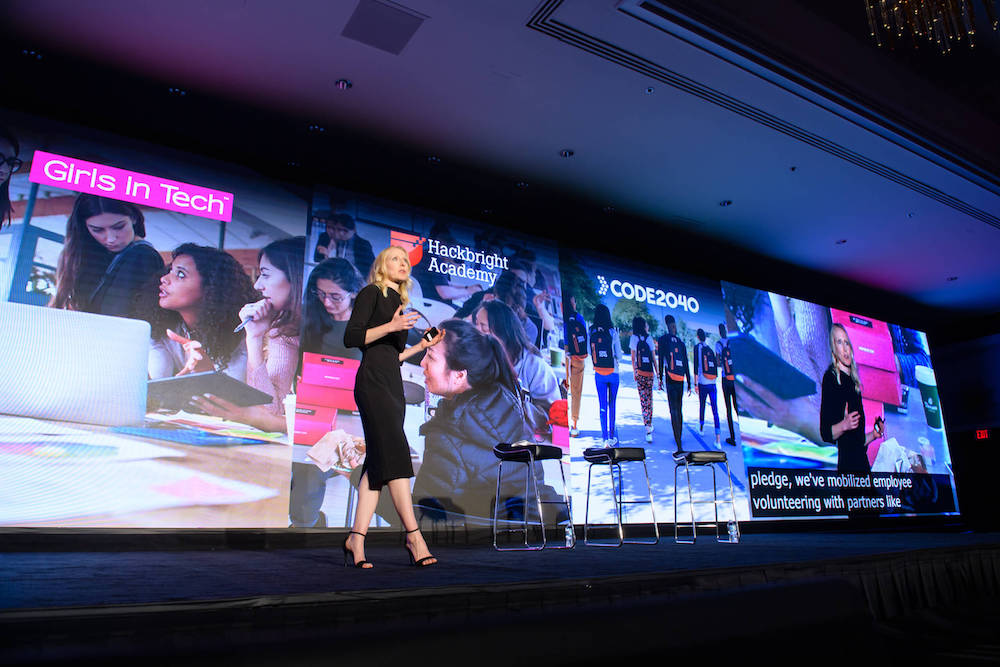
PagerDuty has been in the news since it first surfaced in 2009. Its product was unique: a cloud-based digital-operations management platform that helped companies address DevOps issues in real time. Originally founded in Toronto, PagerDuty came under the wing of the famed Silicon Valley incubator Y Combinator, which has helped launch well-known tech brands such as Airbnb, Instacart, Dropbox, and thousands more. The startup darling collected round after round of funding from the investor community, counted nearly half of the Fortune 500 as customers, and was on its way to following the path of other successful Y Combinator startups.
But the true institutional change came in summer of 2016 when PagerDuty named Jennifer Tejada as its CEO. The veteran tech executive had a reputation for spearheading companies with complex products and opaque missions and infusing them with a dose of humanity: “What is this product and what does it actually do for customers?” Tejada did that effectively at PagerDuty, helping to expand the company’s client roster and simplifying its messaging. But she also wanted the firm to elevate its values. In 2017, she approached the PagerDuty board with the idea of writing the 1-1-1 model into the company’s financial documentation. They emphatically agreed with her: Giving back was a moral imperative and should be literally inscribed into the company’s values.
A year later, Tejada hired Khalili as the company’s impact lead to spearhead efforts to build out its Pledge 1% program. Khalili had experience in enacting social good programs while advising large brands on social impact, and even spent three years setting up a similar initiative while in-house at Yahoo. At PagerDuty, she went pillar by pillar of the Pledge 1% framework and 1-1-1 model, first by setting up a product donation and licensing model for nonprofits, then by building powerful programming to empower employees to effectively give back through their allotted 20 hours of annual paid volunteer time. She then turned her focus to the equity side of the triangle.
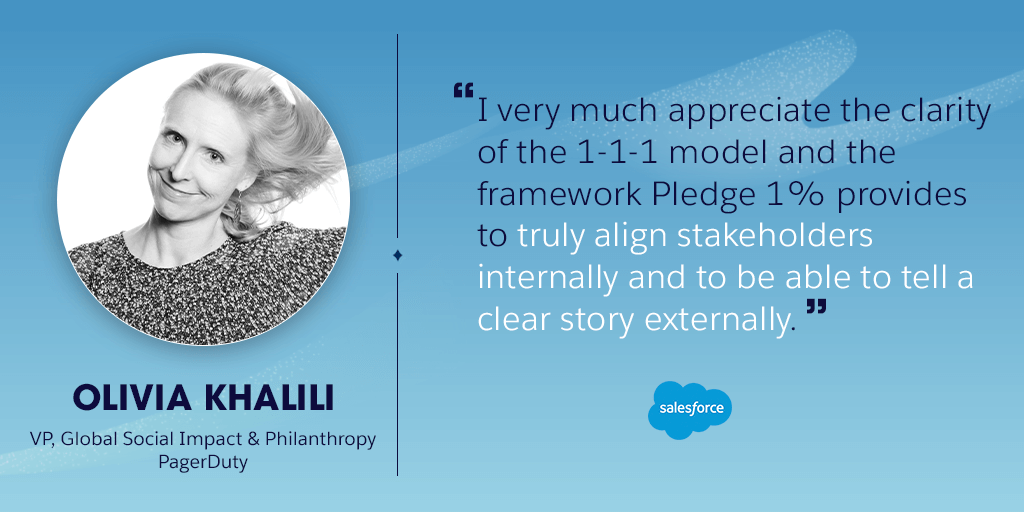
“I looked first at how we would create an integrated strategy,” Khalili recalls. “I very much appreciate the clarity of the 1-1-1 model and the framework Pledge 1% provides to truly align stakeholders internally and to be able to tell a clear story externally. But the question I always return to is, how do we integrate impact across the business and bring these pillars to life in a way that is as embedded in and aligned with our core business as possible?”
When she joined the company, there was no obvious connection to a singular issue to which PagerDuty could dedicate a whole fund, so Khalili rolled up her sleeves and did a significant amount of discovery work – internal interviews, external reviews, and research. Her findings led her to two final potential focus areas, which she reviewed with Tejada before they ultimately decided on time-critical global health.
“We’re a global company and a global platform, so it was important for us to tackle an issue that has global resonance,” says Khalili. “We also wanted to leverage our technology. It was important that technology was innately part of the solution to the problem we are trying to solve. The potential for technology to accelerate outcomes is tremendous. The challenge is how to do so effectively, and responsibly.”
More than that, Khalili and Tejada wanted to identify a cause for which PagerDuty’s core competency of technology and thought leadership could directly make an impact. The idea of time-sensitive global health actually came in part through learning about PagerDuty customers who were using the technology to conquer time-sensitive health challenges at scale.
One of those customers was SightLife, a nonprofit that facilitates 700 cornea transplants globally each month. The eye bank utilized PagerDuty technology to help unify six internal teams to execute on the complex process of preserving and transporting cornea tissue during a critical 48-hour window in which the tissue is viable. Although a specific use case, and atypical of how most PagerDuty customers engage with their platform, that offered a model for the impact PagerDuty technology could drive.
“By zeroing in on time-critical global health as an issue area, we see an opportunity to powerfully impact world organizations through our technology,” says Khalili.
Those on the receiving end of the fund’s mission aren’t the only ones to benefit from PagerDuty’s impact program. Khalili says the stakeholder group she hears from most are employees: “If I had to sum up the feedback I receive pretty consistently, it’s ‘I am so excited that I get to work for a company that cares about making a positive impact in the world.’”
Not only does the Pledge 1% movement impact how employees perceive the company, but also how they engage in learning new skills and volunteering with an organization. Khalili recounts her favorite quote from a colleague in the engineering organization who said, “I would go to volunteer thinking, ‘I’m here to help this organization.’ I always come back thinking, ‘Wow, I’m the one who benefited. I’ve learned so much.’”
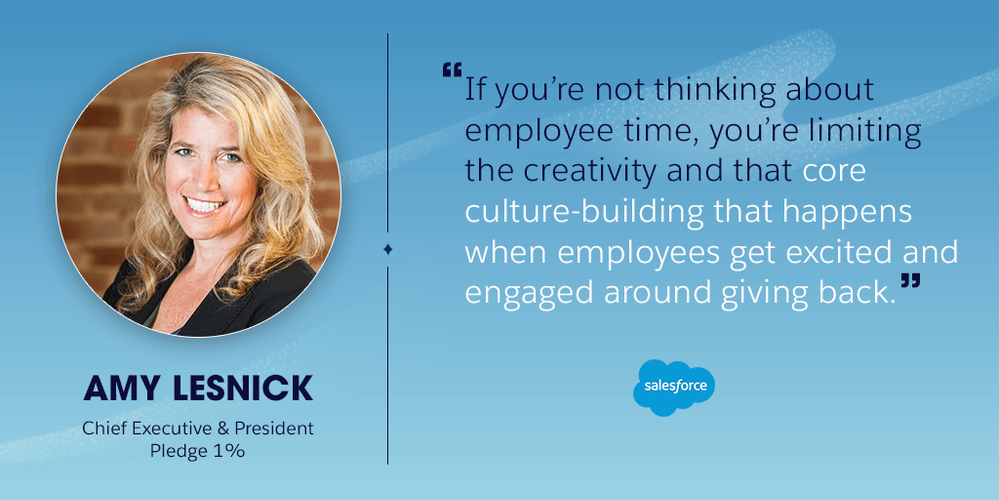
According to Pledge 1% Chief Executive and President Amy Lesnick, PagerDuty’s model is spot on: Providing employees with baked-in volunteer time and experiences in which they’re empowered to leverage their unique skill sets is the secret sauce to engaging them around the 1-1-1 model.
“If you’re not thinking about employee time, you’re limiting the creativity and that core culture-building that happens when employees get excited and engaged around giving back,” she says.
In April 2019, shares of PagerDuty finally debuted on the New York Stock Exchange, making it one of a handful of publicly traded companies with the Pledge 1% Equity Commitment written directly into their financials. PagerDuty joins late-stage companies like Slack, Docusign, Sendgrid, Zuora, Pluralsight, Twilio, Upwork, and Okta, which together have ignited more than $250 million in new philanthropy as a result of their IPOs. In terms of leading the way, PagerDuty is still very much the “unicorn” many have termed it since its early days. Khalili continues to play an integral role in the Pledge 1% community, inspiring and empowering the next generation of leaders to join the 1% movement.
“As a recent IPO, PagerDuty is definitely a role model for other companies,” says Lesnick. “But I also think it’s amazing to have a rock-star female CEO in Jennifer Tejada who inspires others, and one who has so much conviction around the idea that profit and purpose aren’t a trade-off, but something that’s important to be a successful company. And that’s pretty awesome.”
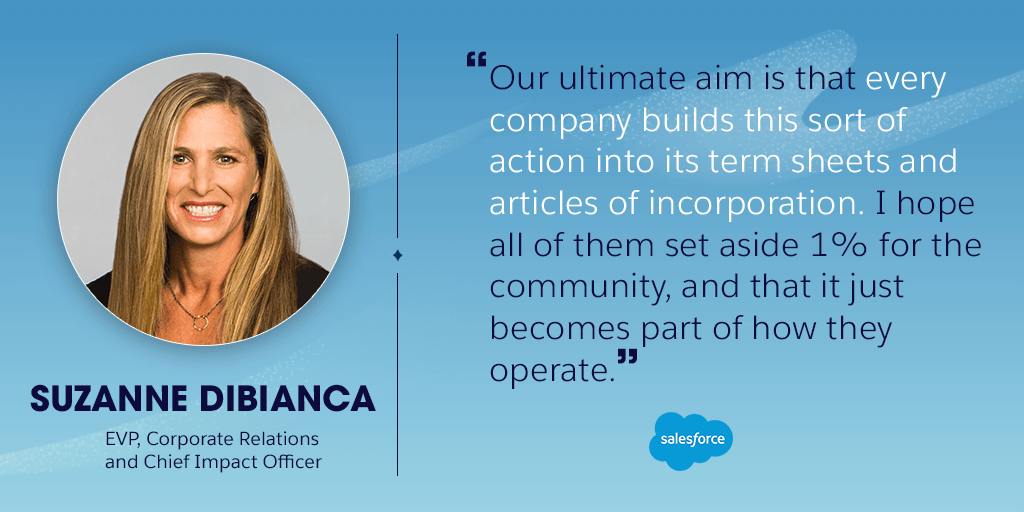
No one agrees more than Salesforce Chief Impact Officer Suzanne DiBianca, who is also a founding board member of Pledge 1%.
“What PagerDuty has done is great,” she says. “Our ultimate aim is that every company builds this sort of action into its term sheets and articles of incorporation. I hope all of them set aside 1% for the community, and that it just becomes part of how they operate. I’d love to see 100,000 companies taking part in the movement.”
Originally posted: January 27th, 2020

A Business That Makes Nothing but Money Is a Poor Business
– Henry Ford
Infostretch has lived the mantra of giving back since inception. As we have grown, so have our ambitions and ability to help. Rutesh and Manish created the CSR vision with the 1% pledge – where Infostretch donates 1% of their staff time, product, profits and equity for charitable causes.
The Infostretch vision took new heights with the inception of Pahel. It is a group of enthusiastic like-minded individuals wanting to make a difference in the immediate environment. Pahel is the Infostretch’s philanthropy platform to help our immediate community and causes. It is not a group to check the box on CSR for Infostretch, but a living testimonial of our belief to give back.
The Pahel model is:
- Community support and service via our active involvement in the causes: Helping schools, tree plantation, menstrual awareness, adopting a village, painting a school, fixing houses in rural areas, cleaning our environmentally sensitive areas, building water coolers in dry areas etc.
- Talent support through our services and ideas: Building digital tools, sites, apps, portals, QMetry products, Digital marketing for awareness to prevent lifestyle diseases etc.
- Infostretch funding: Supporting right agencies and individuals after our checks on genuine causes.
The following are the major Pahel initiatives of 2019:
Ahaan Learning Centre
The anchor cause of Pahel in India is to provide education and rich experiences to people from the less privileged strata of the society through sports, creativity, drama and other methods. Ahaan Learning Centre is one of the anchor causes of Pahel. It is a mission to provide education to the less privileged children. The first centre is at Ahmedabad’s Shivranjani area – where kids who were begging at traffic signals and loitering have been given an opportunity to transform lives. The children are from streets and have had no previous exposure to the values and lives others live. In collaboration with our partner NGO Shwaas, Pahel is making a difference via education and creative activities at the centre.
It has been a challenging project. The start was slow…Initially, it was a challenge to grab the attention of these kids but thanks to creative ideas, firm determination, hard work and zeal, a bond was created with the kids. Young ones started showing up daily. Habits changed. Interest in education and good live arose. The impact goes beyond the basic learning. After literally being invisible and having zero exposure to the outside world, the kids are changing, coming out of their shell and are having a positive attitude towards life.
Ahaan activities are integrated with Infoneers’ life at Infostretch. We have created a planned calendar for activities on Thursdays – where many Infoneers have spent hundreds of hours with these children and shared their amazing experience at the centre. They play games, sing songs, watch videos etc. and inspire them. Indeed, dreams and dedication are a powerful combination!
Ahaan means the first ray of light and we plan to initiate a lot of new light in the lives of more children though more Ahaan centres in the upcoming days.
Happy Periods
The biggest plans have to be executed on ground. India is on a mission to create awareness about menstrual health. The message of Prime Minister, Bollywood Actors & Celebrities has created great awareness. The last mile is equally important.
Pahel Team has taken the initiative called ‘Happy Periods’ to create menstrual awareness in the fringe schools – where girls from less privileged background are present. Happy Periods workshop is a wonderful program that explains the complex topic in a fun way. Pahel Team has taken the idea further with creation of Happy Period Box and Guide – which are distributed free in each awareness session. The Happy Periods program has been conducted in multiple schools so far.
The Happy Periods campaign has met with an overwhelming response from the students. The format of the workshop facilitates the learning in a fun way where kids enjoyed every minute of the workshop as opposed to the traditional format of the workshop which is perceived as a boring & lecture’. The interactive workshop provides an opportunity for the girls to ask questions without any hesitation in a very friendly environment – which they took complete advantage of! The Instructors were treated like superstars and were requested to take selfies by most girls. The feedback from girls and seniors has been consistently positive and overwhelming.
The social networking sites helped remote Gujarat villages observe the success of this campaign which resulted in many of them requesting the Pahel team to visit their villages and run such campaigns in their villages. The Pahel team already planned 5 campaigns in the remote villages of Gujarat. The holistic ‘Happy Period’ campaign framework by the Pahel team which includes workshop, fun games, Happy Period Kit and a guide is such a unique way of handling such a sensitive topic that it has been invited to run in the USA too.
Pahel Movember Movement!
Pahel brought the international Movember campaign to Infostretch – to create awareness around Men’s health issues. Men’s health issues of cancer, mental health and other challenges was the focus. The NoShaveMoovement was a runaway hit! It was christened as Mo-Ment by
our CEO Rutesh Shah. The campaign was truly global. In spite of being a ground zero for the campaign, Infostretch Ahmedabad received tough competition from other Infostretch offices.
The headquarter in Santa Clara was one of the most enthusiastic bunch. Infostretch East-coast also participated in wholeheartedly. Even the fairly new offices like Infostretch Bangalore were equally enthusiastic. Infostretch Pune maintained their enthusiasm throughout the month and was competing for the most enthusiastic team with Ahmedabad and Santa Clara.
More than 120 Infoneers from all the offices participated in the campaign and regularly shared their creative posts on yammer as well as on external social. On the qualitative side, Infoneers have never seen such creative and quality fun posts that playfully delivered serious messages. And, on the quantitative side, Infoneers, in the last month alone, posted more than 300 messages that were read for around 75,000 times and were liked around 3000 times by the Infoneers. Throughout the month more than 700 Infoneers were active on the campaign.
This was the campaign that truly brought the whole Infostretch family together – regardless of the location or the gender. One of the most important factors for the success of the campaign is the lively participation of female Infoneers.
Navrachit Learning Centre
Navrachit Learning Centre is a slum school for the children of construction workers. Pahel is working with the school for almost two years. Located behind the YMCA stadium, Ahmedabad, this school educates around 50+ students who have never seen the gate of any school.
Pahel has been conducting different activities on bi-weekly bases in addition to sponsoring this school financially. Every alternate Thursday volunteering Infoneers visit this school with a couple of Pahel members and do different fun activities like Zumba, games. During Diwali, new clothes have been provided to the children and toy distribution is arranged.
Pahel has helped in infrastructure development and provided constant guidance. From a makeshift school with zero hygiene facilities and leaking walls, the schools is a proper shed with AC and lights with hygiene and all other necessary facilities.
Shwas Collaboration
Pahel is delighted to collaborate with Shwas for driving several causes for our kids and young
champions. Shwas and Pahel are currently working on the following causes:
- Enrichment of education experience for less privilege kids through sports coaching and computer training
- Driving good healthcare awareness through distribution of health-sanitation kits and preventive medical check-up.
- Ongoing interaction with kids through participation in Infostretch corporate activities, company visits etc.
- Promote empowerment through vocational training for bright kids
- Platform for showcasing skills and talents through exhibitions, events etc.
Shwas kids are wedded into the Infostretch eco-system. They participate in the ICL cricket team matches. The kids’ designed paintings are given as prizes for the tournament winners. Even foreign customers visiting Infostretch, are gifted special paintings designed by the kids.
Moodcafe
Infostretch Pahel has helped a mental health care startup with our ideas and talent in form of our service support. Moodcafe, the supported startup, has got endorsement of CM of Gujarat Vijay Rupani. The startup is also the only Indian startup to be featured in Silicon Valley in SVB Demo Day in Jan 2019 in USA.
Moodcafe is a mental health based startup by alumni of IIM Ahmedabad and IIT Roorkee that aims to bring a new-age empathetic caring approach to mental health and well being by leveraging best practices and emerging research-driven trends of psychology, counselling,
therapies, artificial intelligence and innovative reach out strategies
Additional Activities:
During the last few months, a lot of activities have happened including the following:
- Tree Plantation – More than hundreds of trees planted at Ahmedabad and Pune
- Special Tree Plantation drive with Deloitte
- Screening of special play for children – Mowgli Tunak Tum Tum
- Buttermilk distribution at construction sites
- Infrastructure aid to multiple less privileged school sites
- Diwali celebrations with children
- Spending time and caring for old age, women and mental health children
- Collection of funds for Kerala Floods and India Army – Infostretch matched the contribution
of Infoneer donations.
What makes Pahel a special movement is the top executive support, committed participation of team members, integration with Infostretch daily life, going beyond monetary contribution to causes, careful curation of causes and full 360 degree integration of causes. The multiple acts of sharing and caring showcase what these Infoneers are made up of! And what a great value system they bring to the table! Pahel team members – always say – Its our job to keep trying (Koshish Karna hamaara kaam hai!)
Originally posted: December 20th, 2019

Conducting business in a socially responsible way is engrained in our DNA. We believe this a driver for business success and we will continue to strive to make the planet, our environment and our communities a better place than when we began.
RECYCLING & THE ENVIRONMENT
Pollen is proud to have achieved a carbon negative footprint:
- Planting 1700 trees across Australia
- Selecting renewable energy sources for electricity
- Active recycling in our office – every employee has their own Pollen “Keep-Cup” which is not only used in the office but also whilst travelling at client sites. We calculated that we save over 10,000 plastic cups a year!!
- Being a paperless office – there are no printers at Pollen limiting the use of paper
- Limiting e-waste by limiting the number of computer screens/monitors in our office.
WORKING WITH THE COMMUNITY
Pollen values giving back to the community. We have achieved this through:
- Sponsoring Australia’s leading food rescue charity “Oz Harvest”. They collect quality surplus food, distribute it to people in need and divert food waste from landfill. https://www.ozharvest.org/
- Supporting Drought Angels – a worthwhile charity that supports Aussie farmers: https://www.droughtangels.org.au/
- The planting of 1700 new trees via the “Fifteen Trees” organisation that plants trees in various areas to promote land re-generation, sustainable native forests, bushlands and grasslands, as well as productive land for crops and stock.
- Collaborating on a pro-bono basis with the Bread & Butter company. They specialize in educating refugees from across the world in the crafts of becoming skilled bakers: https://thebreadandbutterproject.com/
- Pollen employees are are frequently volunteering with community-based initiatives such as The Rural Fire Service and Surf Lifesaving Australia

Originally posted: December 4th, 2019

This story was submitted as part of the #Pledge1Gives GivingTuesday campaign, which celebrates the many ways our member companies are having an impact around the world.
By Project Alianza.
Sometimes the world seems so broken, it can feel like there’s nothing to be done. We can end up thinking that nothing we do matters, not realizing that we each have the power to make a difference. That if we think beyond your daily life and recognize that what we choose to do matters, even the smallest action can make the world brighter.
We say this because we know, and we want you to know too – what you do matters. Through Pledge 1% making a difference is turned into a habit. In Project Alianza’s five short years of existence as an organization, we’ve grown from a tiny but devoted team into a movement that has impacted over 8,000 lives and it’s all because people all over the world decided to do something. With the support of sponsors like Eleva Coffee, Uber, and Tinker Coffee, we’ve cheered as students become the first ever to graduate from fifth grade in their communities, and watched as their friends and siblings followed in their footsteps. We’ve known single mothers who have worked to achieve financial independence and pursued higher degrees so they could build the best life possible for their kids. We’ve lent a hand while communities have built new schools and filled them with books and students.
Communities are stronger, lives are changed, and a brighter future is taking shape all because people like you knew that they had the power to do something, and so they did. Through Pledge 1% you have the power to provide the sustained and committed support it takes to shape the future for a bright world. That’s why we want you to know that what you do, what you create, what you give – it all matters. You are pledging 1% to make someone else’s world better.
Originally posted: December 4th, 2019

This story was submitted as part of the #Pledge1Gives GivingTuesday campaign, which celebrates the many ways our member companies are having an impact around the world.
“We believe technology, when used for good, can change the world”.
As a large technology organization, Salesforce makes it their mission to do good, not only where it’s headquartered, but around the world.
In 1999, Salesforce pioneered the 1-1-1 Model of Integrated Philanthropy and encourages its partners and others to join its pledge to donate 1% of its equity or profit, product, and employee time.
Salesforce.org empowers tens of thousands of non-profit organizations and educational institutions through technology, grants, and volunteering programs through its pledge program.
Passionate about volunteering
Riva is proud to be a part of the 1% pledge program. Riva supports our employees to pledge money and volunteer in our local and extended communities in Edmonton, Alberta; Pictou, Nova Scotia; Sunnyvale, California; Sydney, Australia; and Munich, Germany.
With headquarters in Edmonton, our staff members have done some great work in supporting our Edmonton community and beyond. In the past year, activities have included everything from raising $26,000 to support WIN House, iHuman, United Way and Stollery Children’s Hospital Foundation to donating to the Edmonton Food Bank, volunteering and taking part in the Warm Hands, Warm Hearts initiative handing out backpacks filled with winter essentials to the homeless population in the area, and volunteering to build and donate bicycles to the Boys and Girls Club / Big Brothers Big Sisters of Edmonton.
The Pictou office has been involved in some great initiatives that include volunteering and donations of time and money to the Pictou West Food Bank, United Way of Pictou County, and supporting the elementary school breakfast program.
“Being part of the 1% pledge has helped Riva share its warm family culture. It’s important to Riva to support initiatives that our employees and their families care about. These are part of the key interests and passions that have helped our company grow into what it is today and will help us continue to reach new heights,” explains Riva CEO Aldo Zanoni.
Whether Riva is sponsoring a local children’s baseball team or sponsoring and attending a masquerade ball to raise awareness of domestic violence, the activities and causes that Riva supports are those that remain close to employees’ hearts, and in turn, all of our hearts.
One of Riva’s seven core values is “Bring your Passion” and Riva is thrilled to be able to share in the causes that are near and dear to our staff’s hearts and do our part to make the world a better place.
Riva is proud to part of the 1% pledge and we hope to give even more in 2020!
Originally posted: December 4th, 2019

This story was submitted as part of the #Pledge1Gives GivingTuesday campaign, which celebrates the many ways our member companies are having an impact around the world.
By 97th Floor
For the past five years 97th Floor has championed #20Helps. The movement’s mission is simple: Demonstrate the positive power of money by setting aside a $20 bill for good. Each year 97th Floor sends its clients and friends a $20 bill in their holiday card with warm greetings and an invitation to spread good.
Every year this movement touches thousands of people.
Since its inception in 2014, the movement’s focal point has been on doing the most good with a $20 bill. And while this focus remains, new elements join the campaign each year. For example giving 20 minutes of time instead of money, or tracking the impact of a specific $20 bill with the #20Helps app.
At it’s five year anniversary, the #20Helps campaign continues to evolve. This year #20Helps is an invitation to connect with each other through a thoughtful service, which may include a $20 gift.
It’s true that a $20 bill can’t buy everything, but when gifted with the love and attention that can only come through genuine human connection, a $20 bill can elevate the lives of the receiver and the giver.
Some examples include, sharing a book that was impactful to you to someone struggling or giving movies tickets and babysitting for new parents. 4
Those interested can learn more at 20Helps.com.
We live in an artificially connect world. And we believe that a $20 bill can change that.
Originally posted: December 4th, 2019