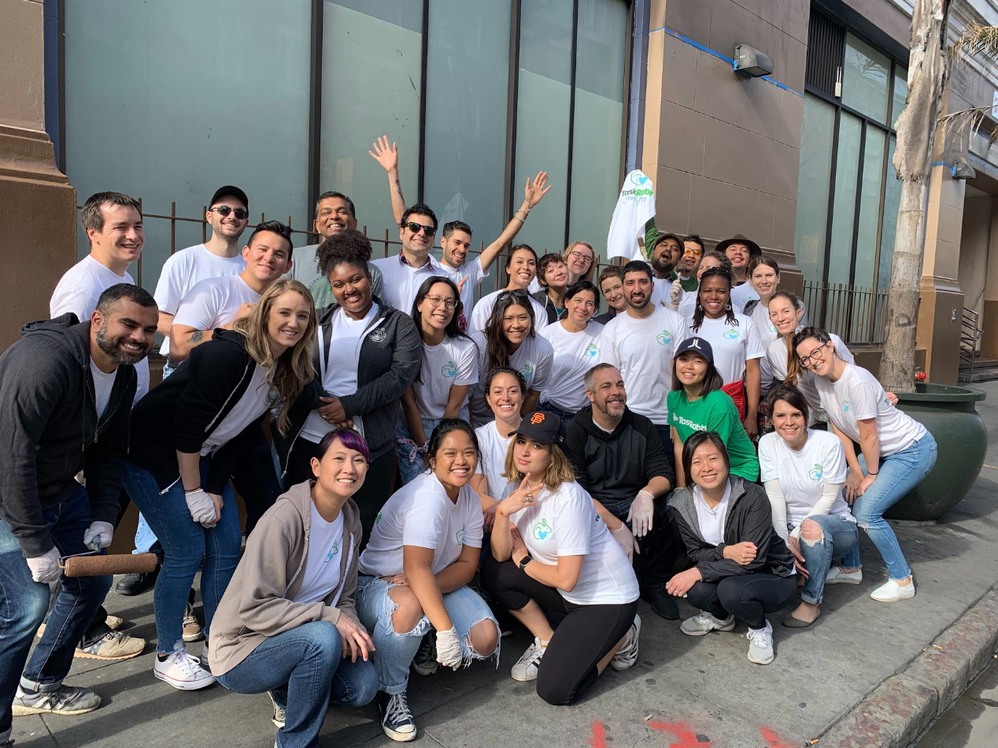
Making everyday life easier for everyday people has been TaskRabbit’s mission from the start, and that mission has taken form in TaskRabbit for Good (TR4G). Now, as part of TR4G, we’re proud to announce that we’ve joined the Pledge 1% movement along with thousands of other companies worldwide, to strengthen communities by helping neighbors in need find work and a place to call home. Given the unique nature of our technology platform, which connects people looking for work to those who need help around the home, our TR4G mission and now our commitment to Pledge 1%, was built into our DNA since day one.
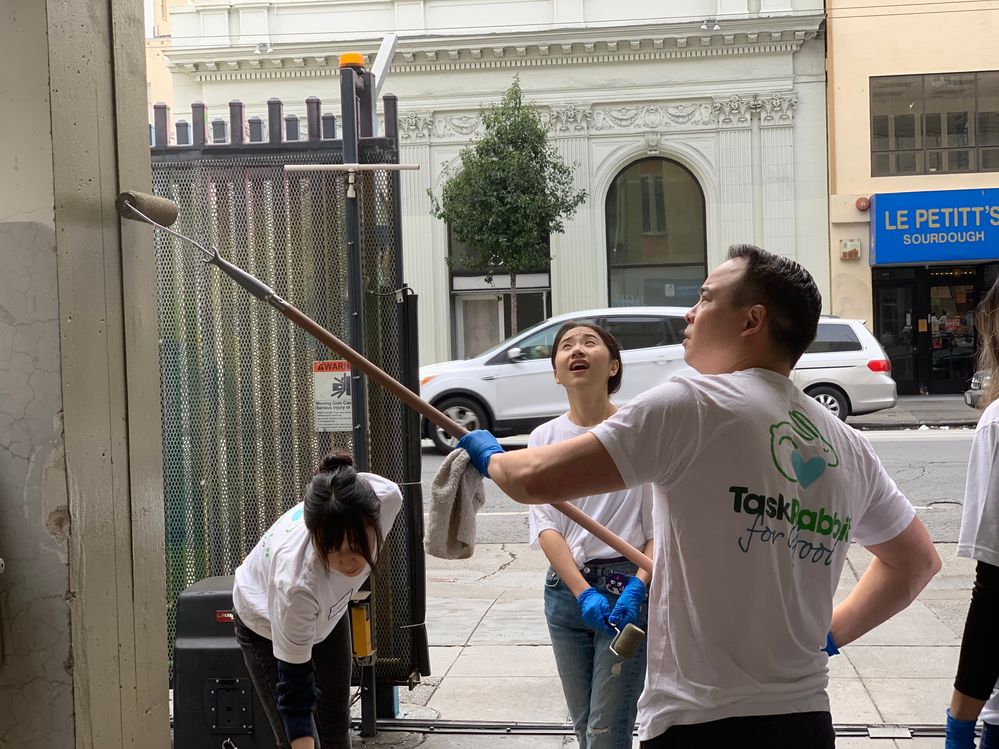
Pledge 1% is a global movement that aims to create a new normal for companies of all sizes, and enable them to have a positive social impact through their business. TaskRabbit will be pledging 1% of our time to volunteer with non-profit organizations dedicated to helping people find work or a place to call home in the communities we serve. We will achieve this through a combination of company office-wide community service days to support organizations such as Breaking Ground (New York, NY), Providence Row (London, UK), Hamilton Families (San Francisco, CA), Episcopal Community Services (San Francisco, CA), and Mobile Loaves & Fishes (Austin, TX), as well as department-specific volunteer events, and volunteer time at a charity of each employee’s choice.
We’ve all experienced moments when we needed a helping hand — and someone reached out offering support — whether it was an organization or a friend. Pledge 1% is an extension of our ethos of neighbors helping neighbors. We’re proud to join the Pledge 1% community and encourage other companies to join us in taking the pledge and leveraging their business as a force for good.
The current system has led to profound inequality. To fix it, we need businesses and executives to value purpose alongside profit.
Capitalism, I acknowledge, has been good to me.
Over the past 20 years, the company that I co-founded, Salesforce, has generated billions in profits and made me a very wealthy person. I have been fortunate to live a life beyond the wildest imaginations of my great-grandfather, who immigrated to San Francisco from Kiev in the late 1800s.
Yet, as a capitalist, I believe it’s time to say out loud what we all know to be true: Capitalism, as we know it, is dead.
Yes, free markets — and societies that cherish scientific research and innovation — have pioneered new industries, discovered cures that have saved millions from disease and unleashed prosperity that has lifted billions of people out of poverty. On a personal level, the success that I’ve achieved has allowed me to embrace philanthropy and invest in improving local public schools and reducing homelessness in the San Francisco Bay Area, advancing children’s health care and protecting our oceans.
But capitalism as it has been practiced in recent decades — with its obsession on maximizing profits for shareholders — has also led to horrifying inequality. Globally, the26 richest peoplein the world now have as much wealth as the poorest 3.8 billion people, and the relentless spewing of carbon emissions is pushing the planet toward catastrophic climate change. In the United States, income inequality has reached its highest level in at least 50 years, with the top 0.1 percent — people like me — owningroughly 20 percentof the wealth while many Americans cannot afford to pay fora $400 emergency. It’s no wonder that support for capitalism hasdropped, especially among young people.
How Geopointe, Salesforce & Pledge 1% are Making a Difference!
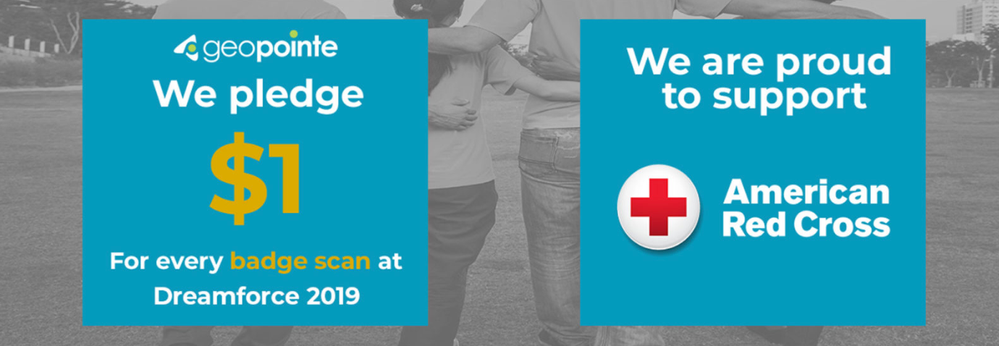
Geopointe is excited to once again be joining Salesforce and Pledge 1% in their efforts to give back at Dreamforce 2019. Geopointe has committed to donate $1 to the American Red Cross for every event ID badge scanned by a Geopointe team member at Dreamforce!
Helping Our Fellow Humans
We are proud to partner with the American Red Cross and support their mission of preventing and alleviating human suffering in the face of emergencies by mobilizing the power of volunteers and the generosity of donors. The American Red Cross, part of the global Red Cross network, holds fast to the seven Fundamental Principles set forth by the global Red Cross network: humanity, impartiality, neutrality, independence, voluntary service, universality and unity.
The American Red Cross has been dedicated to serving people in need since being founded in 1881. In order to fulfill their organization’s mission, they depend on the generous contributions of time, blood and money from the American public. Geopointe is honored to partner with the American Red Cross and contribute to the service they carryout daily.
Our Core Values
As an organization built in the Salesforce ecosystem, Geopointe and Salesforce hold similar philanthropic values. According to Scott Hemmeter, CEO of Geopointe, these values have been at the core of Salesforce for as long as he’s been a part of the Salesforce ecosystem. “Salesforce has been one of the leading organizations both practicing and promoting a commitment to corporate philanthropy. I hope to continue bringing that same commitment to Geopointe and look forward to partnering with Pledge 1% again this year to help make that happen,” said Scott.
Scott has made concerted efforts to keep Geopointe regularly involved in charitable causes. He initiated Geopointe’s $1 per lead scan donation program two years ago at Dreamforce 2017 and has opened Geopointe’s doors to charities in need of a top geolocation solution through Salesforce, offering a special discount to nonprofit organizations.
‘Compassionate Capitalism’
Badge scanning is a standard practice at Salesforce events, creating a cut-and-dry vehicle for commerce. By adding philanthropic importance to each badge scan, it now gives the exchange a feeling of purpose.
Born from the concept of “Compassionate Capitalism,” famously coined by CEO Marc Benioff, efforts like Geopointe’s $1-for-1 scan concept have become more and more frequent at Dreamforce and other Salesforce events. In fact, today, Salesforce events have become a hub for philanthropy, social justice and forward thinking. Every year, Dreamforce provides attendees with opportunities to give back. We’ll be sure to keep you updated on any opportunites or you can check here to see what’s in store closer to this year’s event!
Powered by Pledge 1%
Pledge 1%, officially established in 2016, is the driving force behind philanthropy in the Salesforce ecosystem. Pledge 1% partners with companies to help them give back through various channels: equity, time, product and/or profit to any charity of their choosing.
“Salesforce and Pledge 1% work together to not only provide a great opportunity for companies like ours to giveback to others at Dreamforce, but use their reach and influence to encourage the thousands in attendance to get involved,” said Mark Baird, Geopointe VP of Sales. “Partnering with Salesforce and Pledge 1% makes it even easier for our team to giveback by providing assistance and resources to boost the visibility of our efforts which, in turn, boosts the response from attendees,” Mark added.
Stop by the Booth! (#713)
At this year’s Dreamforce Geopointe is a Groundbreaker Sponsor so make sure to stop by our booth and say “hi”! We’d love to have you come by to meet our team, watch a quick demo and fill your bags with some Geopointe SWAG! But, before you take off, be sure to save a second for a scan.
For entrepreneurs deep in the throes of building a company from the ground up, creating a social impact program is rarely a top priority. Building a formal program can seem daunting and time consuming, but committing to giving back in the early days doesn’t have to be a grand gesture or investment– you just have to start.
As my co-founder Todd McKinnon and I learned while building Okta and creating Okta for Good (our company’s nonprofit arm), taking small steps to solidify a commitment early can make a massive difference in shaping the way an organization gives back later. We learned that embracing social impact from day one signals to employees, customers and investors a firm dedication to giving back through every stage of growth.
Here are four ways leaders can kick off a lasting program and pave a path to long-term corporate social responsibility.
1. Make a commitment.
Making a commitment at the start helps ensure social good is at the forefront of your mission and woven into your company values as you grow. To instill giving into Okta’s DNA, we took the 1% Pledge, an initiative challenging companies to pledge one percent of equity, profit, product, and/or employee time for their communities, back in September 2016.
This enabled us to grow our commitment through Pledge 1%’s resources, case studies and one-on-one guidance. By the time we went public, we formalized Okta for Good in our S-1 registration document and made it clear to public investors that if they invested in us, they invested in Okta for Good, too.
Making an investment in social good also means designating internal leaders to show the way. While most startups can’t yet hire someone full-time to lead social impact efforts, you can encourage (as well as recognize and reward) a team of internal leaders to execute on the vision for social good.
This way, giving efforts aren’t relegated to the back burner among other pressing responsibilities. Ideally, a founder-level sponsor should lead the way with a group of employees who have the bandwidth, resources and cultural influence to bring the commitment to life.
2. Connect your product to impact.
It’s not just about employee time spent and dollars invested, the products or services you build can drive social good too. Many technology companies help nonprofits “get out of their own way” when it comes to IT so they can spend more time and resources delivering on their missions. This includes providing nonprofits with licenses for your products, offering deep discounts, giving technology training courses to nonprofit leaders at no cost or leveraging your product to solve community-focused use cases or pain points.
For example, Twilio launched Twilio.org’s “Recipe for Good” book, outlining how social impact organizations have built thousands of Twilio apps to fuel positive change– through mobilizing volunteers, delivering critical info and engaging supporters. Postmates‘s social impact program, Civic Labs, built a product that enables restaurant partners to utilize the Postmates API platform to deliver excess food to local shelters, enabling a zero-waste solution. Once you identify the best way to connect your product to impact, share your findings with other leaders and organizations for inspiration.
3. Activate your team.
Company leaders have a responsibility to engage the broader organization in social good efforts– and to ensure everyone has the bandwidth to contribute time and effort to local volunteering or fundraising events. Make it simple for your team to put day-to-day work aside on a regular basis and to give back to local communities.
One easy way to do this is to give employees time off each year to participate in social good efforts. Bay Area companies like Salesforce, Cisco and Intuit for example have created a contagious culture of giving back that stems from giving each employee a designated number of days off per year to volunteer.
At Okta, each employee gets three days of volunteer time off per year, and we integrate volunteering into our new hire orientation process to infuse giving back into the Okta experience from the start. A commitment to providing this time off benefit ensures social good is on everyone’s mind, and it’s good for team morale, too; a recent study showed companies engaged in CSR programs saw a 50 percent reduction in employee turnover.
4. Don’t go it alone.
I co-founded an integration company– so unsurprisingly, I’ve found that partnering with technology companies committed to driving the future of work and building seamless customer experiences has helped us grow faster and smarter. This partnership mindset applies to joining forces with like-minded companies committed to helping the community. Teaming up with other organizations amplifies efforts and can help build relationships with business partners, customers, prospects and industry peers — furthering both business and community objectives.
Look for initiatives in your community that bring companies together and align with your organization’s social impact goals. As an example, the #ImpactCloud initiative offers inroads for impact-oriented technology companies to combine forces and accelerate digital transformation for social impact organizations. The initiative inspired us, Box.org, DocuSign Impact, Salesforce.org and Twilio.org to collaborate and transform how the technology sector can support greater change together.
Creating a successful social impact program does not stem from just one person at a company; it’s a team effort, ideally supported by leaders dedicated to giving back, motivated employees and community partners who view corporate giving in a similar light. We all have a responsibility to give back, and our success is linked to our communities: businesses can’t thrive unless our communities are thriving as well. The earlier you embed the “giving mindset” into your organization, the easier it will be for your company to scale alongside the mission and build on it as you grow.
In recognition of her contribution, Madhavi, 29, was invited as a speaker to United Nations.
BENGALURU: Madhavi Shankar is a young, passionate, socially committed entrepreneur who advocates equal educational opportunities through her start-up SpaceBasic- an interactive hurdle free application for student housing. In recognition of her contribution, Madhavi, 29, was invited as a speaker to United Nations. Within two years, her engagements resonated through a series of appreciations, awards and recognition from the country.
Speaking about her encounter with the start-up ecosystem, Madhavi Shankar takes Deccan Chronicle through her two-year journey from an entrepreneur to becoming one among the 9 ambassadors for UN’s ‘One Million Global Youth Leaders for Sustainable Development by 2030 (1M2030) initiative launched in Geneva. She was invited along with her co-founder Aiden Bingham to represent SpaceBasic.
Can you explain the journey of the birth of Madhavi Shankar as an entrepreneur?
One afternoon, on a working day, I found myself resorting to watch a series after delegating work. This was the initial trigger that urged me to yearn for four-and-a-half years of hard work that resulted in my promotion as a Product Manager at Vodlo Pty Ltd, a start-up in Sydney. I missed the feeling of working at the ground level in a start-up, like we did in building Vodlo with a 5-member team. Instead of looking for a change in job, I decided to experiment by setting up one myself.
While this urge lay deep within, it bore fruits after my meeting with Indu Navar, my mentor and co-founder of SpaceBasic. I decided to move with my parents to India to work towards fulfilling my dreams.
What is SpaceBasic and its social outreach?
SpaceBasic is an interactive networking platform, where we address critical problems like student safety checks, digital data management, open and improved communication channels between all stakeholders within independent student housing communities (SHC) and SHCs in schools and colleges. Founded in 2017, SpaceBasic is headquartered in the US with Bengaluru as the functioning branch in India. We have currently collaborated with over 70 educational institutions and 120,000 users in Karnataka with two set-ups in Delhi and Mumbai.
We also work towards creating equal opportunities for students by connecting them with global companies seeking student engagement in the form of internships, skill development training etc. To provide equal educational opportunities, we have expanded our reach towards tier 2 cities in Karnataka. Based on our collaboration with UAS-GKVK, Bangalore, 20+ students were chosen for a 6 month farming internship in the US. By 2020-21, I want to be able to reach out to 1 million students from the world. With calls of interest from the Middle East and Vietnam, we want to impact lives of students pan India and pan World.
What were the challenges that you faced in the transition from being an employee to that of an entrepreneur?
Challenge for me was to basically sail through the mindset internally and externally. By internally, I mean the effort of getting accustomed to the Indian working space and moving in with parents as I was an overseas student and an employee. Externally, I would directly like to specify the social norms of prejudicing women’s roles in the society.
Can you give some insights about your recent participation at UN’s ‘Beyond 2030’ initiative?
There are about 1.2 billion youngsters globally, and this number is expected to grow by seven per cent in the next two decades. I was one among the 9 young leaders invited as a speaker and panelist at the United Nation’s ‘One Million Global Youth Leaders for Sustainable Development by 2030.’ This was launching event to train the next generation of community entrepreneurs.
On this occasion, 9 speakers including me were appointed as ambassadors and committee members, by Dr. Walters, Director of Global Challenges Forum to lead the march to attain the sustainable goals.
Whom would you like to attribute this successful journey?
Behind every successful man is a woman. However, in my case, I believe, behind my aspiring journey was my father’s support and guidance throughout. Sim ilarly, without Indu Navar’s mentorship and confidence in my spirit was indeed the turning point in my life. My mother and sister raised me to become independent and fierce. Also, my great founding team has made my dream work.
As an advocate for global women educators and employment, what is your contribution?
Giving back is in our corporate philanthropy. We are part of the movement called Pledge 1% movement. We pledge 1% of our profits, time and software to reinvest into our community and towards educating women each year.
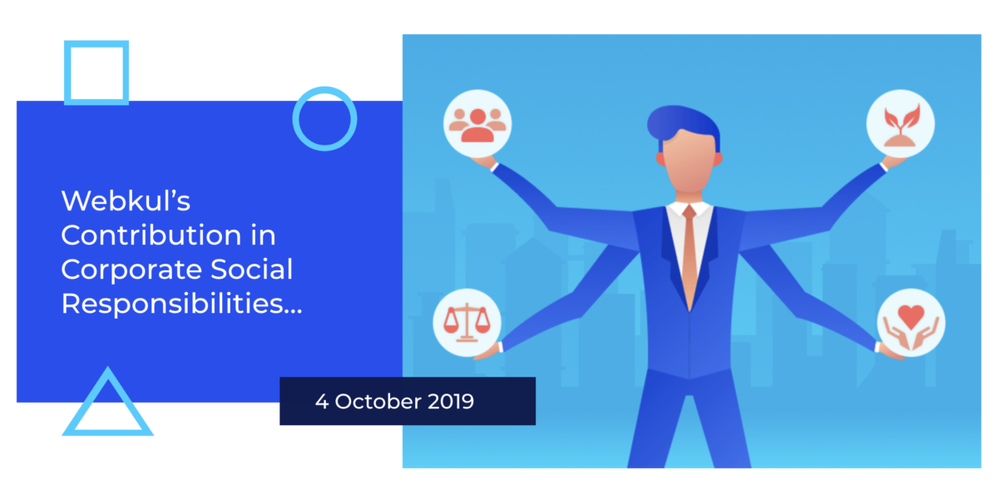
Corporate Social Responsibility (CSR) is a concept that suggests that it is the responsibility of the corporations operating within society to contribute towards economic, social and environmental development that creates a positive impact on society at large.
In short, Corporate Social Responsibility reflects a company’s sense of responsibility towards the community and environment (both ecological and social) in which it operates.
In the era of growing partnerships and stiff competition rising among corporates, building a successful business based on profits is not enough.
Corporates need to realize the importance of giving back to society and incorporate corporate social responsibility into their core business ethics.
Webkul’s Contribution towards CSR –
Webkul believes in having strong business ethics, work culture, and work-life balance. As well as Webkul completely understands the roles and responsibilities of an organization towards society and non-profit organizations. And hence, making some contribution towards society as well as for non- profit organizations.
Webkul’s contribution to Non-profit organization-
Webkul is providing a discount on eShopSync for non-profit organizations. So that non-profit organizations that are using Shopify for their online store can easily purchase this connector at an affordable price. And hence, making it easy and reliable to integrate their Shopify platform with Salesforce.
This connector provides real-time synchronization, interactive design with a brilliant user interface to manage data efficiently, Multi-store oriented integration to enhance management of e-Commerce data, effective utilization of multiple Shopify stores in single Salesforce CRM and with the use of this connector they can process bulk data from their Shopify Store to Salesforce. It allows to sync categories, products, customers & orders from Shopify to Salesforce.
The idea behind the concept of this connector is to increase data integrity, maintain proper inventory of stock, provide brilliant customer care services and much more.
The non-profit organizations which are using this connector developed by Webkul are –
Vermont Association of Snow Travelers – VAST is responsible for the organization of the sport, maintaining and grooming trails, VAST is one of the oldest snowmobiling organizations in the U.S. and a non-profit, private group that includes 131 clubs statewide with over 24,000 members combined. VAST is using eShopSync for Shopify for managing its online store.
Native Hope, Inc – Native Hope is a non-profit organization that exists to dismantle barriers and inspire hope for voices unheard. Their 100% of donations go to fund vital programs. They believe in the power of storytelling to dismantle barriers, bring healing and inspire hope for Native people. Native Hope is using the connector developed by Webkul for the integration of their Shopify’s online store with Salesforce.
Ascension– Ascension is a faith-based healthcare organization dedicated to transformation through innovation across the continuum of care. And one of the leading non-profit and Catholic health systems in the U.S.Ascension is using Shopify platform and also using eShopsync for Shopify for the synchronization purpose.
The Kabbalah Centre – The Kabbalah Centre International is a non-profit organization located in Los Angeles, California that provides courses on the Zohar and Kabbalistic teachings online as well as through its regional and city-based centers and study groups worldwide. The Kabbalah Centre is also using this connector eShopsync for Shopify developed by Webkul.
So, the above mentioned are the non-profit organizations that are using eShopsync for Shopify as well as there are many other non-profit organizations are there which are using this connector developed by Webkul.
Webkul’s contribution to Social Welfare –
Webkul is supporting Goonj, as Goonj is a non-governmental organization headquartered in Delhi, India which undertakes disaster relief, humanitarian aid, and community development in parts of 23 states across India.
Goonj focuses on clothing as a basic but unaddressed need. As well as Goonj uses the under-utilized and excess urban household material as a tool for rural development across 23 states in India. It thus aims to bring an equitable relationship of strength, sustenance, and dignity between the cities and villages.
So, Webkul helped Goonj by distributing ready to eat packets of food, Clothes, and Study materials for orphan children.
Webkul at Goonj –
We believe it’s not our responsibility rather it’s our social duty. A simple step from our side to make a millions of smile face.
Identity management company Okta is a major advocate of the Pledge 1%. Here are some of the ways that Okta is driving social good.
Okta, a company that has built a solution that helps organizations both big and small accomplish important missions, had taken an oath to Pledge 1% for social good a few years ago. Through the program, Okta started offering its products free to nonprofits with 25 employees or fewer. And the company will be offering deep discounts to larger organizations.
Back in 2016, Okta CEO and co-founder Todd McKinnon pointed out that “technology can truly be the catalyst for positive change, which is why we recently debuted our Okta for Good program and took the 1% pledge — committing our time, product, and equity to give back to the community.”
And Okta co-founder and COO Frederic Kerrest also explained in an Inc. article that there are 4 ways that startups can launch a social impact program. The four ways include making a commitment, connecting your product to impact, activating your team, and not going at it alone.
Kerrest pointed out that Okta’s commitment to Pledge 1% enabled the company to grow its dedication towards providing resources, case, studies, and one-on-one guidance. Once Okta went public, Okta for Good was formalized in the S-1 registration document. This documented emphasized to public investors that an investment in the company was an investment in Okta for Good as well.
And it is not just about the employee time spent and dollars invested. Kerrest explained that the products or services you build can drive social good too. For example, Twilio had published Twilio.org’s “Recipe for Good” book, which outlines how social impact organizations have built thousands of Twilio apps in order to fuel positive change by mobilizing volunteers, delivering critical information, and engaging supporters.
In order to activate a team, company leaders need to engage the broader organization in social good efforts. And leaders need to make sure that everyone has the ability to contribute time and effort to local volunteering or fundraising events. One of the best ways to do this is by giving employees time off each year to participate in social good efforts. Okta gives each employee 3 days of volunteer time off per year.
Plus it is important to team up with other organizations in order to build relationships with business partners, customers, prospects, and industry peers. By driving social good as a team, it will further business and community objectives.
“Creating a successful social impact program does not stem from just one person at a company; it’s a team effort, ideally supported by leaders dedicated to giving back, motivated employees and community partners who view corporate giving in a similar light. We all have a responsibility to give back, and our success is linked to our communities: businesses can’t thrive unless our communities are thriving as well. The earlier you embed the ‘giving mindset’ into your organization, the easier it will be for your company to scale alongside the mission and build on it as you grow,” wrote Kerrest via Inc.
MILL VALLEY, Calif., Aug. 6, 2019 /PRNewswire/ — In 2003, Rick Bakas left a lucrative job at Nike’s California headquarters and headed to Boulder, Colorado to care for his mom, who has Multiple Sclerosis. Cannabis proved to be a lifesaver for his mother, helping with her pain, sleep and seizures and allowing her to stop taking several medications that came with harsh side effects.
Today, Bakas’ appreciation for the benefits of cannabis and his amassed product expertise has morphed into a major fully licensed, premium cannabis delivery service in Northern California called Flowsent. Its team is comprised of business owners and marketers, with a combined 50+ years of experience in and outside of the cannabis industry – several of whom have won awards for their cannabis recipes and resulting products.
This month, Flowsent stretched its wings even further with the launch of its weed club, akin to wine or beer of the month clubs. Club members can choose from four packages:
Keep Tahoe Green (monthly selection of flower products)
710 Racing (monthly selection of cannabis oil)
Goddess (monthly selection of health and beauty products with a focus on CBD)
Flow Box (monthly selection of any type of product including edibles and gear)
Club members also enjoy a host of added perks, including discounts on purchases, priority delivery and invitations to grower dinners and other exclusive events. The organization’s founders say the weed club is the “first-of-its-kind” in the legal cannabis space.
“We are a bit spoiled here in California. We have the best of everything right at our fingertips and just expect access to the finer things across the board. Flowsent caters to that expectation by offering an award-winning selection of the highest quality cannabis products delivered right to our customers’ doors,” explained Aaron Grimes, one of the co-founders, whose relationships with California growers have been a key to giving the company a competitive advantage.
“When looking for cannabis products for our menu, we intentionally look for those that come from plants with minimal or, preferably, zero exposure to chemicals. We believe cannabis, like the foods we eat, should come from farmers who grow their crops sustainably,” said co-founder Stig Westling, who brings degrees in chemistry and business to the table.
“Since my mom started using cannabis products 16 years ago for her MS, the products available and the industry have completely evolved. Yet, one thing remains the same: cannabis is changing and saving lives, and its wide range of uses continues to expand,” Bakas added.
Bakas said the company always keeps its roots top of mind. As such, it advocates for improved access to cannabis and CBD products for medicinal purposes for people like his mother, cancer patients, veterans suffering from PTSD and others who can benefit from them. The company has, in fact, taken the 1% Pledge and donates both products and employee time as a result. Pledge 1% challenges companies to pledge one percent of their equity, profit, products and/or employee time for their communities.
Expansion plans for Flowsent are in full swing as the business prepares for the launch in 2020 of its full line of CBD products to be sold nationwide. For more information about Flowsent, its products and weed club, go to flowsent.com/hello.
Initiative will enable communication efforts by nonprofits supporting individuals and communities in times of crisis
Establishes crisis response technology network to help nonprofits expand the number of people they serve via communications
$5 million in grants available to nonprofits for communications technology supporting people in crisis
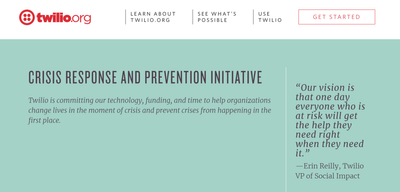
Twilio (TWLO), the leading cloud communications platform, today announced that the company’s social impact arm — Twilio.org — has launched its Crisis Response and Prevention Initiative. The announcement was made at SIGNAL, the company’s annual developer and customer conference held this week at the Moscone Center in San Francisco.
As part of the initiative, Twilio.org has established the Crisis Response Technology Network (CRTN), intended to help nonprofits develop communications technology to serve individuals and communities in times of crisis. The CRTN will bring together organizations that have the greatest capacity for delivering crisis response communications at scale via technology. Members, including engineers and program specialists, will identify barriers and opportunities for nonprofits to utilize technology to decrease response times for providing help to people in crisis. The CRTN will also work to make sure that nonprofits are receiving enhancements to and maximizing the functionality of the Twilio technology they are currently using. The CRTN reflects Twilio.org’s vision that one day, everyone who is at risk will get the help they need, right when they need it.
Meetings will be held quarterly, with costs covered by the Twilio.org Impact Fund. Charter members of the Crisis Response Technology Network were announced at SIGNAL, including:
Child Helpline International – a collective impact organization with 175 members from 145 countries and territories around the world coordinating information, viewpoints, knowledge and data from child helpline members, partners and external sources to help and support child protection systems globally, regionally and nationally.
International Rescue Committee – established in 1933 by Albert Einstein, the IRC responds to the world’s worst humanitarian crises, helping to restore health, safety, education, economic well-being, and power to people devastated by conflict and disaster.
Partnership for Drug-Free Kids (Center on Addiction) – the only national nonprofit committed to supporting the whole family as they address every aspect of substance use and addiction, from prevention to recovery.
Rape, Abuse & Incest National Network (RAINN) – the nation’s largest anti-sexual violence organization, operating the National Sexual Assault Hotline (800.656.HOPE) and carrying out programs to prevent sexual violence, help survivors, and ensure that perpetrators are brought to justice.
Save the Children – founded 100 years ago, Save the Children is devoted to providing children a healthy start in life, the opportunity to learn and protection from harm and has changed the lives of more than one billion children.
Trevor Project – the leading national organization providing crisis intervention and suicide prevention services to lesbian, gay, bisexual, transgender, queer & questioning (LGBTQ) young people under 25.
“More and more nonprofits are using Twilio’s technology given the important role of communications in life and death situations,” said Erin Reilly, vice president of Social Impact and general manager of Twilio.org. “Nonprofits want to deliver the right message at the right time to the right person, all at the scale of the problem they’re tackling. They are the experts in changing people’s lives, and we want to help them expand their reach to even more people. We’re looking forward to working even more closely with leading organizations that have been supporting people in times of crisis for decades.”
To support the effort, Twilio.org announced that it will provide a total of $5 million in grants from the Twilio.org Impact Fund by the end of 2019 to nonprofits in the United States and globally that leverage innovative communications technology to address the following areas:
Domestic violence
Substance abuse
Sexual assault
Suicide prevention and mental health
Natural disasters
Nonprofits can submit applications for the grants at the Twilio.org website.
An initial round of $1.2 million in grants was announced at SIGNAL, awarded to the following recipients:
These grants were made through the Twilio.org Impact Fund, which has provided over $3.75 million to social impact organizations since the start of 2019. These grants are part of the company’s Pledge 1% initiative to support social impact.
Keeli Sorensen, vice president of Victim Services at RAINN, provided a keynote address at SIGNAL about the critical role that communications technology has played in their efforts to help individuals survive and recover from sexual assault. “Twilio’s Programmable SMS allows our hotline staff to safely share resources across the globe, whether that’s with a survivor in rural Alaska, or a NOAA scientist in the Arctic. Twilio’s Programmable Voice also helps RAINN connect with people worldwide. Together, these technologies have made it possible for our staff to provide survivors with emotional support, develop safety plans to leave abusive environments, and learn ways to report their assaults to law enforcement,” said Sorensen.
For more information on the Twilio.org Impact Fund, visit twilio.org/impact-fund.
About Twilio.org
Twilio.org works with nonprofits and social enterprises to fuel communications that give hope, power and freedom. By connecting social impact organizations, passionate software developers and the full power of the Twilio platform, Twilio.org ignites positive change on a local and global scale. To date, more than 3,000 charities and nonprofits have used Twilio to send more than a billion messages for good.