My favorite donut shop is a good 45-minute drive from my house. I go out of my way to stop by Spunky Dunkers in Palatine, IL whenever I can. You know the donuts are good because:
They don’t have a website.
No two donuts look the same. They’re like snowflakes.
On one particular day last summer, I had a client meeting close by, so I made a morning stop for a donut and coffee. As I was about third in line, the cashier announced to the short line of customers:
“Our credit card machine is down right now, we’re only taking cash.”
The guy in front of me didn’t take the news that well.
“What? Are you serious?” he said so that we could all hear. I looked in my wallet. I had about $10 in cash. I tapped him on the shoulder.
“What were you gonna order?” I asked him.
“A donut and coffee” he said, frustrated.
“Well it’s your lucky day,” I said. “I never carry cash. I’ve gotcha covered.”
He looked at me confused, but relieved. “Are you serious?”
“Of course.”
He said thanks and left after that. It cost me $2.53, which I’ll never get back.
That day, I made an investment in someone that I’ll probably never meet again, with money that I’ll never see again, but I made a memory that I’ll never forget.
I learned 3 things that day:
The best investments are not in someTHING, but someONE.
Giving is about gaining.
I don’t worry about money that I don’t have anymore.
The best investments are not in someTHING, but someONE.
“This is why we can’t have nice stuff!” I’ve heard people say. And they’re right. I don’t think we should be careless with our stuff, but I think we should care less about “stuff.” People and memories will last. Stuff won’t. I didn’t always think this way. I’ve been learning this from my wife, who gets great joy from investing in people rather than things.
For that guy, it turned his bad morning into a good one. For the cashier, it turned a potentially ugly situation into a peaceful one, and for me, well I felt great. I’ll tell you about that next. All for just $2.53.
Giving is about gaining.
I’ve been to Spunky Dunkers dozens of times. I’ve bought dozens of donuts and cups of coffee. And I don’t remember any of them. I remember that day, though. A whole year later. Why? Because even though I gave away a little bit of money, I felt zeroloss. I actually felt a sense of gain. Of satisfaction. Of joy. Neuroscientists have even discovered that giving money away is “neurologically similar to ingesting an addictive drug or learning you’ve received a winning lottery ticket.”
I don’t worry about money I don’t have anymore.
I worry about money sometimes. Do you? I worry about my stuff. I want my money to grow, not shrink. I want my stuff to stay brand new. But when I think about money that I have given away? Do I wonder about its security? Do I worry that it’s not growing enough? That’s a firm no.
When’s the last time you gave something away? Do you still worry about it?
What I’m going to do now.
I want more days to start like this one did. I want to feel this way again. So here’s what I’m going to do. 3 simple steps:
Go to the ATM and get some cash. Maybe $50. Put some in my wallet. Some in my car.
Whenever I’m waiting somewhere, I can stop looking at my phone and start looking for ways I can invest in someONE.
Invest in someONE before the end of the day on Monday each week.
That day at Spunky Dunkers, I lost $2.53. Some people might call that a bad investment. I would agree. It’s a bad investment if your goal is just to earn more money.
Some of the most important organisations globally are those most invested in helping their local community’s or global causes. Registered charities and non-profit organisations play a crucial role providing critical services and funding to those most in need of assistance. With their focus on reinvestment, not profit, often the funds available for technological investment can be reduced. Charitable organisations, however, have the same requirements and demand for the benefits that technology can bring. Providing their users or donors with the best possible experience can be the difference between success and failure. Non-profits often rely on the assistance of the technology community to provide discounts and support so that they can leverage the most cutting edge platforms. In today’s episode we hear how CRM Integration experts, AMC Technology, do exactly that.
Patrick is joined by expert guest Lorelea Moore, who is Director of Strategic Partnerships at AMC Technology.
Lorelea first explains to Patrick why AMC are so passionate about helping charities and non-profit organisations. Everyone at AMC has benefited at some point from the work of charities and the whole organisation is grateful and keen to providing assistance back in any way possible. As well as wanting to help, AMC are also uniquely placed to assist charities with CRM integration to improve contact centre efficiency, which often forms a critical part of their fundraising systems.
“We really understand the challenges that charitable organisations come up against.”
Lorelea explains to Patrick that although non-profit organisations don’t have identical requirements to conventional businesses often the demands in terms of contact centre provision are even more important to their overall efficacy. Ensuring donors have a smooth and simple experience is key to increasing potential donations which can in turn be reinvested in good causes.
The Helping Hands Initiative is AMC’s own internal scheme for charitable discount. It provides a quantity of its DaVinci software licences completely free of charge, for registered charities and non-profits, and then further licences at a significant 65% discount. As well as the discounted software AMC also makes its professional services expertise available at the same massively discounted rate.
“This enables them (Charities and non-profits) to put their budgeted dollars, from donations, phone calls etc into their more crucial projects that support the communities they serve.”
AMC has also been supporting, and participating, in the global Pledge 1% program. The program asks organisations around the globe to donate 1% of their equity, profit, product, and/or employee time back into their communities.
Patrick also asks Lorelea how else AMC have been helping charities and non-profits. Lorelea explains that AMC can use its expertise in the field of contact centres to help organisations improve their efficiency by streamlining CRM integration within platforms to enhance the process of receiving financial donations or support.
Finally Lorelea tells Patrick about some examples of how AMC have assisted charitable organisation with its unique set of specialisation and skills.
Listen on your daily commute, whilst walking the dog, or in the gym. UC Today – Out Loud provides bite size podcasts, bringing you all of the latest communication and collaboration news.
Rate, review, share on Apple Podcasts, and Buzzsprout, and join the conversation on LinkedIn, Twitter and email.
Presenter Patrick Watson and special guest Lorelea Moore from AMC Technology.
Over the years, I’ve written about my belief in the importance of giving back to your communities and #givefirst. In this spirit, one of the key organizations my partners at Foundry Group have helped create and nurture is Pledge 1%.
While all of the Foundry Group partners have been involved, Seth Levine has been spearheading our engagement and the transformation from EFCO to Pledge 1% (he, along with key members of the teams from Salesforce, Atlassian and Ryan Martens are the founders of Pledge 1%). At a partner offsite at the end of last year, we were reflecting on some of the gifts from Foundry Group through our Pledge 1% involvement, which included:
The Community Trust of Boulder – We believe that a rising tide raises all boats and wanted to do our part to support our local community here in Boulder and Colorado.
Museum of Boulder – Our city has a rich history on numerous dimensions. We now have a museum in downtown to be proud of.
BCH Foundation Mental Health Campaign – Mental health is a major issue in our society, as well as in entrepreneurship. We are pleased to be able to help expand the mental health resources in our community.
We had some extra money left in our Pledge 1% Colorado account from distributions over 2018 and decided that, rather than saving it up for another larger gift, we’d give a series of modest gifts to a handful of local (and one non-local but nearby) organizations as a surprise holiday gift. Those organizations were:
If you are a co-founder at a startup, leading a company, or an employee at a company and want to learn more, check out the Pledge1% (or here if you’re in Colorado). Or email me or Micah Mador if you want to get involved.
DroneDeploy, the enterprise-grade drone data platform, announced today the roll out of two major philanthropic efforts: the organization’s commitment to the Pledge 1% Initiative and the launch of DroneDeploy.org, the philanthropic arm of the company focused on employing the use of “Drones for Good.”
“We think it is critically important that we utilize the power of technology to make our world a better place and to empower others to join us in our mission,” said DroneDeploy Chief Customer Officer and Co-Founder Jono Millin. “It is equally important that outside of our technology, we are giving our time and support to the many great nonprofits both here in the Bay-Area and across the globe that believe just as strongly as we do in creating value for our people and our planet.”
The Pledge 1% movement seeks to change the world by inspiring companies of all sizes and stages to donate 1% of employees’ time, 1% of profits, 1% of equity, and/or 1% of products to nonprofits.
DroneDeploy will join Pledge 1% in two ways. First, DroneDeploy will continue partnering with nonprofit organizations engaging in work that meets the mission of “Drones for Good” by providing its drone software free of charge. Second, DroneDeploy team members will be volunteering at charities such as the Ronald McDonald House and the Bay-Area’s own Room to Read and Project Open Hand.
With the launch of DroneDeploy.org, DroneDeploy is seeking to partner with even more organizations committed to creating a better future for people and communities across our planet. By visiting the new website and sharing their stories, individuals and organizations across the globe will have the chance to partner with DroneDeploy to achieve our shared purpose.
To learn more about “Drones for Good” or to partner with DroneDeploy on these important missions, please visit DroneDeploy.org.
About DroneDeploy
DroneDeploy is the enterprise-grade drone data platform. Trusted by leading brands globally, DroneDeploy makes the power of aerial data accessible and productive for everyone by transforming data collection and analysis across industries, including construction, energy, agriculture, and mining. Simple by design, DroneDeploy enables professional mapping, 3D modeling, and reporting from any drone on any device. To learn more visit www.dronedeploy.com and join the conversation on Twitter @DroneDeploy.
ABOUT PLEDGE 1%
Pledge 1% is a global moment that is creating a new normal for companies of all sizes and stages to donate 1% of either their product, equity, profit, or staff time to whatever charity of their choosing. Founded in 2013 by Atlassian, Rally, Salesforce, and Tides, Pledge 1% aims to encourage and empower companies to bake social impact into the DNA of their business. Thousands of companies around the world have taken the pledge and used Pledge 1%’s framework and toolkits to give back. To learn more or to take the pledge, please visit www.pledge1percent.org.
As one of the first customer experience management companies to join this social impact initiative, Medallia will drive action at the community level to help nonprofits improve and transform lives.
Medallia, Inc. (www.medallia.com), the worldwide leader in experience management, announced today it has joined Pledge 1%, the global philanthropy movement that makes giving back to communities a fundamental piece of every business, and is one of the first customer experience management (CEM) companies to join this social impact initiative.
Pledge 1% integrates giving back into the DNA of companies of all sizes, and challenges them to pledge 1 percent of equity, profit, product, and/or employee time to community causes. Aligning with this global network of companies adds to Medallia’s long list of employee-led volunteering and fundraising initiatives, and formalizes its commitment to harnessing people and product power for social good.
“Our strong culture that values people is best demonstrated by the way we come together to give back,” said Susan Lovegren, Chief People Officer at Medallia. “These shared experiences bring people together to serve the communities in which we live and work, and I believe that giving back together is one of the best team-building opportunities and wellness activities any organization can offer. I am super proud of Medallia’s Pledge 1% commitment and look forward to what we will accomplish this year!”
Since the company established its nonprofit social impact group, Medallia.org, in 2017, it has garnered over 10,000 volunteer hours; fundraised more than $100,000 worth of nonprofit donations; and contributed nonprofit resources benefiting a diverse range of causes, from LGBTQ+ rights to closing the opportunity divide. Now, Medallia’s Pledge 1% focus will be on using employee time to serve diverse local and global communities by investing in processes and policies that make employee volunteerism and fundraising as easy as possible, including a Volunteer-Time-Off and an Employee Resource Groups Gift-Matching Policy. The company also aims to focus its pledge on using Medallia’s pioneering CEM product services to help nonprofits transform donor, grantee, beneficiary, volunteer, and employee experiences through the power of feedback.
“Two years ago, a few passionate Medallians and I began this grassroots effort and it fills me with pride to now formally announce Medallia.org as the company’s social impact arm, as well as joining the Pledge 1% global movement,” said Heather Jin, Global Head of Corporate Social Impact at Medallia. “We have inspirational employees all around the world who founded charities, mentor nonprofits as board members, fundraise for organizations, and donated their skills in transformative ways. I am excited to create opportunities for our employees to make more of these stories as we start our journey with Pledge 1%.”
This initiative was first announced at Medallia’s Experience 2019 conference in San Diego, CA, which took place from June 3 to June 5, 2019.
For more information on Medallia, please visit www.Medallia.com.
About Medallia
Medallia is the pioneer and market leader in Experience Management. Medallia’s award-winning SaaS platform, the Medallia Experience Cloud, leads the market in the understanding and management of experience for customers, employees and citizens. Medallia captures experience signals created on daily journeys in person, digital and IoT interactions and applies proprietary AI technology to reveal personalized and predictive insights that can drive action with tremendous business results. Using Medallia Experience Cloud, customers can reduce churn, turn detractors into promoters and buyers, and create in-the-moment cross-sell and up-sell opportunities, providing clear and potent returns on investment.
About Pledge 1%
Pledge 1% is an effort spearheaded by Atlassian, Rally, Salesforce and Tides to accelerate their shared vision around integrating philanthropy into businesses around the world. Pledge 1% encourages and challenges individuals and companies to pledge 1% of equity, product and employee time for their communities, because pledging a small portion of future success can have a huge impact on tomorrow. Pledge 1% offers companies turnkey tools and best practices, making it accessible for any company to incorporate philanthropy into their business model. To learn more or to take the pledge, please visit pledge1percent.org.
In decades past, business leaders had to focus on two things: product and profit. In modern times, they must add social impact to the list. If leaders want to win the war for talent and customers, they must abandon the traditionally siloed approach to social impact and instead integrate social consciousness into every seam of their business.
The data speaks for itself. More than two-thirds (67%) of millennials would not work for a company that does not have strong social responsibility commitments, and alternatively, 87% of consumers would purchase a product simply because the company “advocated for an issue they cared about.” It is understandable why a study from the Harvard Business Review and EY found that businesses with a clearly established purpose perform better than those without one.
Google
One company with a comprehensive social impact strategy is Google and its philanthropic arm Google.org. “[O]ur goal is to identify how we can bring the best of who we are as a technology company to help address complex challenges,” said Jacquelline Fuller, president of Google.org, via email. “Everyone benefits from a more equitable world.” Although most companies cannot operate at the level of Google.org, which awards $200 million in grants each year, companies of all sizes can be inspired to implement social impact into their overarching strategies.
As a member of the board of Tides, a globally-known philanthropic partner and nonprofit accelerator, I have witnessed these changes in action. It can be difficult for leaders to know where to begin, so here I highlight three companies who have been successful in their efforts. All of them have worked with Tides, and all of them are achieving their social responsibility objectives in the central impact areas of employees, supply chains, and customers.
Pledge 1%
Pledge 1% is a unique organization that encourages companies at all stages, from founding to post IPO, to pledge at least 1% of their equity, profit, product, or employee workday time to their communities. Spearheaded initially by the founders of tech companies Salesforce, Atlassian, Rally, and now a special initiative of Tides, Pledge 1% provides an outstanding example of the social impact movement at scale.
Since its launch in 2014, it has grown 150% each year and has amassed pledges from more than 8,500 companies across 100 countries. “Imagine a world where giving back is baked into the DNA of every single business. At Pledge 1%, that’s our goal,” said Scott Farquhar, board member and co-founder and CEO of Atlassian.
Pledge 1% understands the importance of involving employees in social impact initiatives, encouraging its member businesses to commit 1% of staff time to volunteering. At Salesforce, the company that pioneered the concept, team members have volunteered more than 1 million hours since 1999, undoubtedly having a measurable impact on their communities — and on the employees themselves.
Kate Spade New York
When seeking an arena in which to create social impact, companies can also tackle their supply chains. While there are myriad examples of companies lambasted for unsustainable practices, such as Nike and Apple, there are few examples of companies who have gotten it right. Kate Spade New York is one notable exception.
“[W]e encourage all women to be the heroines of their own stories,” CEO Anna Bakst said in an email. “Our brand promise carries over to the way we think about social impact and responsibility.” In terms of supply chain, the company has progressed beyond a basic negative screen — ensuring no child labor is involved, for example — to a positive screen that supports small producers through its On Purpose initiative.
As Bakst explained, the company is “empowering women by intentionally bringing our supply chain to marginalized communities.” For its first project, it focused on a community in Masoro, Rwanda, where it built and financed an independent, employee-owned business staffed by local women. (Tides supports this work through grantmaking in the community.) Last year the new company, Abahizi Rwanda, produced 32,000 handbags for KSNY.
“We know that our customer connects with On Purpose and the stories of the women who make this product,” said Bakst. “By going direct to the supplier, we found that we could scale our business along with creating greater social impact.”
Twilio
As Bakst suggested, companies should also consider their customer base when evaluating social impact initiatives — how can they help more people, while also reaching new markets? Cloud communications platform Twilio is one company that found great success in using its expertise to expand both reach and impact.
In 2017, it launched an impact fund, funded by its 1% pledge and managed by Tides in the form of a corporate Donor Advised Fund, which “supports nonprofits and social enterprises” that are utilizing “innovative communications technologies.” The fund provides both grants to nonprofit organizations and equity and loan investments to for-profit social ventures whose missions align with Twilio and Tides, such as Hack the Hood and Edovo.
From 2017 to 2018, Twilio’s revenue increased by 63%. Erin Reilly, executive director of Twilio.org, believes the success of the “for-profit” and “for-good” arms of the company are intertwined. “[W]hen our social impact program grows, so too does our business,” she wrote. “Creating a virtuous cycle between the two and actively making them inextricably tied is important for the sustainability of both efforts.”
As these examples have shown, social responsibility can spur corporate success . To many emerging leaders, in fact, generating social impact is more than a catalyst; it is an essential component of running a business in the modern world. “At the end of the day, social impact will not be successful if it’s a ‘nice to have,’” explained Reilly. “Put the full weight of the company behind your program, and you will be amazed by the impact it has on the strength of your business, your customer’s trust in you as a company, and your employee culture.”
Moment marketing company commits to giving with new charitable arm, joins the Pledge 1% movement
Aki Technologies, the moment marketing company that improves the mobile ad experience by identifying moments consumers are most receptive to marketing messages, is doubling down on its commitment to better experiences with the launch of Aki for Good, a new philanthropic arm dedicated to giving back.
As one of its first Aki for Good initiatives, the company has joined the global Pledge 1% movement. Pledge 1% encourages and challenges individuals and companies to Pledge 1% of equity, profit, product, and/or employee time for their communities. Every Aki office (New York, Chicago, Los Angeles, Mexico City and San Francisco) will designate a day of service each quarter. Aki’s New York team recently spent a day with the Make-A-Wish Foundation, while Aki’s San Francisco office helped Glide, a community dedicated to alleviating suffering and breaking the cycle of poverty.
“Today’s business leaders are challenged to consider their impact on the world beyond the bottom line, and it’s deeply inspiring for us,” said Scott Swanson, CEO of Aki Technologies. “For Aki Technologies, the decision to be a part of this broader philanthropic movement rose organically—whether in the context of ad experiences or building a team, it’s part of our DNA to be thoughtful about how our actions impact others. I couldn’t be more excited to launch Aki for Good and join Pledge 1% as one of our first initiatives.”
Last year, Aki celebrated the holiday season by launching Aki Giving Moments, in which it donated $10,000 to the Make-A-Wish Foundation. As part of that effort, Aki also donated bonus impressions to the charity of choice for advertisers who executed Q4 campaigns. The annual campaign is coming back for the 2019 holiday season.
To learn more about Aki for Good, or Aki’s Giving Moments, visit Aki for Good. For information on how Pledge 1% can help your company give back, check out Pledge 1%.
About Aki Technologies
Aki Technologies helps brands personalize advertising through the power of mobile moments. Through its unique methodology, Aki uncovers patterns in mobile behavior to give brands an unprecedented view of consumer needs and wants as people move through their days. Leading brands use Aki’s moment marketing science to inform strategy and drive meaningful impact on campaign metrics like awareness, engagement, foot traffic and sales. The company has offices in San Francisco, New York, Boston, Los Angeles, Chicago, Bentonville and Detroit. To learn more about the company visit http://www.a.ki.
Originally posted: June 13th, 2019
There are many ways in which IT companies can help make the world a better place. The most effective way to do this will always use the skill, that your organizations know best. In the case of the IT companies, the choice is obvious: code development skills are a great tool to make some real social impact. There are many great digital development initiatives, that help hundreds of thousands of people in the world, especially for developing countries. SolDevelo, an IT company from Poland, started their social impact program by helping one of the most important open-source e-health projects right now – OpenMRS
OpenMRS is a global community that has developed an open-source electronic medical record system (EMR), made to support healthcare in low and middle-income countries. It supports both patients and doctors by providing easy access to medical records, diagnosis, prescriptions, and test results. Any healthcare system or member of the healthcare team, worldwide, can download the OpenMRS application for free and customize it according to their needs. This free software allows clinics and hospitals that use OpenMRS to provide efficient and effective medical care.
OpenMRS mission is summed up perfectly in their motto: Write code. Save lives.
What started as a simple fix in a single database in a clinic in Kenya, soon became something much more: a community. Almost 9 million patients in more than 3000 sites have registered digital medical records thanks to OpenMRS.
SolDevelo, an IT company from Poland, that often works with digital development initiatives, was very happy when in 2013 could join this incredible community. Our first project was to introduce a new Concept Dictionary Open Web App to the OpenMRS and create a library of UI components. Three developers, working pro-bono, spend over 2000 hours to make this software better for everyone. Thanks to this work, adding new features to the OpenMRS became easier and faster. The community could add new functionality that will help bring better healthcare in the most vulnerable regions in the world.
SolDevelo created the Concept Dictionary OWA – a dictionary of medical terms which stores terms describing diseases, drugs, diagnoses, tests, procedures, other questions and potential answers, including measures defining the patient’s condition. Thanks to it, it becomes possible to manage dictionary medical terms (medical concepts) from the level of the new user interface. It allows collecting data in a simple and standardized way. And this saves time and effort for the healthcare workers in the developing world.
In addition, the SolDevelo team created a library of UI (User Interface) components. Thanks to this library, all of the new modules for the OpenMRS system has the uniform feel and greatly improve the experience of the users while using the new feature. It can be used when creating new Open Web Apps for OpenMRS in AngularJS, which is one of the most modern and popular technologies.
What was the impact of this work?
Modern solutions were delivered to OpenMRS
New technologies were implemented, commonly used in developed countries
The more intuitive and friendly system was introduced to facilitate non-developers using the OpenMRS system
Unified interface and modernized look & feel, lowered the barrier to entry for identifying new developers capable of working with OpenMRS without Java expertise
The system has become easier to modify for developers, which increased efficiency, helping developers creating new applications and features.
Costs of system maintenance have lowered
Modern front-end tools were introduced for OpenMRS developers, which attracted more contributors
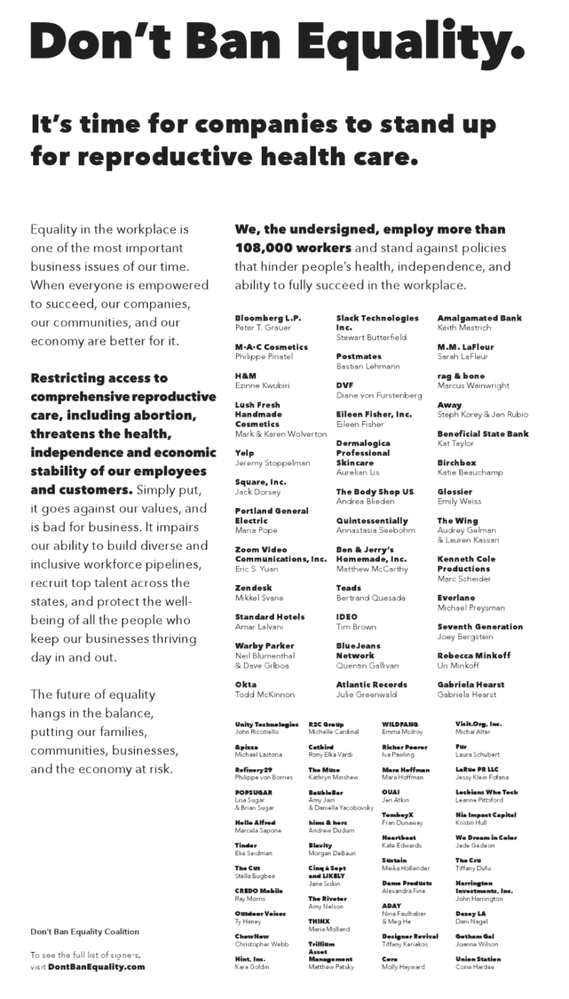
With over 60% of female customers, and tens of thousands of woman-owned businesses who earn and sell through the Postmates marketplace — today we joined the ACLU, PPFA, and NARAL in a full-page New York Times ad to underscore why banning equal access to health & reproductive services can weaken the independence, choice, and economic well-being of people around the country.
Restricting access to comprehensive reproductive care, including abortion, threatens the health, independence and economic stability of our employees and customers. Simply put, it goes against our values and is bad for corporate America. It impairs our ability to build diverse and inclusive workforce pipelines, recruit top talent to states that have extremist policies, and protect the well-being of all the people who keep our businesses thriving day in and out.
The future of gender equality hangs in the balance, putting our families, communities, businesses and economy at risk. We, the undersigned, represent more than 180 workers and stand against policies that hinder people’s health, independence and ability to fully succeed in the workplace.