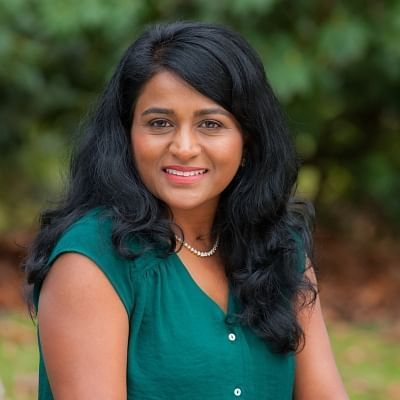
Cloud Pathfinder Consulting (CPC), a national consulting firm enabling clients to fully harness the capabilities of Salesforce customer relationship management (CRM) software tools, announced today that it is partnering with Liberty IT Solutions (Liberty), a service-disabled veteran owned IT firm, to jointly pursue the growing number of IT contracts with U.S. government agencies that require implementation of Salesforce software.
“Liberty’s well-deserved reputation for excellence in meeting tough IT challenges faced by the US Department of Veterans Affairs and other federal agencies makes it an ideal partner for us,” said CPC founder and CEO Jesse Grothaus, a veteran who served eight years in the Army Reserves. “Combining our extensive Salesforce expertise with Liberty’s market presence is a win-win, positioning both of our veteran-owned firms to play major roles in helping federal agencies successfully deploy and benefit from the capabilities of Salesforce.”
The partnership is already off to a good start, with Liberty currently working with several U.S. government agencies on modernization strategies that involve Salesforce. Liberty will partner with CPC to handle the design, configuration, implementation, migration, testing, deployment and training of Salesforce systems for these and future contracts.
“Choosing CPC as a Salesforce partner was an easy decision as they have impressed us with their work and their commitment to employing Salesforce-certified military veterans and spouses,” said Chris Bickell, a Partner at Liberty IT. “The future is bright for this partnership, and together we will jointly pursue opportunities to use the power of Salesforce to help our government clients to effectively modernize in ways the make a difference to the citizens they serve.”
About Liberty IT Solutions
Liberty IT Solutions is a mission-centric Service-Disabled Veteran-Owned Small Business (“SDVOSB”) that supports multiple government agencies across a diverse portfolio of security, digital transformation, and Health IT projects. Liberty IT Solutions currently holds a number of large purchasing contracts including the GSA IT Schedule 70, US Navy NAVSEA SeaPort-E, Transformation Twenty-One Total Technology Next Generation (T4NG), and Strategic Partners Acquisition Readiness Contract (SPARC) contracts for the federal government. In 2018, Liberty was awarded a multi-year $88 million Task Order by the Department of Veterans Affairs (“VA”) to sustain and modernize its Enrollment Health Benefits Systems. In 2018 Liberty IT Solutions also launched the WhiteHouse VA Hotline under VA’s Veteran Integrated Enterprise Workflow Solution (“VIEWS”) program, powered by Salesforce Service Cloud and Mulesoft. Liberty IT Solutions was founded in 2010 and is headquartered in Herndon, VA with approximately 350 employees. More information is available at http://www.libertyits.com.
Ghana’s leading bulk messaging and e-commerce platform, Hubtel, has donated ICT equipment to five schools in the Greater-Accra Region.
The donation is part of the company’s social responsibility commitments.
Hubtel is Ghana’s first tech company to become a member of the globally acclaimed Pledge 1%.
In 2017, the company pledged to give 1% of profits, 1% of products and 1% of paid employee time towards charity.
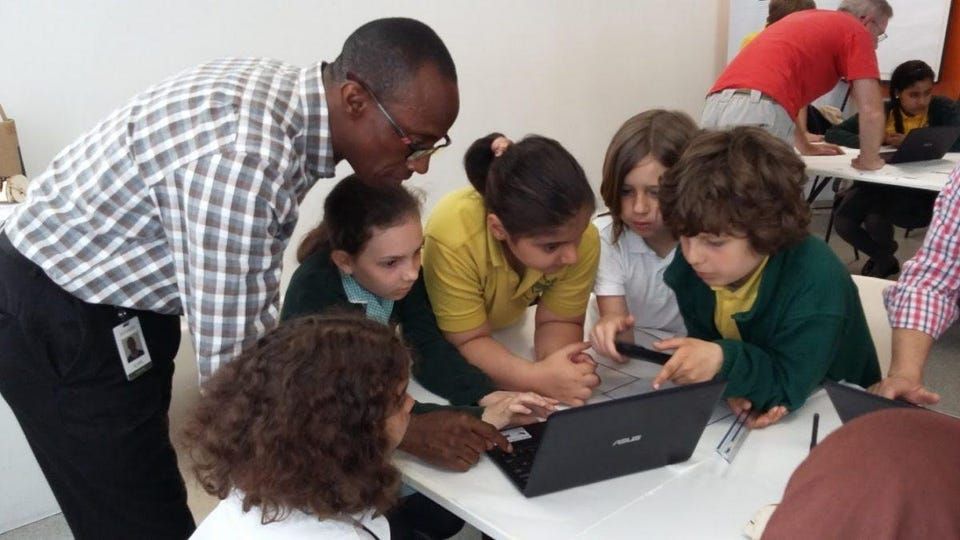
The items donated to the five schools included laptops, projectors, projector screen stands, speakers, microphones, internet routers and other computer peripherals.
The schools were selected by employees of Hubtel after several visits to understand the challenges the schools face in the teaching and learning of information technology subjects.
The beneficiary schools are St. Paul Primary & Junior High School at Kpehe, Liberty Avenue 2 JHS at Adabraka, Dr. FV Nanka-Bruce Junior High at Korle-Gonno, the Nima Cluster of Schools and the Bethel AME Zion JHS at Ashaiman.
Until the intervention of Hubtel, these schools either had only one PC for teaching and learning ICT or none at all.
Making the donations at St Paul Primary & JHS, CEO of Hubtel, Alex Bram, said Hubtel is committed to making the teaching and learning of ICT fun and memorable.
“We believe school children should not be intimidated by technology – what we are doing is to provide early access to quality computer education for these pupils – we wish to see more school children take computing programs at higher levels because we believe the illiterates of the future will be people who cannot use computers,” he said.
Officials of all the beneficiary school expressed relief and gratitude to Hubtel for the donation.
Assistant Headmaster at the St Paul Primary and JHS, Michael Owusu, told journalists, “it really feels special. For more than three years, we’ve made frantic efforts to acquire these items with little success. Now, our pupils can have a real chance to understand ICT better. This is a moment of pride for us.”
Hubtel was founded in May 2005 on the campus of Kwame Nkrumah University of Science and Technology, Kumasi.
In its 14 years of operation, the company has carved a reputation as a trusted and admirable tech brand across Africa.
Starting with a bulk SMS messaging platform, the company has evolved into the e-commerce space – offering businesses tools to enhance the customer shopping experience; in-store, online and on mobile.
In becoming a signatory to Pledge 1%, Hubtel joined the ranks of Silicon Valley giants like Salesforce, Yahoo, Box, Glassdoor, DocuSign and other leading companies in over 100 countries.
At Zylo, we believe that community is a pillar to the success of any endeavor.
For us, the concept of community takes many different shapes. From your local neighborhood or a city that actively supports new businesses; to friends and family who lend support; to the guidance of investors and experienced entrepreneurs who help new companies get established; or simply the sense of shared camaraderie within an organization created by a shared vision, the idea of community comes in many forms.
But a common feature is that when companies weave a community focus into their culture early, the impact can be awesome. Because when viewed in this lens, the company’s success translates to the community’s success. For example, in the last four years, companies in the High Alpha portfolio (of which Zylo is a member) have created hundreds of new jobs.
Zylo Pledges to Give Back
In Zylo’s early days, we learned quickly that it’s nearly impossible to achieve success in any form without the support of our community, so we’re proud to take the opportunity to give back.
That’s one reason we’re thrilled to announce that Zylo is partnering with Pledge 1% to maximize support of nonprofits in the Indianapolis community and beyond. Pledge 1% invites participating companies to pledge to share at least 1 percent of their equity, profit, products, and/or employee time with their communities.
Tech’s Impact on the Community
To celebrate Zylo’s commitment to Pledge 1%, we hosted an event at Zylo headquarters to discuss the impact that technology-focused companies can make on their communities.
The event included a panel discussion featuring Byron Deeter from Bessemer Venture Partners, Sara VanSlambrook, Chief Impact Officer of United Way of Central Indiana, and Chris Barbin, from GGV Capital. The session was moderated by Gerry Dick from Inside Indiana Business and the event was made possible by Silicon Valley Bank.
Tech Companies Uniquely Positioned to Give Back Early
A central theme that emerged from the panel conversation was that emerging technology companies represent a new form of corporate philanthropy, one that’s driven both by an entrepreneurial spirit and direct employee activism.
This trend stems in part from the strong focus on culture that tech companies cultivate. Tech company leaders are more actively, directly involved in shaping their company’s culture and identity, making them more likely to undertake charitable initiatives. But it’s not just leadership motivating this focus on philanthropic endeavors.
Employees are influencing organizational change through individual leadership and promotion of worthy causes they believe in. And with strong competition for talent, authentic and demonstrable philanthropic initiatives create a symbiotic advantage for companies and employees. Simply put, employees want to work for companies that align with their values and create positive impacts in their communities.
Understanding the Opportunity to Impact Our Community
Following the conversation with our panel, we had the opportunity to see what’s at stake firsthand. Unfortunately, every year, more families in our community in Central Indiana cross the threshold into poverty and need, or come much closer to it. To gain a more understanding, empathy, and context of this need, the United Way of Central Indiana led Zylo employees and assembled guests in a poverty simulation.
For many families and individuals in our community, the risk of poverty is one missed paycheck or a difficult life event away. Getting a better understanding of this scenario underscored the opportunity we have to make an impact in our community.
The Commitment Starts Now
It’s one thing to pledge your commitment, another to follow through. We capped the day by following through on our commitment by investing some old-fashioned sweat equity in our community.
With the help from the United Way of Central Indiana’s volunteer coordination, Zylo volunteers converged at Flanner House, a local non-profit focused on programs that provide education, social resources, and food equality.
Their mission is to support, advocate for, and empower individuals, children, and families by applying educational, social, and economic resources that move members of the community towards stabilization, and self-sufficiency. We’re proud to contribute to that mission and benefit the Indianapolis community.
And we’re also thankful for that fact that organizations like United Way of Central Indiana to partner with. Without their help connecting and coordinating volunteers to the opportunities that have the most effective impact and outcomes, many companies would miss the chance to give back.
Throughout the afternoon, more than four dozen volunteers including Zylo employees and event guests helped Flanner House prepare their annual produce crop for families in need by weeding and renewing garden beds and landscaping throughout the grounds.
It’s Never Too Early to Give Back
For any organization, it’s never too early to start building community involvement into the DNA of your company. Whether you look at it through the lens of your local neighborhood, your professional community, or the community formed by like-minded companies in the technology category, we’re all direct products of our communities.
Although it feels like we’re just getting started at Zylo, we’re already creating programs that help connect employees with the opportunity to contribute to their communities.
For example, our employee referral bonus includes a traditional cash bonus for a successful referral but also includes a cash donation to a local charity of the referrer’s choice.
We’ve also similarly established a community contribution program for sales referrals, we take part in several team volunteer opportunities each year as a company, and we encourage individual employees to give back to their communities via our PVTO or personal volunteer time off policy. These policies are relatively easy to implement, but over time, their impact is tremendous.
We as a company feel it’s important to give back and reciprocate the benefits that have helped us achieve our success. If you’re able, I encourage you, your employees, and your company to contribute to your community through the Pledge 1% program, United Way, or direct involvement with a charitable organization most suited for your company’s culture.
Because all philanthropy is good philanthropy and our communities need committed partners now more than ever.
Few issues have confounded urban policymakers more in recent years than homelessness. And while agreement has lately been growing among advocates and funders that providing housing first, especially packaged with support services, is a key to confronting this defining challenge for American cities, many questions remain about how to implement such policies and also address the underlying causes of homelessness.
Enter Marc and Lynne Benioff, who recently made a $30 million gift for research into homelessness. The donation comes as state and local governments in California and elsewhere are stepping up spending to tackle homelessness—yet facing tough questions about priorities and impact. Last week, for example, theLos Angeles Timesreported that officials there “are bracing for the release of a report that’s likely to show little or no progress in reining in homelessness, despite the $619 million they spent last year to grapple with the crisis.” L.A. plans to spend hundreds of millions more to address homelessness, while California governor Gavin Newsom recently called for doubling state spending in this area. Meanwhile, across the country, New York City is slated to spend $3 billion this year to address its homelessness crisis. Ensuring that such funds are deployed effectively is critical.
The Benioff gift funds the University of California at San Francisco, which has launched the UCSF Benioff Homelessness and Housing Initiative to conduct what it calls “groundbreaking” research into the causes of homelessness and identify evidence-based solutions to the problem. The initiative is a part of UCSF’s existing Center for Vulnerable Populations (CVP). Ina press release, Marc Benioff referred to the project rather grandiosely as “a North Star for truth on homelessness… providing the latest research, data and evidence-based solutions to ensure we’re investing in programs that will help solve the homelessness crisis.”
Dr. Margot Kushel, who serves as the CVP’s director and will lead the new initiative, said in the same release that service providers and advocates already know a great deal about how to end homelessness. The problem, she says, is that policymakers aren’t always aware of that knowledge—even as ballot measures like Santa Clara’s Measure A and Los Angeles’ Proposition HHH raise considerable local sums for affordable and supportive housing.
Nevertheless, on Twitter and in articles covering the Benioff gift, commenters called out the Salesforce billionaire for funding research while unsheltered people suffer on San Francisco’s streets. A deeper critique of homelessness funders from tech (and elsewhere) is that these donors fail to acknowledge structural factors behind the problem and that their companies can be complicit as rents rise and neighborhoods gentrify.
Marc Benioff, however, is one tech billionaire who’s long been attuned to soaring inequality in the Bay Area and he’s been a persistent advocate for greater action on homelessness among his ultra-wealthy peers. Last year, he pledged to help raise $200 million to address the problem, and he’s backed a $100 million effort by the Tipping Point Community to create permanent supportive housing in the region.
Also telling is Benioff’s public spat with fellow tech winners—notably Twitter co-founder Jack Dorsey—over Proposition C, a ballot initiative passed by San Francisco voters last year that would tax the city’s biggest businesses to support a homelessness fund. Despite possible repercussions for Salesforce’s profits, the Benioffs spent millions to support the measure, which is expected to raise $300 million—although it’s still mired in lawsuits and hasn’t yet taken effect.
Given the new public and private funding that Benioff is working to unlock for the homeless, it’s not surprising that he and Lynne are now backing research on what solutions are most effective. Since the 1980s, government agencies across the U.S. have spent a fortune on failed approaches to this problem. With the political stars aligned in key cities for a stepped-up push on homelessness, it’s imperative that policymakers and nonprofits direct resources to the solutions that work.
As CEO of Salesforce, Benioff pioneered the Pledge 1% campaign and the associated 1+1+1 model of corporate philanthropy, in which firms commit funds, employee volunteer hours, and product to charitable ventures.The model has caught on.
But where Benioff stands out as a philanthropist—and as an advocate—is right at home in the Bay Area. Both the Benioffs and Salesforce have given extensively to local schools and hospitals, including $50 million to the San Francisco and Oakland school districts over the past five years. On homelessness, the Benioffs have given $11.5 million to Hamilton Families, a nonprofit that locates homes for families on the street. That’s in addition to $3.5 million Salesforce has given to the organization. In a highly publicized move, Benioff also gave San Francisco $6.1 million late last year to preserve a hotel in the Tenderloin district as housing for the homeless.
If you were (or are) the founder or CEO of a start-up company or later-stage firm, would you be willing to pledge one percent of your equity to charity? How about one percent of your profit? Or your products? Or your staff time? Pledge 1% is a global on-line movement that encourages and empowers companies of all sizes and stages to do just that.
The founders of Pledge 1% believe that all companies have the capacity to give; it just takes the knowledge and flexibility to decide what way best suits a company’s values, culture, business goals and stage of development.
If a company doesn’t have much cash or profit to give at an early stage of development, it’s possible that pledging one percent of your equity is a quick and easy way to get started. Businesses can pledge company equity at an early stage without diluting the value of the company, and this kind of pledge sets the tone for future funders and employees. Alternatively, founders can make personal equity pledges, which most likely will not require board or stakeholder approval.
Another way to give without spending cash or pledging equity is employee time through volunteering in your community. This can be done through traditional hands-on volunteering like serving meals at a homeless shelter or cleaning up a waterfront in teams or individually. Or by encouraging employees to use their business skills (e.g., marketing, finance, technology) to help nonprofit organizations in their communities. One percent of a 40 hour work week is 20 minutes or about two days a year, so making this kind of pledge will motivate your employees to spend time making a difference in their communities.
Likewise, pledging one percent of your products – either your products in full or by discounting your products for charities – can be an effective way of supporting nonprofit organizations in your community. Some typical ways of doing this, according to the Pledge 1% website are: tech products in existing form (via software or licenses), tech products in a form revamped specifically for nonprofit use, hardware or goods, and services.
Pledge 1% counts 8,500 companies (mostly start-ups and early-stage firms) from over 100 countries as members. A few of these companies are highlighted on the organization’s website, including:
Twilio. This company started by giving product to social impact organizations from its cloud communications platform and then launched an employee volunteer program. Later, it pledged one percent of its equity over a ten-year period and created a donor-advised fund at Tides. “We launched the Impact Fund to support both nonprofits and social enterprises,” said Erika Balbuena, head of strategic initiatives at Twilio. “We want to do even more to deploy capital and provide access to communications that will scale impact.”
Okta. This identity and access management firm wanted to break down some of the perceived barriers between members of various communities and the tech sector, especially in communities where it operates. So, Okta opened its doors to the public in offices around the world by hosting a week-long event called Tech Week. Tech Week reached 2,000 students and jobseekers through in-person workshops and career counseling sessions, and it provided a great opportunity for Okta employees to come together across offices to give back and connect with their local communities
Box. Box, a cloud content management and file sharing company, works with TechSoup Global on giving product through Box.org. It started by identifying youth enablement, social equity and health as the pillars of Box.org, and then partnered with TechSoup to donate products through TechSoup’s global network. “Box.org believes that nonprofits and tech can do more together,” said Bryan Breckenridge, executive director of Box.org. “We are committed to enabling nonprofits to innovate and fulfill their social missions be elevating their technology.”
In return, Pledge 1% lists the following benefits to companies for making a pledge:
Joining Pledge 1%’s community of like-minded leaders will help build your network.
Pledge 1% boosts your bottom line.
Pledge 1% helps you hire and keep top talent.
The 1% model is easy to implement.
It’s completely up to the pledging company or individual to decide what nonprofit organizations and causes to support. Pledge 1% operates as a platform and resource provider, and does not promote specific charities or causes on its site.
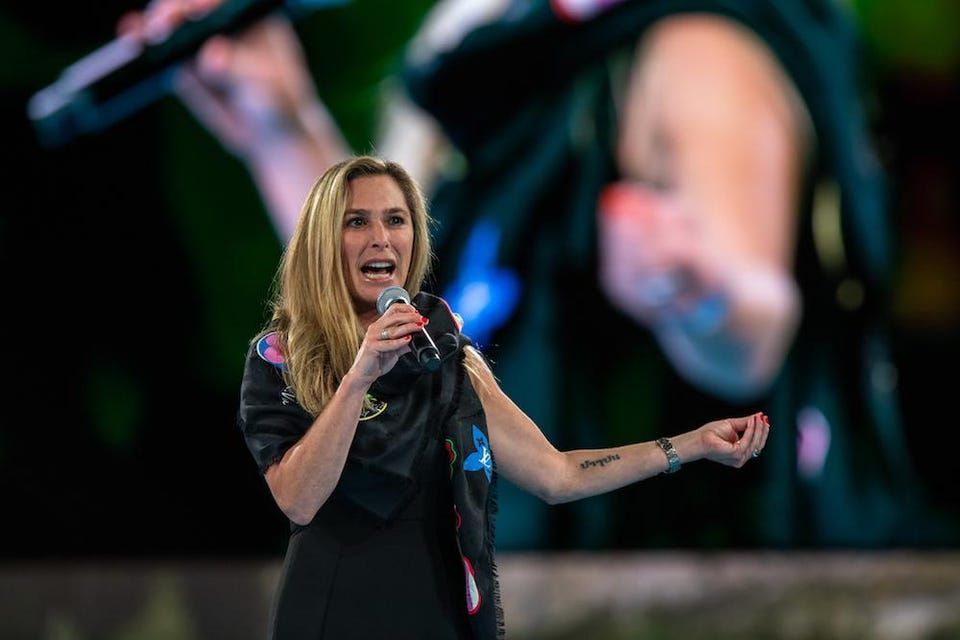
Suzanne DiBianca, Chief Impact Officer and EVP of Corporate Relations at Dreamforce 2018, Salesforce.com’s user and developer conference JAKUB MOSUR PHOTOGRAPHY
Suzanne DiBianca is Chief Impact Officer and EVP of Corporate Relations at Salesforce, where she leads the company’s stakeholder strategy—including all corporate giving, community relations, and sustainability efforts. DiBianca was previously co-founder and president of the Salesforce Foundation and Salesforce.org. Under her leadership, Salesforce pioneered the Pledge 1% model of integrated corporate philanthropy, which dedicates 1% of Salesforce’s equity, employee time or product back into the community, which has so far generated more than $280 million, 3.8 million employee volunteer hours, and technology to 40,000 nonprofits and educational institutions around the world.
In addition, over 8,500 companies in 100 countries (including companies like Box, Yelp, Docusign, Postmates, Twilio, Okta, Harry’s and General Assembly) now participate in Pledge 1% (now its own separate non-profit run by Amy Lesnick) which in itself has donated a staggering amount; more than a $1 billion in volunteer hours, product licenses, pro bono resources and philanthropic funding–making it the B2B equivalent of the TOM’s “One-For-One” B2C model in its simplicity and scale. I caught up with DiBianca to find out more about the genesis of the program and how companies should be guided by their employee’s passions as much as strategic goals.
DiBianca talked about her role at the beginning of the company. “I joined 18 years ago. The company was about 60 people. I was actually hired to run the Foundation. So Marc Benioff had a very unique vision of creating a new kind of company, that took community service and baked it in really early on. He really was trying to create sort of a new model of business from the very beginning. In the early dayswe had no money and very little product. So, in the beginning, we were really focused on our employees and the volunteer part of it. And looking back it was the right place to start, it really became part of the hearts and minds of the people who work there.”
Salesforce’s ‘Future Ready’ program SALESFORCE
I asked her about how she created the genesis of the Pledge 1% model.
“That was me going out and doing a review of the industry landscape to look at what people doing in this space that I really respected, like Levi’s and Cisco. eBay was, I think, the first company who put a percentage of their pre-IPO equity into a foundation and that fascinated me as it related to a business going public. The second part I looked at was the product donation programs, and Cisco was phenomenal at that. And Hasbro really stood out from the time perspective, they had an excellent employee engagement program. So we smashed them all together because what we realized was every company on the planet, no matter where you are, what you do, has those three assets.”
DiBianca elaborated on how centralizing purpose also helped. “I think what we did uniquely about it was not only smash them all together and put a brand on it that could resonate with any company, but also integrate it. At the time there were many companies that believed in philanthropy and had embedded it into their company but it was disintermediated. They would give product from one place, give their people’s time somewhere else, put their grants in a third area. There wasn’t a lot of integration on how to focus those resources for maximum impact. So when we started working in afterschool programs, for instance, we gave them product, people and funding that we directed centrally, which just made for a much better partnership and a way bigger impact,” said DiBianca.
Part of the success was picking the right partners from inception. “Google was one of the original Pledge 1% partners that really made it to scale. So they were sort of the tipping point on the equity set-aside because of their IPO. I give a lot of credit to Atlassian, who are co-founders of the Pledge 1% with us, and talked a lot about it because they saw the power of the movement. And then it really took off in our Salesforce ecosystem. We’re a platform company and we’re a big believer in our ecosystem of AppExchange marketplace partners, who then began to pick it up. These are companies like Twilio, Okta and others who have had had successful IPO’s. I think its the simplicity and the holistic model that resonates, and because it’s translatable across industry, region, and size.” When I ask her about the similarities with the TOMS One-for-One model, DiBianca points out one crucial difference. “I think the distinction is that its much less scary than a one-for-one model because you can start anywhere on the continuum. You can just start with employee time which doesn’t cost you anything, so it takes the fear out of it.”
Salesforce celebrated the Grand Opening of Salesforce Tower with numerous events in San Francisco JAKUB MOSUR
DiBianca’s also revealed how she visualized the different areas of focus for Salesforce which allows both leveraging its massive scale but also allow customization down to an employee level. “When I draw it out for people, I draw a triangle that’s divided into three. The top is ‘strategic philanthropy.’ For us right now that means education and workforce development and the work we do around ending family homelessness. The second part of it is ‘technology innovation’, your core competency as your company, as the middle layer, like the nonprofit success pack that we built. The bottom is what I call ‘citizen philanthropy’ which is, for instance, getting behind people who lost a loved one to a disease and they want to fight for that, or someone who wants to foster animals. That is totally valid. So we tried to not put up a lot of guard rails and really let people’s passions blossom. That’s my mental model.”
From DiBianca’s perspective, everything comes down to how purpose manifests itself in the companies core values.”It’s about our core values and how they translate. And those core values are number one, trust: nothing is more important than trust. Trust with your customers, trust with your employees. The second is customer success: if our customers are not successful, we are not successful. And the third is around innovation, for human beings at work, for our product, for our lines of business….innovation is going to keep a company and a human being strong over time. Those values haven’t changed in 18 years. And recently we added ‘equality’ which has really added to the further deepening of the notion of purpose; so we believe in equality of every human being: equal access, equal rights.”
Developing Salesforce’s unique approach involved a lot of innovation and experimentation. DiBianca said, “I think what we did really, really well, was we listened to the needs of the community and we listened to our employees and their passions and we matched them up. It was not my agenda, or Marc’s agenda, it was really driven from the grassroots. For a long time, we didn’t have strategic grants, we just put our money behind our people. We’re very committed to building what we call ‘citizen philanthropists’ and ‘democratic philanthropy.’ So we took that principle and we experimented with it: we like to say in our company that ‘tactics drive strategy’ and as a former management consultant, I had a real big problem with that in the beginning. And yet I realized also (as an Italian!) ‘The Spaghetti Principle’ where you throw stuff on the wall and you see what sticks? I began to see actually made for really robust, authentic programs. When you really listened and you really experimented alongside of people, you meet people where they are.”
TheGiving Pledge is the brainchild of some of the most prominent elders of Silicon Valley — people like Bill Gates, Pierre Omidyar, and Larry Ellison — who made billions of dollars in the first wave of tech giants only then to pledge to give most of it away.
Silicon Valley, though, thrives on disruption. And in an age when billionaires are on the ropes — and when tech leaders are reckoning with their corporate and personal responsibilities — there is new movement behind the scenes in tech to broaden the conversation that Gates began nearly a decade ago.
That’s the backdrop for efforts gaining steam like the Founders Pledge, which on Monday shared with Recode that it had amassed $1 billion in commitments. That milestone reflects both its recent momentum and also (in tech-speak) the strength of an incumbent like the Giving Pledge, which is expected to route close to $500 billion in commitments to philanthropy.
Rivals to the Giving Pledge — including a separate effort spearheaded by Salesforce founder Marc Benioff — are, in ways, trying to both disrupt it and replicate it simultaneously.
“They sort of made the market of pledges of this kind, and started challenging the wealthiest of the wealthy to do more than token philanthropy — to really put their name and reputation on the line,” David Goldberg, the head of Founders Pledge, said in an interview. “Founders Pledge is a way to hold their future selves to account.”
To be clear, the Founders Pledge has not signed up brand names like Warren Buffett or Mark Zuckerberg. Its highest-profile commitments are from people like Miguel McKelvey, a cofounder of WeWork; Niklas Adalberth, the founder of Klarna; and Jose Neves, the founder of Farfetch. But it’s trying to appeal to a younger, less-endowed class of the aspiring rich — and focusing exclusively on tech.
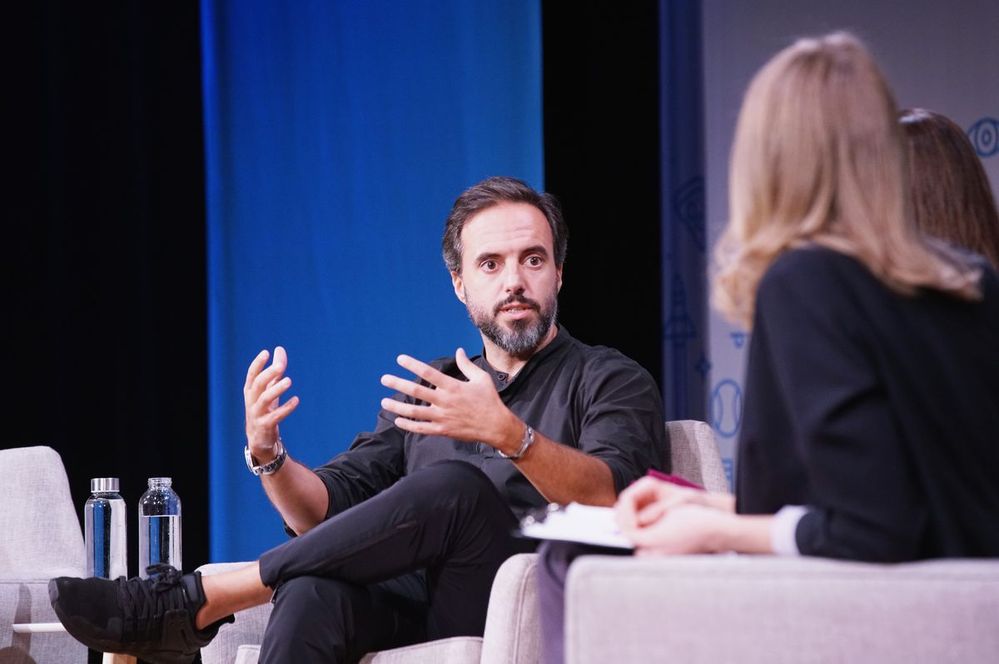
Founders Pledge signer Jose Neves, the founder of Farfetch. Bennett Raglin/Getty Images for Fast Company
In fact, not only do you have to not be a billionaire to sign the Founders Pledge like you must with the Giving Pledge, you don’t even have to be a millionaire. Or even have a likely company exit. Or even have company revenue. Or anything, really. (Okay, you generally need to be the company’s founder.)
All it asks is that you commit to a future gift. It’s a percentage of your profits — a minimum of 2 percent of your personal proceeds — which leaves open the possibility that you could be giving away hundreds of millions of dollars if you build a unicorn company or, more likely, a big fat zero.
That also makes the effort much more accessible. About 1,500 people have signed the Founders Pledge — eight times the number who have signed the Giving Pledge — which has led to about $360 million in commitments that have been fulfilled, according to the organization.
The big idea here: What if there were a way for today’s younger aspiring tech billionaires to publicly affirm their willingness to donate some of their personal fortunes — but to do so before they really have the money to make good on the promise?
In 2019, billionaires find themself in a philanthropic bind
Even critics generally admit that the Giving Pledge has shifted the conversation around philanthropy, bestowing some social stature around large donations (even if not quite stigmatizing the act of passing along inheritances). Since 2010, 190 billionaires have signed the GivingPledge, committing to give away at least half of their assets.
But the easiest-to-convince pledgers signed up, as you’d expect, early on: 122 people committed in the first four years, but only 65over the next five years (three have signed up so far in 2019). And while adding roughly 15 people a year might sound like a lot, only about 7 percent of the world’s billionaires have affixed their name to a document; the Giving Pledge particularly has work to do overseas.
The most prominent snub is the world’s wealthiest person, Jeff Bezos, whose omission fits with his historically paltry giving to charity (although he has recently tried to atone for that). Some of the wealthiest people in tech remain conspicuously absent from the Giving Pledge rolls: Google founders Larry Page and Sergey Brin, Steve Ballmer, and Michael Dell, who are each worth tens of billions of dollars.
And the on-the-rise set? The 40-and-under leaders of the next generation of iconic tech companies? People like Evan Spiegel, Adam Neumann, or Ben Silbermann are also no-shows.
Rob Rosen, who oversees philanthropic efforts like the Giving Pledge from his perch at the Gates Foundation, argues that it still appeals to today’s younger tech entrepreneurs, naming recent additions like Brian Armstrong, the founder of Coinbase; Garrett Camp, the co-founder of Uber; and especially citing the trio of 30-something Airbnb founders who announced togetherin 2016 that they would join the effort.
Rosen said it felt it had “strong representation” from the tech community, with his team pointing to 46 couples that it says signed the pledge from that sector.
The broader challenge for the Giving Pledge — and, to be fair, for all philanthropic efforts — is that newly rich CEOs are often less than eager to want to commit to giving away half their net worth. Who knows what life could bring? So they tend to set up family offices, preserving their options; maybe they’ll begin to think more seriously about philanthropy as they get older, when the money appears less “spendable,” so to speak.
But a big push in the philanthropy world is to encourage lifetime giving so that the principals can be hands-on with their charitable efforts rather than passing those duties to offspring. More time to give also means more time to improve as philanthropists. That’s why younger entrepreneurs can have such a big impact if they commit early.
That’s essentially the premise of the Founders Pledge — but committing even earlier. People who experiment with philanthropy only when they become billionaires, Goldberg says, are going to have some pretty painful experiences.
“When you’re a billionaire, those mistakes are at a different scale than when you’re just Joe on the street,” Goldberg said.
Neither Rosen nor Goldberg considers the other a rival — you could certainly sign both pledges, or maybe you’d graduate to the Giving Pledge once a few more millions hit your bank account.
“One of the goals of the pledge is to put the conversation on the table of what’s even possible,” said Rosen. “Tech has historically been quite innovative in doing this, so it’s not surprising that you’re seeing some traction.”
One reason why rivals’ efforts are gaining traction? Well, the problem with megadonors committing $5 billion to the Giving Pledge in 2019, for instance, is that they still might have $5 billion more in assets that they’re not committing to the Giving Pledge.
And being a billionaire is not particularly popular right now. Some Giving Pledge signers these days, such as hedge funder Paul Tudor Jones, are barely publicizing when they sign it lest they remind people of their massive net worths during a time when voices on the left are pounding billionaires for personifying American income inequality.
Rosen said his donors are as aware as ever about how their wealth is perceived, but that when it comes to the new dialogue about bllionaires, “net-net, I don’t think it’s had an impact.”
Another big difference between the two: The Giving Pledge, as its critics point out, has no teeth but is merely a public affirmation. Founders Pledge is a binding document; it can recoup the money if the signatory renegs.
The Founders Pledge, which is headquartered in London and at first hooked European founders, clearly is getting beat in Silicon Valley. So, last month, it opened an office in San Francisco, and Goldberg visits the Bay Area once or twice a quarter for dinners with prospective pledgers. He says his program has merely been a “beta test” until now.
What Goldberg has been hearing from Silicon Valley millionaires during that beta: Show me the numbers, not the narrative.
“Our members were increasingly frustrated with being told stories,” Goldberg said. “The same way we invest money — we’re hyper-rational and utilitarian in a certain respect — I’d rather achieve more return than less,” he said. “They want to be as rational with their philanthropy as they are with their investments.”
And just like Silicon Valley investors claim to offers startups more than money, almost all Silicon Valley-focused philanthropic efforts claim to be more than soliciting money: They offer a “network.” They help you think “long term” and are “patient.” They are a “partner” that wants to be part of a “movement.”
Can’t all the Pledges get along?
Athird pledge effort that has adopted some of this VC-style messaging — and seen some of this traction — too: Pledge 1%, which asks tech companies to promise to donate 1 percent of their company equity, time, product, or profit to philanthropic efforts. If that sounds like a rather loose way for a corporation to satisfy a philanthropic commitment, that’s intentional. It’s also, like the Giving Pledge, not binding in any way, and it’s pretty difficult to track. (How do you define “time,” really?)
More than 8,500 companies have signed this classic initiative in corporate and social responsibility, which Pledge 1% says has led to over $500 million in philanthropy.
Amy Lesnick, the Pledge 1% CEO, said she considered the two other efforts not competitive because she is focused on signing up a company rather than a billionaire.But her organization is still competing for the mindshare of a company founder — who might be a Giving Pledge-eligible billionaire, too — who is trying to weigh his personal and professional charitable obligations.
Lesnick still stressed ways in which her organization differs from the other pledge drives trying to remake tech philanthropy.
“I think that Pledge 1% has a reach and accessibility that is infinitely broader,” Lesnick told Recode in an interview. “We are not just saying, ‘Hey, I’m going to look at who are going to be the companies that are going file for IPO in the next 12 months — and we are only going to talk to them.’”
To be sure, there is a world in which all three of these programs patch together to make a philanthropic quilt. Maybe a young entrepreneur signs the Founders Pledge, setting a standard for her personal philanthropy, and then Pledge 1% to set a standard for her company’s philanthropy. And when she really makes it big — becoming a bona fide billionaire — she signs the Giving Pledge.
For instance, Benioff, the Salesforce founder behind the Pledge 1% initiative, has signed the Giving Pledge as well. But Benioff is perhaps Silicon Valley’s most omnipresent (and, yes, abrasive) advocate for philanthropy. And given Benioff’s own words in the past about Silicon Valley billionaires, it probably wouldn’t surprise him to learn that they’re not jumping to participate in all three programs simultaneously.
“Not all of them are giving money away. A lot of them are just hoarding it,” he told the Guardian last year. “They’re keeping it. That’s just who they are and how they look at their money.”
Recently,Flexport.org shared the progresswe’re making in delivering humanitarian aid, increasing environmental sustainability, and demonstrating social responsibility. We believe that social and environmental issues are deeply intertwined, so we’re proud to announce our newest initiative: making all of our disaster relief shipments carbon neutral!
87% of people in extreme povertylive in countries that are environmentally fragile. The communities living in these vulnerable environments are more likely to be disproportionately impacted by the effects of climate change, like theincreased frequencyof droughts, floods, and severe weather events. Community development isseverely inhibitedas a result. Droughts and floods destroy crops, disrupt water systems, and contaminate water reserves. Severe weather events disrupt or destroy critical infrastructures like schools, medical facilities, and transportation.
Cyclone Idai, for example, one of Mozambique’s worst disasters, recently caused massive destruction and a rise in cholera outbreaks. Flexport.org, together with Airlink and many other nonprofit partners, delivered over 50,000 lbs of aid supplies to Mozambique in the past few weeks, but we want to take our efforts even further.
Because shipping is a major contributor to climate change, we are expanding our carbon neutral services in honor of 2019’s Earth Day. Last year, we launchedcarbon neutral LCLto make climate-friendly solutions accessible to all Flexport clients at no additional cost. This year, starting on Earth Day,Flexport will offset all shipping-related carbon emissions of every disaster relief shipment we procure and manage. We partner withCarbonfund.orgFoundation, a leading 501(c)3 climate solutions provider, to donate to third-party verified, international offset projects.
We are proud to be the first freight forwarder to deliver 100% carbon neutral aid shipments, leading the new way forward in partnering with both our international communities and our planet.
Anyone who has ever lived in a hostel will relate to this pain point:getting approval from the warden for a night out. Assuming that your parents or local guardians have already greenlit your plans, the steps that follow are tedious and cumbersome, entailing much back-and-forth and a lot of manual paperwork.
And this is just one issue out of a pile of concerns involved in the day-to-day task of hostel management. Most Indian educational institutes and their student housing units, in fact, are still caught in the web ofredundant paperwork, time-consuming manual processes, and an obsolete style of parent-student-management communication.Now, when there’s an app for everything under the sun, why not an app that makes hostel management painless and automated?
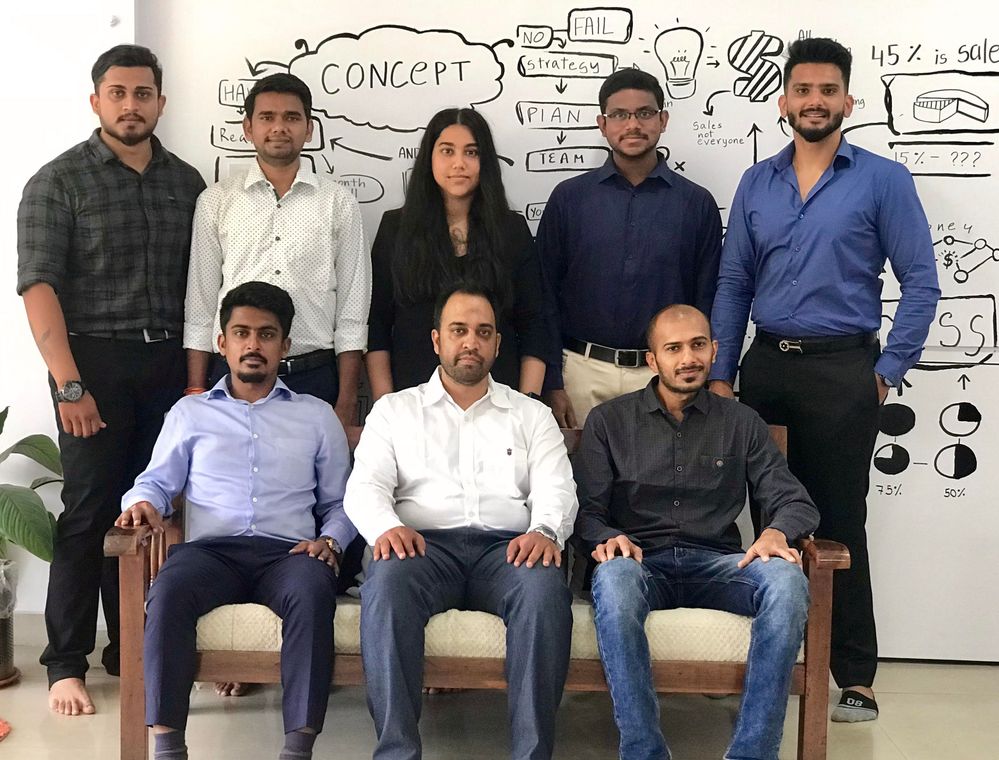
SpaceBasic team
California-headquartered SpaceBasic, which has an office in Bengaluru,addresses this very concern. Born out of the founders’ experience across different fields, the SaaS-based platformaims to do away with old-school methods to facilitate seamless communication between hostel management, students, and parents.
Of chance meetings and varied experiences
In early 2016, when Madhavi Shankar, now CEO and Co-founder of SpaceBasic, was working in Australia, her father introduced her to a successful entrepreneur based in San Francisco, US. They met on a Friday afternoon at Four Seasons in Palo Alto, and within no time the meeting pivoted towards a chat around startups and brainstorming ideas.
Indu Navar, SpaceBasic
“I thought it would be a social meeting. Now we are co-founders,”says Madhavi, who launched SpaceBasic in March 2017, along with Indu Navar, who ran venture-backed logistics companySerus Corporation for 10 years until a successful exit in the Silicon Valley. The third founding member,Aiden Bingham, was juggling between life as a freshman in college and entrepreneurship while Madhavi was working as a product manager with Vodlo, for the Asia-Pacific region in Australia at the time
Talking of their combined experience across diverse backgrounds, Madhavi says, “We each bring very different skills, talents, and perspectives to the table.”
Initially built as a mobile app to assist a charity student hostel, the SpaceBasic app now offers a two-fold advantage: firstly, it allows hostels to eliminate all manual processes, and secondly, it helps hostels to communicate with students more efficiently.
Social media for hostel dwellers and much more!
When it comes to managing hostel administration, “SpaceBasic is a welcome change”, according to Christo Joseph, who heads strategy and planning at Garden City University, Bengaluru. He says, “We have been able to bring about a cultural change among students in the hostel.”
The SpaceBasic application itself is extremely simple and easy to use. Madhavi adds, “we had designers build this app keeping these two things in mind.It’s a clean UI, not too complicated, and because it’s role-based users only get to see the actions they must provide. It’s not a clutter.”
Besides digitising the hostel administration, SpaceBasic also serves as an interactive social networking platform for information sharing and process management among students, parents, student housing communities, and more. Additionally,students can use the platform to apply for leaves, lodge complaints, track submitted applications, and access real-time status updates without being physically present.
The app also allows students to post announcements to fellow students, requesting or offering valuable services.
“Our key feature is the networking platform that gives students access to our global industry partners who provide students with skill development programmes, jobs, internships, trainings, scholarships, and other such student-centric opportunities,” Madhavi explains.
As of now, the startup is working with partner companies based out of both India and the US.
The end goal, Madhavi adds, is to create a talent pool of the underrepresented and provide students “opportunities without bias of background or location”. This entails offering the opportunities availed by students from the crème de la crème colleges in India to students in the Tier II and III cities.
Scaling up and expansion
Almost two years into operation, the platform is already making its presence felt pan-India, with team-ups and partnerships with key private and government institutes, including Indus International Schools, DY Patil University, PES University, and University of Agricultural Sciences.
“Our growth has been completely organic with a team of five-seven people,” Madhavi says.
When they started out, in 2017, the SpaceBasic team was justthree-member strong. It added five-seven members in the next year, and has now expanded to a team of 13 and counting. Along the way, the co-founder explains, they havegarnered recognition from the United Nations, Government of India, as well as Government of Karnataka. Even their user base has grown during this period,from 3,000 to around 25,000 users by the end of 2018, an impressive growth in the second year.
Madhavi says,
“Today, we are a high growth startup with 700 percent growth in 2018, 25,000+ users, and 30 K12, universities, and colleges pan-India.”
Perhaps the biggest advantage with SpaceBasic is that it works as a plug-and-play module and as a standalone, multiplatform application optimising communication and collaboration processes in hostel management. Simply put,“universities and student housing communities pay us per student per year,” explains Madhavi, while “companies pay us monthly fees”.
“For charity-based institutes, we provide our software free of charge as part of our give-back programme,” she adds. As part of their corporate philanthropy, they are involved with thePledge 1% movement, whereby they pledge 1 percent of their profit, time, and software to invest back into “our community and towards educating women each year”.
The very fundamentals of running a startup involve preparedness for unexpected challenges and the usual ups and downs, and Madhavi is quite familiar with the cycle. From quitting a well-paying corporate job in Australia to testing waters in a unfamiliar startup community, and now doubling their revenues month on month, she is doing it all while relying on what she calls “my gut”.
SpaceBasic plans to raise seed funding this year to scale operations even as it sticks to its one true mantra: “customer is the king (or queen)”.
“We are building a culture that focuses on customer experience and quality products,” Madhavi says.