
I recently sat down with my two boys, ages 10 and 6, over our bowls of Cheerios before we all headed off to our daily duties of learning and “farming” in the entrepreneurial world. Right before I was about to get up to clean the dishes, my ten-year-old said, “Dad, I’ve been pondering why I was chosen to be a human? I mean, I could’ve easily been a dog or a tree, but I was selected to be a human.” After I picked my chin up from the depths of my bowl, I asked him why he thought he was chosen? After a couple of seconds, he said, “I guess I’m here to change the world by making someone’s life a little better.” This was one of those times when I realized we are going to be ok.
Now, I want to make sure I’m transparent in that I could easily share other stories where I’ve stayed up at night thinking I’ve screwed up this fatherhood thing. In fact, this idyllic moment quickly disappeared when someone farted, resulting in denials and belly-laughs, but the moment was worth noting as we approach #GivingTuesday.
While I have almost 50 years under my belt (and sometimes over my belt) and have studied with some cool people, it seems my kids continue to be my greatest teachers. Somehow, they seem to boil everything down to the most salient point.
In this day and age of “likes” within our personal and mass syndication ecospheres, giving is often judged through recognition as a CNN Hero, your name on a building, or the ability to document the gift in a color-corrected filter for our feeds. It’s heartening to frame giving from my son’s eyes—the idea that giving is personal and doable by all of us, not just by superheroes. My friend and writer, Adam Grant, points out in his book, Give and Take, that “Givers Can’t Burn Out If They Focus on How Big Their Impact Is.” As my son points out, a single impact in one person’s life is big enough to change the world.
In business, we are constantly focused on scale, but the reality is that when it comes to giving, the ten-year-old’s perspective is more meaningful. Giving—and all collective creations for that matter—is felt by an individual, not a “target-market.” If we were to judge our impact through my son’s lens that we’re “here to change the world by making someone’s life a little better,” I am confident that together we could easily create mass change. Our ten-year old selves know it can be as easy as a smile or saying hello.
On this #GivingTuesday—and every day—know that we can all create change in the world simply by making it more personal.
#keepmoving
Originally posted: November 27th, 2018

Every year at 97th Floor, we set out to show the world how quickly kindness can grow.
What Does Twenty Dollars Mean
For many people, twenty dollars isn’t a lot of money. In a world of debit cards and Venmo, twenty dollars is probably all the cash you’ll ever need to have on-hand. It’s the biggest bill most people have in their wallet, but it’s not enough to cover expenses like rent, medical bills, or a car payment. It’s usually not even enough to break the bank.
As we said, it’s not a lot, but it’s enough.
Twenty dollars is enough to pay for a meal. If you lose it, it’s enough to ruin your day. It’s enough to pay for a couple of hours of minimum wage work. It’s the difference between being able to buy groceries or having to go without. Twenty dollars is enough to keep the lights on, put gas in the tank, or buy someone a holiday gift.
The #20Helps Campaign
The #20Helps program is an annual charity campaign hosted by 97th Floor. #20Helps encourages people to help others by giving them twenty dollars. It also lets those participants track the good deeds that their twenty dollars does for others.
All you have to do is download the #20Helps app, scan your bill, add your story, and watch your twenty dollar bill go around the country helping people. The #20Helps participants find it inspiring to see how their twenty dollar bills move from person to person doing good.
Not only does the campaign help us do good things for other people, but it also shows us how small acts of kindness make a big impact.
It helps us remember that twenty dollars isn’t a lot, but it’s enough.
Originally posted: November 27th, 2018

Daniel Mintz, chief data evangelist at Looker, announces the company’s commitment to Pledge 1% during his keynote at Looker’s annual data conference, JOIN, in October at the Palace of Fine Arts in San Francisco.
Originally posted: November 27th, 2018

One of Arizona State University’s goals is to enhance our local impact and social embeddedness. The University Technology Office (UTO) at ASU embraces its role as both an enabler and catalyst for advancing the vision and work of the New American University.
UTO enthusiastically formalized its commitment to serve the broader community by developing a framework for increasing our impact and supporting a sustainable community volunteer program. In January 2018, UTO created a Giving Back Team, which organized volunteer events and has joined Salesforce in the 1% pledge.
As an IT organization, the Giving Back Team established a mission to grow and sustain a culture of giving and drive community impact. During development of the infrastructure, the team engaged in a variety of volunteering events to start cultivating the spirit of team giving, and jump-start the momentum. These events continue and are now warmly expected rather than the exception.
UTO seeks to address causes that speak to the expertise of the organization. However, participating in local events, such as harvesting oranges for the local food bank from the Arizona State University Campus grove and cleaning up the nearby inner city desert park, directly support the community and begin to build stronger relationships.

Staff spent several hours together volunteering with park rangers at Papago Park in Tempe, Arizona. One volunteer stated, “It was great to hang out together outside of the office. Though I think we lost John. Maybe he was kidnapped by Sasquatch. We should do this more often. Let’s do it again in the fall.”
In addition to oranges and desert improvements, the UTO has also volunteered at the local St. Mary’s Food Bank, packed over 118,000 meals for Feed My Starving Children, and raised $600 for the Valley of the Sun United Way in a coin wars competition.
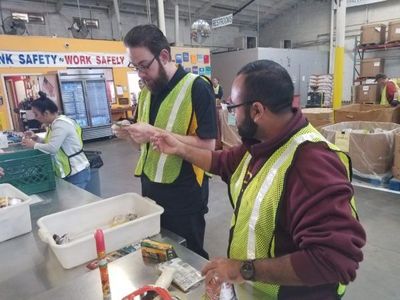 Joshua, ASU West Campus staffer, remarked, “My team was really disappointed we missed the last food packaging, so we found an opportunity to do some outreach with St. Mary’s Food Bank on our side of town. We had a blast!”
On Giving Back Tuesday, the UTO is launching an Ambassador Program! This program will allow members of the UTO to be more active in the Giving Back community, organizing events, socialize the initiative, and generally represent our goal of helping the community. Ambassadors will be key to sustaining the Giving Back program, from marketing events to actually developing programming. They will be embedded in various UTO groups to expand the scope of giving. Coupled with the UTO leadership pledge of ‘time to give’, Ambassadors will be the delegates taking the program into the new year.
The new year promises to be exciting. In addition to local programming and the new Ambassador program, the UTO is getting ready to kickoff Girls Who Code. Leveraging our technology focus and infrastructure for community service, the UTO is gearing up to facilitate locations, resources and curriculum for girls and young women who aspire to work in technology. The UTO is looking forward to a great year of giving!!
Originally posted: November 27th, 2018

By Erin Baudo Felter, Executive Director, Okta for Good
At Okta’s first office, our co-founders Todd McKinnon and Frederic Kerrest had a poster above their desks with former Southwest Airlines CEO Herb Kelleher’s famous quote: “We have a strategic plan, it’s called doing things.” That philosophy can be applied to almost every aspect of the business when you’re a fast-growing company like Okta, but nowhere does it resonate more than with social impact.
When it comes to making a commitment to your communities, you don’t have to have a grand plan or all the answers — you just have to start. And the earlier you do, the more impact you’ll make, and the more powerful the long-term effects will be.
Okta sent a signal when we took the 1% Pledge, and with the success of our IPO, that early commitment has paid dividends for the community. Here are a few highlights to give you an idea of how far we’ve come:
- To date, we, along with our employees, have donated more than $1.3M in cash and equity to nonprofits. But guess how much we raised in our first employee giving campaign? $9K!
- More than half of our employees participate in our programs nowadays. But at our first major volunteer effort, only 15% of employees participated.
- We now have a team of three that runs Okta for Good. But there was a committed group of employee volunteers to thank for getting the program up and running — before I even started.
That growth is due to the fact that we started with a commitment to give 1% of our equity, time and product back to our communities.
Our founders shot a signal flare into the sky by taking the pledge — and it lit the way for dedicated employees to build a culture of giving back. As we’ve scaled, we’ve continued to attract like-minded individuals into our ecosystem and employee base. We’ve heard from several new hires that Okta for Good was the deciding factor for them in accepting their offers. We’ve seen individual employees like Simon Marlor bring his personal passion to Okta, rallying hundreds of his fellow teammates to help children and families battling cancer, and developers like Matt Raible are using their technical superpowers for good.
And we know that our early, pre-IPO pledge signified to our community partners that we are a company authentically invested in their success. This has built trust and a feeling of shared outcomes that has led to strong partnerships, like our relationship with NetHope.
Our program wouldn’t be what it is today without our early pledge. You have to start somewhere. Send a signal, and then build from there.
Originally posted: November 27th, 2018

In October 2018, Classy, a social enterprise that creates world-class online fundraising software for nonprofits, reached the incredible milestone of $1 billion raised on the platform by organizations funding programs around the world that provide disaster relief, advocate for human rights, cure disease, fight injustice, protect our environment, and so much more.
In the midst of the exciting celebration we shared with our customers, we discovered that The Sheridan Story, a Classy customer in Minnesota committed to fighting child hunger, received the billionth dollar raised. While we were considering the best way to celebrate their impact, we saw this as an incredible opportunity to honor our Pledge 1% commitment just ahead of the peak charitable giving season by visiting The Sheridan Story and getting a hands-on look at their mission. So, leveraging our volunteer time off (VTO) and our partnership with Southwest Airlines, we flew out to the Twin Cities.
Once there, we joined their team to learn more about their mission and programs. Rob Williams, the founder and executive director of The Sheridan Story, explained that they address child hunger in their community through food packing events and weekend delivery programs. The organization began because Rob saw a huge need in their community, where more than 90% of the students were on reduced lunches and often taking food home to eat during the weekends. The Sheridan Story now serves more than 5,400 students in 144 schools and continues to grow through a combination of grassroots events, online fundraising, and local business partnerships.
While in Minnesota, we attended a bag packing event where local volunteers meet at The Sheridan Story warehouse to fill bags with nonperishable food to be delivered to schools the next day. The energy in the warehouse was palpable, and with everyone pitching in, it took less than two hours for the team to pack 7,600 meals.
The next day, we joined the organization’s volunteers at a local elementary school to distribute the meals to their students. It was inspiring to see how passionate their volunteers were as they served their community.
We were even lucky enough to speak with the donor who made the billionth-dollar donation and learn why she got involved with The Sheridan Story as a recurring donor. Overall, it was a rewarding opportunity to see Classy’s mission—to mobilize and empower the world for good—come to life in such a tangible way.
The Sheridan Story is just one of the thousands of organizations that helped raise $1 billion for social impact on the Classy platform. The sky’s the limit, and we are so thankful to be on this journey to the next $10 billion with some of the most dedicated nonprofits—and alongside innovative partners like Pledge 1%.
To get a peek into our trip to The Sheridan Story, watch this video and visit the classy blog at https://www.classy.org/blog/. This piece was written by Stacy Meyer, Customer Success Manager at Classy.
Originally posted: November 27th, 2018

Crunchbase’s mission is to help innovators discover opportunities. Whether you’re an entrepreneur looking for funding, a sales person looking for buyers, or you’re just trying to stay on top of the latest industry trends, Crunchbase has the information you need, in one place.
But Crunchbase also recognizes that not all innovators have equal access to opportunities. And those innovators’ ideas–no matter how great–may not have the same chances to break through the noise and be heard. That’s why Crunchbase has joined forces with Pledge 1%. Crunchbase plans to donate 1% of their product, equity, and employee time to help support nonprofits that are working to close the opportunity gap.
In addition, Crunchbase is also partnering to help spread Pledge 1%’s vision to other companies around the world. With Crunchbase’s unique ability to tap a millions-strong community of innovators, Pledge 1% can reach the individuals who will help promote a new normal in which all companies—big and small—integrate giving back as a core value.
Originally posted: November 27th, 2018

By Randall Ward
From the very beginning, every major decision we’ve made at Appfire has been driven by our number one core value — be human.
Today, we are incredibly proud to launch an entirely new brand in line with that value: Feed Three. For every Feed Three enterprise license purchased from the Atlassian Marketplace, Appfire will donate 100% of the profits to help feed three children for a year.
Our mission in this new endeavor is to provide children around the world with the essentials they need to live healthy, happy lives.
Why invest in giving back?
My co-founder Mat Gauvin and I believe that being philanthropic is an integral part of operating our business, not merely the result of our success. That’s why, three years ago, we joined a small group of pioneer businesses that pledge 1% of our equity, 1% of our employees’ working time, 1% of our profits, and 1% of our product towards helping our communities.
Initially backed by three successful businesses that are deeply committed to philanthropic efforts and foundational giving (Salesforce, Rally, and Atlassian), Pledge 1% wasn’t simply an experiment in giving back. No, this was much more — this was an experiment in humanity. Fast-forward to today, and Pledge 1% is now represented by more than 5,000 companies in over 100 countries.
Since joining the Atlassian ecosystem more than a decade ago, Appfire has generated hundreds of millions of dollars from product and professional services, and in turn, we’ve contributed well over $1.5 million towards non-profits and educational organizations such as Room to Read, American Cancer Society, and others.
While we certainly felt satisfaction from these contributions, deep down, we knew we could do more. A lot more.
Feed Three: A new brand and a new challenge
By launching Feed Three, we’re challenging our team, our customers, our partners, and the entire Atlassian ecosystem to do more and give more to leave a lasting impact on humanity.
Over 800 million people don’t get the food they need to live a healthy life, according to the Food and Agriculture Organization of the United Nations, and the World Food Programme estimates that one-third of the food produced in the world is either lost or wasted.
But, we can make a difference. Hunger is a solvable problem — there is enough food in the world to feed everyone, and no scientific breakthroughs are needed to accomplish this mission. We can “be human” enough to see that we’re not simply giving to those in need; we’re standing with our fellow humans.
Our journey is no more special than any of the other businesses that have committed themselves to this great cause. However, it is one that we hope might help pave the way for others. Will you join us and take the Pledge today?
Originally posted: November 27th, 2018
By: Louis Maldonado
As members of the ever-growing Salesforce ecosystem, we at Silverline spend a lot of time thinking about the future—of technology, customers, team members, and the world as a whole. As problem solvers, we turn that thinking into action, impacting the future for the better.
One way we seek to improve the future for our customers and team members is through our Silverline Academy, a rigorous and challenging program designed to provide its alumni with the necessary skills, both soft and technical, to deliver quality innovative solutions to clients. Now in its seventh class, the Academy continues to mold enthusiastic minds into top notch Solution Architects, Client Services Managers, and Developers that will stand out in projects for all the right reasons.
Beyond creating a pipeline of talented team members, the Silverline Academy also cultivates a future where doing great work is about more than the bottom line. This is accomplished through onboarding new recruits through the lens of consulting with purpose, which is why Silverline aligns the Academy with its dedication to the Pledge 1% movement, providing opportunities for hands-on skill-building through projects that give back to the community.
One recent example of this was our work with Project Sunshine, a non-profit organization headquartered in NYC. Project Sunshine partners with medical facilities across the United States and in four international locations to meet the psychosocial and developmental needs of pediatric patients. Project Sunshine’s programming supports these critical needs by providing increased opportunities for play and authentic engagement in the medical environment—restoring a crucial sense of normalcy for patients and their families.
With a long history of delivering innovative Salesforce solutions in the Healthcare space, Silverline selected Project Sunshine as a pro bono project because we knew we could use our expertise to help them increase their donor base, which in turn would allow them to give back to the community that much more. The solution we delivered leveraged the Salesforce Nonprofit Success Pack and other applications like Classy to help Project Sunshine create a volunteer and donor platform that allowed them to see the full picture of all the donation and grant amounts, providing a 360-degree view of their donor lifecycle.
Being part of projects like this is so important because it reminds us to take a step back, connect human-to-human and be grateful for all that we have. As a general practice, Silverline encourages all of its employees to give back whenever possible by hosting different Silverline Cares philanthropic activities such as assembling care packages or building toys for children. Not only that but, Silverline is proud to have an official Volunteer Time Off Policy which encourages employees to donate their time toward 501c3 charities.
By making giving back the norm within the Silverline culture, together, we can make the future extraordinary.
Originally posted: November 27, 2018