
Originally published on New Voice Media’s blog.
Endure24 is dubbed the Glastonbury for runners. It draws together around 3,000 weirdos, like me, from all walks of life to spend 24 hours of their lives running multiple five mile (8k) laps of a course in Wasing Park near Aldermaston which is situated just outside of Basingstoke.
The team prior to the start
When I was first asked by a friend of mine to join a team of six to take part in the event I thought, how easy could this be? Five miles is nothing these days, and I regularly run that, plus some during the evenings after work as I’m a keen runner, with ultra-marathons and all things running on the brain. How wrong could I have been! The team itself consisted of me and five friends, two of whom had partners that worked for St Michael’s Hospice in Basingstoke. One also had a family member cared for by the Hospice during her battle with terminal cancer.
The event itself included camping for the weekend and, being part of a large running club with a lot of its members taking part, meant that we met early to head down to the site and claim a large plot of land for everyone. I was already battling sleep deprivation having been up until 4:30am, and combined with trying to assemble tents and gazebos on a windy day, disaster was inevitable! Breaking a friend’s tent before he had chance to sleep in it was never part of the plan, so a
trip back to Basingstoke to pick up some new tent poles followed, after which it was time to head to registration.
The idea of this event is to run as many laps as you can in 24 hours, with only one member of the team allowed on the course each time. A yellow band is your “license” to be on the course and is handed over in well-rehearsed fashion in a pit funnel at the start/finish of each lap. We had agreed to try and run 120 miles during the event, which would equate to four laps each. We were all more than capable of running 20 miles over 24 hours but we didn’t factor in the effects of no sleep and a lack of quality food over the course of this period.
The first laps were fine and by the time we’d all completed our first lap we were ahead of our schedule and set to go further than originally thought. By the time we were on our third lap each we were all in agony. One hill added to the suffering and we subsequently booked ourselves into the on-site massage tent to try and loosen up our legs. This only worked for one more lap, after which we had to push on and endure the fatigue and pain. Running through the night was a novelty to us all and some were unfortunate enough to also have to deal with rain despite the Met Office saying there was just a 10 percent chance of precipitation.
By 6am we were down to three team members, with three pulling out due to injuries. It was time for my fifth lap by then and the guy after me said he couldn’t go any further; time to put my race pack on that I use for my ultra-training, load up with water and gels and try and run ten more miles. It was never going to be attractive at 6am in the morning but I managed to get through in one piece. I will freely admit though that these two laps saw me at my lowest point of the weekend. Thoughts of my four kids and fiancée were running through my mind and I was close to tears for no apparent reason.
Over breakfast it was clear that the team was close to breaking, we were all pushing ourselves to limits we hadn’t experienced before, were on 145 miles in total and needed one more lap to make it to our increased target of 150. I realised that I hadn’t taken many pictures around the course and decided to put in one final lap for the team (and for my memories) and ran out with just my phone for my last lap. Having captured the memories on my phone, all that was left to do was collect a medal each and take a celebratory picture! After returning home it was a bath and some well-deserved sleep.
End of the double shift and feeling tired
All grand ideas at the time, but on waking it soon became apparent that I should have kept mobile for a little longer as it took all my efforts to stand up and use those things called legs that had decided to rebel against me!
As mentioned above, we were running this event to raise money for St Michael’s Hospice in Basingstoke and, thanks to all the kind donations from friends and family, we’ve managed to raise (including gift aid) over £1,000 that I know will be welcomed and put to good use by the Hospice. If you’d like to add to this amount, for which we would all be very grateful, you can do so HERE.
Alex’s team, ’24Hr Party People’ was supported by the NewVoiceMedia Foundation who will match the funding raised. Find out more about the NewVoiceMedia Foundation.

By Laura Anderson, originally published on the K15t Sotfware blog.
Trash belongs in garbage bins – a statement we probably all agree on. Sadly, beautiful places, such as forest trails, meant for everyone’s enjoyment and recreation end up being littered with plastic bags, empty bottles, and lots of cigarette butts. In order to help clean up some of Stuttgart’s public forest trails, six of our team members recently spent a sunny afternoon picking up all kinds of trash. And who would have guessed that walking through shady forests can be much more exhausting than a project-filled day at the office?
Pledge 1%
By picking up glass bottles and cigarette butts we participated in Pledge 1 % – a corporate philanthropy movement which K15t Software is proud to be a member of. Our team receives paid time for community service, and everyone in the organization can suggest a beneficial project which other team members can participate in.
Pledge 1% in action
Before we get into the details of how we set out to rid a forest trail of bottles, car radios, and socks, here are few facts and figures from our day:
- Participants: 6
- Location: Stuttgart, Germany
- Route: approx. 3 km
- Equipment: trash bags, trash grabbers, and gloves (Thanks to Stuttgart city’s AWS)
- Time: 4 hours per team member (total of 24 man hours)
Our team’s clean-up route through part of Stuttgart’s forest
Shortly after our K15t forest clean-up crew gathered at the trail head in Stuttgart South, it became obvious that finding garbage wouldn’t be a problem. As soon as we started paying attention and looking for trash it seemed as if we were surrounded by it – everything from small, transparent plastic bags to larger, more curious litter items. Anja was the first to discover one of these more unexpected pieces – a abandoned shoe.
Other strange trash pick-ups included:
- BBQ equipment
- plastic grave lights
- socks
- a jacket
- a car radio
- an entire bag full of . . . we weren’t brave enough to look
Of course, we also found lots and lots of cigarette butts, empty packs, and plastic, as well as glass bottles and cans.
Even though some of these items were located in difficult terrain, the team didn’t shy away from scaling steep slopes and crawling through thorn bushes to collect every piece of man-made rubbish they could find. As it turns out, this hunt and retrieval effort gets pretty tiring, at least in comparison to a normal busy work day.
Hard to reach? No matter, our team didn’t give up.
Trash collection in retrospect
At the end of the day, we were able to collect over six big, heavy bags of garbage. And while some of us might have been more exhausted than others, we all felt good about volunteering to make our local trails a more enjoyable place for everyone.
What did the team think?
Davin: “I constantly whizz by trash when I’m riding my bike in the woods, and it felt really good to stop and clean up the trails I benefit from.”
Martin: “We are so used to trash that we don’t see it anymore. This activity was an eye-opening experience. I couldn’t believe how much litter is actually dumped into the local woods.”
Jerome: “Everyone should take the time to do something like this at least once in their life. It’s a valuable experience.”
Anja: “I was surprised how many bottles and cigarette butts were lying around, obviously from people having a good time. I wish people would party and then take their trash out with them.”

By Dan McConvey, Development and Partnerships Associate, The Boston Foundation. Originally shared on The Boston Foundation’s blog.
Pranam Lipinski was born and raised in the Berkshires of Western Massachusetts in the town of Adams. While attending Endicott College as a business major, he co-founded the college’s Investment Club. It was through founding that club that Pranam developed his desire to support and harness the initiative of students who participate in clubs at schools. Today, he is Co-Founder of the new Pledge 1% Boston company Door of Clubs.
A few years ago, he toured Massachusetts and met with about 50 different student clubs to research ways he could support them and connect them with opportunities.
“The one thing students in clubs have in common is that they take the initiative to grow outside the classroom,” says Pranam. “Student clubs are the number one way to develop soft skills. You would think that potential employers would benefit from gaining access to those kinds of students.” He says that many clubs are underfunded and companies have a difficult time recruiting from them directly. The Door of Clubs model aims to address this gap and is built on the belief that initiative should be both supported and rewarded. “The support is the funding and the reward is the opportunity,” says Pranam.
As an entrepreneur, Pranam has been fortunate enough to have mentors and champions. The Executive Vice President of Human Resources at iRobot, Russ Campanello, is one of his closest mentors today. The CEO of Mastercard, Ajay Banga, has also been a gracious mentor, as well as fellow Endicott alumna, Libby Moore, who was Oprah Winfey’s Chief of Staff for several years.
Now Pranam wants to make sure that Door of Clubs is giving back early on. “I think what’s great about Pledge 1% is that we believe you can be a company of purpose and contribution from day one. This is about setting an intention and doing the right thing even before you’re successful. We’re doing this to have a successful company and a consciousness about where we ultimately want to go as a company.”
“Pledge 1% embodies this intent of goodness that is so easy to overlook when you’re going at a breakneck pace as a startup. But it’s important to take a second and set the right intention from the start. There’s a true honor in that. I believe it’s also character building for companies.”
Door of Clubs is pleased to announce its current campaign, which has the goal of raising a $1 million fund for clubs this fall, and is proud to partner with the Boston Foundation on this initiative. Clubs will compete for funding around questions like “What does the inclusive, inspiring and engaging workplace of the future look like?” A dance club could create a dance about it; a business club could create a business plan; and computer science club could create an app.
Door of Clubs has pledged $500,000 and is looking for companies and individuals who want to be strategic partners and help raise the remaining $500,000. Reach out to Pranam to learn more about this initiative.
Fun facts about Pranam Lipinski:
- He has committed to a year of ice cold showers. “I’m now in month 10,” he says. “It’s a good daily awakening and a mental discipline—and it wakes up the senses.”
- Pranam’s name means “I salute the truth within you.”
- He loves trout fishing in the brooks and rivers in Western Massachusetts.
- He is from Adams, which has the tallest mountain in Massachusetts, and his mother is from Nepal, which has the tallest mountain in the world.

By Anna Hendry, originally posted on Inside the Salesforce Ecosystem.
“The business of business is improving the state of the world.” These words from CEO Marc Benioff serve as the guiding principle for the impact Salesforce wants to have on our community. And they describe why, when Salesforce was founded in 1999, the leadership team vowed to set aside 1% of the company’s equity, 1% of employees’ time, and 1% of its products to improve communities around the world.
It’s an idea that’s caught on. Following the 1–1–1 model that Salesforce pioneered, Pledge 1% encourages companies to dedicate 1% time, 1% product, 1% profit and/or 1% equity to improve the world. Since its launch, more than 1,900 companies have joined Pledge 1% to make the community a key stakeholder in their businesses.
It’s also why we encourage our Salesforce Ventures portfolio companies to integrate philanthropy into their culture. And more recently, we hosted our first ever Cloud Gives Back — an afternoon of volunteering for our portfolio companies, to help them turn those pledges into action.
If you are a bootstrapped early-stage company with limited time and resources, it can be easy to dismiss a philanthropic philosophy as something you formalize when you’re more established. But in addition to the benefit of improving the state of the world, there are a few other reasons to build this approach into your corporate DNA in the early stages of your company:
Attract & Retain Top Employees
Companies today are fighting for top talent, especially among millennial employees, who will comprise over 50% of the workplace by 2020. And unlike the generations that came before them, millennials are far more concerned with what their company can offer them beyond the traditional HR benefits.
In fact, 49% of millennials prefer for work for a company committed to positive social & environmental impact compared to only 13% of baby boomers, and six out of ten millennial employees say that a “sense of purpose” is part of the reason that they chose to work for their current employers.
Not only do millennials prefer to work for companies that give back, businesses that do have 2.3 times the employee retention than businesses that do not. Just as Vidyard CEO and Founder Michael Litt says:
“As a group of millennials with bleeding hearts, it’s not just about making money; it’s about making money that matters. And that’s what gets me out of bed every morning, and I think what gets the broader team out of bed every morning. And since we’ve started involving ourselves in corporate philanthropy, I’ve been in interviews, and one of the reasons they want to come to Vidyard is because of the impact we can provide through this program.”
Giving Back Helps Build Employee Morale
This past April, Salesforce Ventures brought together nine of our portfolio companies for our first-ever The Cloud Gives Back — an afternoon of volunteering. Over 100 employees joined us and volunteered at four different locations including Boys & Girls Clubs of San Francisco, La Casa De Las Madres, The Presidio Trust and the Surfrider Foundation.
Not only was the feedback extremely positive (multiple people asked us to host the event weekly), employees were able to bond with their coworkers outside their standard office environments all the while giving back to their communities.
 Volunteers from Salesforce Ventures portfolio companies participate in our first-ever The Cloud Gives Back.
Volunteers from Salesforce Ventures portfolio companies participate in our first-ever The Cloud Gives Back.
“It was great to get out of the office and actually feel like I was making a difference volunteering,” said Lauren Mallen, a marketing coordinator at FinancialForce.
An event such as this is an example of how striving towards a common goal and supporting a cause that you believe in can create a sense of community among your employees. And when charitable giving is a part of the culture, it encourages employees to spend time together in environments outside of the office, letting them get to know each other in contexts that go beyond the day-to-day workday challenges. Beyond that, it exposes them to new environments and ways of life and promotes a work-life balance, something that can often get overlooked in a startup.
Consumers Prefer Socially Responsible Companies
In addition to increased recruiting, retention and employee engagement, philanthropy and corporate responsibility efforts can also affect your company’s bottom line. According to Nielsen, 55 percent of global online consumers are willing to spend more on products from companies that are committed to positive social and environmental impact.
And here’s the secret: Giving back doesn’t take much. Take employee time, for example. One percent of an eight-hour workday comes to just five minutes, roughly the amount of time it takes to grab a cup of coffee and heat up a Danish (and certainly less time than is spent recapping the most recent “Game of Thrones” or “American Gods”). But over the course of a year, that works out to 20 hours — a good amount of time for a good cause.
Amanda Kahlow, Founder and CEO of 6sense, says it best: “Making a commitment to Pledge 1% — that was one of the easiest decisions that I had to make as-as a CEO. We wanted to be a company that could grow revenue and drive a big profitable business, but also one that cares about the world.”
Anna Hendry is the Senior Marketing Manager for Salesforce Ventures at Salesforce. Follow Anna Hendry and @SalesforceVC on Twitter to stay up to date on the exciting activities in the Salesforce ecosystem. You can check out more photos from The Cloud Gives Back here.

Data is a commodity. The data collected by pharmaceutical companies from drug testing, retailers from shoppers, telephone carriers from mobile devices — all that information is valuable. What’s more, the amount of data is astronomical, as is the potential the inherent insight holds; that is, if you have the data or the ability to analyze data.
“While companies in the private sector may have the means to acquire and assess data, companies in the public sector and social organizations may struggle. Think volunteers treating children with HIV or charities dedicated to uplifting struggling communities,” says Ida Lucente, head of Marketing and Data Philanthropy Program at John Snow Labs.
John Snow Labs has helped support groups in South Africa (and around the world) treat mental illness and disease by collecting data and transforming it into actionable insight. A direct result of their work in this area is improved adherence to medical protocol and declining social stigma.
“We see data science and the use of data as a benefit to mankind,” Lucente says.
And her experience led to an epiphany: She believes in data philanthropy — companies sharing valuable private data resources to help solve community needs.
“It’s the future of corporate social responsibility,” she adds.
Data philanthropy typically happens in one of three ways: through donations of data, donating data scientists, or donating data-collecting technology to worthy causes.
Sounds straightforward, but there are intricacies to consider.
John Snow Labs prepares data for analysis. They find it, clean it, and normalize it for consumption. They figure out what the data will be used for and format it in the right way.
“Clean, optimized data sets move faster, work better,” Lucente says.
Let’s say you’re building an app that allows users to find harmful drug interactions. Between the active ingredients, licenses, and the interactions themselves, you need a lot of data. And if the app is for the public, your data set must be continually updated.
Another data-sharing challenge is deciding what data to share and with whom. For example, consider a pharmaceutical company that wants to share its findings on the side effects patients experience using their medication. On the one hand, they want other drug companies using the same ingredients to learn from them. On the other, they can’t put the data online because it could reveal sensitive patient information.
Indeed, privacy is an important issue in data philanthropy, Lucente says.
“A few years ago, there was a company that donated completely anonymized GPS information to the public in order to improve traffic. The data was well-received until someone figured out that you could use the data to track user destinations and addresses,” Lucente says. “Even if your data is completely anonymous, there’s still some risk in making it public.”
In order to avoid those risks, Lucente says companies must work with a team that understands how to handle data and maintain privacy. In other words, make certain you know who you’re giving your data to and that it’s done in a safe way.
The smart use of data can be a powerful agent for change.
“You can help healthcare communities find new therapies faster, farms grow food better, cities manage traffic more efficiently, and contribute to the betterment of the world around you,” Lucente says.
By Sean Dukes, Owner and CEO of Learnsmarter. Originally published on Medium.
The first time I heard about 1:1:1, the Salesforce philanthropy model, was at Dreamforce Europe 2008. Back then, Salesforce’s visit to London was a two-day event, held at the Barbican Centre. I discovered several interesting things during those two days (including ‘Platform as a Service,’ which sowed the seed for the creation of Learnsmarter), but the 1:1:1 model really made an impression on me — especially when Marc Benioff asked all the not-for-profit customers in the audience to stand up and everyone applauded.
For those of you not familiar with the concept of 1:1:1, it’s a philanthropic model where a business gives 1% of its equity, 1% of its product, and 1% of its time to good causes. Salesforce has done this from the start, and in that time has donated over two million employee hours, hundreds of millions of dollars of product value, and over $160 million in cash grants to good causes around the world.
It’s easy to say that Salesforce can do that because they’re a big company, but smaller companies can deliver on the 1:1:1 model, too.
We were slow starters, but we’ve been steadily moving towards 1:1:1 and I’m proud that in 2016 we finally took the 1% pledge. The thing is, it’s easy to pledge, but it’s action that counts.
1% Equity
The equity bit was done quite some time ago. When we did our first small funding round, we set aside 1% of the shares for the planet and registered this at Companies House. We’ve had a couple of small raises since then and have maintained the 1% stake. It’s pretty simple: what we do is issue one new share to the planet for every 99 we issue to anyone else.
1% Product
Product is even easier and we simply offer a discount for not-for-profits. It’s a minimum of 10% and can be much higher. We can’t directly control our customer mix of course, so the exact percentage of the benefit goes up and down. It has been more than 1% and although it isn’t there right now, we certainly hope that we get back to at least that level soon.
1% Time
Time is the tricky one. I can absolutely see the benefits of sending a group of employees out to work with a charity, but the truth is that our customers would probably notice if nobody turned up for the day. The idea that there are alternatives to having everyone out of the office was introduced to me when I decided to spend the night in a cardboard box.
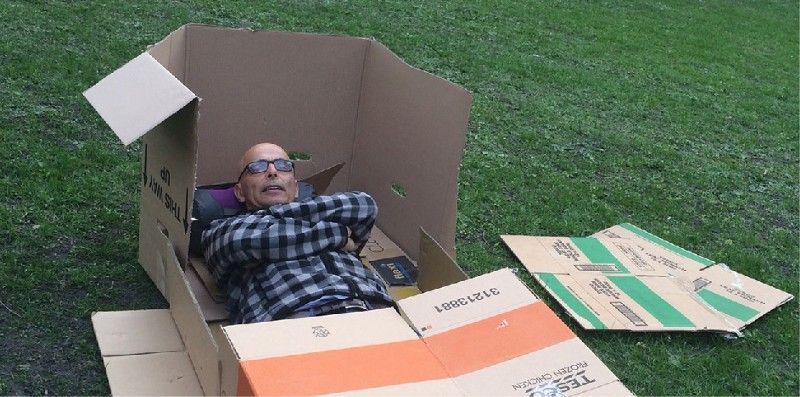
Trinity Winchester is a charity that works with homeless and vulnerable people in Winchester where we have our offices. I see homeless people every day and wanted to do something positive to help. The ‘Big Sleep Out’ was an easy thing to sign up for and it was even quite good fun. I’m doing it again this year if anyone wants to sponsor me!
The Solution to Our Time Problem: Micro-Volunteering
Chatting to one of the Trinity staff the morning after the Big Sleep Out, I was talking about how we’d like to help more, but that finding the time was a bit of a problem. They explained that there are plenty of ways to contribute that don’t involve a huge time commitment. This is a concept known as ‘micro-volunteering.’
Another thing Trinity does is to provide a hot meal every day to those in need. The supermarket supplies the food for free, but this needs to be delivered. You can volunteer by dropping into Sainsbury’s on your way into work, filling up with half a dozen boxes of produce and then taking these to the Trinity kitchen. If any of my staff do this twice a month and get in 45 minutes later than normal, then they’ve done a great thing and we’ve delivered on our volunteering commitment in a way that we’ll hardly even notice, and that doesn’t negatively impact on our customers.
Of course, not everyone has a car or drives into work, so having got the micro-volunteering idea into my head, I started to search around for other opportunities. These aren’t hard to find.
A Few Other Solutions If You’re Short on Time
One organization looking for help is the UN. I’d always thought that volunteering for the UN would involve traveling to a conflict zone and working with refugees or something like that. It’s a great and incredible thing to do, but not necessarily something that’s very practical for us. However, if you visit unv.org, you can also sign up to volunteer online and access a range of opportunities — there’s plenty of translation work and requests for website builders.
Searching through the options, I came across a project that was a perfect fit for us.
The Tanzania Development Trust has a project that rescues girls who are threatened by FGM and takes them to a safe house. But they have a problem: unbelievable as it sounds, in Northern Tanzania there are almost no reliable maps. The rescuers are unable to reach girls in danger because they simply don’t know how to get there.
To create more effective maps, there’s an open-source mapping project that you can sign up for at crowd2map.wordpress.com. They select an area to work on and divide it into squares, then volunteers pick an unfinished square, overlay it with a Bing map and draw in roads, buildings, and other features. People on the ground in Tanzania add in place names and then the maps are available to use. It’s a simple thing to do, but very useful. Another way to help is to donate your old phones: operatives on the ground need smartphones so that they can participate in the project. If you have phones to donate, then you can contact the trust via their website (they want old laptops, too).
Making a Difference — and Seeing It
We’ve held one team ‘mapathon’ to date, and I’m delighted if any of my staff want to do a bit of mapping for an hour or so on any given day. What’s great, apart from the fact that it’s a really good cause, is that you can donate as much or as little time as you have and you’re making a difference: more girls were rescued last year and mapping played a direct part in that.
The final thing is to make sure we meet our target. You’ve probably heard the expression ‘what gets measured gets done,’ so of course we have built an object in Salesforce and a simple dashboard to measure this.
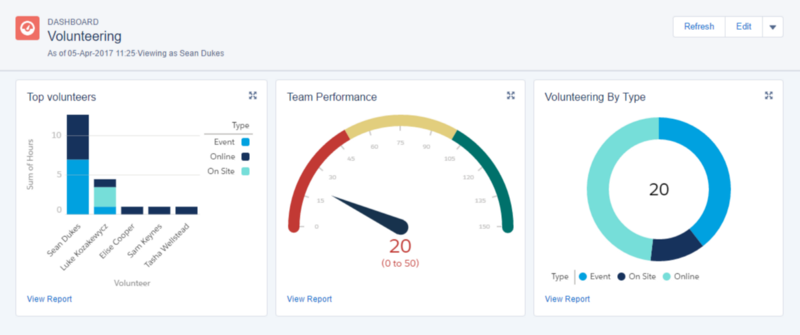
When we pledged 1%, we were signing up to an ideal without a clear idea about how we were going to deliver. Micro volunteering has given us the tool we needed to turn that aspiration into action. I’m not just proud to have pledged; I’m proud of what we are achieving too.
Originally published by Tim Smith, Director of Innovation Partnerships and Pledge 1% Boston on the Boston Foundation blog.
Brendan Ciecko is the founder of Cuseum, and a proud early member of Pledge 1% Boston. Growing up in Massachusetts, he got his entrepreneurial start as a teenager and has always been dedicated to making our region more vibrant and engaging. Brendan built and scaled a successful company in the fast-paced music industry and was named one of America’s top entrepreneurs by Inc. Magazine – all before he could legally buy a drink.
In his 20s, his attention turned to museums. “Museums should be easy to access and enriching for all,” says Brendan, who is driven to help museums improve their digital engagement. As more visitors turn to their smartphones, Cuseum enables museums to offer a “digital docent” to meet this demand and improve visitor experiences. Founded in 2014, Cuseum can now be found in some of the most renowned institutions in the world, including the Museum of Fine Arts Houston, Asian Art Museum in San Francisco, and the Institute for Contemporary Art in Boston. Cuseum recently launched a new digital membership fulfillment product to help institutions save time and money as well as increase member renewals and satisfaction.
As part of its mission, Cuseum has also developed tools to help museums address accessibility and inclusion with the support of multiple languages, assisting in mitigating a common barrier for diverse populations. Additionally, Cuseum has introduced elastic pricing models that make it possible for organizations of every shape and size to take advantage of their platform.
Early backers of Cuseum include Paul English (a fellow Pledge 1% Boston member), Techstars, Boston Syndicates (BOSS) and a lineup of savvy and successful tech industry leaders and investors. As Brendan has supported various nonprofits and community initiatives throughout his life, joining Pledge 1% Boston was an easy decision.
“As entrepreneurs and problem-solvers, we have an obligation to give back and drive positive change around us” he explains. Making the decision to pledge 1% toward the common good was totally aligned with the goals and culture of Cuseum.”
Brendan is also an emerging thought leader around ways that the nonprofit community can look to the innovative models of accelerator and incubator programs. Check out his recent opinion piece in TechCrunch.
5 Fun Facts About Brendan & Cuseum:
- Brendan has a Platinum record for his work with OneRepublic.
- Cuseum’s office is filled with whimsy… including artwork by Gary Baseman and Boston artist Pat Falco.
- Brendan is a graduate of the “School of College Dropouts.”
- At the age of 19, Brendan managed an alternative hip-hop group signed to Warner Bros. Records.
- Brendan is married to his high-school sweetheart and fellow do-gooder, Elizabeth Dobrska, who is Managing Director of TUGG and a member of the Boston Foundation’s Innovation Economy Leadership Council.

Originally published on FinExtra.
Today The Upside Foundation, a national charity that makes it easy for early-stage or high-growth Canadian companies to give back in a meaningful way, announced the launch of their campaign, 150×150: Turn Equity Into Charity.
The campaign aims to grow the number of companies who have pledged to give back to 150, as we celebrate Canada’s 150th birthday. Canadian startups who make the pledge will donate a small portion of their equity to The Upside Foundation (typically in the form of stock options), which are converted to cash upon a liquidity event and donated to the charity of the company’s choosing. The Upside Foundation is also announcing several prominent Canadian startups who have taken the Upside pledge, including Wattpad, the Toronto-based entertainment company for original stories, as the first company to kick-off the 150×150 challenge.
“The Upside Foundation provides an easy solution for both early-stage startups and high-growth companies who want to give back but don’t necessarily have the time or money,” said Rob Antoniades, Board Chair and Co-founder of The Upside Foundation. “Through this national campaign, we hope to empower 150 Canadian startups to take the pledge to donate a portion of their equity and help build a stronger future for Canada.”
The Upside Foundation is partnered with Pledge 1%, a global movement founded by the Salesforce Foundation and others to inspire companies around the world about the benefits of early stage corporate philanthropy. Through Pledge 1%, over 1800 companies have donated one per cent of their equity, people or product to charity. In Canada, over 75 companies have already taken the Upside pledge, including Hubba, which raised Series B in funding in December 2016. New members include Wattpad, Wealthsimple, and Overbond, with additional members to be announced leading up to Canada’s 150th birthday.
“At Wattpad, we believe startups aren’t just about profits, they’re about giving back to communities, at home and abroad. We’ve already made a remarkable impact on millions of people’s lives around the world. Today, we pledge to join the 150×150 campaign to demonstrate our continued commitment to positive social impact,” said Allen Lau, Wattpad co-founder and CEO. “Whether you’re in the early stages or a well-established start-up nearing exit, it always makes sense to support charities that serve your users and mean something to your team. If you haven’t already joined the Upside Foundation, what are you waiting for? Join the 150×150 campaign today!”
Any Canadian startup or private high-growth company can take the Upside pledge by committing stock options or warrants that will be converted to cash at the time of an exit or IPO, and donated to a registered Canadian charity.
“I’ve always believed in giving back to the community,” said Vuk Magdelinic, CEO of Overbond. “I’m proud that we have now found a way to make Overbond’s success mean that charities in the community will win alongside us.”
To date, there have been two exits from the Upside network, including BlueCat Networks, which sold for $400 million in February 2017; BlueCat CEO, Michael Harris donated the proceeds from a portion of his stock options to the Enbridge® Ride to Conquer Cancer® benefiting the Princess Margaret Cancer Centre. The first company to exit was Understoodit, who was acquired by EventMobi in 2013 and donated their equity proceeds to the East York Learning Experience and Mentoring Junior Kids Organization. The Upside Foundation is led by a coast to coast Board of Directors and Advisory Board of industry leaders and partners with leading incubators, accelerators and investors – creating a supportive community for members to be a part of.
“People work at startups because they want to effect change, and the Upside Foundation enables startup employees to have a meaningful impact on their community,” said Mike Katchen, founder and CEO of Wealthsimple. “Our team is proud to join the 150×150 challenge.”
How Companies Can Take the Pledge
The Upside Foundation encourages Canadian companies to join those who have already taken the pledge.
1. Companies will need to fill out the online pledge form found on The Upside Foundation’s website and a representative will be in touch.
2. Once the pledge form is received, companies will receive detailed instructions on how to contribute from an ESOP (employee stock ownership plan) or a simple legal form, with flexibility depending on the stage of the company.

Originally published on the Upside Foundation blog.
From the Upside Foundation Team:
Today we are excited to announce the launch of 150×150: Turn Equity Into Charity, our campaign to double our membership to 150 companies as we celebrate Canada’s 150th Birthday. We are also announcing several prominent Canadian startups who have taken the Upside pledge, including Wattpad, Wealthsimple and Overbond, as well as our second exit resulting in funds going to charity.
“The Upside Foundation provides an easy solution for both early-stage startups and high-growth companies who want to give back but don’t necessarily have the time or money,” said Rob Antoniades, Board Chair and Co-founder of The Upside Foundation. “Through this national campaign, we hope to empower 150 Canadian startups to take the pledge to donate a portion of their equity and help build a stronger future for Canada.”
Wattpad, the Toronto-based entertainment company for original stories, is the first company to kick off the 150×150 challenge.
“At Wattpad, we believe startups aren’t just about profits, they’re about giving back to communities, at home and abroad. We’ve already made a remarkable impact on millions of people’s lives around the world. Today, we pledge to join the 150×150 campaign to demonstrate our continued commitment to positive social impact,” said Allen Lau, Wattpad co-founder and CEO. “Whether you’re in the early stages or a well-established start-up nearing exit, it always makes sense to support charities that serve your users and mean something to your team. If you haven’t already joined the Upside Foundation, what are you waiting for? Join the 150×150 campaign today!”
Over 75 companies have already pledged to give back with the Upside Foundation. Recently, we had our second exit when BlueCat was acquired for $400 million. BlueCat CEO, Michael Harris, had previously pledged to donate proceeds from a portion of his own stock options to the Upside Foundation. The funds have been distributed to the Enbridge® Ride to Conquer Cancer® benefiting the Princess Margaret Cancer Centre, a 200-kilometre cycling trip which Michael is participating in- read more here.
We’re looking forward to working with our members, partners and supporters to grow the number of companies who have committed to giving back to communities in Canada to 150. Stay tuned for campaign updates over the coming months, including new members, events, and opportunities to join the movement.
Vuk Magdelinic, co-founder and CEO of Overbond, a primary bond issuance platform, said, “I’ve always believed in giving back to the community, and I’m proud that we have now found a way to make Overbond’s success mean that charities in the community will win alongside us.”
Any Canadian startup or private high-growth company can take the Upside pledge by committing stock options or warrants that will be converted to cash at the time of an exit or IPO, and donated to a registered Canadian charity.
“People work at startups because they want to effect change, and the Upside Foundation enables startup employees to have a meaningful impact on their community,” said Mike Katchen, founder and CEO of Wealthsimple. “Our team is proud to join the 150×150 challenge.”
How Companies Can Join the 150×150 Challenge
The Upside Foundation encourages Canadian companies to join those who have already taken the pledge.
- Companies fill out the online pledge form and a representative will be in touch.
- Once the pledge form is received, companies will receive detailed instructions on how to contribute from an ESOP (employee stock ownership plan) or a simple legal form, with flexibility depending on the stage of the company.
Others looking to get involved with the Upside Foundation and our 150×150 campaign are invited to check out www.upsidefoundation.ca/150×150/ or reach out at info@upsidefoundation.ca to connect with us.
ABOUT WATTPAD
Wattpad, the global multiplatform entertainment company for original stories, transforms how the world discovers, creates, and engages with stories. Since 2006, it has offered a completely social experience where people everywhere can participate and collaborate on content through comments, messages, and multimedia. Today, Wattpad connects a community of over 45 million people around the world through serialized stories about the things they love. As home to millions of fresh voices and fans who share culturally relevant stories based on local trends and current events, Wattpad has unique pop culture insights in virtually every market around the world. Wattpad Studios co-produces stories for film, television, digital, and print, to radically transform the way the entertainment industry sources and produces content. Wattpad Brand Solutions offers new and integrated ways for brands to build deep engagement with consumers. The company is proudly based in Toronto, Canada.
ABOUT WEALTHSIMPLE
Wealthsimple is a new kind of financial advisor — one that’s intuitive, affordable, and human. They provide world-class, long-term investment management without the high fees and account minimums associated with traditional investment managers. They invest your money in a globally diversified portfolio of low-cost index funds modeled after the same Nobel Prize-winning research used by the world’s savviest investors.
ABOUT OVERBOND
Overbond is transforming how global investment banks, institutional investors, corporations and governments connect and access the primary fixed income market. Overbond’s fully-digital platform for primary bond issuance eliminates inefficiencies, provides higher transparency, optimal price discovery, and investor diversification for all counterparties in the primary bond market.
ABOUT THE UPSIDE FOUNDATION
The Upside Foundation of Canada is a registered charity. The Foundation provides an innovative corporate philanthropy platform to help Canadian startups and high-growth companies “Share the Upside”. Since startups’ cash is scarce, as is time, the Foundation makes charitable giving quick, easy and cash-free.
The model is powerful: Earlier-stage and high growth private companies pledge stock options or warrants to the Upside Foundation. When the company has a liquidity event (e.g., IPO, acquisition), the Foundation monetizes the options and donates the proceeds to registered Canadian charities selected by the donors (and approved by the Foundation).