
By Philip Rojc. Originally published on Inside Philanthropy.
It’s nothing new to see corporate donations that complement the company’s core business and reflect its worldview. A set of grants last month from cloud communications firm Twilio certainly fits the bill. Totaling $1 million, the grants represent part of the company’s 2015 pledge to commit 1 percent of its equity to social impact programs. At some point during this calendar year, Twilio plans to give out another $1 million in grants.
Established in 2007, Twilio sells a cloud communications platform, essentially taking care of underlying infrastructure like servers and databases. Through Twilio’s API (app programming interface), clients can then construct their own bespoke communications systems. In 2013, the company launched a social impact arm, twilio.org, catering to nonprofit B corp and social enterprise clients. These eight initial grants were awarded through the newly created Twilio.org Impact Fund.
Twilio’s commitments here underscore the growing embrace of philanthropy among newer tech companies. As we’ve reported, a great many such firms have joined the Pledge 1% campaign, which Salesforce developed to spread its 1+1+1 model.
Twilio’s recent grantees represent an array of constituencies and causes. Linking the projects together, unsurprisingly, is digital communications, as well as several plans to utilize Twilio’s service. Like a lot of corporate funders these days, Twilio is clearly keen to align its philanthropy with its core competencies—a strategy that has the added benefit of promoting its brand and products.
Twilio’s niche is increasingly critical to nonprofits. As we’ve reported, communications can be the make-or-break factor for social service and aid campaigns. When information flows poorly, as is often the case in poverty-stricken or underprivileged communities, aid can be stalled. NetHope, an initiative to enhance connectivity amidst humanitarian crises, has gotten support from a range of tech titans like Google.org, Paul Allen, Gates and Intel. Cisco has also been a big player in global aid through tech. During the ongoing global refugee crisis, various tech and communications companies have stepped forward to address the connectivity needs of displaced people.
Many of Twilio’s grants benefit causes closer to home. Recipients like CareMessage and Mission Asset Fund serve underprivileged communities in the U.S., in part by engaging people via SMS and other mobile technologies. Trek Medics, an emergency care provider, is improving its dispatch system. And initiatives like Lesbians Who Tech and #YesWeCode present underrepresented communities with paths to potential tech employment. Another grantee, Fast Forward, serves tech entrepreneurs tackling social issues.
One interesting component of Twilio’s grants is a focus on civic engagement. A grant to the OpenGov Foundation supports open-source tools in the hope of decreasing the distance between elected officials and their constituents. Another grant to Democracy Works backs voter engagement by digital means (i.e. through messaging to remind voters when the polls open).
In a lot of ways, these kinds of grants come down to narrowing the digital divide, both in the United States and overseas. That’s a cause with significant traction among tech companies, carrying with it the bonus of potential new business along with their social investments.

Ostendio has joined the Pledge 1% movement, a national philanthropic organization encouraging companies to give 1 percent of their equity, employee time and products to good causes. Ostendio has committed to 1/1/1, which means committing at least 1% of employee time, equity and product to worthy causes.
At Ostendio we have a deep commitment to the concept that everyone deserves to have access to excellent and affordable healthcare, independent of where they live or how much they can afford. This is why Ostendio joined Pledge 1%, which now has over 2,700 members in over 60 countries.
Pledge 1% in Action
The Ostendio team spent an afternoon in February giving back to the local community by volunteering with the Arlington Food Assistance Center. Ostendio was tasked with bagging food for the Backpack Buddies program. The Backpack Buddies program provides weekend and holiday meal packs for food-insecure Arlington County schoolchildren.
A recent study commissioned by AFAC and conducted by Virginia Tech’s Center for Social Research estimates that as many as 9,400 children in Arlington are food insecure. For many of these children, their lunchtime meal at school is their only meal each day. Over weekends or holiday breaks, these children often go with little to no food. AFAC’s Backpack Buddies program strives to help these children.

The Ostendio Team Volunteering
On Fridays at their school, each child in the Backpack Buddies program is given a backpack filled with nourishment for the weekend. Items usually distributed in the backpacks are ready-to-eat meals, microwave soups, snack bars, fruit cups, shelf-stable milk, fresh produce, and canned vegetables. There is enough food in each pack to feed the child for two days (six meals, plus snacks). Members from Ostendio packed up 200 bags of food.
The Backpack Buddies program runs year-round. AFAC coordinates with all of the Arlington Public Schools as well as several community centers, after-care programs, and summer camps to make sure all children in our community have the food they need when the weekend comes.
The Ostendio team had a great time knowing that they had spent the day helping young children get access to additional food resources. We’re already planning our second volunteer day in August!

By Joshua Hall. Originally posted on Techpoint.
You already know about part of Salesforce’s impact in Indiana — the software giant is creating more than 800 new jobs and 500 new apprenticeships, and investing $40 million that’s causing a ripple effect of growth and prosperity in the state’s tech sector.
What you might not know is that the Pledge 1% movement, a model of corporate philanthropy inspired by Chairman and CEO Marc Benioff’s 1/1/1 program at Salesforce, has the potential to compound that positive ripple effect through cooperation with other Indiana companies like Appirio, Torchlite and TrendyMinds.
Founded in 2014 by Salesforce, Atlassian, and Rally, Pledge 1% is a new normal for companies of all stages and sizes to give back to their communities. By pledging just a small portion of future success — one percent of corporate equity, profit, product and/or employee time — these three founding partners proved that the model can have an enormous impact on their local communities, which will be the same for Indianapolis.
Even if you are not quite ready to take the pledge, you can fill out this form to stay in the loop and receive more information about the Pledge 1% movement.
For example, the Salesforce employees in Indianapolis will donate more than 200,000 volunteer hours by the end of this year, mostly within public schools. That massive amount of volunteer time is achieved by employees giving their time simply four hours a month, or a total of six days of paid volunteer time a year that has a huge impact for the schools as well as the employees.
Susan Marshall, Founder & CEO, Torchlite

“We have found that the Pledge 1% program just naturally brings people together and lets them get to know one another. I think when you find out what people are passionate about it reveals common ground beyond just getting the work done and helps improve collaboration, communication and empathy.”
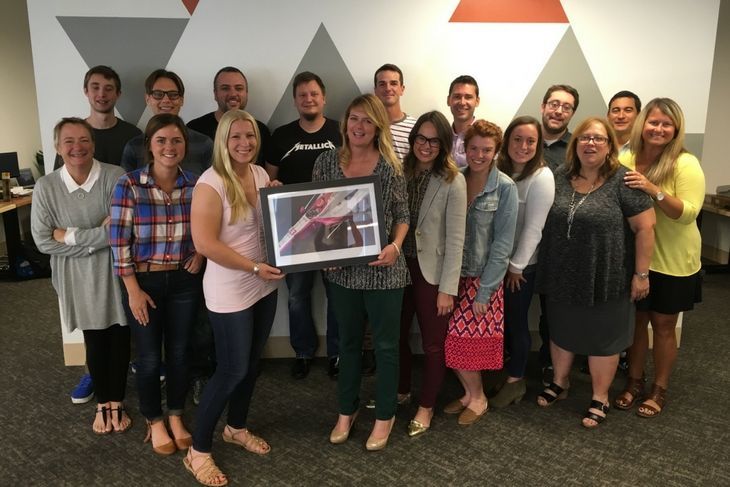 THE TEAM AT TORCHLITE FOCUSED ON DONATING THEIR EMPLOYEE TIME AS A STARTUP COMPANY PLEDGING 1% TO THE MOVEMENT.
As a two-year-old startup, Torchlite signed up to participate in the Pledge 1% program from the beginning with a focus on donating employee time. Later this summer, however, the marketing tech platform and marketplace company will roll out a new feature in its software that connects freelancers with nonprofits they are passionate about so they can contribute to campaigns through creating content pro bono or at a discounted rate.
As a signatory to the Pledge 1% movement, companies can choose to focus on one aspect like donating employee time or products and services, or they can choose to do a combination or all three — profits, products and time — or even a fourth way via company equity.
Trevor Yager, founder and CEO of TrendyMinds, says that his company chose to commit to all three when they made the pledge a little over a year ago because it was actually something they were already doing and that the Pledge 1% program helped to make it official.
Trevor Yager, Founder & CEO, TrendyMinds

“One of the things I really like about the Pledge 1% program is that they have everything organized,” Yager said. “If you need a letter to send out to your team that says how the program works or how to set it up, they already have a structure in place that makes things so much easier to run.
“We were actually already doing a lot of what we still do today on our own, so for us it was more of a validation than trying to ramp up efforts. We didn’t need to change who we are or what we were doing, but it was a matter of validating our programs and joining forces with our neighbor companies and having an even greater community impact.”
Following its first year of official participation in the movement, TrendyMinds is starting to see most of its employees get involved. According to Yager, Pledge 1% is a very flexible program structure that accommodates doing things together as a company or as individual employees.
Over the course of the year, TrendyMinds provided $220,000 worth of in-kind product and service donation to a single client event as a company (just one piece of their total), but they also incentivize their employees to volunteer on their own. For example, after volunteering 12 hours with the company, one employee earned an additional eight hours of volunteer time off, which he used to take his little brother fishing through Big Brothers Big Sisters of Central Indiana.
“The great thing about Pledge 1% is that It’s not too hard to do; they just give you everything, so especially for small companies and tech companies that have a lot going on sometimes, it can be hard to come up with a program from the ground up. This is a great way to get everything you need to give back and not have such a heavy lift to get started,” Yager said.
Even large companies can adopt the program and sign on to the Pledge 1% movement without having to abandon their established philanthropic programs or their own branding. Appirio, for example, the Indianapolis-headquartered global cloud services company, started its own internal Silver Lining program a decade ago, and also chose to sign on to the Pledge 1% program.
Steve Pruden, SVP Human Resources, Appirio

“We kept the original Appirio Silver Lining branding, which interestingly also was inspired by Benioff’s 1/1/1 model, and it has grown way beyond the basics of the Pledge 1% mantra,” said Steve Pruden, senior vice president of human resources for Appirio.
“All of our volunteer and philanthropic initiatives flow under the Silver Lining umbrella and so that’s how we brand it internally, but we also make sure we meet our commitments as a company signed on to the [Pledge 1%] movement.”
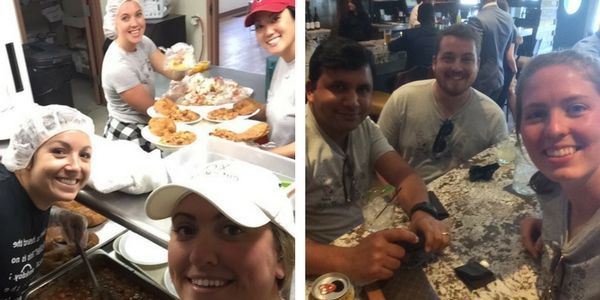 THE PLEDGE 1% PROGRAM ALIGNS WELL WITH APPIRIO’S OWN INTERNAL SILVER LINING PROGRAM, WHICH OFFERS EMPLOYEES FLEXIBILITY TO VOLUNTEER WITH CHARITIES THEY CHOOSE.
By lining itself up with thousands of other companies, and doing so publicly, Appirio is fulfilling a broader purpose than just selling more services or generating more revenue. The Pledge 1% program helps the company identify culturally with other great companies and it’s a key to holding themselves accountable.
“Whether we are doing things like setting budgets, tracking volunteer time or looking at what types of pro bono technologies we want to offer, we always look to make sure that we are meeting or exceeding our one percent obligation, and most of the time we go beyond it,” Pruden said.
At Appirio, the volunteer hours are measured in the tens of thousands and the amount of money donated through their Pledge 1% affiliated Silver Lining program is in the millions. The company has a Silver Lining program manager based in Indianapolis and champions in every physical office, including Tokyo, Dublin, London and more, as well as in different global regions to make sure its large virtual workforce is thoughtfully engaged.
Pruden thinks the impact of the Pledge 1% movement will dramatically increase in the near term as more Indianapolis-based companies become aware of the program and choose to sign on. “If you look at the combined impact of what all of the Pledge 1% companies are doing globally with just a small one percent pledge of time, product or profits, it’s amazing,” Pruden said.
“When you take a step back and look at what Appirio has accomplished over a decade of doing this and all that we alone have been able to do, it puts it into perspective how big that impact really is when you realize that there are now thousands of companies signed on to the movement having an impact all over the world. It just makes sense that companies like ours and Salesforce and so many others that are doing well are smart to join forces to give back, and the Pledge 1% program is a great way to go about doing it.”

Hiring is hard. We make it easier.
Savvy Hires is a consulting and workforce development firm that helps companies develop Strategic Internship and onboarding programs for pipeline development.
80% of employee turnover is due to bad hiring decisions. $136.5M/ yr in the US is wasted on bad hires. The result of a poor cultural fit can cost 50-60% the person’s salary. This turnover can be attributed to poor fit, or poor on-boarding/ training tactics. Savvy Hires was created to help.
A Strategic Internship Program, when done correctly, is invaluable to a business’ recruiting strategy and bottom line. The difference between having an intern and hosting a Strategic Internship Program gets boiled down to business objectives – what are the goals for the program, and are they achieved? The most impactful goal of any program is having an intern convert to a full-time hire – studies have shown employees who were interns are 40% more loyal (have higher retention rates) than their peers who were hired at an experienced level. They also have a higher ability to work cross-functionally, and are more likely to be a strong cultural and skill-set fit, because the company and student have an opportunity to evaluate each other during the Intern Program, prior to committing to a full-time offer. Large companies know this – they employ entire teams to create and manage Strategic Internship Programs and have large hiring “classes” that stem directly from their Intern Program. But for mid-size companies who don’t have the internal resources to manage such a program, the ability to hire this way was out of reach, until now.
Enter Savvy Hires. Savvy Hires uses our 3-phase approach to create and execute our Intern to Employee Program. It starts with a deep dive in to company culture, understanding the company’s long-term growth needs (what functions are growing, where will they need talent in the future, etc.), writing job descriptions, and creating advancement paths for the positions. We then work with our client to recruit and evaluate candidates, and build and execute an Intern Program. Our Intern to Employee program usually consists of pre-internship training for Hiring Managers, creating a Mentor Program, Orientation for the students, weekly development and networking events, and a work assignment/ evaluation process. Feedback is integral to any successful program, and we measure success through bi-weekly online 360 reviews with our performance analytics software, as well as formal mid and final program reviews.
Why Pledge 1%
The Founder of Savvy Hires (Felicia Fleitman) knew from the beginning that she wanted a mission tied to her company, and that her company should “give back” to the community in some way. Not only did the opportunity emerge quickly after she launched, but it has even opened a new line of business for Savvy Hires.
It all started at a networking event Felicia attended a few days after launching Savvy Hires. The keynote speaker was Priscilla Arena, Founder of SASI (Suffolk Asperger & Autism Support & Information – www.sasiny,org), and mom of a son on the Autism Spectrum. Felicia immediately “connected” with Priscilla, mother to mother – she was trying to create a better life for her son – every parent can relate to that. Felicia was surprised to learn how challenging it was for parents with children on the spectrum to support their children in public school, find sensory-friendly activities, etc. A new mother herself, Felicia understood how hard it was to be a parent, even more-so when the “system” is working against you. Then Priscilla said something that really struck a chord: over 90% (not a typo) of people on the Autism Spectrum are unemployed or under-employed. Felicia knew she could help. Felicia began volunteering with SASI to conduct job search strategy training to their population, and is working on the candidates’ behalf to help them find jobs. The work is incredibly rewarding – “we’ve volunteered for other things before (raised money for walks, packed gift bags for fund-raising events, etc.), but this is the first time we are using our skillset and business contacts to impact so many people,” Fleitman said.
The volunteer work has also led to a new line of business. Through a connection with SASI, Savvy Hires was retained by the Bridges Program at Adelphi University. The Bridges Program is for students who have been accepted to the University who are also on the Autism Spectrum. Bridges provides an additional layer of support to ease the transition. One of the best Bridges Programs in the Country, they have two national NASPA awards: The Gold Award for the best College Student Health, Wellness, and Counseling support program in the country; and The Grand Bronze Award for the third highest rated program in all categories. They want to build out their job placement program, and hired Savvy Hires to help. “We created relationships with two employers: Northwell Health, New York State’s largest employer) and Enterprise Holdings. Working with Bridges and the employers, we were able to “tweak” the employers’ hiring practices to make them more inclusive for our students, and get the students interview/ career ready. We’ve also provided training for employer staff, and will provide job coaches through the internships as needed,” said Fleitman. The students are working in several functions, including: IT, HR, Research, Marketing, Management Training, and Customer Service.
“As more employers recognize the benefits of having inclusive hiring practices for people on the autism spectrum, I expect this line of business to grow exponentially,” Fleitman said. “And it all started with our volunteer work.”
To learn more about Savvy Hires, visit www.savvyhires.com.

Originally published on New Voice Media’s blog.
Endure24 is dubbed the Glastonbury for runners. It draws together around 3,000 weirdos, like me, from all walks of life to spend 24 hours of their lives running multiple five mile (8k) laps of a course in Wasing Park near Aldermaston which is situated just outside of Basingstoke.
The team prior to the start
When I was first asked by a friend of mine to join a team of six to take part in the event I thought, how easy could this be? Five miles is nothing these days, and I regularly run that, plus some during the evenings after work as I’m a keen runner, with ultra-marathons and all things running on the brain. How wrong could I have been! The team itself consisted of me and five friends, two of whom had partners that worked for St Michael’s Hospice in Basingstoke. One also had a family member cared for by the Hospice during her battle with terminal cancer.
The event itself included camping for the weekend and, being part of a large running club with a lot of its members taking part, meant that we met early to head down to the site and claim a large plot of land for everyone. I was already battling sleep deprivation having been up until 4:30am, and combined with trying to assemble tents and gazebos on a windy day, disaster was inevitable! Breaking a friend’s tent before he had chance to sleep in it was never part of the plan, so a
trip back to Basingstoke to pick up some new tent poles followed, after which it was time to head to registration.
The idea of this event is to run as many laps as you can in 24 hours, with only one member of the team allowed on the course each time. A yellow band is your “license” to be on the course and is handed over in well-rehearsed fashion in a pit funnel at the start/finish of each lap. We had agreed to try and run 120 miles during the event, which would equate to four laps each. We were all more than capable of running 20 miles over 24 hours but we didn’t factor in the effects of no sleep and a lack of quality food over the course of this period.
The first laps were fine and by the time we’d all completed our first lap we were ahead of our schedule and set to go further than originally thought. By the time we were on our third lap each we were all in agony. One hill added to the suffering and we subsequently booked ourselves into the on-site massage tent to try and loosen up our legs. This only worked for one more lap, after which we had to push on and endure the fatigue and pain. Running through the night was a novelty to us all and some were unfortunate enough to also have to deal with rain despite the Met Office saying there was just a 10 percent chance of precipitation.
By 6am we were down to three team members, with three pulling out due to injuries. It was time for my fifth lap by then and the guy after me said he couldn’t go any further; time to put my race pack on that I use for my ultra-training, load up with water and gels and try and run ten more miles. It was never going to be attractive at 6am in the morning but I managed to get through in one piece. I will freely admit though that these two laps saw me at my lowest point of the weekend. Thoughts of my four kids and fiancée were running through my mind and I was close to tears for no apparent reason.
Over breakfast it was clear that the team was close to breaking, we were all pushing ourselves to limits we hadn’t experienced before, were on 145 miles in total and needed one more lap to make it to our increased target of 150. I realised that I hadn’t taken many pictures around the course and decided to put in one final lap for the team (and for my memories) and ran out with just my phone for my last lap. Having captured the memories on my phone, all that was left to do was collect a medal each and take a celebratory picture! After returning home it was a bath and some well-deserved sleep.
End of the double shift and feeling tired
All grand ideas at the time, but on waking it soon became apparent that I should have kept mobile for a little longer as it took all my efforts to stand up and use those things called legs that had decided to rebel against me!
As mentioned above, we were running this event to raise money for St Michael’s Hospice in Basingstoke and, thanks to all the kind donations from friends and family, we’ve managed to raise (including gift aid) over £1,000 that I know will be welcomed and put to good use by the Hospice. If you’d like to add to this amount, for which we would all be very grateful, you can do so HERE.
Alex’s team, ’24Hr Party People’ was supported by the NewVoiceMedia Foundation who will match the funding raised. Find out more about the NewVoiceMedia Foundation.

By Laura Anderson, originally published on the K15t Sotfware blog.
Trash belongs in garbage bins – a statement we probably all agree on. Sadly, beautiful places, such as forest trails, meant for everyone’s enjoyment and recreation end up being littered with plastic bags, empty bottles, and lots of cigarette butts. In order to help clean up some of Stuttgart’s public forest trails, six of our team members recently spent a sunny afternoon picking up all kinds of trash. And who would have guessed that walking through shady forests can be much more exhausting than a project-filled day at the office?
Pledge 1%
By picking up glass bottles and cigarette butts we participated in Pledge 1 % – a corporate philanthropy movement which K15t Software is proud to be a member of. Our team receives paid time for community service, and everyone in the organization can suggest a beneficial project which other team members can participate in.
Pledge 1% in action
Before we get into the details of how we set out to rid a forest trail of bottles, car radios, and socks, here are few facts and figures from our day:
- Participants: 6
- Location: Stuttgart, Germany
- Route: approx. 3 km
- Equipment: trash bags, trash grabbers, and gloves (Thanks to Stuttgart city’s AWS)
- Time: 4 hours per team member (total of 24 man hours)
Our team’s clean-up route through part of Stuttgart’s forest
Shortly after our K15t forest clean-up crew gathered at the trail head in Stuttgart South, it became obvious that finding garbage wouldn’t be a problem. As soon as we started paying attention and looking for trash it seemed as if we were surrounded by it – everything from small, transparent plastic bags to larger, more curious litter items. Anja was the first to discover one of these more unexpected pieces – a abandoned shoe.
Other strange trash pick-ups included:
- BBQ equipment
- plastic grave lights
- socks
- a jacket
- a car radio
- an entire bag full of . . . we weren’t brave enough to look
Of course, we also found lots and lots of cigarette butts, empty packs, and plastic, as well as glass bottles and cans.
Even though some of these items were located in difficult terrain, the team didn’t shy away from scaling steep slopes and crawling through thorn bushes to collect every piece of man-made rubbish they could find. As it turns out, this hunt and retrieval effort gets pretty tiring, at least in comparison to a normal busy work day.
Hard to reach? No matter, our team didn’t give up.
Trash collection in retrospect
At the end of the day, we were able to collect over six big, heavy bags of garbage. And while some of us might have been more exhausted than others, we all felt good about volunteering to make our local trails a more enjoyable place for everyone.
What did the team think?
Davin: “I constantly whizz by trash when I’m riding my bike in the woods, and it felt really good to stop and clean up the trails I benefit from.”
Martin: “We are so used to trash that we don’t see it anymore. This activity was an eye-opening experience. I couldn’t believe how much litter is actually dumped into the local woods.”
Jerome: “Everyone should take the time to do something like this at least once in their life. It’s a valuable experience.”
Anja: “I was surprised how many bottles and cigarette butts were lying around, obviously from people having a good time. I wish people would party and then take their trash out with them.”

By Dan McConvey, Development and Partnerships Associate, The Boston Foundation. Originally shared on The Boston Foundation’s blog.
Pranam Lipinski was born and raised in the Berkshires of Western Massachusetts in the town of Adams. While attending Endicott College as a business major, he co-founded the college’s Investment Club. It was through founding that club that Pranam developed his desire to support and harness the initiative of students who participate in clubs at schools. Today, he is Co-Founder of the new Pledge 1% Boston company Door of Clubs.
A few years ago, he toured Massachusetts and met with about 50 different student clubs to research ways he could support them and connect them with opportunities.
“The one thing students in clubs have in common is that they take the initiative to grow outside the classroom,” says Pranam. “Student clubs are the number one way to develop soft skills. You would think that potential employers would benefit from gaining access to those kinds of students.” He says that many clubs are underfunded and companies have a difficult time recruiting from them directly. The Door of Clubs model aims to address this gap and is built on the belief that initiative should be both supported and rewarded. “The support is the funding and the reward is the opportunity,” says Pranam.
As an entrepreneur, Pranam has been fortunate enough to have mentors and champions. The Executive Vice President of Human Resources at iRobot, Russ Campanello, is one of his closest mentors today. The CEO of Mastercard, Ajay Banga, has also been a gracious mentor, as well as fellow Endicott alumna, Libby Moore, who was Oprah Winfey’s Chief of Staff for several years.
Now Pranam wants to make sure that Door of Clubs is giving back early on. “I think what’s great about Pledge 1% is that we believe you can be a company of purpose and contribution from day one. This is about setting an intention and doing the right thing even before you’re successful. We’re doing this to have a successful company and a consciousness about where we ultimately want to go as a company.”
“Pledge 1% embodies this intent of goodness that is so easy to overlook when you’re going at a breakneck pace as a startup. But it’s important to take a second and set the right intention from the start. There’s a true honor in that. I believe it’s also character building for companies.”
Door of Clubs is pleased to announce its current campaign, which has the goal of raising a $1 million fund for clubs this fall, and is proud to partner with the Boston Foundation on this initiative. Clubs will compete for funding around questions like “What does the inclusive, inspiring and engaging workplace of the future look like?” A dance club could create a dance about it; a business club could create a business plan; and computer science club could create an app.
Door of Clubs has pledged $500,000 and is looking for companies and individuals who want to be strategic partners and help raise the remaining $500,000. Reach out to Pranam to learn more about this initiative.
Fun facts about Pranam Lipinski:
- He has committed to a year of ice cold showers. “I’m now in month 10,” he says. “It’s a good daily awakening and a mental discipline—and it wakes up the senses.”
- Pranam’s name means “I salute the truth within you.”
- He loves trout fishing in the brooks and rivers in Western Massachusetts.
- He is from Adams, which has the tallest mountain in Massachusetts, and his mother is from Nepal, which has the tallest mountain in the world.

By Anna Hendry, originally posted on Inside the Salesforce Ecosystem.
“The business of business is improving the state of the world.” These words from CEO Marc Benioff serve as the guiding principle for the impact Salesforce wants to have on our community. And they describe why, when Salesforce was founded in 1999, the leadership team vowed to set aside 1% of the company’s equity, 1% of employees’ time, and 1% of its products to improve communities around the world.
It’s an idea that’s caught on. Following the 1–1–1 model that Salesforce pioneered, Pledge 1% encourages companies to dedicate 1% time, 1% product, 1% profit and/or 1% equity to improve the world. Since its launch, more than 1,900 companies have joined Pledge 1% to make the community a key stakeholder in their businesses.
It’s also why we encourage our Salesforce Ventures portfolio companies to integrate philanthropy into their culture. And more recently, we hosted our first ever Cloud Gives Back — an afternoon of volunteering for our portfolio companies, to help them turn those pledges into action.
If you are a bootstrapped early-stage company with limited time and resources, it can be easy to dismiss a philanthropic philosophy as something you formalize when you’re more established. But in addition to the benefit of improving the state of the world, there are a few other reasons to build this approach into your corporate DNA in the early stages of your company:
Attract & Retain Top Employees
Companies today are fighting for top talent, especially among millennial employees, who will comprise over 50% of the workplace by 2020. And unlike the generations that came before them, millennials are far more concerned with what their company can offer them beyond the traditional HR benefits.
In fact, 49% of millennials prefer for work for a company committed to positive social & environmental impact compared to only 13% of baby boomers, and six out of ten millennial employees say that a “sense of purpose” is part of the reason that they chose to work for their current employers.
Not only do millennials prefer to work for companies that give back, businesses that do have 2.3 times the employee retention than businesses that do not. Just as Vidyard CEO and Founder Michael Litt says:
“As a group of millennials with bleeding hearts, it’s not just about making money; it’s about making money that matters. And that’s what gets me out of bed every morning, and I think what gets the broader team out of bed every morning. And since we’ve started involving ourselves in corporate philanthropy, I’ve been in interviews, and one of the reasons they want to come to Vidyard is because of the impact we can provide through this program.”
Giving Back Helps Build Employee Morale
This past April, Salesforce Ventures brought together nine of our portfolio companies for our first-ever The Cloud Gives Back — an afternoon of volunteering. Over 100 employees joined us and volunteered at four different locations including Boys & Girls Clubs of San Francisco, La Casa De Las Madres, The Presidio Trust and the Surfrider Foundation.
Not only was the feedback extremely positive (multiple people asked us to host the event weekly), employees were able to bond with their coworkers outside their standard office environments all the while giving back to their communities.
 Volunteers from Salesforce Ventures portfolio companies participate in our first-ever The Cloud Gives Back.
Volunteers from Salesforce Ventures portfolio companies participate in our first-ever The Cloud Gives Back.
“It was great to get out of the office and actually feel like I was making a difference volunteering,” said Lauren Mallen, a marketing coordinator at FinancialForce.
An event such as this is an example of how striving towards a common goal and supporting a cause that you believe in can create a sense of community among your employees. And when charitable giving is a part of the culture, it encourages employees to spend time together in environments outside of the office, letting them get to know each other in contexts that go beyond the day-to-day workday challenges. Beyond that, it exposes them to new environments and ways of life and promotes a work-life balance, something that can often get overlooked in a startup.
Consumers Prefer Socially Responsible Companies
In addition to increased recruiting, retention and employee engagement, philanthropy and corporate responsibility efforts can also affect your company’s bottom line. According to Nielsen, 55 percent of global online consumers are willing to spend more on products from companies that are committed to positive social and environmental impact.
And here’s the secret: Giving back doesn’t take much. Take employee time, for example. One percent of an eight-hour workday comes to just five minutes, roughly the amount of time it takes to grab a cup of coffee and heat up a Danish (and certainly less time than is spent recapping the most recent “Game of Thrones” or “American Gods”). But over the course of a year, that works out to 20 hours — a good amount of time for a good cause.
Amanda Kahlow, Founder and CEO of 6sense, says it best: “Making a commitment to Pledge 1% — that was one of the easiest decisions that I had to make as-as a CEO. We wanted to be a company that could grow revenue and drive a big profitable business, but also one that cares about the world.”
Anna Hendry is the Senior Marketing Manager for Salesforce Ventures at Salesforce. Follow Anna Hendry and @SalesforceVC on Twitter to stay up to date on the exciting activities in the Salesforce ecosystem. You can check out more photos from The Cloud Gives Back here.

Data is a commodity. The data collected by pharmaceutical companies from drug testing, retailers from shoppers, telephone carriers from mobile devices — all that information is valuable. What’s more, the amount of data is astronomical, as is the potential the inherent insight holds; that is, if you have the data or the ability to analyze data.
“While companies in the private sector may have the means to acquire and assess data, companies in the public sector and social organizations may struggle. Think volunteers treating children with HIV or charities dedicated to uplifting struggling communities,” says Ida Lucente, head of Marketing and Data Philanthropy Program at John Snow Labs.
John Snow Labs has helped support groups in South Africa (and around the world) treat mental illness and disease by collecting data and transforming it into actionable insight. A direct result of their work in this area is improved adherence to medical protocol and declining social stigma.
“We see data science and the use of data as a benefit to mankind,” Lucente says.
And her experience led to an epiphany: She believes in data philanthropy — companies sharing valuable private data resources to help solve community needs.
“It’s the future of corporate social responsibility,” she adds.
Data philanthropy typically happens in one of three ways: through donations of data, donating data scientists, or donating data-collecting technology to worthy causes.
Sounds straightforward, but there are intricacies to consider.
John Snow Labs prepares data for analysis. They find it, clean it, and normalize it for consumption. They figure out what the data will be used for and format it in the right way.
“Clean, optimized data sets move faster, work better,” Lucente says.
Let’s say you’re building an app that allows users to find harmful drug interactions. Between the active ingredients, licenses, and the interactions themselves, you need a lot of data. And if the app is for the public, your data set must be continually updated.
Another data-sharing challenge is deciding what data to share and with whom. For example, consider a pharmaceutical company that wants to share its findings on the side effects patients experience using their medication. On the one hand, they want other drug companies using the same ingredients to learn from them. On the other, they can’t put the data online because it could reveal sensitive patient information.
Indeed, privacy is an important issue in data philanthropy, Lucente says.
“A few years ago, there was a company that donated completely anonymized GPS information to the public in order to improve traffic. The data was well-received until someone figured out that you could use the data to track user destinations and addresses,” Lucente says. “Even if your data is completely anonymous, there’s still some risk in making it public.”
In order to avoid those risks, Lucente says companies must work with a team that understands how to handle data and maintain privacy. In other words, make certain you know who you’re giving your data to and that it’s done in a safe way.
The smart use of data can be a powerful agent for change.
“You can help healthcare communities find new therapies faster, farms grow food better, cities manage traffic more efficiently, and contribute to the betterment of the world around you,” Lucente says.