By Marisa Lopez, Presence PG. This post was originally published on Medium.
We like to think everyone wants to make positive changes in the world. But where do you start? Corporate Social Responsibility sounds dutiful but very expensive, cumbersome, and, well, corporate. Small businesses may hear the of it and shy away for these reasons. However, being a socially responsible small business is not only important, but completely feasible.
What is Corporate Social Responsibility (CSR)?
CSR is a means by which for-profit organizations can take a stand on public issues, and help to make positive change. CSR refers to the moral obligation of a firm to their stakeholders. Stakeholders include employees, customers, partners, and anyone else affected by corporate policy. It is also an opportunity for company to “give back” to the causes their stakeholders feel passionately about. Typically this includes environmental efforts, philanthropy, ethical labor practices, and volunteering. Companies can launch recycling programs, ensure that they are hiring a diverse staff, and encourage volunteering by presenting volunteer opportunities and/or offering incentives for employees to volunteer. Some companies coordinate “volunteer days” at local nonprofits.
CSR not only helps the community, it also results in many benefits for a firm. For example, strong CSR can help to bolster brand reputation, build trust with key stakeholders, and position your company as a thought leader. Giving back to local communities makes a company more marketable, and more desirable to prospective clients and employees. It is critical that both internal stakeholders (employees) and external stakeholders (clients and prospective clients) are aware of all of the CSR activities your company is engaging in. Communication through social media channels such as Twitter and LinkedIn and tools such as Medium enables prospective customers and partners to identify firms with common values in which they might want to partner with.
What does it mean to be a socially responsible small business?
CSR is often associated with large corporations. This being said, small businesses can also benefit from socially responsible practices. In fact, small and emerging businesses (SME’s) account for a whopping 70% of the workforce! More attention to CSR in small businesses is needed, as the world truly benefits from SME’s developing and implementing a culture of giving.
However, SME’s face unique challenges to CSR, namely a finite pool of resources, including limited equity and time. Fortunately, programs administered by Pledge 1%, CoolCalifornia.org and the U.S. Small Business Association and have been designed to scale down for small businesses. The CSR Wire, a digital newsletter and information repository is also a great resource for small business who are rolling out a CSR program.
Presence Social Impact
With so many entry points into CSR, it is easy to get overwhelmed. We are a small business, with finite resources and very high aspirations for CSR. Here is how we got started.
This year we joined Pledge 1%, a global movement to create a new normal where giving back is integrated into the DNA of companies of all sizes. Pledge 1% encourages and challenges individuals and companies to pledge 1% of equity, product, and employee time for their communities, because pledging a small portion of success can have a huge impact on tomorrow. Pledge 1% also offers companies turnkey tools and best practices, making it accessible for any company to incorporate philanthropy into their business model.
Over 1000 companies in 30 countries have joined the Pledge 1% movement, including Glassdoor, Yelp, General Assembly, Docusign, Salesforce, Atlassian, and Techstars. As a part of our pledge, we are crafting a unique Social Impact practice. We offer discounted rates on services to nonprofits as our services are our product. Companies such as Classy and Twilio have gotten involved other ways. Classy gives their staff paid time off for volunteering and dedicates 1% of their product to their clients by waiving transaction fees on #GivingTuesday. Twilio is investing 1% of their equity through Twilio.org, a foundation that was established in 2013 to provide nonprofits with access to their products, thereby equipping charitable organizations with the power of communication.
Employee-driven corporate social responsibility is common at small businesses. For example, at Presence, Mike Havrilla participated in the 2016 Nonprofit Success Pack Community Sprint. Sara Chieco leads a Girlforce Study Group as well as facilitates Salesforce.org Office Hours. Esther Weon leads coding classes for Girl Develop It as well as joined many other Presence employees as a mentor at CODE2040’s Hack4Diversity Ideation session this summer. With our CODE2040 fellow Scott Paillant leading the charge, it was easy, and frankly a lot of fun, to become involved with the group. We look forward to hosting fellows every summer.
We are proud to join Salesforce.org, Bigger Boat Consulting, Heller Consulting, and several other Salesforce.org partners in sponsoring the Girlforce at Dreamforce Event in October. Girlforce is a nonprofit organization whose mission is to empower women in the nonprofit Salesforce community to be fearless leaders in technology. Girlforce is based in the Power of Us Hub, which is an online community available for Salesforce.org customers and partners. Members include Salesforce users, administrators, developers, and consultants who are working together to improve our careers, our organizations, and our communities.
Whether you are a small or a large business developing a CSR practice is important for your community as well as your business. Small businesses have the power to embrace sustainability and corporate social responsibility — while also strengthening their bottom line. Joining Pledge 1%, CoolCalifornia.org, or the U.S. Small Business Association are great ways to get started. The possibilities of becoming involved are endless. Don’t be frightened by the challenges and get started.
Originally posted: November 29, 2016
By Dan Israel, Vice President and General Manager, Vlocity
This is a time of year when many around the world reflect on giving back to those less fortunate. This year, Vlocity is honored to reflect with Salesforce on a community project we started work on at the end of last year with WoodGreen Community Services, a local non-profit in the Toronto area. WoodGreen had been tasked by the City of Toronto with creating an application to help Syrian refugees find and access the housing and other assistance their families needed. WoodGreen partnered with Salesforce, Vlocity and Deloitte to provide a tool to connect refugees with the local community’s offers of housing, jobs and much more.
This year, Canada took the world stage on the refugee crisis and welcomed twenty-five thousand refugees, all within a short span of time. These refugees arrived in Canada with little or no belongings, shelter, or employment. The rapid deployment of WoodGreen’s H.O.M.E. (Housing Opportunities & Marketplace Exchange) portal made a big difference for those newly arrived to the Toronto area get the support they needed to begin their lives in Canada.
“The need to connect people with much-needed assistance presented a perfect opportunity to leverage the relationship and service capabilities of our Vlocity Public Sector apps to help others,” says Dan Israel, Vice President and General Manager, Vlocity Public Sector. “One of Vlocity’s core values is ‘We Give Back.’ Our pre-built industry cloud application designed to manage the delivery of social assistance programs allowed WoodGreen to quickly deploy the portal when time was of the essence.”
Vlocity’s easy-to-use application connects refugees with housing, jobs, household goods and a range of donated services. Donors, sponsors and refugees are guided through the simple and efficient process of enrolling, listing, and searching for available housing and other services.
The H.O.M.E. portal is powered by Vlocity Public Sector, built on Salesforce’s world-class Customer Success platform. WoodGreen deployed the application within weeks to be ready upon the refugees’ arrival. Today, the platform still connects donors and refugees, giving them access to clothing, electronics, housing and much more. Several refugees have even found employment through the portal.
As the world grows more connected, we all need to support one another in new and innovative ways. The H.O.M.E. portal recently won the prestigious best “Application of New Technologies” award at the annual ISM (IT Solutions Management for Human Services) Conference. Vlocity is proud to provide the tools that are connecting refugees with the assistance they need in the local community. Watch the video to learn more.
For more information about Vlocity’s app for Public Housing, or the Salesforce HHS Case Connect app, please contact Dan Israel at disrael@vlocity.com.
Vlocity, the Industry Cloud app leader and one of Salesforce’s top strategic ISV partners, has put the world’s #1 customer success platform to work in Canada, helping Syrian refugees find housing and other supports as they begin their new lives in Toronto.
Originally posted: November 29, 2016
Bstow is a tech company with social impact at its very core. Jason Grad, CEO and Co-Founder, shares what it means to join a global movement of companies that have pledged 1%.
Tell me about Bstow.
Bstow is a platform that let’s people automatically donate spare change from everyday purchases to a nonprofit of their choice. Our mission is to make it easier than ever for people to support to the causes they care about, and in turn, we help nonprofits raise more funds and engage donors on a deeper level.
What drew you to start Bstow?
I have always been interested in giving back, and after the ALS Ice Bucket Challenge raised over $115 million in 2014, I realized that I was not alone. Everyone wants to make a difference — even people who can’t write huge checks or make a commitment to volunteer regularly. Bstow was my solution to getting people, especially Millennials, giving on a regular basis and in a way that feels achievable for their wallets and schedules.
Why has Bstow joined Pledge 1%?
Everyday, we work with nonprofit partners that pledge 100% to making the world a better place. They open our eyes to innovative ways to address society’s greatest challenges and are the true definition of “grit.” These nonprofits and the impact that we can have collectively are the inspiration for our work and the reason we’ve decided to Pledge 1%.
Also as an entrepreneur, having a meaningful commitment to something beyond the company is crucial. It’s easy to get wrapped up in the company’s goals, but when these goals include social and environmental impact, there can be harmony between what we do and the world that we wish to create.
How has Pledge 1% impacted Bstow’s company culture?
As with any startup, there are ups and downs, and having a purpose greater than ourselves is what makes everyday worth it and having a strong mission pushes us to work harder to achieve our goals.
We ask every new hire what cause they care about in our interview process — it’s that important to us that everyone has a cause that they’re fighting for. Having this passion and drive directly translates into the work we do at Bstow.
When I first proposed that we join Pledge 1% to the team, everyone was thrilled and immediately on board. That’s the kind of culture Bstow has — caring for our communities and the world is woven into our company’s DNA. Pledge 1% is one more way that we ensure everyone who is a part of Bstow’s growth and progress is also invested in this vision.
Originally posted: November 29, 2016
By Okta.
More and more companies today are embarking on an important journey of corporate social responsibility programs and joining the Pledge 1% movement. Okta announced our program, Okta for Good, in August at our annual customer conference and since then we’ve put together the infrastructure, operations and key pieces to making the program a success. In the spirit of “Giving Tuesday”, I’ve outlined some lessons we’ve learned along the way.
Get focused:
There are millions of non-profit organizations in the world and many important causes. It’s hard to decide where to start first. We recommend picking a few causes that you can focus on throughout the year.
We found that it’s easiest to start local, which we did with our commitment to SF Gives to benefit the Tipping Point Community. Through SF Gives, 20 leading technology companies including Box, DropBox, Google, LinkedIn and others have committed to raising $10 million to fight poverty in San Francisco Bay Area. Starting local is a great way to make an immediate impact to your local community.
To help pick additional cause areas, we solicited feedback from our employees. It’s important to build a program that reflects your employee base and we wanted everyone to be involved in the process. Based on the survey results, we will also focus on youth education and wildlife in the upcoming year.
There are also a number of monthly causes that make it easy to get started. We hosted Breast Cancer Awareness programs in October, encouraging employees to wear pink, purchase pink baked goods and donate to fund cancer research.
Get operational:
When thinking about how your company can give back, one of the first places to look is your product. How can you donate your product or extend discounts to the organizations that need it most? In any non-profit organization, every dollar matters and the more dollars they can get directly to their cause, the better.
We’ve long supported non-profit customers with deep discounts, and have extended our commitment with a new offer of 25 free licenses of our product. We have +150 non-profit customers today including well known organizations such as Rotary International, Planned Parenthood, and City Year. However Okta can make any company and organization more efficient and by donating 25 licenses of our enterprise IT product line, any non-profit can better manage how their employees, donors and members access important applications online.
Deciding what portion of your product to donate is one thing, implementing it is another. In order to successfully offer this discount and onboard new non-profits, we formed an operations committee.
First, validating non-profits is a tall order. In addition to determining what types of organizations qualify, every country has different documentation requirements. A number of companies work with TechSoup to help distribute their product to hundreds of thousands of qualified non-profits.
You’ll also need to think about the distribution and tracking of your product and most importantly, how to make your customers successful. Get the right leaders involved from marketing to sales to operations to customer success so that your new non-profit customers are successful and have customized content. And once they are successful, you can capture their success story to share with the world.
Make the time:
Mobilizing your workforce is key for the time commitment. Once we joined Pledge 1%, a number of team members raised their hands to get involved so we formed a volunteer committee. It has been incredibly rewarding to see the grassroots effort with a core Okta for Good committee and regional and departmental ambassadors.
So if you’re considering this, but worried about who will do the heavy lifting, start by asking around. You may be surprised to find ambassadors across your organization who will spend the extra time to source opportunities. Our committee pulled off a number of events in October for Breast Cancer Awareness month and our ambassadors are pulling together activities for the holiday season. I’ve also seen organizations dedicate volunteer days or Volunteer Time Off (VTO) to make their commitments.
There are a number of tools that can help source and track your volunteer efforts, including Benevity, BrightFunds, Golden and VolunteerMatch, so I encourage you to check out these resources as well.
Tap your network:
The great thing about working in social innovation is that you aren’t alone. We’ve partnered with other Pledge 1% companies Box, DocuSign, Tableau, Salesforce, Splunk and Twilio in ImpactCloud, a coalition of cloud vendors focused on helping humanitarian organizations with disaster response efforts. Through this cause, we’ve connected with similar companies building “for good” into their business.
Reach out to your partners, ask how they are giving back to the community and encourage them to Pledge 1%. Odds are you aren’t alone, and there’s a great benefit in being able to partner together.
There are a number of helpful groups and resources that we’ve tapped including the awesome Pledge 1% team, Tipping Point Community and the Social Innovation Summit to share ideas and inspiration.
Create a culture of giving:
Key to making a corporate social responsibility program part of your culture is leadership and cross-functional support.
We’re fortunate that giving back has been part of Okta’s culture since the early days as our co-founders Todd McKinnon and Frederic Kerrest engaged in local non-profits and have always encouraged employees to do the same. As we expand globally, it’s increasingly important to infuse Okta for Good across every department, regional office and to our remote employees to keep our our workforce engaged as we give back to the community.
To make this part of your culture, think about how each department can leverage their skills such as coding or resume-writing “for good,” and keep open lines of communication. We’re talking about Okta for Good in new hire on-boarding, our Weekly All Hands, sharing resources on our Wiki and sourcing volunteer opportunities to tap our team’s talents.
Ready, Set, Go!
While it may be daunting to build a corporate social responsibility program, any commitment you can make is a step in the right direction. Over the past few months I’ve been so inspired by the support across Okta and our network, so I encourage you to form a committee, find a few stakeholders and reach out to your partners for advice. When it comes to giving back to the community, we’re in this together so I hope this info helps get you started in the right direction!
Learn more about Okta for Good.
Originally posted: November 29, 2016
Careers In Salesforce is a market leading job site that connects employers seeking Salesforce talent, with candidates who are looking for their next career move. We recently caught up with their Founder and CEO, Richard Eib, for a fireside chat to learn more about why they joined Pledge 1% and what inspires them to #PledgeitForward on this #GivingTuesday.
Q: Careers In Salesforce is one of the first companies to Pledge 1%. What inspired you to join the movement?
A: For the last sixteen years, I have been consulting on, developing on and recruiting for clients who use the Salesforce technology platform. One of the core values of Salesforce that really grabbed my attention and made me an advocate for their technology, was a philosophy of giving 1% of equity, 1% of employee time and 1% of product, to organizations that make a difference, whether it be in the local community or on the global stage. The notion of such a small amount like 1% having such an impact made us look at how our firm could support communities around us through giving back. The founding of Pledge 1% allowed us to solidify our many ideas into an action plan and empowered us to make a formal commitment to making a difference and take the pledge.
Q: Since taking joining Pledge 1%, what have you learned the most from the partnerships and opportunities that have
come your way?
A: The learning curve for my firm and I has been incredibly steep. My original concept of giving back was going to a soup kitchen on Thanksgiving, coaching former felons to find gainful employment and turning street skills into employment smarts. Careers In Salesforce in addition to being a job site, also provides consulting and staffing services. The greatest demand from those we select to give back to is consulting services. Over the last six months it has been challenging from both a cultural and workflow perspective to comfortably provide meaningful solutions. In many cases, it has felt like we were integrating a business we had acquired. That being said, seeing the true impact we have made and knowing the savings we have enabled makes the process all the more worthwhile and pushes us forward to accept more of the same.
Q: What role do you feel business has in the community if any?
A: Both of my parents hail from industrial cities in the U.K. My father from Newcastle-Upon-Tyne and my mother from Birmingham. For their generation and the many before them, the workplace, alongside church (and the local pub) was the focal point of the community. Whether it was bottling Newcastle Brown Ale or manufacturing Cadbury chocolate, business and the employer held a special place in the heart of employees. It was not just a paycheck, but in many cases a provider of recreational space and facilities, healthcare, housing and more.
As we have continued on our march down the path of technology and automation, we have lost that sense of social responsibility for our fellow humans in the pursuit of profit and the elimination of costs.
You can be a one person business or have many thousands of employees – adopting the concept of giving back 1% of time, equity and product or any variation thereof, restores some of that old school community mindedness as well as making a real difference to those who you help.
Q: What impact has Pledge 1% had on your business?
A: It has strengthened my sense of purpose and that of my firm. It has provided opportunities to make a difference that have been more than about how those opportunities translate to the bottom line . Business 101 teaches us that revenue is vanity, profit is sanity and cash flow is king. Perhaps that adage should be adapted to include another line, something to the effect of “revenue is vanity, profit is sanity, cash flow is king and giving back is above all”.
Q: Tell us why you think businesses should take the pledge?
A: We’re at a junction in life where those of us who are fortunate need to lend a helping hand to the organizations who help those who are not. Heck it doesn’t even need to be the organizations, you can make a difference today by pledging to take a hot meal to the widower in your apartment building, helping a teacher with classroom supplies or reaching out to your local prison to mentor those who want a better life on the outside. That being said, imagine the difference you could make if this became culturally ingrained in your organization and a mission that everyone from the receptionist to the CEO adopted – Giving 1% of something, be it time, product, equity or all three to make life just a little easier for those who need it.
Originally posted: November 29, 2016
By Philipp Stauffer, Co-Founder and Managing Director, FYRFLY Venture Partners
If you haven’t seen Gordon Gekko say “Greed is Good,” then go watch his speech in the movie Wall Street, released in 1987. Greed, for lack of a better word, is an important ingredient in capitalism and efficient markets. However, there is a movement and mindset that, in FYRFLY’s opinion, will drive greater returns than pure capitalism. We call it “Greed for Good.”
Greed for Good has appeared under many different names. Salesforce founder and CEO Marc Benioff calls it “compassionate capitalism,” a way corporations can make doing good an integral part of doing well. Eighteen years since its founding, Salesforce is going strong with its 1-1-1 philanthropy program and has impressive results to show on both shareholders’ and stakeholders’ balance sheets. Similarly, John Mackey, Co-CEO at Whole Foods, is nurturing the concept of “conscious capitalism,” an approach that infuses businesses with a higher sense of purpose and interdependence.
The premise of Greed for Good is that compassion and consciousness lead to a better world, and a better world fuels a stronger brand with a more talented, passionate and committed team. That dedicated team creates and lives by an unbeatable culture, grounded in a mission to solve big problems. As a result, that brand can attract a more loyal customer base and increase customer lifetime value, one of the most important drivers of corporate value. In essence, mission-driven organizations become stronger and more resilient in the long run because they stand for something that matters.
Several consumer studies document the rise of Greed for Good over the past 10 years. Many companies have already used the model to achieve superior marketing ROI, as I highlighted in a previous article.
As an entrepreneur, you can instill a mission-driven culture from day one, before knowing if your company will succeed. Think about what could happen if thousands of start-ups and companies followed this mindset and dedicated their capital/profits, time and product to causes that matter to them. The outcome would be massive value creation that makes capitalism stronger, more resilient and more rewarding. Leaders in Greed for Good can drive exceptional returns while making the world better.
Marc Benioff and the other founders of Pledge 1% have inspired us at FYRFLY Venture Partners for years, and we’re proud to have been one of the first venture capital firms to adopt the concept. Pledge 1% calls for companies to donate 1% of their equity, time and product. We are not impact investors, but we believe giving is part of the formula for generating superior investment returns. We are early in this wave and are committed to measuring the impact of Greed for Good on investment performance.
At FYRFLY Venture Partners, we make seed-stage investments in data-driven technology teams that have global aspirations and game-changing ideas. One of our ‘stealth’ portfolio companies is Doky, a new breed of cloud productivity platforms. Founder and CEO Francesco Tripepi is passionate about how Doky’s platform can have an impact on education globally and is establishing a giving program on this mission. Francesco and his team pledged 1% and started their journey of giving back by kicking off the Doky Foundation.
The Doky Foundation intends to go beyond 1% in terms of product donations and plans to offer its platform for free to any school and student in need. Francesco and his team would love to eliminate the digital divide by helping students access all the tools they need to learn and reach their potential. Doky’s initial programs will focus on education in African countries, but the initiative has global aspirations.
This is just one example of what we see in the next breed of entrepreneurs and start-ups. Giving back does not start once companies are doing well – it starts from the beginning, from day one. Impact is built into the company DNA and Pledge 1% is the new normal.
Guided by Greed for Good, we will create great companies with sustained profitability and meaningful value creation. To that end, we have a request for our fellow VCs and investors: let’s proactively support our entrepreneurs to pursue Greed for Good at the Board level. If we take on the mission to prove that giving enhances shareholder value, we can set a model that Wall Street will follow.
In an article summarizing his book Give and Take, Adam Grant recounts what Bill Gates said at the 2008 World Economic Forum in Davos: “There are two great forces of human nature – self-interest, and caring for others.” He argues that in many organizations, those forces come together with damaging effect. Adam explains that with thoughtful management though, these two forces can be yoked in such a way that caring for others becomes the best strategy for the most ambitious. At FYRFLY Venture Partners, we believe that is not only true for a company’s internal environment but also for the economy as a whole. As we seed companies that cherish Greed for Good, we will create new global winners. Stay tuned.
Originally posted: November 29, 2016
By Nithya Das, SVP, General Counsel, AppNexus
One of AppNexus’ core company values is to see and improve the whole system – whether that system means the internet, our technology or initiatives in our local communities where our offices are based.
Last year, when AppNexus became the 500th company to join the Pledge 1% movement – a global initiative where corporations dedicate one percent of their work hours, money or products to bringing about lasting change in local, underserved communities – AppNexians went to work to make our commitment come alive through an initiative called AppNexus Impact.
Given AppNexus’ global scope and reach, we knew there was significant potential to make an impact. Over the course of 2016, AppNexians were given volunteer time off hours that they could use for volunteer efforts. Then in September, over the course of an entire week, AppNexians – from New York to San Francisco to São Paulo to London to Sydney – were encouraged to take a full, paid-day off to serve their local communities as part of our Global Impact Week.
The week was a success and made a significant impact. In office and after office, AppNexians spent their time working in homeless shelters, soup kitchens and orphanages – not to mention cleaning polluted estuaries and building low-income housing. For many AppNexians, our Global Impact Week was one of the highlights of their year above other company-sponsored events.
But time wasn’t the only resource we devoted to impacting our communities. During that same week, we donated a total
of $25,000 to the very same causes our employees were serving at.
AppNexus Impact is not just a once a year effort for us. We’re making a point of improving our local communities year
round through outreach and internship programs like Girls Who Code and Out in Tech.
To that end, we’re excited to announce that we’ve committed another $20,000 to one of our favorite local causes here in New York: She’s the First, a nonprofit dedicated to ensuring that girls in third-world countries can receive a full education, regardless of any obstacles that income, geographic location and personal circumstances might present.
To give a sense of how impactful our donation will be, we are donating over 15% of their total funding last year. In 2015, campus chapter students raised more than $130,000 in scholarship funding for their international peers,
For more information on AppNexus Impact, check out our website for a comprehensive list of communities we represent and programs we provide.
Originally posted: November 29, 2016
When Accomplice CEO Jeff Fagnan pledged one percent of his company’s carry to the long-term benefit of two Boston-based nonprofits – InnerCity Weightlifting and Resilient Coders, he described the move as a “pledge to pay it forward if you become successful.”
In remarks to the Boston Foundation, Fagnan elaborated that he was impressed with both organizations’ visible impacts on the communities they’ve pledged to serve. “It moved me and broke me down,” Fagnan explained. “And it drove home the point that companies must make tangible commitments to their communities and to organizations that are on the ground working to close the gaps and help people find opportunity.”
Further, Fagnan wrote about joining the Pledge 1% movement, “pledging 1% of our carry to these nonprofits means that we’re thinking of them every day we come into work, with every company we invest in, and with all the time we put in. We know that we’re part of funding the great things they’ll do with it. And we’ll work even harder.”
Fagnan’s exhortation to think about nonprofits we believe in “every day we come into work,” most certainly extends to#GivingTuesday, which kicks off its fifth year at midnight, Tuesday, November 29.
Celebrated on the Tuesday following Thanksgiving (in the U.S.) and the widely recognized shopping events Black Friday and Cyber Monday, #GivingTuesday kicks off the charitable season, when many focus on their holiday and end-of-year giving. Since its inaugural year in 2012, #GivingTuesday has become a movement that celebrates and supports giving and philanthropy with events throughout the year and a growing catalog of resources.
So follow Fagnan’s lead. Care every day about nonprofits whose work moves you. Give back. And know that Pledge 1% can facilitate your giving this Tuesday and many more moving forward.
Originally posted: November 29, 2016
By Zubin Irani, CEO, cPrime
cPrime is happy to be members of the Pledge 1% #PledgeItForward campaign. Mandating 1% of employee time to charitable causes is a social initiative that we’ve been contributing to for many years. We’re excited to share our continued involvement with organizations like Year Up, a non-profit organization dedicated to training urban young adults in tech careers.
Through a high-support high expectations model paired with an intensive curriculum and corporate internship, Year Up provides urban young adults the opportunity to develop and enhance their professional and educational potential. Since 2000, Year Up has transformed the lives of more than 13,000 young adults with proven results. Four months after the program, 89% of Year Up Bay Area graduates are employed full-time or in college full-time. On average, Year Up Bay Area graduates make $18.00 an hour or around $36,000 a year as a result of the program.
Now in it’s 5th year, cPrime’s Year Up training focuses on the basics of Project Management and dives deeper into the Agile methodology. Our team continues to make sure that the class is practical for students by incorporating workshops with real world concepts for the younger non-project management students. The Agile Essentials Workshop is a comprehensive topic geared towards helping customers adopt Agile, overcome the roadblocks of adopting a new methodology all while learning the fundamental ceremonies of a Scrum project. The students receive an initial understanding of Agile methodologies which are based on iterative and incremental development. They learn about adaptive planning and how to be flexible and responsive to change. Students then are given practical hands-on knowledge of Scrum and skills conducted in the workshop so that they can directly apply these to future internships and job opportunities. The fun part is when the students simulate a real Scrum project with sprints, stories and retrospectives.
Brandon Huff, cPrime’s Agile Coach who conducts Year Up’s training, explains how the skills of a Project Manager are relevant to any career these students may choose to go into, “Learning communication skills, project, time, and team management skills are key to the majority of roles these students will employ”. Jay Banfield, Founding Executive Director of Year Up Bay Area, explains, “This kind of contribution from cPrime offers our students incredible value and makes them even more prepared for the careers they will now have access to. We look forward to continuing trainings with cPrime in the future.” Year Up Bay Area student, Oscar Munoz, shares his feedback on the training, “I didn’t know anything about the Agile process before this training and now, I walked away with a working definition for scrum, agile and waterfall. Even better, now I can actually talk through the concepts. Brandon is a skilled instructor and I appreciated that the training was very interactive – I was never bored.”
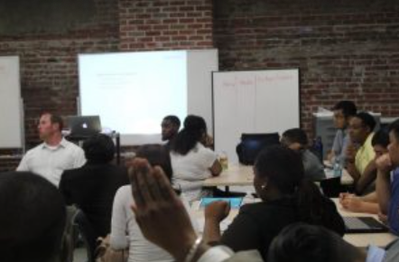
To learn more about Year Up and see the many student success stories from the program, please visit
Originally posted: November 29. 2016