Sep 26, 2016 By Naomi Morenzoni, Salesforce.org
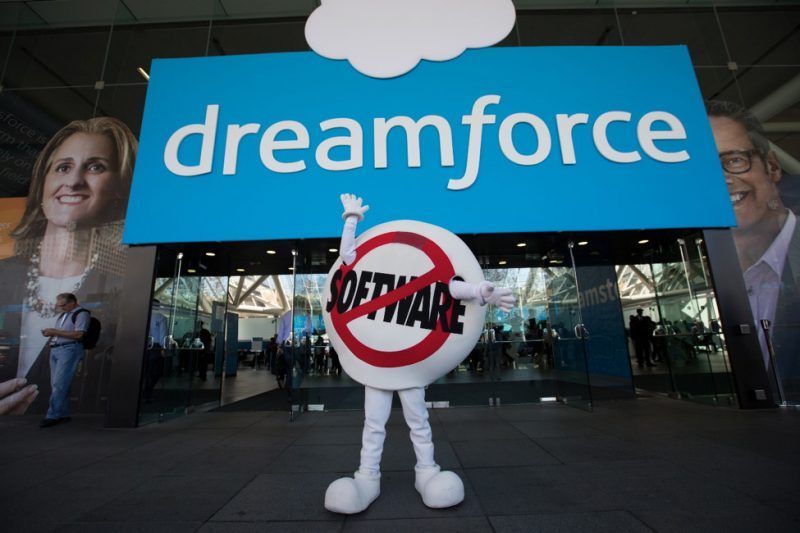
At Dreamforce this year, you won’t be able to go far without seeing or hearing about Pledge 1%. Inspired by Salesforce’s 1-1-1 Model, Pledge 1%encourages and challenges individuals and companies to pledge 1% of equity, product and employee time for their communities.
Earlier this month, Pledge 1% announced an exciting milestone—1,000 companies in 30 countries have joined the global movement to make giving back part of their DNA. In fact, over 20% of Dreamforce sponsors have taken the Pledge.
Interested in learning more about how you and your company can take a stand and get involved with the movement? A number of Pledge 1% companies will be sharing their advice throughout the event and encouraging others to take the pledge. Check out the schedule below. See you there!
Wednesday, October 5
Attract Millennials With a Give Back Culture
9:45 – 10:15 AM at Moscone West, 1st Floor, Developer Forest | Innovation Theater
Millennials need to feel a sense of purpose. Studies show they want to make a difference in their communities, near and far. How can you cultivate a company culture that will attract, retain and motivate millennial employees and customers? Hear from Samasource, Copia, and SOMA Water on innovative ideas from Samasour to help you integrate giving back into your company culture.
Building a Company as a Platform for Change
11 AM – 12 PM at Moscone West Level 2
For years, business leaders have considered giving back something to do when they’ve “made it” – something to consider once their companies have achieved success. But the conversation is changing. Today, CEOs are seeing that by building philanthropy into a company’s DNA, it can drive true business value, in addition to incredible impact on communities around the world. Join us to hear from CEOs from Twilio, Atlassian and 6Sense who have made giving back at their companies an early priority.
Women’s Innovator Network
4 -7 PM at Rotunda in Neiman Marcus
Join the BlueWolf networking event and for every 5 attendees we’ll donate $25 and 1 hour of consultants’ time to the organization ChickTech. This donation is part of their Oledge and they will also be encouraging people to #PledgeItForward with their own pledges throughout the week of Dreamforce. Topics include the impact of gender diversity on the bottom line of businesses as well as strategies to combat unconscious bias and improve diversity. To request an invite click here.
Thursday, October 6
Salesforce LIVE
1:30pm streaming live at www.salesforce.com/video
Join us for an on-air broadcast to hear from DocuSign, Okta and GlassyBaby, three companies that have actively been involved in Pledge 1%.
1% to Change the World
3:30 pm at Partner Lodge Theater, Park Central Hotel
More than 150 Salesforce Partners have made a commitment to giving through Pledge 1%. Hear from BlueWolf and Vlocity, two Partners that have actively been involved in this movement and the impact they’ve seen in their companies and communities.
Friday, October 7
Community Campfire
10 AM – 12 PM at Dreampark
Drop by the Pledge 1% Community Campfire. Hear from other Pledge 1% companies on their success and share your own story. Not a Pledge 1% company? You can still be involved by either taking the Pledge or becoming at #PledgeItForward Ambassador.
By Marc Benioff. Originally published on The Huffington Post.
Every day I am reminded that we are living in the most exciting and transformative era in history. In my 35-plus years in the technology industry I’ve never experienced so much innovation, and at such an incredibly rapid pace. Tectonic changes sparked by cloud, social, mobile, data science and Internet of Things technologies are transforming every industry, from transportation and entertainment to shopping and financial services.
In addition, breakthroughs in artificial intelligence, quantum computing, robotics, clean energy, genetic engineering and other fields have the potential to profoundly reshape manufacturing, agriculture, medicine and more. Business leaders everywhere are trying to keep up with this immense wave of digital transformation.
It’s also a time when every business leader needs to consider how these digital technology breakthroughs are going to impact not just their companies, but their communities, the planet and society as a whole. These amazing innovations not only create phenomenal opportunities for economic growth, but also serious societal challenges as well. Vast numbers of jobs will be replaced by machine intelligence and robots. The increasing capabilities of artificial intelligence and genetic engineering have the potential to get beyond the control of their creators.
As a society, we are entering uncharted territory—a new world in which governments, business leaders, the scientific community and citizens need to work together to define the paths that direct these technologies at improving the human condition and minimizing the risks.
As Professor Klaus Schwab, founder and Executive Chairman of the World Economic Forum, states in his new book, The Fourth Industrial Revolution, “Unless public- and private-sector leaders assure citizens that they are executing credible strategies to improve people’s’ lives, social unrest, mass migration, and violent extremism could intensify, thus creating risks for countries at all stages of development.”
It’s my belief that businesses are the greatest platforms for change and can have an enormous impact on improving the state of the world. As business leaders we are in positions of influence, and responsible for more than just shareholders.
We are accountable for the well being of an extended community of employees, customers and partners, as well as our fellow beings on this planet we inhabit.
This belief was further solidified for me during a meeting last year in Geneva with Peter Maurer, president of the International Committee of the Red Cross (ICRC). We were discussing the tragic, unprecedented situation of one million migrants seeking refuge in Europe, and how he and the ICRC are dedicated to helping these displaced people. While he was talking, I noticed a picture on the wall of a man who I had never seen before. It was Swiss businessman Jean Henri Dunant, who I subsequently learned had the initial vision for the ICRC and was the first recipient of the Nobel Peace Prize.
Dunant’s vision for the Red Cross grew out his experience witnessing the aftermath of the Battle of Solferino in Italy during the summer of 1859. The French Army under Napoleon III and the Sardinian Army under Victor Emmanuel II had defeated the Austrian Army of Franz Joseph I. There were more than 20,000 warriors on the field dead, dying or wounded. Dunant applied his entrepreneurial and business skills to rally the local townspeople to get the wounded off the battlefield and into a stable situation. He also organized the funding for supplies and building temporary hospitals.
Following his return to Geneva, Dunant was inspired to create an organization dedicated to improving the quality of medical services on the battlefield, which led to the founding of the ICRC in 1863. Today, the ICRC continues its efforts to relieve suffering around the world, with more than 12,000 staff working in 80 countries around the world.
Dunant made a shift that I believe many business leaders want to make—applying his leadership, resources and relationships in a more humanitarian way. Only with compassion and generosity can we address the difficult challenges ahead, from the rising tide of inequality to global warming.
At my company, Salesforce, we baked philanthropy into our business model from day one, leveraging one percent of our technology, people, and resources to help nonprofits around the world achieve their missions. So far, we’ve provided more than $100 million in grants, our employees have logged more than 1.1 million volunteer hours and we’ve given products to more than 27,000 organizations. Following our example, more than 550 companies have signed up for Pledge 1%, committing one percent of their equity, product, and employee time to their communities.
As businesses we can be financially successful, and at the same time we can make the world a better place for everyone.
As business leaders, we can collaborate with our customers, employees, partners, communities, governments and institutions to create cultures of trust that put the wellbeing of our people and planet first. We can engage in corporate philanthropy with the same focus and dedication as other business investments. We can rethink our educational systems to train the workforce of tomorrow. We can work together to ensure that this technology revolution serves humanity to its fullest potential and benefits the all citizens, not just a chosen few.
Going forward, business leaders, not just government leaders, will be judged by whether they succeed in directing the wave of exponential technology innovation to making the world a better place. As another Nobel Peace Prize winner, Martin Luther King Jr. said, “Life’s most persistent and urgent question is: What are you doing for others?”
Marc Benioff is the Chairman and CEO of Salesforce
Originally posted: January 18, 2016
By Rebecca Koenig. Originally published in the Chronicle of Philanthropy.
After years of sporadic interest, technology startups are embracing the practice of setting aside company stock before initial public offerings to endow new charitable ventures.
Tech entrepreneurs say they hope to place corporate giving, once a personal matter for executives or a peripheral project for shoring up community goodwill, at the heart of budding companies.
Venture-capital firms, once skeptical of mixing business with charity, are also testing the waters by adding philanthropic startups to their portfolios and earmarking their own equity in startups for charitable purposes. Just this month, for example, Fyrfly pledged to start a new foundation — believed to be a first for a venture-capital firm.
The momentum is such that charity set-asides could soon become the new normal, according to some philanthropists, venture capitalists, and entrepreneurs in the tech world. What remains unclear is exactly how they will play out for the
nonprofit world and the populations they serve.
After all, “if the business doesn’t materialize, the money doesn’t materialize,” says Seth Levine, managing director at Foundry Group, a venture-capital firm.
If tech stock prices soar, it could mean a windfall. With $47.2 billion in venture capital invested in the first three quarters of 2015, according to the MoneyTree report, nonprofits could benefit significantly if they capture even a small fraction of those resources.
eBay Blazes a Trail
The equity set-aside movement started in 1998, the year eBay’s founders created the company’s eponymous foundation using stock reserved from before eBay went public.
The concept spread from there, according to Silicon Valley philanthropist Laura Arrillaga-Andreessen. Marc Benioff set aside 1 percent of the equity of his cloud-computing company, Salesforce.com, in 1999 to start the Salesforce foundation.
And Mr. Benioff’s move helped guide Google’s 2004 decision to set aside 3 million shares of stock, worth more than $900 million, to support its for-profit charitable arm, Google.org, Ms. Arrillaga-Andreessen says.
Today, nearly 300 companies have pledged equity through Pledge 1%, a movement to encourage business leaders to build charity into the structure of their companies. The Silicon Valley Community Foundation is working with 20 companies that have agreements to donate equity or closely held stock to charitable vehicles.
The idea has caught on outside of Silicon Valley, too — sometimes in a big way.
In 2014, Chinese e-commerce giant Alibaba announced a 2 percent set-aside of the company’s pre-IPO shares — an amount worth billions of dollars — to support two charitable trusts that will benefit the environment, education, medicine, and culture in China.
Also last year, Australian software vendor Atlassian, valued at more than $3 billion, set aside 1 percent of its shares to create the Atlassian Foundation. The company, which co-founded Pledge 1%, filed its intent to go public in November.
And in December 2014, Seattle-based software company Tableau used shares it had set aside before going public in May 2013 to establish a donor-advised fund — called the Tableau Foundation — at the Seattle Foundation, worth more than $20 million.
“It is an obvious future to me that in 10 years the majority of startups will adopt a program like this,” says John Hering, co-founder and executive chairman of mobile-security firm Lookout.
The company, still privately held and valued at around $1 billion, recently pledged to set aside equity for charity through
Pledge 1%.
“Once critical mass has taken hold, this is going to become the default,” Mr. Hering says.
Making a Commitment
By setting aside equity to endow new charitable institutions, company leaders hope to signal a long-term commitment to corporate philanthropy. Several have gone the route of opening corporate donor-advised funds at community foundations.
It’s an attractive option for startups, according to Fidelma McGinn, vice president for philanthropic services at Seattle Foundation. It saves time, affords more flexibility, doesn’t have annual payout requirements, and costs less in taxes.
It also allows them to outsource overhead expenses and administrative duties to community-foundation professionals.
That’s important in part because startups prefer their own employees, many of whom lack philanthropy experience, to run the new giving vehicles, sometimes as volunteers, says Suzanne DiBianca, co-founder and president of Salesforce’s foundation.
It is a calculated move: Startups are betting that engaging employees directly in corporate giving will help them attract and retain talent.
For example, Tableau pays an employee, Neal Myrick, to oversee its donor-advised fund. He works with 15 other employees who volunteer their time to help guide Tableau’s grant making.
Mr. Myrick says staff members seem to appreciate the opportunities they have to determine how the company uses its equity fund. During the presentations he makes to all classes of new hires, “one or more people will raise a hand and say one of the reasons they picked Tableau over other organizations is they feel we’re having a positive impact in the world,” he says.
Appealing to Customers
In addition to scoring talent, start-up leaders say building philanthropy into their companies could attract consumers who support businesses they view as agents of positive social change.
For this kind of cause marketing to work, customers must perceive it as authentic, says Deborah Small, a marketing and psychology professor at the Wharton School at the University of Pennsylvania. Although that term is difficult to define, she says, it means that consumers look for an alignment between the brand and its charitable giving.
However, there’s a danger for companies if their charitable activities appear to be insincere or, worse, self-serving.
“Consumers quickly become cynical if there’s anything that smells of hypocrisy,” Ms. Small says.
Consumers also seem to favor brands that devise creative ways to give back, she adds: “If you’re a copycat, that doesn’t
seem very authentic.”
That may be an obstacle to the proliferation of IPO set-asides.
“I think it will be a requirement for doing business, but businesses will have to use their creativity to find out ways to make it not just a requirement but to make it competitively advantageous,” Ms. Small says.
Persuading Venture Capitalists
There are signs that another obstacle — persuading investors to support the practice — is eroding. Proponents report that attitudes among venture capitalists are beginning to shift as they “recognize there’s actually a return from a business perspective” in setting aside equity for charity, Mr. Levine says. His venture-capital firm, Foundry Group, gives money raised when it exits investments through the Pledge 1% program to the Community Foundation of Boulder County’s general fund.
Still, skepticism endures. Swaying doubting investors will require evidence that IPO set-asides improve company success, and measuring that may prove difficult. Researchers say it’s nearly impossible to prove that an individual start-up that has set aside equity is doing better or worse for having made that decision, although it may be possible to assess the sector as a whole once enough companies have done it.
And movement leaders say they’re still puzzling over how to collect and measure evidence of employee engagement and customer approval. Pledge 1% asks participants to report the effects of their charitable programs.
There’s little experimental evidence about whether people actually prefer to work at philanthropic companies, says John List, economics professor at the University of Chicago. He’s testing the question by running a large-scale field experiment using job ads on Craig’s List; results should arrive in the spring.
Mr. Myrick says Tableau can measure employee engagement by checking how many staff members use the company’s
online portal for logging personal volunteer hours. So far, 26 percent do.
But the company is not measuring the level of influence the foundation has over customer purchasing decisions, he says. Although he acknowledged that corporate foundations “have to return value to the company in some way or another,” he doesn’t want that mind-set to direct the foundation’s work.
“Our focus on a foundation is on the social impact,” Mr. Myrick says. “Any benefits to the company we see as collateral benefits, not part of the primary decision-making process. We don’t want to put them in the driver seat.”
New Normal
Despite the doubters, start-up leaders and their venture-capital allies are forging ahead. Ms. DiBianca says it’s her dream that companies of the future won’t think twice before setting aside equity for charity. She wants the number of companies signing up through Pledge 1% to double.
“People are learning that this is how you build a great company today,” she says. “The new normal is our big vision.”
And proponents have one more rationale for setting aside equity for corporate giving, Mr. Hering says: “It’s also just the right thing to do.”
Correction: An earlier version of this story incorrectly referred to Suzanne DiBianca as co-founder and executive director of Salesforce’s foundation. She is co-founder and president.
Originally posted: December 15, 2015
By Joe Garofoli. Originally published in the San Francisco Chronicle.
Few entrepreneurs focus on charitable giving when they are building their companies — mere survival is a much bigger concern.
But leaders in corporate philanthropy circles say bigger companies find it even harder to make charity part of their business model, as investors have other priorities.
A campaign launching Tuesday aims to get growing businesses to do what San Francisco’s Salesforce.com did in its infancy 15 years ago: Promise to donate 1 percent of its equity, 1 percent of its employees’ time and 1 percent of the firm’s products to charity. Called the Pledge 1% Program — and led by Salesforce and others — it aims to get 500 other corporations to do the same over the next year.
Those who have bought into the idea have seen other benefits.
“It’s good for business, too,” said Bradley Heinz, program manager at Optimizely.org, the social impact arm of Optimizely, a firm which helps users enhance and grow their websites. The San Francisco company — which includes several top execs who used to work at Salesforce — is participating in the program.
It started early
Optimizely had already incorporated philanthropy into its business model when it was a 100-person firm. Now the 4-year-old company is three times that big. Employees saw the value of giving back when it donated its product to a campaign to help earthquake victims in Haiti four years ago. Improving the fundraising website led to $1 million more in additional donations toward earthquake victims, Heinz said.
“It’s much easier to integrate this when you’re a smaller company,” Heinz said.
But that can be difficult to sell to a growing company.
“I think it’s a mental barrier for most people,” said Ryan Martens, co-founder of the Entrepreneurs Foundation of Colorado, which is leading the campaign along with Salesforce and Atlassian, a software company. “People will say, ‘What will the venture capitalists say?’ Or, ‘Oh, that’s only for older adults who have made it, not for young ones.’”
“We’re just trying to make it easier for them to do this,” said Martens, who is also a co-founder of Rally, a software company that spends 4,000 hours annually volunteering and has donated $1.5 million through incorporating its principles over the past dozen years.
While saying that the goals are noble, privately some entrepreneurs say the hardest part is getting their employees — or VCs — to part with their equity shares. That’s why Martens suggested the “time to start talking about that is when it’s worth nothing. That’s the best time to talk to people about it.”
It is somewhat easier to convince a young firm to volunteer time and offer its product at a deeply discounted rate. Many young tech firms sell their software to nonprofits for up to an 80 percent discount, not only as a way to give back to the community, but also to broaden their customer base.
Aimed largely at startups and smaller firms, the campaign will provide a website where companies can learn how to enact each of the 1 percent pillars — and allow them to satisfy their commitment by taking on one challenge at a time instead of all three at once.
Making it easier
The hope is that if a younger company can make philanthropy part of its DNA when it is smaller, it will become a way of life as it grows. So far, 200 firms have signed up during the campaign’s quiet period.
Not every company can give with the volume of Salesforce. Founder Marc Benioff and his wife, Lynne, have donated tens of millions to the UCSF Benioff Children’s Hospital, to homeless families and to San Francisco public schools. In March,
Salesforce and the nonprofit Tipping Point Community formed SF Gives, an initiative to get the corporate community to raise money for Bay Area antipoverty programs.
Still, San Francisco’s income inequality divide — the fastest-growing in the country — is inspiring other growing companies to look at what they can do to help those less fortunate.
Employees at Practice Fusion, a cloud medical records company in San Francisco, decided that they would take $50,000 that would have been used for their holiday gift — usually something like a fleece pullover — and give it to the poor. Later this month, some of its 400 employees will box holiday meals for 700 San Francisco families and deliver them to three nonprofit organizations.
“People were not that into the gifts and swag,” said Practice Fusion CEO Ryan Howard. “They wanted to give back.”
Its biggest effort
While Practice Fusion has regular volunteer programs, this is the largest such outreach in its nine-year history.
Martens, one of the campaign’s leaders, hopes that by taking the pledge, such types of philanthropy can become institutionalized.
“It breeds a very virtuous cycle,” he said. “If you lean into it, it leans back on you and delivers way more benefit than you put into it.”
Originally posted: December 2, 2015
By Carolyn Said. Originally published on SF Gate.
Ever since receiving cochlear implants 15 years ago at age 12, Caroline Clark has wanted to help other hearing-impaired people. She started a foundation, the Baker Institute, to provide speech therapy and offer a weeklong summer camp at Stanford University for hearing-impaired children.
Now a product marketing manager at San Francisco software company Atlassian, she was attracted to the company when she discovered that philanthropy is embedded in its mission. Since its launch 12 years ago, Atlassian has given 1 percent of its profit, products and equity, and a bit more than 1 percent of employee time, to nonprofits. That freed her up to spend a week volunteering at the camp.
“As a Millennial, social purpose is really important,” Clark said. “We don’t just look at a company as a way to make money, but something we want to feel passionately tied to. Atlassian is at the forefront of that revolution and really speaks to our generation. I feel really lucky to be at a company that allows me to dedicate time to a cause.”
A year ago Atlassian partnered with Salesforce, which has long had a similar approach to philanthropy, the Entrepreneurs Foundation of Colorado and Rally for Impact to inspire other companies to make similar charitable commitments. They launched the Pledge 1% Foundation, dedicated to transforming corporate philanthropy by helping companies donate 1 percent of their equity, products, employee time and/or profits to nonprofits.
“Corporations need to step up and provide an outlet for people to give back,” said Scott Farquhar, Atlassian co-CEO and co-founder.
The founders have spent the year raising awareness through launch events, seminars and networking with affiliated companies at Salesforce and Atlassian conferences. Salesforce CEO Marc Benioff hosted dinners for executives at companies like Lookout, Glassdoor and Twilio. The Pledge 1% Foundation website provided resources, legal documents, case studies and other information for corporations.
“We came together with a collective vision: To help companies integrate giving and a culture of social impact from the beginning so it’s part of their DNA,” said Dipti Pratt, director of the foundation. “We want to make it easy for any company in the world to be philanthropic.”
On Tuesday — designated as Giving Tuesday — the foundation is announcing that it’s exceeded its goal of getting 500 companies to sign up in the first year. It drew 530, including high-growth companies like DocuSign, Glassdoor, Lookout, Twilio, Xactly and Zuora. Now in the coming year, it hopes to secure another 1,000 pledges.
“We saw a groundswell of not only interest but people who were ready to execute,” said Suzanne DiBianca, president and co-founder of Salesforce.org, the software firm’s philanthropy wing. “It’s a movement. We wanted to take away the myth that it’s too hard or complicated or time consuming to do.”
Almost all the pledged companies are tech firms, and the majority are fairly new.
“The earlier you are as a company, frankly the easier it is,” DiBianca said. “It’s very easy for a small company to pledge a percentage of its equity, for instance, because the pie isn’t cut up yet. It can make this part of the articles of incorporation.”
Each of the 530 companies picked one or more resources to pledge donations. Equity (59 percent) and employee volunteering time (54 percent) were the most popular options, followed by products (39 percent) and profit (19 percent).
Of course, an equity donation doesn’t translate into money until a company goes public or is sold. The foundation suggests trust structures such as a donor-advised fund operated by an existing foundation as a mechanism to transfer money once there’s a sale. “Effectively it means just setting aside the shares,” Farquhar said. “Some do it through a dedicated foundation.”
The Entrepreneurs Foundation of Colorado provides a map for how the 1 percent pledge works. Ryan Martens, who’d incorporated the 1 percent model into Rally, a company he co-founded in 2002, worked with the foundation to get about 100 Colorado companies taking a similar pledge, although Rally was the only one that went public. After its Wall Street launch, it put $700,000 into a donor-advised fund and donated the same amount to the community foundation in its Boulder hometown.
“It takes a peer relationships to really get this started,” he said. “It’s not common that giving is the first thing you think of when you start a business. Meeting someone else who’s done it, and hearing what it’s meant to them and their community personalizes it, and shows how it can become a cultural norm.”
Ultimately, they hope this will be the new normal as part of the startup process.
“The great news is that venture capitalists aren’t blocking it anymore, which is massive,” DiBianca said, crediting supporters like Ron Conway, SV Angel, and accelerators like General Assembly and Techstars. “They’re starting to see that (philanthropy) can add to your success as a company.”
Both Salesforce and Atlassian say their 1 percent commitment is a powerful recruiting tool.
“Millennials tell us it’s in the top three reasons they join Atlassian,” Farquhar said. “And it’s great for morale. We let employees choose projects they’re passionate about (for volunteering); we don’t put any rules around it. I think humans have an innate desire to give back and help people.”
Pledge 1% first-year results
Pledge 1% launched a year ago seeking to transform corporate philanthropy by inspiring and helping companies to pledge 1 percent of various resources to charity. Some 530 companies worldwide are now participating. Here’s a breakdown of the pledge types from those companies.
Equity: 59%
Time: 54%
Product: 39%
Profit: 18%
Companies that joined the Pledge 1% movement in its first year include 6Sense, AppNexus, Campaign Monitor, Dstillery, Glassdoor, Gliffy, Hampton Creek Foods, Lookout, MediaMath, Planet Labs, Sage, Splunk, Twilio, Weebly, Xactly and Zuora.
Originally posted: December 1, 2015
Originally published on Next in Nonprofits.
Pledge 1% “is a corporate philanthropy movement dedicated to making the community a key stakeholder in every business. Pledge 1% encourages and challenges individuals and companies to pledge 1% of equity, product, and employee time for their communities.”
Co-founder and Rally Software CTO Ryan Martens joins host Steve Boland to talk about the important work of encouraging corporations – starting with the technology sector – to pledge to improving our communities through diverse giving. Ryan talks about working with community foundations, measuring the impact of in-kind gifts, and reaching sustainable business models for increased giving.
Listen now by clicking the player above, download the file for later here, or subscribe to the podcast on your phone for automatic updates. Get more details on how to subscribe on our podcast page.
Originally posted: December 1, 2015
By Therese Poletti. Originally published on MarketWatch.
As #GivingTuesday donation pleas flood social networks and in-boxes today in a worldwide effort to raise attention and funding for nonprofits, some might be skeptical of pleas or philanthropic touts from tech companies, which have an inconsistent reputation for philanthropy.
But Pledge 1%, a year-old corporate philanthropy movement, is using the fourth annual Giving Tuesday to announce that more than 500 companies, including many tech startups, have committed to the once-novel donation model created by Salesforce.com Inc. CRM, -0.66% co-founder Marc Benioff in the early days of the cloud-based software company.
Pledge 1% is a promise to give 1% of a company’s equity, 1% of the company’s product, or 1% of employee time back to communities around the world; Salesforce does all three.
“We try to make it easy for CEOs and for startup companies and CEOs to be focused with their philanthropy,” said Suzanne DiBianca, president of Salesforce.org, the company’s nonprofit arm. “We want every company to make their own decisions where their investments should be.”
San Francisco-based Salesforce.org is joined as a founding members of Pledge 1% by Atlassian, the Australian software company with a Slack rival called HipChat; the Entrepreneurs Foundation of Colorado; Tides; and Rally for Impact.
Among the list of 500-plus companies that have taken the pledge are a mix of unknown young tech companies and better known startups with hefty valuations, such as Twilio and Zuora Inc. Others are not even tech firms, like Half Moon Bay Brewing Co. Some venture capital firms — from well-known funders such as Bessemer Venture Partners to smaller shops like Blackbird Ventures in Surry Hills, Australia — are also joining in to make it part of the process for startups they fund.
The effort could help tech’s somewhat poor reputation for community outreach, which has festered despite the efforts of Microsoft Corp. MSFT, +0.90% co-founder Bill Gates, who created the world’s largest private foundation in the Bill and Melinda Gates Foundation. Benioff and the Salesforce model have often been highlighted as an example of a rare tech company focused on giving back to its community, especially as San Francisco Bay Area residents blame rising rents, evictions and the cost of living on the tech boom.
DiBianca defends tech companies and says any negative reputation is a bit of a myth.
“I don’t think it’s true, it’s true for some companies and some CEOs,” she said, adding that many companies just want guidance or help. “They just don’t know what to do and how to do it. We are just providing tools.”
A recent corporate philanthropy list compiled by the San Francisco Business Times based on 2014 cash donations made in the Bay Area shows that many tech companies are not the Scrooges they are often believed to be. Of the 83 companies cited, 26 are tech firms, with Google Inc. (now known as Alphabet Inc.)GOOG, -2.28% GOOGL, -2.26% topping the list with cash donations to Bay Area nonprofits of $40 million in 2014. Cisco Systems Inc. CSCO, +0.13% ranked No. 5 with $14 million in local giving, followed by Salesforce at No. 6, with $12 million.
The list does not include time spent volunteering by employees, product donations and equity donations, which Salesforce pioneered. A company spokeswoman said that since its founding in 1999, Salesforce has donated $100 million in grants around the world, employees have volunteered 1.1 million hours, and 27,000 organizations are using Salesforce software for free or at a discount.
The group has big plans for the initiative: Emboldened by their success this year, the Pledge 1% movement hopes to reach more than 1,500 pledges by Giving Tuesday in 2016. Here’s wishing them luck in pushing tech to follow Salesforce’s example in the community.
Originally posted: December 1, 2015
By Ludovic Ulrich. Originally published on the Salesforce blog.
Last year, Salesforce for Startups launched globally with the mission to empower startups to build, grow and give back. In that time, more than 3,500 members have joined the program from more than 85 countries. And we’re just getting started. To coincide with this milestone, the program has introduced a new offer related to Salesforce’s marketing automation tool, Pardot; a new partnership with enterprise technology venture fund Work-Bench; and new plans to grow and expand globally.
We’ve listened to the community.
The countless conversations we’ve had with entrepreneurs in our first year confirms there is no lack of passion, innovation and creativity across the global startup community. However, many entrepreneurs struggle with laying the right foundation for long-term success. As we’ve worked with startups over the last 12 months, it’s become clear that beyond choosing the right development environment or technology platform for their products, startups’ more pressing challenge is finding ways to better connect with their customers. We’ve listened to these concerns, and Salesforce for Startups is committed to helping these early-stage startups become customer-focused companies.
A vision to help startups become customer companies.
Startups that join Salesforce for Startups have access to the technology, tools and expertise needed to become thriving customer- and community-focused companies. We focus on helping startups build, grow and give back.
- Build – Through Salesforce for Startups, startups gain access to development platforms in the Salesforce App Cloud to quickly build any type of app at scale. We chose to build our Salesforce for Startup program on this very same technology, and we can help startups do the same so they can stay close to their customers’ needs.
- Grow – Once startups establish a product and market fit, they need to focus on growing efficiently at scale. Living in spreadsheets and multiple email inboxes is a recipe for failure. Salesforce for Startups’ goal is to provide startups with the tools they need to connect to customers across sales, service and marketing to support their growth. Today, we’re excited to announce we’re offering registered startups a 30% discount on Pardot to kickstart their B2B marketing automation efforts.
- Give Back – In partnership with Pledge 1% – an organization founded by Salesforce.org, Atlassian and the Entrepreneur’s Foundation of Colorado – Salesforce for Startups enables startups to easily adopt the 1-1-1 integrated philanthropy model that Salesforce itself pioneered at an early stage in its history. More than 25% of our members are currently working with Pledge 1%. Salesforce for Startups members who have recently taken the pledge include Auctio, LendUp and Yesware.
We’re just getting started.
By our second anniversary, our goal is to triple our membership and see our program reach all corners of the globe. Many thanks to our current network of accelerators and other startup organizations, including Communitech, StartupAUS, Startupbootcamp, Startup Grind and UPGlobal, who have introduced us to their innovative communities. We’ll continue to develop programming through partnerships like these.
And, speaking of partnerships, today we’re proud to announce our new relationship with Work-Bench, an enterprise technology venture fund and well-respected thought leader in the NYC enterprise startup ecosystem. Much of our growth can be attributed to support from organizations like Work-Bench, which helps startups accelerate product development and customer insights by connecting them with forward-thinking Fortune 500 companies. We look forward to working with Work-Bench and other partners to develop content and workshops in the coming year. Stay tuned for more news on that front.
Salesforce for Startups is the only global startup program guides startups through their build and grow phases, and is also focused on giving back. If you’re a startup that wants to become a customer company, join us!
Learn more about Salesforce for Startups at http://salesforce.com/startups.
Read great startup stories here: https://startups.salesforce.com/startup-customers.
Follow @Salesforcestart to keep up to date with our latest news and offers.
Originally posted: November 19th, 2015
SALESFORCE WORLD TOUR TORONTO—May 14, 2015—Salesforce, the Customer Success Platform and world’s #1 CRM company, today announced it is joining forces with the Canadian startup ecosystem. Salesforce also announced a new partnership with Communitech, an innovation centre that provides mentorship, training and resources to help high potential startups scale into profitable technology companies.
Comments on the News
- “We’re thrilled to join forces with the Canadian tech startup ecosystem to accelerate innovation,” said Ludovic Ulrich, director startup relations, Salesforce. “The tech startup sector is a critical part of the Canadian economy and we’re proud to provide the technology, tools and expertise entrepreneurs need to take their businesses into the future.”
- “Salesforce is an ideal partner for Communitech and the Rev program,” said Iain Klugman, CEO, Communitech. “With their industry leading technology and expertise, Salesforce can provide the mentorship, training and resources that will help our companies scale quickly.”
- “Many early-stage companies want to make civic engagement part of their business, but it can be challenging for them to establish a framework,” said Suzanne DiBianca, president, Salesforce Foundation. “In partnership with Canada’s Upside Foundation, we’re helping private Canadian companies build an integrated philanthropy model early on that will have a significant social impact on Canadian communities today and into the future.”
Salesforce and Communitech Fuel Technology Entrepreneurship in Canada
Salesforce for Startups to Accelerate Growth of the Canadian Startup Ecosystem
- Build: As part of the program, startups will have access to the Salesforce1 Platform, enabling them to quickly build any kind of app at scale.
- Grow: Salesforce for Startups provides access to curated content and tools to help startups delight customers and grow.
- Give Back: Startups are encouraged to integrate philanthropy into the fabric of their company from the very beginning.
Canadian Companies of All Sizes Join the Pledge 1% Program
About Salesforce World Tour Toronto
Connect with Salesforce
- Follow @Salesforce on Twitter and join the conversation
- Follow Salesforce Canada on its blog
- Follow @salesforcestart on Twitter for all the latest on Salesforce for Startups
- Take the pledge today, visit www.pledge1percent.org
About Communitech
About Salesforce