
Original post here
Author – Catherine Wylie
The Duke of Sussex has said the mind is “like a muscle” in that it needs to be “honed, trained, rehabbed, and coached”.
Harry was speaking as chief impact officer at professional coaching and mental health firm BetterUp, which has announced that it is teaming up with the Invictus Games Foundation where the duke is a founding patron.
BetterUp will offer one-to-one coaching and personalised assessments to support members of the Invictus community.

The Duke of Sussex (Yui Mok/PA) (PA Wire)
The Invictus Games will take place in The Hague from April 16 to 22 after being delayed by the pandemic.
Harry founded the games to aid the rehabilitation of injured or sick military personnel and veterans from across the globe, by giving them the challenge of competing in sporting events similar to the Paralympics.
Harry said: “At its heart, the Invictus Games is about empowering every single person around the world.
“It’s a worldwide display of resilience, determination, and community for which each of us can draw inspiration.
“I couldn’t think of a better new partner for the Invictus Games Foundation than the mental fitness platform BetterUp.
“The mind is like a muscle: it needs to be honed, trained, rehabbed, and coached.
“The men and women I served with understand this, the Invictus community knows this, and now the world is beginning to see it too.
“I’m honoured to bring the work we do at BetterUp to Invictus and look forward to expanding the support systems that service members and veterans depend on to achieve remarkable feats.”
San Francisco-based BetterUp is valued at 4.7 billion dollars and Harry’s role, which he took on in March 2021, includes product strategy, philanthropy, and public advocacy related to mental health.
He is also involved in the firm’s commitment to Pledge 1% – a movement which encourages companies to donate 1% of equity, staff time, product or profit to their communities.
Harry has said BetterUp envisioned a “world where growth and transformation are possible for everyone, and everyone has access to the support and care they need to thrive”.

Originally published on Coveo
Author: Kiyomi Harrington
We’re thrilled to share that we surpassed a major milestone, donating more than $1 million dollars (CAD) under Pledge 1% , a global movement to inspire, educate, and empower all companies to leverage their assets for good. This is on top of the $1.7 million dollars (CAD) we have contributed to Centraide (United Way), since partnering with them in 2006.
Since joining the Pledge 1% movement in November 2021, we’ve contributed time, products, expertise and money to support organizations that provide learning and growth opportunities, including knowledge-sharing and mentoring, technical access, and financial assistance for young people in vulnerable social groups.
“Our aim is to make the democratization of knowledge a force for good both locally and globally,” said Sheila Morin, Chief Marketing Officer at Coveo. “With the structure of our pledge, we’re able to contribute our time, our technology, our money and our equity to help give equal and unrestricted access to knowledge and education to combat poverty, to reduce inequalities and improve human wellness. We’re proud to share some of the impact we have already had thanks to our Pledge 1% commitment, and we’re just getting started.”
Through the Pledge 1% movement we’re able to direct our support for organizations that are in line with our vision to democratize knowledge through education and technology. As an organization we’ve committed 1% of our equity, 1% of our profits, 1% of our product and 1% of our time through the following means:
1% Equity
In pursuit of our 1% pledge mission to democratize education, we support non-profit organizations that provide learning opportunities and skill development in underserved communities. We’re proud to have donated over C$1,000,000 to our partners allowing them to reach thousands of children across North America. We will continue to build long-term relationships with our partners beyond our donations with skills-based volunteering by our employees, resource-sharing, and asset donations.
1% Time
In 2022, Coveo created a 1% Time Pledge Committee with the aim of reigniting Coveo’s long-standing tradition of volunteering, which had been put on hold due to the pandemic. Since then, we’ve built relationships with partner organizations, enabling us to provide both skill-based and event-based volunteering opportunities. Each year, Coveans are giving their time to help others and giving back to the communities. More than 4000 hours have been given since the launch of the Pledge 1% program with organizations like Maison Bon Acceuil, the Foodbank and Santropol Roulant.
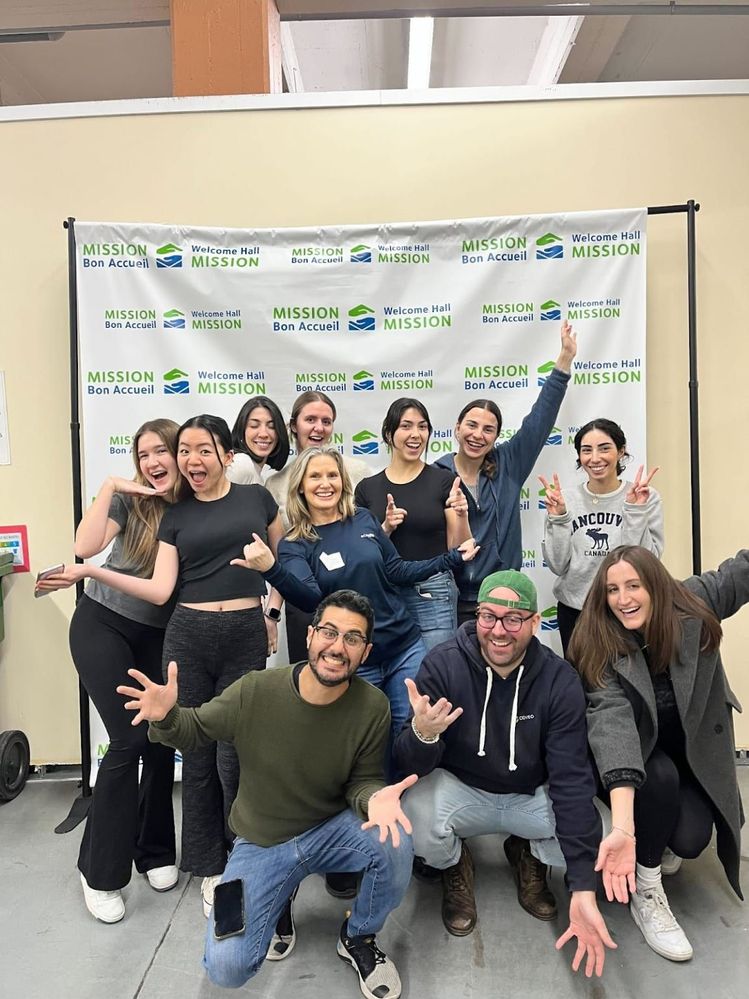
Coveo employees donating 1% of their time
1% Product
We take pride in our partnership with Alloprof, a Quebec-based non-profit that offers parents and students aged 6-17 free, practical resources to help them succeed along their academic journey. Alloprof uses Coveo AI to power the search and recommendation experiences on their website, helping students and parents find resources relevant to them. We’re able to deliver a best-in-class digital experience that embraces their brand and engages users with our headless and atomic technology. By doing so, we help empower students, parents, and teachers to efficiently and effectively access knowledge, saving them time and also allowing Alloprof to deliver a streamlined and personalized service to their clients. In January, we kicked off a project with Actua to start using the Coveo Platform. They will be using the Coveo AI on their intranet to support AI-powered search across their internal website. We’re committed to increasing our support to other organizations that make a difference in our communities through access to our product in the years to come.
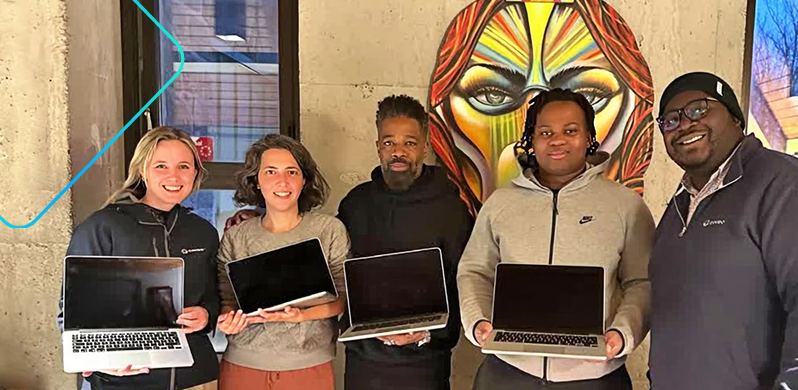
Coveo employees delivering Laptops at Maison des Jeunes de Côte-des-Neiges – Chalet Kent
Let’s dig into some of these amazing organizations we have partnered with and see the impact that the Pledge 1% are having on their missions.
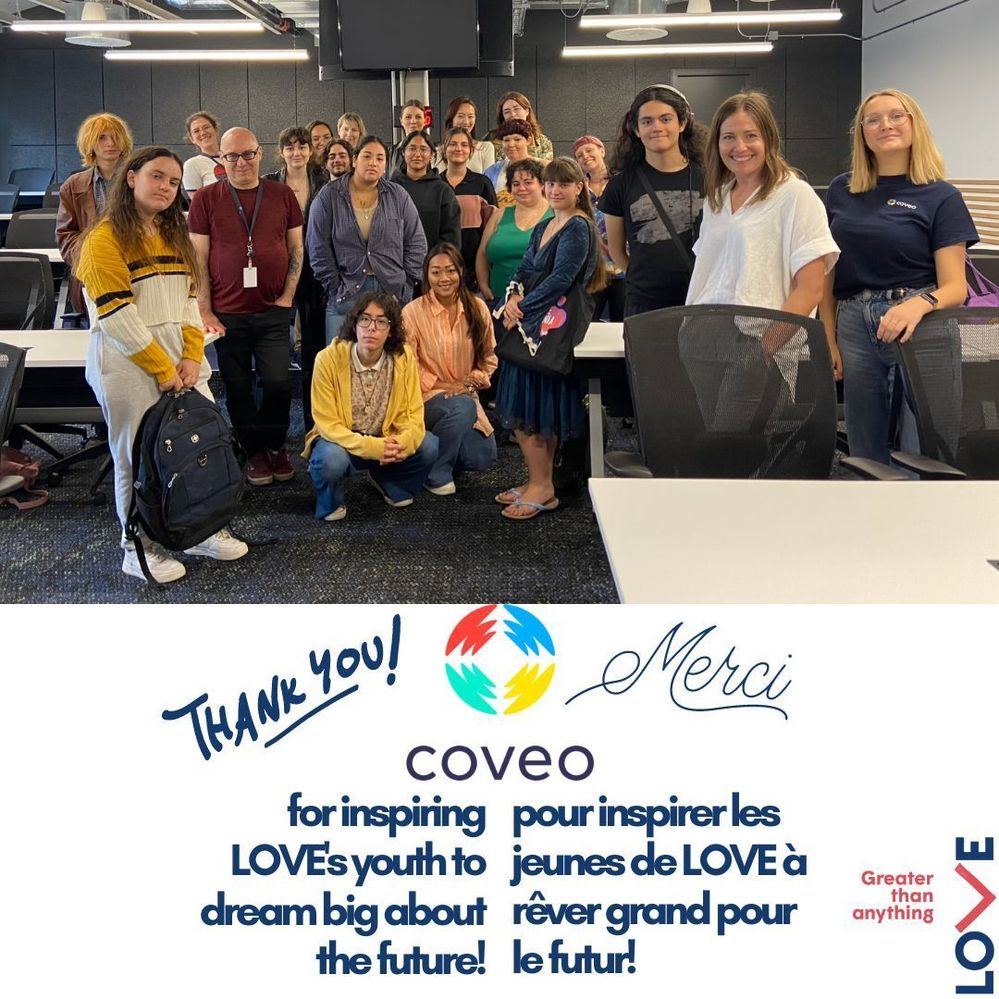
LOVE (Quebec) has been changing the lives of thousands of vulnerable youth across Montreal, providing a safe environment to those who have experienced bullying or violence. Their mission is to support their mental health through arts-based activities that help them develop the emotional intelligence and resilience they need to thrive. In 2023, LOVE (Quebec) had an impact on 2463 youth.
Actua, a leading science, technology, engineering and mathematics (STEM) education outreach organization in Canada works with a national network of 43 universities and colleges. Actua engages youth from all corners of the country in transformational STEM learning experiences that build critical employability skills and confidence. Reaching nearly a half million youth annually, including 43,668 Indigenous youth, 33,099 Girls in all-girl programs, and 11,162 Black youth across 744 communities across Canada. My 8-year-old daughter got to experience Actua’s impact when she was able to attend the Engineering Science Quest summer camp at the University of Waterloo last summer.
Girlstart, is a US-based national women-led organization, offering year-round out-of-school STEM (science, technology, engineering, and math) programming for girls in grades 4-8 in Texas, California, Massachusetts, and other locations across the country. They support after-school programs, summer camps and community STEM programming to name a few.
Pour 3 Points, believes in social equality for youth from underprivileged neighborhoods. And that someday, all of them will have the opportunity to develop their potential to become happy, resilient, and healthy adults involved in their community. That is why P3P helps sports coaches become life coaches. By assisting underprivileged youth, coaches help them gain the skills needed to succeed in life and in school.
U-Go, a non-profit that helps ambitious and promising young women in low-income countries to pursue higher education by providing financial scholarships funded by individuals and corporations, just celebrated their two-year anniversary. In such a short time, they have made a huge impact on the access to education for girls from low-income countries. Their access to education not only lifts them out of poverty but has a generational impact on their families and wider community. Available in 9 countries around the world; from Bangladesh, to India, to Vietnam, Tanzania and Nepal – these girls are on their way to becoming teachers, doctors, nurses, pharmacists, entrepreneurs and more. Coveo is supporting 108 scholarships for these ambitious and promising young women in the U-Go program. The U-Go program is so successful, it grew by 160% to 2,494 scholars. As their founder John Wood put it, “to visualize, that is like having 19 Boeing 737s lined up on the runway with every seat filled.”
We haven’t stopped there…
We’ve also made donations to several other organizations within the educational, inclusion, and environmental spheres including Interligne,Techspark, Environmental Defence and Centraide.
For the past eighteen years, Coveo has been proud to support Centraide (United Way), an organization that is making a real difference in the lives of people in our communities. Each year, Coveo organizes an employee campaign to generate donations for Centraide. As part of this effort, for every dollar donated by an employee, Coveo also contributes $1. For calendar year 2023, Coveo and its employees committed over C$403,668.88 in donations to Centraide, bringing total contribution to more than C$1,700,000 since the beginning of the partnership.
To learn more about our ESG strategy, the organizations we’ve partnered with and hear some more impact stories — check out these videos.
Originally published on Corporate Wellness Magazine
Author: Good Stuff Partners
Good Stuff Partners, a purpose-driven branding and communication agency, is celebrating 10 years of impact-driven work supporting local communities as well as global initiatives. On a mission to “build brands that give a damn,” Good Stuff Partners has elevated campaigns and causes spanning social and political justice, sustainability, healthcare access, and more.
When Adrian Power and Aimee Kilmer co-founded Good Stuff Partners a decade ago, they had a simple vision: work solely with brands that are doing good things for people, animals, and the planet. They’ve since provided branding, design, and identity work for Habitat for Humanity, Beyond Meat, VegNews, The Tides Foundation, Marin County, and dozens of other mission-driven organizations and companies. The agency’s values and ethos are also embodied in their credentials – a certified B Corp, Marin Green Business Partner, member of Pledge 1%, and Clean Creatives pledge member. And most recently, they made a commitment to increase employee wellness by trialing the 4-day workweek.
“Our work at Good Stuff Partners is about so much more than just designing a brand or campaign, it’s about capturing the true essence of a cause to evoke emotion, intrigue, and action, and that’s what drives us every single day,” said Aimee Kilmer, Co-founder and Creative Director.
“When we decided to start a purpose-driven agency, we had no idea what our success rate would be but it’s been extremely rewarding to see the validation of our work through our client’s success in reaching their impact goals. To be truly purpose-driven you need to be fully committed to your values and ethos – and be ready to turn clients away, which I think really sets us apart,” said Adrian Power, Co-founder and Brand Strategist at Good Stuff Partners.
“Our work at Good Stuff Partners is about so much more than just designing a brand or campaign, it’s about capturing the true essence of a cause to evoke emotion, intrigue, and action, and that’s what drives us every single day,” said Aimee Kilmer, Co-founder and Creative Director at Good Stuff Partners.
Clients who have experienced the impact of Good Stuff Partners’ identity and design work include:
- For The Many, a grassroots movement seeking to transform New York experienced a 155% increase in fundraising
- Pivotal, an agency in Silicon Valley supporting young adults in and from foster care, received $750K in unsolicited donations in less than a year
- Community Action Marin, the county’s largest nonprofit, grew from a $17M organization to a $29M in just four years
- Global Fund for Women, a nonprofit funding women’s human rights, continues to see a 500% increase in social media engagement year after year
As Lindsay Rubin, VP of V-Dog emphasized: “By having just the right brand positioning for such a niche audience, we were able to increase our sales 500% after our rebrand with Good Stuff Partners.”
Good Stuff Partners’ work doesn’t stop at transforming their client’s brands. They are deeply committed to their community in Marin County, and actively involved in campaigns, volunteering for organizations such as the Marin Human Society and When Pigs Fly Ranch, and mentoring work. Most recently, Good Stuff Partners provided pro bono work in partnership with OD Free Marin, the Marin Community Foundation, the Marin Independent Journal, and the County of Marin to launch a public awareness campaign called “Hey Marin, WTF?” to combat the fentanyl crisis.
One of Good Stuff Partner’s most rewarding experiences has been mentoring students with the Griot Theater Company. Four years ago, they partnered with Sausalito Marin School District to help students design t-shirts, programs, and their website, and they’ve been providing funding and mentorship support ever since. With their help, Griot Theater Company was just recently awarded a Marin County Participatory Budget Grant for $250,000.
Good Stuff Partners’ work has not gone unnoticed, as they’ve received several recognitions including winning the Sprudge Design Award for their work with Ritual Coffee, being named a Global and Champion awardee by Clutch, and winning a Graphis Merit Award for their work with Global Fund for Women.
About Good Stuff Partners
Good Stuff Partners is a purpose-driven branding and communication agency that makes life better for people, the planet, and animals. To learn more, visit https://www.goodstuffpartners.com/.
Author: Erin Baudo Felter, Okta
Originally posted here.
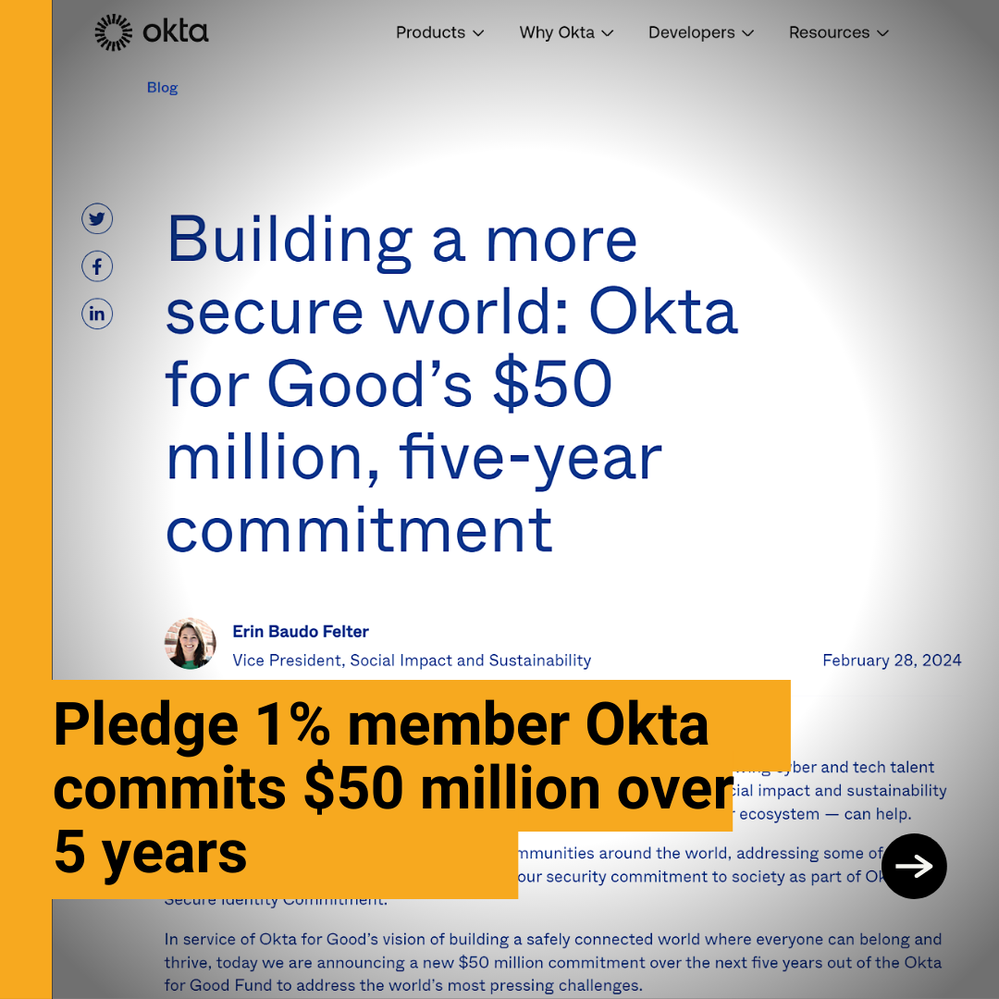
Building a more secure world: Okta for Good’s $50 million, five-year commitment
In a challenging year where we have seen rising cybersecurity threats, a growing cyber and tech talent gap, and an acceleration of climate emergencies, Okta for Good, Okta’s social impact and sustainability initiative, has continued to stay focused on the unique ways Okta — and our ecosystem — can help.
It continues to have a measurable impact in communities around the world, addressing some of the world’s most critical challenges and extending our security commitment to society as part of Okta’s Secure Identity Commitment.
In service of Okta for Good’s vision of building a safely connected world where everyone can belong and thrive, today we are announcing a new $50 million commitment over the next five years out of the Okta for Good Fund to address the world’s most pressing challenges.
Our $50 million, Five-year commitment
These funds will be split across three key areas:
-
- $20-million Tech for Good: Accelerating digital transformation and cybersecurity for the social sector and strengthening the cybersecurity posture of civil society organizations.
Cyber insecurity remains one of the top 10 global risks over the next 10 years and has implications for every organization across every sector while having a significant impact on society’s most vulnerable communities. Nonprofits are the second-most-attacked sector, behind only governments, when it comes to cyberthreats, with 65% of large NGOs lacking confidence in their own security posture due to insufficient resources to protect themselves and those they serve.
Okta is a founding partner of Nethope’s Center for the Digital Nonprofit and Nethope’s Global Humanitarian Information Sharing & Analysis Center (ISAC) — a first-of-its-kind public-private partnership created to better protect nonprofits from rising cyberthreats. Okta’s continued support will help unlock more resources to protect these organizations while increasing their confidence in their security posture for the billions of vulnerable people they serve around the world.
-
- $15-million Digital Equity: Closing the digital divide and expanding economic opportunity by making cyber and tech jobs more accessible to all.
There are simply not enough skilled workers to keep us all safe from cybersecurity threats. In fact, four million cyber jobs remain unfilled globally. We need to move faster to train the next generation of cyber talent.
Since 2022, Okta has funded CodePath, a nonprofit organization focused on re-programming higher education by delivering industry-vetted courses and career support centered on the needs of Black, Latine, Indigenous, and low-income students.
-
- $10-million Climate Action: Supporting security and resilience for communities most impacted by climate change.
Climate change impacts everyone, but particularly communities with limited means and resources.
Since 2022, Okta has supported The Solutions Project, a nonprofit that builds power by scaling solutions, funding, and influence for climate justice. They provide grants to support more than 300 grassroots solutions across the U.S., Puerto Rico, and Indigenous sovereign nations.
We will also allocate $5 million of the funds to support our employees as they invest in their local communities around the world.
Building on foundation of impact
Okta for Good has been a cornerstone of Okta’s culture and values since before Okta’s IPO and a driving force in the community, deploying nearly $24 million in grants, supporting hundreds of organizations, and touching 14 global communities in the first seven years of grantmaking from FY’18–FY’24.
This commitment is the next step in Okta’s journey and builds on years of Okta for Good’s efforts to turn the company’s people, products, and financial resources toward the community.
In our just-released FY24 Okta for Good Impact Report, we outline some of the progress we’ve made over the last year.
-
- $7.3 million in cash contributed by the Okta for Good Fund, Okta, Inc., and Okta employees, representing a 22% year-over-year increase
- $6.0 million in technology and services donated, representing a 25% year-over-year increase
- 88% employee participation in Okta for Good (giving and/or volunteering)
- ~4,000 nonprofits supported through giving and volunteering
Looking ahead
We recognize the interconnected nature of societal issues, and we strive to ensure that social and environmental impact is integrated across our business strategy and processes. This latest investment reinforces our ongoing commitment to serve our communities at a time when macro world threats demand that we step up and do more. We have the opportunity to be intentional and accountable for being the driving agent for the change we want to see. We look forward to the work ahead with our partners and stakeholders and to providing updates on our progress.
To learn more about Okta for Good, our mission, and commitment, read our Impact Report here.

Author: Stephanie Mehta
Originally posted here.
When serial entrepreneur Craig Dubitsky (Hello Products, EOS) was developing Happy, his new coffee company, he says he also wanted to reinvent the relationship between entrepreneurship and philanthropy. Rather than making a one-time gift to a charity or even donating proceeds from every purchase to a nonprofit, he and cofounder Robert Downey Jr. decided to grant an undisclosed equity stake in Happy to the National Alliance on Mental Illness (NAMI), a grassroots organization that helps individuals and families affected by mental health conditions.
“We thought, ‘What can we do that’s relevant culturally and socially, and do it in a way that hopefully is as endearing as it is enduring?’” Dubitsky tells Modern CEO. “This was a big idea around what we like to think of as emotional innovation, which is focused on meaningful human connection.”
GIVING BACK WITH EQUITY
Dubitsky and Downey join the ranks of hundreds of tech startup founders who have given away part of their companies to philanthropic causes. Pledge 1%, a 10-year-old nonprofit, helps companies and founders donate 1% of their time, products, profits, or equity to social impact initiatives. Of the 18,000 companies that have made a pledge, about 10% have pledged to grant equity in their companies. Organizations that have set aside equity to fund their social impact programs include Airbnb, DocuSign, PagerDuty, and Slack. Pledge 1% says, thanks to equity set asides, more than $2 billion in new philanthropy has been earmarked in recent years.
Pledge 1% has helped make the process more turnkey for founders—it has worked with law firms, for example, to create documents to facilitate equity set asides—and it has created frameworks and talking points to make equity grants more palatable to boards and investors, who may object to dilution of their shares.
A POWERFUL COMMITMENT
Jan D’Alessandro, chief legal and philanthropy officer at Pledge 1%, says equity grants are a powerful way of signaling to employees, customers, and partners “that we are a company that cares about giving back.”
For NAMI, being on Happy’s cap table—or list of owners—is just one of the benefits of its partnership with the company. Each container of Happy coffee has a QR code that links to the NAMI website. “While the opportunity of equity revenue is exciting and groundbreaking, I also understand, beyond the financial, the undisputable value of this partnership is the idea that so many people are going to learn for the first time about NAMI and available mental health resources,” says Jessica Edwards, NAMI’s chief development officer.
“The partnership is emotional and authentic, not just transactional.”

Originally posted here.
Author: Navanwita Sachdev, Hindustan Times
In recent years, you must have heard of Environmental, Social, and Governance (ESG) and how companies are embracing ESG principles. If you think this trend is just a corporate one, think again. ESG has direct implications for consumers, moulding purchasing decisions and creating a more sustainable and ethical marketplace. Moreover, in this digital age with all information at our fingertips, ESG principles are converging with technology to transform the consumer landscape in India.
Recent reports show that ESG investments in India have increased from US$330 million in 2019 to US$1.3 billion in 2023, proving the significance of ESG. Companies need ESG not just to cater to the consumer; investors are duly interested in companies with ESG-focused practices, because the resulting regulatory intervention can ensure investor protection. In May 2021, the Securities Exchange Board of India (SEBI) introduced the Business Responsibility and Sustainability Reporting framework, ensuring that certain listed companies must disclose their ESG related information.
According to a study by Avendus Capital, India’s ESG is expected to contribute to nearly 34% of total domestic AUM by 2051, which is in sync with India’s 2070 Net-Zero target.
Why should the Indian consumer care about ESG and how is technology playing a role in the integration of ESG practices within India’s business ecosystem?
Jitesh Shetty, Founder and CEO of Credibl, a sustainability tech company and Qwiklabs Inc., which was acquired by Google, says while India is doing well with regard to ESG, we do have a long way to go. ?India is doing very well when you look at regulations like BRSR reasonable assurance, we are quite ahead of the curve here from the rest of the world,? says Shetty. ?But also, our problems are large-scale problems and hence we have a long way to go.?
He cites the example of TATA Sons, which is a leader in sustainability, and their company IHCL, the Taj hotel group, which is doing well with ESG KPIs.
They deeply care about ESG and don’t do this because someone is policing. Their program called PAATHYA has a huge consumer mindshare. You walk into any Taj hotel and you will see the impact PAATHYA is having,? he explains.
We are on WhatsApp Channels. Click to join.
Why Consumers Should Care?
ESG is a set of standards that investors, companies, and consumers practice to appraise how a company impacts the environment, society, and its governance structure. Why should consumers think of ESG or things like digital footprint when they buy a product or service? As consumers become more socially and environmentally conscious, they are increasingly seeking products and services that align with their values.
?This is a multi-front problem,? says Shetty. ?Corporates have to better their ESG posture. But consumers also have to do their part. Buying decisions can have a significant impact on the environmental footprint. For example, you are buying a home textile product. If it’s made from organic cotton, green energy is used in the factory and packaging is green. Then, the overall environmental impact will be very low.?
Digital Footprint and Environmental Impact
If we look at the Indian market, it’s flooded with digital products and services, and the Indian consumer is aware of the environmental implications of this digital transition. E-waste, energy consumption, and sustainable data management practices are, slowly but steadily, becoming part of household discussions.
For instance, digital giant Google’s commitment to operate on 100% renewable energy since 2017, is an announcement that environmentally conscious consumers took notice of. Closer to home, the Mumbai-based RPG Group, has vowed to conserve, restore, and grow a million trees by 2030 with 1t.org, a Geneva- based World Economic Forum platform that wants to rally a global reforestation community that grows and looks after a trillion trees worldwide by 2030.
As issues like climate change and global warming become more and more pressing, consumers in India are starting to pay more attention to a company’s environmental practices. From carbon footprint to waste management, they are starting to read the labels for the products and services they buy. For proof, just look at the arrival of electric car giant Tesla in India. Tesla is banking on the environmental aspirations of Indian consumers to own a vehicle that is climate friendly.
Social Responsibility in the Digital Realm
The digital space, where we interface every single day of our lives with various digital entities, is a prominent platform where companies can learn about what consumers care about.
At the same time, they can showcase their own commitment to social responsibility, which can include aspects from fair labour practices in tech supply chains to diversity and inclusion initiatives in digital workplaces.
For example, when cloud company Salesforce announced its Pledge 1% initiative to donate 1% of its product, equity, and employee time, it inspired many other companies to follow suit.
Governance in the Digital Age
With the rise of cyber threats and data privacy concerns, digital governance is not something consumers can ignore. Already, what’s being called ?the mother of all breaches’ just occurred a few days ago, revealing 26 billion records, which includes popular and regular sites like LinkedIn, Snapchat, Venmo, Adobe, and X. This is why consumers now look for companies with robust cybersecurity measures, transparent data practices, and ethical usage of technology.
While international tech giants like Apple and Microsoft are known for their digital ethics approach, in India, IT giant Infosys, has been recognized for its robust governance framework.
Last year, Infosys Co-founder Nandan Nilekani, spoke about how ESG not only builds trust but also elevates brand value.
“A commitment to strong governance is not just a matter of compliance; it’s a strategic imperative for sustainable success in the dynamic world of startups,” he said.
Technology’s Role in Advancing ESG in India
Significant as ESG is, technology has been aiding the sector, so that organizations can integrate ESG principles in their functions as much as possible. How is technology enabling ESG in the Indian landscape? Will it get better in the future?
?Technology across raw materials, energy sources and software is helping,? says Shetty. ?Innovation in materials is where you can take organic fibre but make it durable for real world use, efficiently use solar energy in manufacturing and then use software for better traceability and ESG data management with automation.?
Some key ways in which technology is aiding the adoption of ESG practices are as follows:
Data analytics: With copious amounts of data related to their ESG performance, organizations are able to analyze, find patterns, and identify the do’s and don’ts in their structure. This helps decide the future courses of action that are environment and society friendly.
As Nitesh Mehrotra from business consulting firm EY India says, ?ESG today is a focused boardroom agenda for all leading enterprises to create and protect value. And I think it is very critical to have consistent and comparable scientific measurement of sustainability variables across all our stakeholders. So, clearly, there is a critical need to have a single version of truth with near to real time performance analytics to create actionable insights.?
It’s imperative that this data be shared with consumers, and that consumers themselves demand it from companies, in order to help them make more conscious purchasing decisions.
Blockchain for transparency: An emerging technology that can increase transparency in ESG is blockchain. Its ledger technology allows companies to provide consumers with real-time information about the origin, production processes, and ethical practices applied in their products and services.
ESG rating platforms: Technology has given rise to ESG rating platforms, like MSCI, Sustainalytics, and Bloomberg ESG, which evaluate and score companies based on their ESG performance. Anyone, investor or consumer, can access these platforms to make informed decisions, influencing companies to improve their ESG practices.
The Path Forward
As the influence of ESG on Indian consumers continues to grow, the onus is on businesses to embrace sustainable and ethical practices. Companies that prioritize ESG considerations not only contribute to a better planet and society but also gain a competitive edge in the evolving marketplace.
?When you start with ESG at the core it makes that a differentiator in the marketplace. Also, you start with a green foundation,? advises Shetty.
He also adds that ESG can lead to a more equitable society, ?In India, citizens face significant environmental concerns on a daily basis. The air quality in all tier-1 cities is bad. Waste management is not streamlined and solved yet. When it comes to social indicators, we are far from creating an equitable society. The same is true with corporate compliance and governance. ESG compliance can help address all these issues.?
As consumers, the power to drive positive change lies in your purchasing decisions. By choosing products and services from companies that uphold ESG principles, you can become a part of the sustainable and socially responsible business environment. As technology helps in advancing ESG practices, going ahead, you’re likely to see even more transparency and accountability in the products and services you choose, ultimately shaping a more conscious and responsible marketplace in India.

Author: Fast Company Executive Board
Originally posted on Fast Company
As consumers become more focused on brands that practice corporate social responsibility, more and more companies are finding impactful ways to make a positive mark on their local communities. Forward-thinking businesses are spearheading work programs, offering financial assistance, and nurturing entrepreneurial talents in their neighborhoods.
Here, Fast Company Executive Board members discuss the strategies companies can adopt to contribute to their local communities in an impactful way. Follow their recommendations to create a lasting and meaningful change in your community beyond your bottom line.
1. ALIGN WITH ENVIRONMENTAL AND SOCIAL INITIATIVES.
Companies can establish impactful community engagement by aligning with local environmental and social initiatives. Fostering partnerships with entities that assist in reducing your environmental footprint not only aids in eliminating pollution but also actively contributes to the restoration and conservation of the local community and ecosystem. – Kenneth Svendsen, Oasis Marinas
2. OFFER PAID INTERNSHIPS.
Paid internships for different levels of skills and needs are certainly an option. Typically, we think of internships as an opportunity only for students. However, people in need financially or even who may be looking to develop real-world skills to make career transitions can benefit from short- or long-term paid internship opportunities. – Jeffery Keilholtz, Broadway Licensing Global
3. ENCOURAGE DAYS OF SERVICE.
The opportunity to impact local communities increases when you consider the rise in remote or hybrid work environments. With employees dispersed across regions and geographic locations, a day of service enables people to participate or get educated in local programs or band together for virtual activities or sponsorships that have more of a global impact. – Karen Budell, Totango
4. FORGE PARTNERSHIPS WITH EDUCATIONAL INSTITUTIONS.
Partnerships with local universities and technical institutes can allow a company to contribute to the local community while encouraging innovation and helping ensure a steady supply of skilled, engaged labor. Whether through research grants, internships, scholarships, or other development programs, collaboration between industry and education can help advance the goals of both institutions. – Mike Field, The Raymond Corporation
5. OFFER FREE MENTORING AND SKILL BUILDING.
In the creative field of advertising, social media, design, and digital design, an “agency or company” school that provides free mentoring and skill building is invaluable. It doesn’t require a college degree or even a high school diploma. Artistic ability comes from experience, building confidence at a young age, and stokes passion which is how best to build a career. – Peter Nicholson, Hill Holliday
6. CREATE AN ENTREPRENEURSHIP PROGRAM.
You can work with community leaders to create entrepreneurship programs, have workshops to train, coach people from the community on the value of innovation, and train them on technology. Help them build new skills. Work with small businesses and try to determine synergies among local small businesses to create an ecosystem for them to work together and collaborate to help each other. – Kaitki Agarwal, A5G Networks, Inc.
7. GET INVOLVED IN EVERY ASPECT.
We apply our time, talent, and treasure. For example, we donate over $60,000 in time to support nonprofits each year with the PR and marketing needed. We also have a volunteerism program that allows us to pick nonprofits in our community that need volunteers. Finally, we encourage our team to provide expertise by being on local boards, speaking at universities, and providing mentoring and internships. – Kathleen Lucente, Red Fan Communications
8. CREATE PARTNERSHIPS WITH LOCAL LEADERS.
Connect and speak with local government and NGO leaders. Offer special events for local entrepreneurs with heavy discounts, training, and quick-start engagement opportunities. It’s essential not to make assumptions about the local community’s needs. Engaging with the community on economic, entrepreneurial, and work empowerment opens up conversation and partnership opportunities with value for all. – Jimmie Lee, JLEE
9. HIRE FROM THE LOCAL COLLEGE COMMUNITY.
Hire from the local college community people hungry to learn your business. The investment is steep. You’ll need to spend the time and energy to train these people. They won’t have the business acumen of more senior hires. They’ll often go on to other companies, taking your insights with them. But this is an excellent way to help locals step into positions they otherwise would not have access to. – Robert Brill, Brill Media
10. ELEVATE YOUR EMPLOYEES TO MAKE AN IMPACT OUTSIDE OF WORK.
We make sure everyone has a professional development plan and that whatever limitations may have been set upon you in the past are left at the door when you enter our workforce. We elevate our employees as high as they can go and this has a ripple effect on the community at large. The rising tide lifts all boats. – Esther Kestenbaum Prozan, Flowspace, Inc.
11. OFFER SKILLS-BASED PROGRAMS IN YOUR AREA OF EXPERTISE.
Create programs that build skills related to what your company does best. This not only helps people in your local community become more employable, but it also strengthens your company’s reputation in the community, making it easier to attract great talent in the future. – Gergo Vari, Lensa
12. ESTABLISH A ‘COMMUNITY INCUBATOR PROGRAM.’
Create a “community incubator program,” to combine work programs, financial assistance, and entrepreneurial development to curate local talent and address community-specific challenges. Program efforts include identifying community needs, engaging local entrepreneurs, selecting projects, mentoring, providing resources, creating networking opportunities, involving employees, and measuring success. – Britton Bloch, Navy Federal
13. HIRE FROM YOUR COMMUNITY.
Hiring from a community is actually the best way to provide help. Cash grants, donations, and other forms of help are good. However, creating a job for someone in the area is a real way to create hope and wealth among the local residents. The more the locals are involved with your company, the less they will view your presence as an insignificant matter in their lives. – Zain Jaffer, Zain Ventures
14. FOCUS ON SUPPORTING THE YOUTH.
A powerful way to contribute to local communities is by supporting the youth with internships, free training, and mentorship. Most people grow up not knowing the opportunities that are out there, and the right advice at the right time can change a young person’s life trajectory for the better. Create programs for schools and community centers in this way to make a difference. – Syed Balkhi, WPBeginner
15. OFFER MICRO-GRANTS OR INTEREST-FREE LOANS TO STARTUPS.
An innovative way for companies to support local communities is by launching a mentorship and funding program, where employees mentor local entrepreneurs and small businesses, and the company offers micro-grants or interest-free loans to promising startups, particularly those addressing social or environmental challenges. – Kristin Marquet, Marquet Media, LLC
16. SHOWCASE AND RECOMMEND YOUR INTERNS ON LINKEDIN.
Leverage interns from local universities, trade schools, or community colleges. They will appreciate the “real world” experience and you will be able to help students along the way on their journey and help build their resume. Give your intern a boost on LinkedIn by recommending them and showcasing their work. – Jo Ann Herold, Herold Growth Consulting
17. CREATE A SKILLS EXCHANGE PROGRAM.
A skills exchange program goes beyond monetary donations and makes a meaningful impact on your local community. This method leverages the unique strengths of a company matched with the needs of the community. You can do this by collaborating with local stakeholders, mapping and then matching skills to needs, structuring volunteer programs, purposeful financial assistance, and measuring the impact. – Alexander Kwapis,The Wild Dirt
18. COLLABORATE WITH OTHER ORGANIZATIONS TO MAKE A COMMUNITY IMPACT.
Collaborate with other large industries by finding joint venture projects that benefit the community, particularly those offering apprenticeships. Joining forces with other companies creates unexpected professional bonds and casts larger nets throughout the community, doubling what you can offer residents and maximizing reach and results. – Larry Brinker Jr., BRINKER
19. IMPROVE STEM CAREER OPPORTUNITIES FOR THE FUTURE WORKFORCE.
Businesses have an opportunity to engage with local students and educational institutions to invest in the future workforce—advancing entrepreneurship, experiential learning, and curriculum development. At my company, we’ve launched an internship program and have worked with the Chicago Tech Academy, supporting our Pledge 1% commitment to improve equitable STEM education access. – Godard Abel, G2
20. INVEST IN THE TALENT POOL IN YOUR BACKYARD.
Build an apprenticeship program and partner with local unemployment offices, community colleges, universities, and even high schools. Not all jobs should require four-year degrees and there are ways to build career pathways within your organization. If you can’t afford an apprenticeship, launch a mentorship program in your community and partner with your rising star employees to serve as mentors. – Mack McKelvey, SalientMG
Author: o9 Solutions
Originally posted link is here.
MAD, a prominent India-based nonprofit organization, was selected for its innovative tech-enabled mentorship project
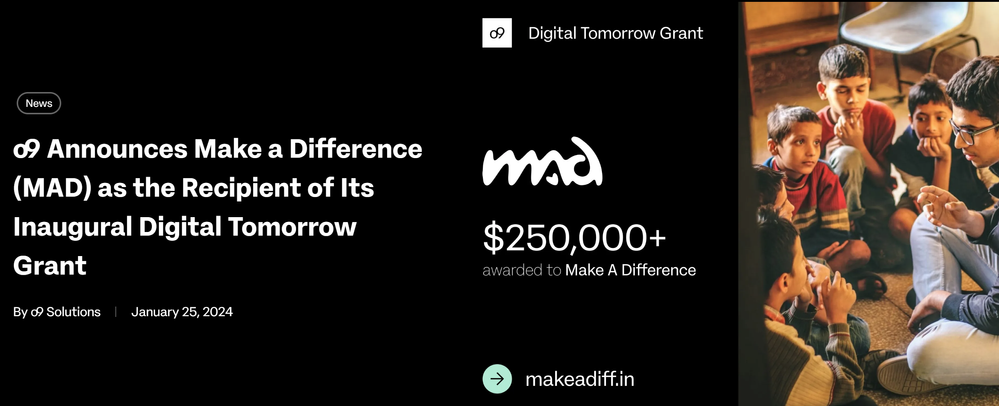
DALLAS, Jan. 25, 2024 – o9, a leading enterprise AI software platform provider for transforming planning and decision-making, today announced that it has selected Make a Difference (MAD), a prominent nonprofit organization in India, as the recipient of its first o9 Digital Tomorrow Grant. This grant will support MAD’s groundbreaking project, Empowering India’s Children: Tech-Enabled Progression Mentoring.
The o9 Digital Tomorrow Grant provides $250,000 to support initiatives that help advance digital literacy and promote technology inclusion for underserved communities. The grant’s intended purpose is to:
-
- Help communities improve digital literacy;
- Enhance and broaden access to technology devices;
- Empower marginalized groups’ use of technology;
- Promote responsible digital citizenship;
- Foster innovation, and;
- Strengthen community engagement.
MAD’s project was selected due to its focus on leveraging technology to provide mentorship opportunities for children in underserved communities through the Progression Mentoring program. The collaboration between o9 and MAD exemplifies a shared commitment to fostering technological inclusion and creating lasting positive impacts on communities. Both organizations aim to contribute to a more inclusive and connected future by supporting similar projects.
“Almost half of the world’s 1.1 billion underprivileged people are children under the age of 18, according to UNDP’s 2023 Global Multidimensional Poverty Index (MPI) Report. MPI defines six years of schooling, but we know that’s only about halfway to the Empowerment Line, which is what MAD aspires to, so that the cycle of intergenerational poverty can be broken within one generation instead of the seven generations it currently takes in countries like India,” said Jithin Thadani, Co-Founder and CEO at Make A Difference. “Tech-based tools that will enable us to deliver all our educational and support interventions and monitor their outcomes for our beneficiaries from 10 years all the way up to 28 years of age are crucial for poverty to be solved at scale. Tech-enablement is also key to our mission of ending poverty in our lifetime by empowering the sector. So, receiving this grant from o9 is doubly meaningful — apart from the funding, we’ve found a global knowledge partner that is unwavering in its support in helping us build the ecosystem-enabling tools we’ve set out to build.”
“Choosing a recipient was a challenging task due to the outstanding applications we received. Make a Difference (MAD) stood out for the organization’s dedication and novel approach, and we believe that its endeavor will contribute significantly to advancing digital literacy in underserved communities,” said Igor Rikalo, President and COO at o9. “MAD’s Tech-Enabled Progression Mentorship program is a testament to its commitment to empowering the next generation, and we are confident that this collaboration will drive positive change in the lives of vulnerable children in India.”
For more information about o9, visit www.o9solutions.com.
About Make A Difference: Founded in 2006 with the singular purpose of permanently breaking the cycle of intergenerational poverty for India’s 35 million Children in urgent Need of Care and Protection (CNCP), Make a Difference (MAD) is an award-winning nonprofit that delivers educational, social, and economic outcomes through a specialized progression mentoring model for institutionalized children in 46 shelter homes and youth from the Care-Leavers Network in 18 cities across India. Over the last 17 years, MAD has grown from 30 volunteers to a network of 20,000 past and present volunteers, many of whom are now important voices within the social impact sector nationally and internationally. It is the only NGO in India that operates solely on a scalable, self-organizing, volunteer-led community model. For more information, please visit www.makeadiff.in

UNITED STATES, December 8, 2023 /EINPresswire.com/ — Hyatus Stays, a leader in the hospitality industry, is proud to announce its commitment to donate 1% of its annual profits to support local charities and sustainability initiatives. This initiative is a testament to the company’s dedication to social responsibility and environmental stewardship.
The company’s decision to allocate a portion of its profits is rooted in a deep understanding of the importance of community engagement and environmental care. Hyatus Stays’ approach is not about seeking attention but about making a tangible difference in the communities that have supported its growth.
Collaboration with Resettlement Agencies
A key component of Hyatus Stays’ commitment is its collaboration with resettlement agencies. These agencies are instrumental in aiding refugees who are starting anew in a different country. Hyatus Stays is working closely with these organizations to ensure that the needs of refugee guests are met with compassion and dignity.
This partnership is designed to provide more than just accommodation; it aims to offer a supportive and welcoming environment for those who have faced significant challenges and upheaval.
Support for Asylum Seekers
In addition to its work with refugees, Hyatus Stays is also engaging in initiatives to assist asylum seekers. Recognizing the unique challenges faced by individuals awaiting the resolution of their asylum applications, the company is offering subsidized stays. This effort is intended to alleviate some of the stress and uncertainty experienced by asylum seekers, providing them with a safe and stable environment.
Invitation to Join in Positive Change
Hyatus Stays is committed to leading by example and encourages others in the hospitality industry and beyond to participate in efforts to foster a sustainable and inclusive future. The company believes that collective actions, no matter how small, can lead to significant positive change.
As Hyatus Stays embarks on this initiative, it welcomes its guests, partners, and community members to join in this journey of social responsibility. This effort is a reminder of the power of collective action and the impact of responsible corporate citizenship.
In an era where actions speak louder than words, Hyatus Stays is demonstrating how corporate responsibility and genuine commitment can effectively contribute to societal and environmental betterment.
About Pledge 1%
A worldwide initiative, Pledge 1%, motivates, informs, and equips every entrepreneur, business, and worker to be a positive influence in the world. More than 17,000 members across 100 countries have leveraged Pledge 1%’s adaptable framework to spark billions of dollars and countless volunteer hours in new charitable giving.
For more information about Pledge 1% and how your organization can join the movement, visit pledge1percent.org.