Since our founding in 2013, Circle has been focused on our mission of raising global economic prosperity through the frictionless exchange of value. And, for more than a decade in parallel, we’ve deployed our people and technology to expand access to financial tools that help people thrive — from enabling more efficient delivery of humanitarian aid, to helping entrepreneurs solve pressing global challenges. Now, we’re taking that commitment further.
Today, we’re proud to introduce Circle Foundation, a new philanthropic initiative dedicated to advancing financial resilience and inclusion in the United States and around the world. Seeded by Circle’s Pledge 1% equity commitment — a global initiative uniting thousands of companies in dedicating a portion of their equity and resources to philanthropy — the Circle Foundation will support groups that strengthen the financial systems people rely on every day. This includes organizations that work with small businesses in US communities and international groups modernizing the infrastructure of humanitarian aid.
From moments of impact to systemic change
Circle has seen firsthand how access to better financial tools can change lives, and over the years we’ve worked to help provide that access. We’ve continuously sought ways to collaborate with global organizations to help humanitarian organizations deliver aid faster, more securely, and at lower cost, while supporting entrepreneurs creating new models for financial access.
In Ukraine, we worked with the UN Refugee Agency to help deliver assistance via USDC to thousands of displaced people, giving them the means to start rebuilding their lives. In Venezuela, a collaboration with humanitarian and fintech partners helped route nearly $18 million to more than 60,000 healthcare workers at the height of the COVID-19 pandemic. And, through Circle’s Unlocking Impact Pitch Competition, past winners like Rahat in Nepal and Ensuro in Kenya, and 2025 winner ATEC Global in Cambodia, demonstrated how they used USDC and open, digital infrastructure to build financial resilience against climate and economic shocks. Each of these efforts demonstrates the same truth: when financial systems are open, efficient, and inclusive, people gain access to opportunity.
Circle Foundation exists to build upon that impact by turning individual programs into systemic change, focusing on building durable infrastructure for economic participation that gives people and communities the tools, knowledge, and access they need to thrive.
Supporting access and resilience, starting at home
In its first phase, Circle Foundation will focus on strengthening the financial resilience of small businesses across the United States. Small businesses employ nearly half of all US private-sector workers and drive more than 40% of GDP, yet many still struggle to access affordable financing, digital tools, and the capital readiness they need to grow.
Through grant making, Circle Foundation will address this challenge by partnering with mission-driven lenders, known as Community Development Financial Institutions (CDFIs), that fill critical gaps left by traditional finance. The Foundation will prioritize results-driven, technology-forward CDFIs that share best practices and data-driven insights across their networks, amplifying the reach and effectiveness of every dollar of support.
Expanding opportunity globally
While our initial grants will be made in the US, Circle Foundation’s mission is global. Around the world, billions remain excluded from financial systems that enable a prosperous future. The Circle Foundation will work with international organizations to modernize the infrastructure behind humanitarian finance, helping aid reach more people, more efficiently, and with greater transparency.
These efforts build on Circle’s long-standing collaborations with multilateral institutions and NGOs, and reflect our belief that financial access is a foundational element of global economic prosperity.
More than money: a commitment of time, expertise, and trust
Circle Foundation’s impact won’t be measured in dollars alone. Through our participation in Pledge 1%, Circle has committed both financial resources and employee time toward advancing social good. Every Circle employee will have up to 40 hours of paid volunteer time annually to contribute to nonprofits and community organizations of their choice.
Circle Foundation is also structured for independence and longevity. As a donor-advised fund housed with Fidelity, it is separately governed and focused entirely on mission-aligned giving. Circle covers the operational costs, so that Foundation dollars are directed where they matter most — right to impact.
Leading with purpose
After 9 years serving as Circle’s Chief Operating Officer, Elisabeth Carpenter has turned her attention to accelerating and giving permanence to Circle’s broader mission as Chief Strategic Engagement Officer and Founding Chair of Circle Foundation.
Circle Foundation marks the next step in Circle’s mission to raise global economic prosperity. Where Circle’s technology has helped move value faster and farther, Circle Foundation will help those benefits reach deeper through systems-level change at home and abroad.

Original post here.
Author: Reddit
We proudly announce that today Reddit has joined Pledge 1% to help support and grow communities that are driving social good online and in real life. Pledge 1% is a nonprofit and global movement of over 18,000 companies in 100 countries that inspires, educates, and empowers every entrepreneur, company, and employee to be a force for good.
We believe that Reddit is one of the most human places on the internet. Our communities play an impactful role in driving change and building a better future. Since Reddit’s founding, we have seen how communities create a positive impact and take action for the causes they believe in. From organizing local trash cleanups, raising donations for food banks and conservation funds, hosting an art gallery exhibition promoting local artists, printing redditor usernames on a Talladega racecar for a “ride-along” experience, and sending care packages to healthcare workers, communities are continuing to change the world every day.
“Communities play a special role in enabling human virtues and bringing more good in the world,” said Steve Huffman, Reddit CEO. “I’m constantly inspired by the creativity of Reddit users and communities. I’m excited to see people continue to do incredible things with support from our Pledge 1% commitment.”
Joining Pledge 1% means making a long-term commitment to reserve 1% of our common stock over 10 years to fund community-related programs. This commitment allows us to continue supporting the positive impact of our communities and investing in new opportunities that align with our mission to bring community, belonging, and empowerment to everyone in the world. We will also be able to build upon our one-of-a-kind Community Funds program that gives real people funding to bring community ideas and passions to life.
“Reddit is a community of communities, and we have seen firsthand the positive real-world impact that people have when empowered with the right resources,” said Roxy Young, Chief Marketing and Consumer Experience Officer at Reddit. “By joining Pledge 1%, we will further activate our communities in meaningful ways to help advance their interests and reach their impact potential.”
“As a business focused on empowering communities, Reddit is successfully integrating social impact into their business in a way that’s aligned with their values,” said Amy Lesnick, CEO of Pledge 1%. “This makes Reddit an incredibly important role model for other companies as we strive to transform the default DNA of every company to have social impact ingrained.”
We are thrilled to join a global network of companies that support the social good of communities today and tomorrow. We look forward to sharing more about how we are funding community-related initiatives that align with Reddit’s Community Values and empower people to do even more.
About Pledge 1%
Pledge 1% is a nonprofit and global movement that inspires, educates, and empowers every entrepreneur, company, and employee to be a force for good. Over 18,000 companies in over 100 countries around the world have taken the pledge and used Pledge 1%’s flexible framework to build their social impact programs. To learn more about Pledge 1%, and how your company can get involved, visit pledge1percent.org.

This story was submitted by Chime.
Chime pledges 1% of equity to fund higher education opportunities for everyday Americans.
A message from Chris Britt, Chime CEO and co-founder
We started Chime to improve financial services for everyday people. Our idea was simple. If we could reduce stress around money, our members would have a better chance to thrive and live better lives.
Today, we’re taking another step to help unlock financial progress with the launch of the Chime Scholars Foundation (CSF). CSF will fund college and other post-secondary programs for those with a passion to pursue a brighter future through higher education. Our scholarships are designed to lend a hand to ambitious, everyday people so they can pursue careers without the heavy debt burden facing so many graduates.
Accessing Education – My Story
I grew up in Mount Vernon, NY, a working-class city that bordered the Bronx. With divorced parents struggling to provide for me and my siblings, it was our neighbor in the apartment below us, a WWII veteran named Joe, who stepped in to help. While my mom worked a variety of jobs, it was often Joe who made sure I got to practice, ate dinner, and did my homework, while still finding time for us to watch the Yankees highlights at the end of the day.
As a Little League player, I remember winning my team’s “Heart and Hustle” award. While I initially saw it as a consolation prize, Joe was thrilled and insisted it was the highest honor to earn on a team. I didn’t get it at the time – but I do now. Joe was everything to me – my surrogate grandfather and my best friend.
Life was tough in my neighborhood sometimes. Our schools weren’t great and when they got worse, my mother, a former elementary school teacher, decided to apply to a private school. Even with a scholarship, my family couldn’t afford to send me. Fortunately, Joe realized this and generously offered to pay the difference. Later, when I received a partial scholarship for college, once again Joe stepped up and paid the balance of my tuition. Thanks to this incredible man, I was able to get a great college education and kick off my professional career without the stress of student debt.
To say Joe was a blessing is an understatement. He taught me the importance of loving your family unconditionally, staying positive, working hard, and giving back when you can. It was his generosity and support that helped inspire the approach to CSF.
Chime Scholars Foundation
Higher education is one of the most powerful engines for economic mobility. With CSF, we aim to expand access so that others have the same opportunity I did. After all, we live in a country with a shrinking middle class and with more than half of American households living paycheck to paycheck. We also know that people with higher education or training earn nearly 2x over their lifetime than high school only graduates and are half as likely to be unemployed.
Too often, our post-secondary education system fails us. College tuition costs have far outpaced wage growth and inflation over the past few decades, making it out of reach for many. For those who do pursue a degree, more than half end up with crippling debt for years to come. For others, a four-year program may not be the best path for success, but they too are left with few options.
This is why we created the Chime Scholars Foundation. Operating as a non-profit, CSF awards annual, renewable scholarships for students pursuing education after high school. There are two attributes that make CSF unique.
First, CSF is designed for any type of post-secondary education, including four-year university, community college, or even vocational training like nursing programs and other apprenticeships.
Second, we didn’t design CSF grants just for the star students with 4.0 GPAs and a long list of extracurricular activities. These kids often have opportunities for grants and scholarships from the schools they attend. CSF is specifically for everyday kids like me who have responsibilities at home, work hard, hustle, and yearn for something more in life. Many of these students just need a little financial support to jump-start opportunities.
While we are formally announcing the Chime Scholars Foundation today, I’m proud to report that CSF has already awarded more than 350 scholarships in our pilot program. Going into 2024, we plan on expanding the program by welcoming over 100 new scholars.
Our ambitions for CSF are high, and my co-founder Ryan and I are enormously proud and grateful to our board of directors, investors, and leadership team for pledging 1% of Chime Financial equity to fund CSF going forward. With this funding and our unique approach, I’m confident that the Chime Scholars Foundation will be a positive force in our communities for generations to come. To learn more or to apply please visit the Chime Scholars Foundation website.
If only Joe could see us now!
Chris
Story submitted by Chime Financial.
Chime Financial has pledged 1% of its equity to fund the Chime Scholars Foundation (CSF). CSF has operated as a pilot program for one school year, and has already awarded more than 350 scholarships. Going into 2024, CSF plans on expanding the program by welcoming over 100 new scholars.
CSF awards annual renewable scholarships of up to $5,000 to kids pursuing education after high school, and is built to fund college and other post-secondary programs for those with a passion to pursue a brighter future through higher education. CSF scholarships are designed to lend a hand to ambitious, everyday people so they can pursue careers without the heavy debt burden facing so many graduates.
Learn more: https://www.chime.com/blog/scholarship-spotlight-chime-scholars-foundation/

Originally posted here.
Bpeneur announced today that it has joined Pledge 1%, a global movement to create a new normal for companies of all sizes and stages to have a positive social impact through their business. Bpeneur is joining over 18,000 companies around the world who have committed to Pledge 1% of either their product, profit, equity, and/or staff time to whatever charity of their choosing.
The primary objective of Bpeneur revolves around strengthening startups, boosting their long-term viability, and elevating their prospects for success. This platform acts as a vital link between AI innovation and real-world solutions, aiming to tackle the widespread challenge of elevated failure rates among startups.
According to Bpeneur Founder and CEO, Loughlin Nestor “With an annual rate of 305 million aspiring startups entering the market, we’ve observed countless promising ideas falter due to a lack of adequate support. Our platform aims to change that narrative by leveraging AI to provide startups with a competitive edge.”
“We are proud to join the Pledge 1% community and encourage other companies to consider this opportunity to use their business as a positive force for good”
For more information about the Bpeneur program, please visit https://www.bpeneur.com/
About Bpeneur
Bpeneur is an AI-powered catalyst for startup success, offering a wealth of knowledge, tailored AI tools, and insights to entrepreneurs and startup founders. Our platform is dedicated to empowering the next generation of business leaders with the tools, strategies, and inspiration they need to succeed. Join our community today and take the first step towards turning your startup into a sustainable venture.
ABOUT PLEDGE 1%
Pledge 1% is a global movement that inspires, educates, and empowers every entrepreneur, company, and employee to be a force for good. Over 18,000 members in 100+ countries have used Pledge 1%’s flexible framework to ignite half a billion dollars in new philanthropy. To learn more about Pledge 1% and to take the pledge visit www.pledge1percent.org.

Originally published on Twitter.
Today, we’re celebrating the news that as part of our 1% equity commitment through @PledgeOne, we’ve helped to unlock $1B in new philanthropy in just 4 months. pic.twitter.com/B8MxQXZVUl
— BetterUp (@BetterUp) October 26, 2021
With the support of @dougpepper of @ICONIQGrowth, @alexkayyal and @jsomorjai of @SalesforceVC, and @RonConway of @svangel, we’re leveraging our assets to connect corporate philanthropy to community building to help people everywhere live with more clarity, purpose, and passion.
— BetterUp (@BetterUp) October 26, 2021
Beyond our equity commitment, we’re also donating 1% of our revenue, employee time, and product to create positive changes within our communities and support mission-aligned non-profits.
Better all for a better world ⚡️
— BetterUp (@BetterUp) October 26, 2021
Congratulations! We’re proud to have you in the Pledge 1% community. Thank you for your leadership and support, BetterUp!
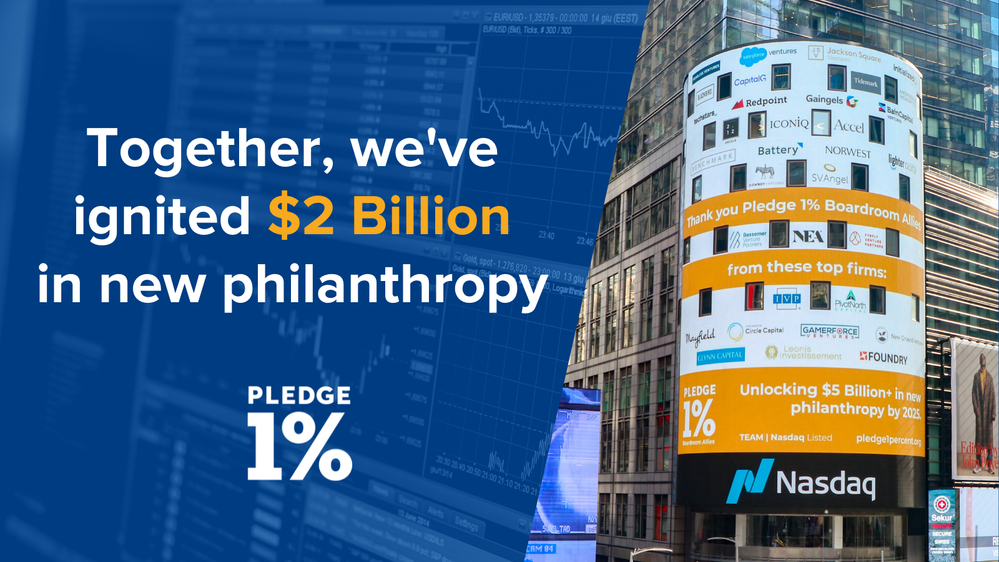
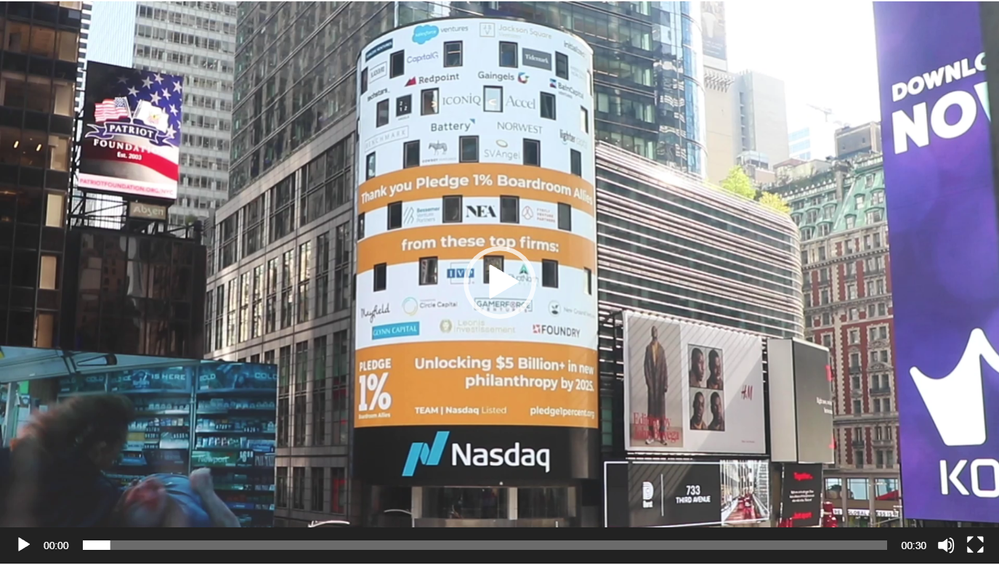
On the 25th & 26th of October, we celebrated reaching this milestone with our Pledge 1% Boardroom Allies, who were featured on the Nasdaq Tower. Scroll down below to see some of the day’s highlights!
Working closely with Boardroom Allies to help top companies set aside equity for social impact prior to liquidity events, Pledge 1% has doubled the $1 billion equity impact announced just four months ago, ensuring proceeds from a record-setting summer of IPO and market activity are earmarked for philanthropy. Pledge 1% ensures nonprofits benefit along with private markets, and is well on its way toward a goal of unlocking $5 billion in new philanthropy by 2025.
This momentum builds on more than $1 billion in philanthropy previously ignited by Pledge 1% industry leaders. Formalizing how executives and their teams can easily join the movement has dramatically accelerated impact. To learn more about the Boardroom Allies who helped us achieve this milestone achievement, click here to read the official press release.
Check out some of the day’s highlights and watch the reel below!
 Richard Wong and Andrew Braccia of Accel
 Ron Conway of SV Angel
 Seth Levine, Ryan McIntyre and Brad Feld of Foundry Group
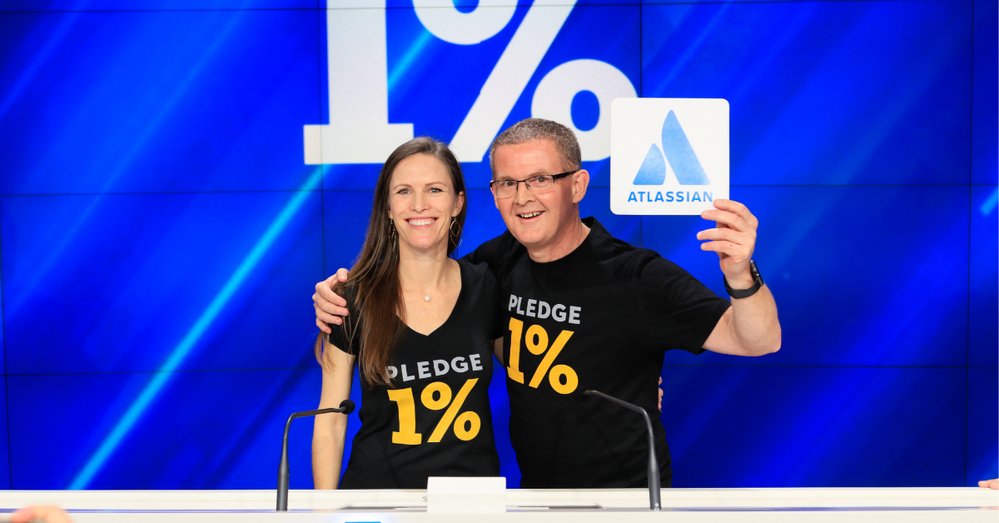
Originally published at Philanthropy Australia. Written by Mark Reading, Head of Foundation, Atlassian Foundation.
The non-profit Pledge 1% movement has prepared detailed guidance on ways for USA-based members to implement their equity pledges. There has been no equivalent guidance in Australia, until now.
Startup founders want to have an impact on the world around them. They are fixated on disrupting established industries in a way that makes life better for customers. They’re often also focused on wanting to make a philanthropic commitment related to social or environmental causes.
Businesses doing good in the world is also important to employees across industry sectors and in both large and small companies. In Atlassian’s 2020 Return on Action report, 69 percent of Australian workers said businesses should be just as concerned with their societal impact as their financial performance.
In 2014, Atlassian co-founded Pledge 1%, a non-profit that helps startups globally bake philanthropy into their business model.
Pledge 1% participants can choose to pledge 1% of equity, profit, time, product, or a combination of all four. As they grow, so does their contribution to society.
Pledging equity is feasible for all companies, but it is particularly relevant for startups, who are interested in giving back but may have low or even no profit.
Australian equity pledges have in the past been made via a public statement.
There’s been good intent, but no legal substance to validate this deep commitment to making a difference. A change in circumstances could mean that a well-intended pledge never translates into non-profit funding.
That is why the Atlassian Foundation partnered with PwC Australia, Herbert Smith Freehills and Australian Philanthropic Services, who each provided pro bono support, to create a Deed of Equity Gift. The Deed provides a clear legal pathway for founders to formalise their pledge of equity to their chosen non-profits, clearly demonstrating their commitment to employees, customers and other stakeholders.
At its core, the Deed legally commits founders to donate the nominated shares to an Australian Deductible Gift Recipient (DGR) entity in the event of a liquidity event occurring within 10 years of signing the Deed.
There was a slight concern that executing the Deed may give rise to adverse tax consequences – perhaps triggering an upfront tax bill or denying the donor a tax deduction for the gift. Consequently, the first person to execute the Deed, Andrew Herbert, the founder of data analytics and artificial intelligence startup, Cangler obtained from the Australian Taxation Office (ATO) a Private Binding Ruling (PBR). The redacted PBR, which can be accessed via the ATO’s Legal Database included confirmation that based on his particular facts and circumstances, there would be no unexpected tax consequences.
While founders should obtain independent tax advice for their own circumstances, the template Deed of Equity Gift and the redacted PBR allow founders and philanthropic shareholders to follow a process to confirm their tax position and focus on their impact for our communities.
The Pledge 1% movement has over 12,0000 members globally and more than 1,500 members in Australia. To date, the founders of more than 100 Australian companies have taken an equity pledge. Successful Australian companies whose founders have taken an equity pledge include Atlassian, Canva, CashRewards, CultureAmp, Mathspace and SafetyCulture.
Atlassian’s co-founders, Mike Cannon-Brookes and Scott Farquhar pledged 1% of equity, profit, time and product almost 20 years ago. As Atlassian’s business has grown, the Atlassian Foundation has been able to make a positive impact on causes around the world, particularly the education of youth from marginalised communities. Scott and Mike’s pledge has enabled the Atlassian Foundation to pass A$50 million in donations earlier this year and to have an asset base exceeding A$200 million.
For additional information, or to download a copy of the template Deed of Equity Gift, please refer here.
If you’re a founder interested in executing the Deed, feel free to contact me: mreading@atlassian.com. I’d be delighted to provide any support you need.

Originally published on Protocol. Written by Biz Carson.
SPACs may have been the hottest IPO trend in the last year, but now a bunch of investors are hoping to make another aspect of going public just as cool: corporate philanthropy.
The blockbuster IPOs of companies like Coinbase and UiPath came with a pledge to set aside shares of the company for charity. This week, over 40 investors, including folks like Benchmark’s Peter Fenton and SV Angel’s Ron Conway, joined Pledge 1% as boardroom allies to help their portfolio companies follow the same path.
- UiPath’s CEO Daniel Dines heard about Pledge 1% during a Forbes event when he was talking to other CEOs who had gone through the process, like those from PagerDuty and Atlassian. The company had already engaged in some philanthropic activities through a nascent foundation, but when UiPath went public, it set aside nearly 3 million shares to be reserved for philanthropy as part of its new pledge.
- “When you look at the long list of amazing companies that are part of Pledge 1%, Salesforce included, this isn’t a new unproven approach to charity,” said UiPath CMO Bobby Patrick. “It’s actually quite well-proven, and in our view, this is what every up-and-coming tech company should be doing as a normal course of business.”
Companies need support to become effective in their philanthropy, said Amy Lesnick, CEO of Pledge 1%.
- “We really see a time that’s not so far away when setting aside equity for your philanthropy is really just as common as setting it aside for your employees. It’s just what people do,” she said. “To make that happen you need standards, you need an ecosystem of support and you need to make it easy.”
- Recruiting VCs to evangelize corporate giving is just the start. UiPath board member and CapitalG partner Laela Sturdy had often fielded questions from founders about how they should be giving, but it wasn’t until UiPath that she realized Pledge 1% had a playbook ready to go. “I’ve brought it up proactively with so many founders I work with and they’re just relieved,” she said.
It’s just one way the tech industry is trying to use its power and newfound wealth for good.
- When Airbnb went public, hundreds of Airbnb employees signed a pledge to donate proceeds of the IPO to charity. “So much of the conversation around tech company IPOs focuses on how the newfound wealth will be used for consumption,” Janet Frishberg, a recruiter for Airbnb from 2013 to 2019, told me at the time. “I was wondering if we could change that conversation and have at least part of the focus be on how we can give these newfound resources to help others and help our local communities and also help the world.”
- Investors are playing other roles too. Bloomberg Beta’s Roy Bahat also helps run a program through Stanford that’s meant to educate early startup employees on how to manage their wealth in an impactful way.
It’s not only good for the world, but it’s also just good for business, said Accel’s Rich Wong, who sits on UiPath’s board.
- The tech industry used to see itself as a niche upstart, but that’s changed. Companies who have seen this tremendous growth have a responsibility to give back, he said. “We have an obligation as a community to our communities,” Wong told me.
- There’s also a competitive advantage when it comes to hiring: “In the battle for the best talents, they want to work for a company that has a mission and has a heart, that’s not just about value maximization,” Wong said.
- UiPath agrees: “Not only is this at the heart of how our founder thinks, but our employees and our new employees coming to work for us, they want to work for a company that gives back,” Patrick said. “They care about the environment and social responsibility, and investors now care about corporate governance and ESG.”