
As a Munich-based software consultancy, anarcon endeavors to provide its customers with the highest quality services. Since summer 2017, we also dedicated ourselves to help people for whom it is not going so well in life and to contribute our part to environmental protection by joining Pledge 1%.
Already via Pledge 1% our employees have taught German to refugees, drove ambulances with care-dependent people, or liberated rivers from trash. When we heard about#GivingTuesday and #Pledge1Gives we knew we had to establish a whole new way of giving back. For this reason, we are launching a one-of-a-kind campaign where we as a company invite socially deprivedpeople and refugees to our business training facilities in Munich in order to facilitate their way back to a better life.
Germany is facing huge social challenges these days and therefore we believe that
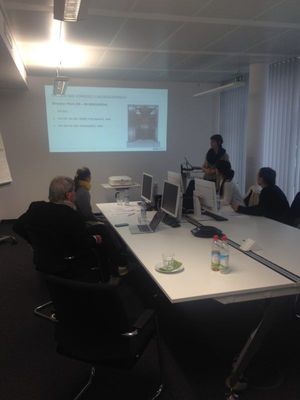
this campaign comes exactly at the right time. Furthermore, we are convinced that this activity will have a great impact on our company culture and our employees.
The campaign kicked off on Tuesday 21st November with a couple of young women–all with completely different social backgrounds. What they all had in common was that they shared a lost control over their lives due to diseases, nursing cases or emigration caused by war in their countries. In a one day workshop, our director of consulting and two more consultants took the chance to teach them how to write a letter of application, to perform well in a job interview, and last but not least, helped them gain confidence. It was great fun to meet such courageous and determined women and to discover the story behind their faces.
This is just the beginning. At anarcon, we will definitely proceed with this campaign, spread the word and tell our business partners to join us in giving via Pledge 1%.

By Chirag Mehta, Founder and CEO, Satrang Technologies
We are especially excited to participate in Pledge 1% Gives this #GivingTuesday, and plan to do a cloth donation drive at office and/or visit a local orphanage to teach children about recycling and waste management. We will also provide lunch to all the kids of orphanage.

At Salesfix, our culture is still evolving. We are a SMB business with big dreams; not just for the business but for the impact we are capable of making on our community and the individuals within, including our own people.
Our philanthropic values have become an integral piece of our day to day business, being driven from management and as a core piece of our annual business planning days. It is at our annual conference that we put a $$ figure beside the 1% Pledge items of profit, services and time. Then we strategize how we are best able to fulfil these targets.
Every year is different, 2016-2017 included a week in Cambodia for a team of 11 out of 13; we packed hampers for Foodbank, we ran up and down the beautiful Sunshine Coast for Cancer, we supported our beautiful Maria as she cycled the mountains of New Zealand for the Smiddy Challenge to name just a few.
It’s not always fun packed days though. As a Salesforce Gold Consulting Partner, we are well positioned to provide valuable support to the administration of our Australian based Non for Profits. This can include Salesforce implementation, Salesforce support and/or Health Checks along with pro-bono sessions supporting our general NFP community. We also support our Melbourne and Brisbane NFP Salesforce User Groups, in fact Wyan Carter is the Melbourne NFP User Group leader and a valued employee of SalesFix.
In addition, our CEO Jason Lawrence actively promotes a workplace culture of respect and equality and is at the forefront on our philanthropic endeavours. He sleeps under the starts every year for the CEO Sleepout (supporting our homeless community), sponsors all our individual charitable endeavours by donation matching, and has a swag of NFP’s that are thankful for his regular donations and services.
Why should partners join the global Pledge 1% philanthropy movement?
Community involvement improves not only the world in which we do business but also the world in which we want to live. Our community is us, we are our community. In fostering respect and equality both internally and beyond, staff appreciation is high, team participation and collaboration comes easier, and the SalesFix business is a happier, and more successful workplace.

By Joel Markoff, General Manager, Nexus Notes
Founded in 2011 in Adelaide Australia, Nexus Notes is a peer to peer marketplace that allows high performing university and professional students to monetise their course summary notes by selling them to students across the globe. Buyers get the benefit of seeing how the top students prepare for exams, and sellers make a passive income from selling their notes and helping other students learn.
We started Nexus Notes because when we were at university – we found it much easier to learn from other students, as opposed to university lecturers and tutors. We believed (and still do) that students are often the best teachers, yet there was no collaborative platform that enabled students to learn from each other.
And so from humble beginnings the company grew and yet in early 2014, we recognised that a lot of our high performing students were less interested in monetising their services and more interested in helping other students learn. We went back to our founding vision and looked to determine the best way to help our top students to give back to the student community through our platform.
After many late nights brainstorming how we could give back to the student community, we decided to partner with a charity organisation and allow students to donate their sales commissions directly to that organisation. After doing significant due diligence we eventually settled on partnering with AIME, Australian Indigenous Mentoring Experience. AIME is a not-for-profit with a simple mission: to get Indigenous students finishing high school and going on to university, further study or employment at the same rate as all Australians. Like Nexus Notes, AIME puts facilitates anyone to learn from top performing students and mentors.
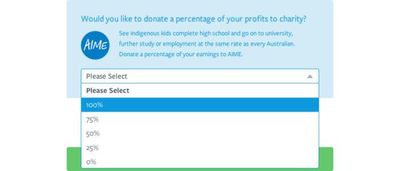
Since introducing the option to donate commissions to AIME, 11% of our note sellers have opted to donate part or all of their commission to ch. Our generous sellers have been amongst our top performing students, resulting in a massive 16% of total commissions occurring through our site being donated to AIME.
The model of donating commissions in a marketplace is something rarely seen across the world and we are proud of have come up with such an innovative way to give back to the student community.

By Doug Cronin, Pledge 1% Member and Director of Change and Upstander, Our Race
Recently someone asked me why are you a Pledge 1% member, you are already giving back so much more than that.
My response was that for any significant change to happen, a movement if you will, it takes many voices standing together, not competing of who is doing more but what as a collective are we doing.
Later, I reflected on this answer and looked at what is it that my organisation can do in supporting a social impact movement like Pledge 1%. As a start-up and an organisation which aims to create more inclusive and welcoming workplaces and communities by connecting people through storytelling, mentoring and leadership, I realised we could definitely play a role with organisations who stand up against racism and see multiculturalism as one of our greatest strengths.
You may ask what are the similarities between these two movements?
This, for me is where it gets very interesting as both have an authentic purpose but also a positive impact on profitability and attracting and retaining talent.
We have all read the Benefits of Pledging on the Pledge 1% website and will look at how a few of these are related to Leading for Change: A Blueprint on Cultural Diversity and Inclusive Leadership. To do this I will refer to research conducted by the Leadership Council on Cultural Diversity, chaired by Dr. Tim Soutphommasane, the Race Discrimination Commissioner of The Australian Human Rights Commission.
Attracting customers and increasing productivity
“87% of consumers believe corporations should place equal weight on business and supporting communities”, yet do we need the data to prove this point or can we look around at our own spending habits and that of our friends and family?
At the same time, we often buy products and/or services that are aligned to our values, whether that be environmental, social or cultural. From there consumers ask the question does the company know how to provide goods and services to my preferences.
As a result, businesses find that having greater diversity they are able to reach a broader audience.
We all know there is a push for gender diversity and that this makes good business sense. A study of 366 companies from the United Kingdom, Canada, Latin America and the United States, found that companies in the top quartile of gender diversity were 15% more likely to have financial returns above the median, while companies with in the top quartile of cultural diversity were 35% more likely to have financial returns above the national industry median.
So just from a profitability perspective a culturally diverse leadership group just makes basic business sense. And with Australia increasingly becoming more culturally diverse (half the population were either born overseas or have at least one parent born overseas) working towards culturally diverse and inclusive leadership is a no-brainer.
Attracting and retaining top talent
“60%+ of Millennials state that a “sense of purpose” is a key reason why they work for their current employers, while companies with giving programs have 2.3 times the employee retention rate.”
The idea of a sense of purpose goes hand in hand with a sense of belonging because if there is no sense of belonging, how can one of a sense of purpose?
Businesses which have culturally diverse leadership, employees from diverse backgrounds feel a greater sense of belonging where their uniqueness and input is also valued. This then benefits both the business and employees.
As Ajay Banga, the CEO of MasterCard says ‘If you don’t have a diverse company, if you don’t have people around you who don’t think like you, don’t walk like you, don’t talk like you, didn’t have the same experiences as you, how will you ever make sure that you are not blinded to the same mistakes that you can otherwise make because you can only see things through one prism.’
Everyone can make a difference. Be part of something bigger than yourself
Finally, if we were only pledging 1% to increase profitability and attract more customers then what is the purpose?
And is an organisation employing one or two people from a different background just a tokenistic gesture?
After attending a breakfast with Atlassian founder Scott Farquhar, I could see the passion and the leadership he is showing in this movement. It is obvious that he is taking action on this but is also agitating the market to help grow the size of the movement, and therefore impact.
This same type of leadership from him is also being shown by many members of this group, which ultimately will lead to greater change.
A movement is also occurring in the area of culturally diverse and inclusive leadership starting with members of the Leadership Council on Cultural Diversity. As a result of this and other forward-thinking leaders, we are seeing organisations agitating in this space. This has been through their recruitment strategies, policies and training, but most importantly by starting the conversation and committing to the movement.
Both of these movements are very much in their infancy but some progress is being made. It now takes the agitators and leaders to show this staunch commitment.
Are you going to be a leader of this movement also?
If you are leader in this space and want to start the conversation, we would like to invite you to the launch of Our Race in Sydney on Thursday 4th December or organise another time to be part of this movement.

Joining Pledge1 has helped us to engage our employees and be more transparent in the way we give to charity – Co-founder Jimmy Lundström
We want to create a workplace people are proud to work at – CEO and Co-founder Emil Sjödin
At RefinedWiki we aim to instill ‘effective altruism’ into our company culture, and joining Pledge 1% has given us the means to do so. You may or may not have heard of the term ‘effective altruism’. The premise of the movement is that we use evidence and reason to help others with our time and money. Highly regarded philosophers William MacAskill and Peter Singer have both written books, given many talks, founded organizations and spearheaded the effective altruism movement. In line with this, RefinedWiki want our work and charitable giving to have a well reasoned and targeted positive impact on society. Pledge 1% has helped us to bring effective altruism into focus.
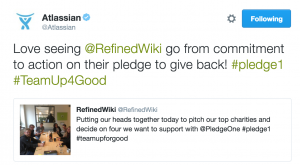
In order to bring our pledge into action and engage employees in the process, we decided this November to arrange a forum from which each staff member had the opportunity to pitch a charity they would like to support most, and why.
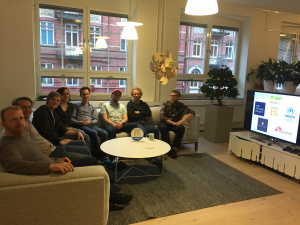
Following the pitches we voted on the top charities we want to support. This was a great way of:
- Working as a team to decide which charity we want to support;
- Targeting our efforts towards worthwhile (and effective) causes;
- Increasing the awareness of the charities we support, and;
- Feeling a part of the giving culture in the company.
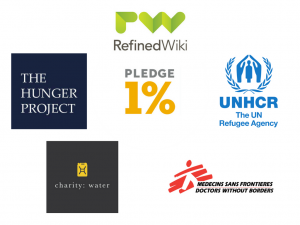
We are proud to be Pledging1% and supporting four wonderful charities; Doctors without Borders, Charity Water, The Hunger Project and UNHCR.
By Carolyn Said. Originally published on SF Gate.
Ever since receiving cochlear implants 15 years ago at age 12, Caroline Clark has wanted to help other hearing-impaired people. She started a foundation, the Baker Institute, to provide speech therapy and offer a weeklong summer camp at Stanford University for hearing-impaired children.
Now a product marketing manager at San Francisco software company Atlassian, she was attracted to the company when she discovered that philanthropy is embedded in its mission. Since its launch 12 years ago, Atlassian has given 1 percent of its profit, products and equity, and a bit more than 1 percent of employee time, to nonprofits. That freed her up to spend a week volunteering at the camp.
“As a Millennial, social purpose is really important,” Clark said. “We don’t just look at a company as a way to make money, but something we want to feel passionately tied to. Atlassian is at the forefront of that revolution and really speaks to our generation. I feel really lucky to be at a company that allows me to dedicate time to a cause.”
A year ago Atlassian partnered with Salesforce, which has long had a similar approach to philanthropy, the Entrepreneurs Foundation of Colorado and Rally for Impact to inspire other companies to make similar charitable commitments. They launched the Pledge 1% Foundation, dedicated to transforming corporate philanthropy by helping companies donate 1 percent of their equity, products, employee time and/or profits to nonprofits.
“Corporations need to step up and provide an outlet for people to give back,” said Scott Farquhar, Atlassian co-CEO and co-founder.
The founders have spent the year raising awareness through launch events, seminars and networking with affiliated companies at Salesforce and Atlassian conferences. Salesforce CEO Marc Benioff hosted dinners for executives at companies like Lookout, Glassdoor and Twilio. The Pledge 1% Foundation website provided resources, legal documents, case studies and other information for corporations.
“We came together with a collective vision: To help companies integrate giving and a culture of social impact from the beginning so it’s part of their DNA,” said Dipti Pratt, director of the foundation. “We want to make it easy for any company in the world to be philanthropic.”
On Tuesday — designated as Giving Tuesday — the foundation is announcing that it’s exceeded its goal of getting 500 companies to sign up in the first year. It drew 530, including high-growth companies like DocuSign, Glassdoor, Lookout, Twilio, Xactly and Zuora. Now in the coming year, it hopes to secure another 1,000 pledges.
“We saw a groundswell of not only interest but people who were ready to execute,” said Suzanne DiBianca, president and co-founder of Salesforce.org, the software firm’s philanthropy wing. “It’s a movement. We wanted to take away the myth that it’s too hard or complicated or time consuming to do.”
Almost all the pledged companies are tech firms, and the majority are fairly new.
“The earlier you are as a company, frankly the easier it is,” DiBianca said. “It’s very easy for a small company to pledge a percentage of its equity, for instance, because the pie isn’t cut up yet. It can make this part of the articles of incorporation.”
Each of the 530 companies picked one or more resources to pledge donations. Equity (59 percent) and employee volunteering time (54 percent) were the most popular options, followed by products (39 percent) and profit (19 percent).
Of course, an equity donation doesn’t translate into money until a company goes public or is sold. The foundation suggests trust structures such as a donor-advised fund operated by an existing foundation as a mechanism to transfer money once there’s a sale. “Effectively it means just setting aside the shares,” Farquhar said. “Some do it through a dedicated foundation.”
The Entrepreneurs Foundation of Colorado provides a map for how the 1 percent pledge works. Ryan Martens, who’d incorporated the 1 percent model into Rally, a company he co-founded in 2002, worked with the foundation to get about 100 Colorado companies taking a similar pledge, although Rally was the only one that went public. After its Wall Street launch, it put $700,000 into a donor-advised fund and donated the same amount to the community foundation in its Boulder hometown.
“It takes a peer relationships to really get this started,” he said. “It’s not common that giving is the first thing you think of when you start a business. Meeting someone else who’s done it, and hearing what it’s meant to them and their community personalizes it, and shows how it can become a cultural norm.”
Ultimately, they hope this will be the new normal as part of the startup process.
“The great news is that venture capitalists aren’t blocking it anymore, which is massive,” DiBianca said, crediting supporters like Ron Conway, SV Angel, and accelerators like General Assembly and Techstars. “They’re starting to see that (philanthropy) can add to your success as a company.”
Both Salesforce and Atlassian say their 1 percent commitment is a powerful recruiting tool.
“Millennials tell us it’s in the top three reasons they join Atlassian,” Farquhar said. “And it’s great for morale. We let employees choose projects they’re passionate about (for volunteering); we don’t put any rules around it. I think humans have an innate desire to give back and help people.”
Pledge 1% first-year results
Pledge 1% launched a year ago seeking to transform corporate philanthropy by inspiring and helping companies to pledge 1 percent of various resources to charity. Some 530 companies worldwide are now participating. Here’s a breakdown of the pledge types from those companies.
Equity: 59%
Time: 54%
Product: 39%
Profit: 18%
Companies that joined the Pledge 1% movement in its first year include 6Sense, AppNexus, Campaign Monitor, Dstillery, Glassdoor, Gliffy, Hampton Creek Foods, Lookout, MediaMath, Planet Labs, Sage, Splunk, Twilio, Weebly, Xactly and Zuora.
Originally posted: December 1, 2015
By Therese Poletti. Originally published on MarketWatch.
As #GivingTuesday donation pleas flood social networks and in-boxes today in a worldwide effort to raise attention and funding for nonprofits, some might be skeptical of pleas or philanthropic touts from tech companies, which have an inconsistent reputation for philanthropy.
But Pledge 1%, a year-old corporate philanthropy movement, is using the fourth annual Giving Tuesday to announce that more than 500 companies, including many tech startups, have committed to the once-novel donation model created by Salesforce.com Inc. CRM, -0.66% co-founder Marc Benioff in the early days of the cloud-based software company.
Pledge 1% is a promise to give 1% of a company’s equity, 1% of the company’s product, or 1% of employee time back to communities around the world; Salesforce does all three.
“We try to make it easy for CEOs and for startup companies and CEOs to be focused with their philanthropy,” said Suzanne DiBianca, president of Salesforce.org, the company’s nonprofit arm. “We want every company to make their own decisions where their investments should be.”
San Francisco-based Salesforce.org is joined as a founding members of Pledge 1% by Atlassian, the Australian software company with a Slack rival called HipChat; the Entrepreneurs Foundation of Colorado; Tides; and Rally for Impact.
Among the list of 500-plus companies that have taken the pledge are a mix of unknown young tech companies and better known startups with hefty valuations, such as Twilio and Zuora Inc. Others are not even tech firms, like Half Moon Bay Brewing Co. Some venture capital firms — from well-known funders such as Bessemer Venture Partners to smaller shops like Blackbird Ventures in Surry Hills, Australia — are also joining in to make it part of the process for startups they fund.
The effort could help tech’s somewhat poor reputation for community outreach, which has festered despite the efforts of Microsoft Corp. MSFT, +0.90% co-founder Bill Gates, who created the world’s largest private foundation in the Bill and Melinda Gates Foundation. Benioff and the Salesforce model have often been highlighted as an example of a rare tech company focused on giving back to its community, especially as San Francisco Bay Area residents blame rising rents, evictions and the cost of living on the tech boom.
DiBianca defends tech companies and says any negative reputation is a bit of a myth.
“I don’t think it’s true, it’s true for some companies and some CEOs,” she said, adding that many companies just want guidance or help. “They just don’t know what to do and how to do it. We are just providing tools.”
A recent corporate philanthropy list compiled by the San Francisco Business Times based on 2014 cash donations made in the Bay Area shows that many tech companies are not the Scrooges they are often believed to be. Of the 83 companies cited, 26 are tech firms, with Google Inc. (now known as Alphabet Inc.)GOOG, -2.28% GOOGL, -2.26% topping the list with cash donations to Bay Area nonprofits of $40 million in 2014. Cisco Systems Inc. CSCO, +0.13% ranked No. 5 with $14 million in local giving, followed by Salesforce at No. 6, with $12 million.
The list does not include time spent volunteering by employees, product donations and equity donations, which Salesforce pioneered. A company spokeswoman said that since its founding in 1999, Salesforce has donated $100 million in grants around the world, employees have volunteered 1.1 million hours, and 27,000 organizations are using Salesforce software for free or at a discount.
The group has big plans for the initiative: Emboldened by their success this year, the Pledge 1% movement hopes to reach more than 1,500 pledges by Giving Tuesday in 2016. Here’s wishing them luck in pushing tech to follow Salesforce’s example in the community.
Originally posted: December 1, 2015