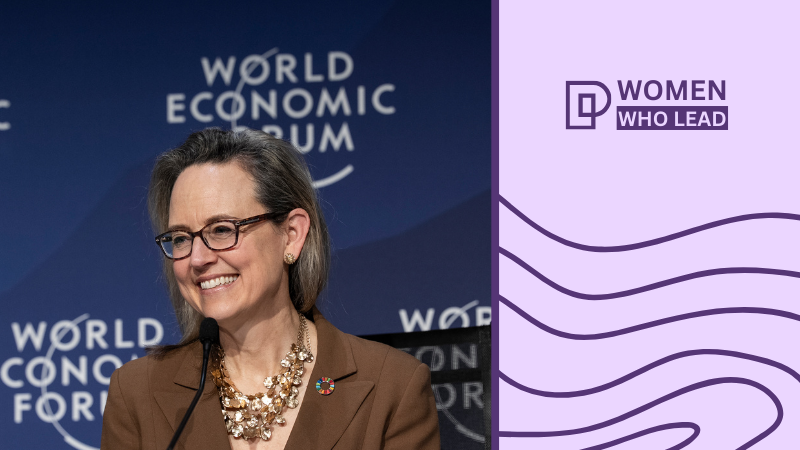
Elisabeth Carpenter
Chief Strategic Engagement Officer, Circle
📍New York
What qualities do you think leaders need to have in today’s world?
First and foremost: clarity. The world is loud, there are more opportunities for the sharing of opinions than ever, and it’s very easy to confuse motion with progress. Leaders have to be able to say, plainly, what problem we’re solving, for whom, and what a “good” result actually looks like in effect.
Second: the courage to build through uncertainty. Often the answers to the inevitable questions you’ll find yourself asking along the way are not obvious, even if you know exactly where you’re going. Sometimes it’s the facts themselves that change. You have to be willing to change your mind, or your strategy, when presented with new information. The leaders I respect most can simultaneously remain steady on the mission while being flexible on the path forward. I think this only happens if you’re willing to hold on to the humility of reality throughout the process and be honest with, and respectful of, yourself, your team, and the customers, communities, policymakers, and people affected by what you’re building.
If you had to describe your leadership style in one word, what would it be and why?
Direct. I wholeheartedly believe that directness is how you respect people’s time and intelligence. It’s how you tell the truth about what’s working, what isn’t, and what needs to change without mincing words. I’ve heard many times that “clear is kind,” and I abide by that principle. It’s also important to note that direct leadership only works if it’s paired with a genuine and deep respect for those with whom you work. I am relentless about asking “What am I missing?” and making room for debate, especially with those closest to the work. I don’t always have to be the person in the room with the right answer, but I know that I’m the person in the room that will guide us toward it and then make sure we execute against it accordingly.
How does your company’s Pledge 1% program help shape the kind of workplace culture you believe in?
Since Circle began, our mission has been to raise global economic prosperity through the frictionless exchange of value. While we work toward that vision as a team every day, Pledge 1% turns purpose into tangible practice internally too. When you commit equity, time, and attention, impact shows up at Circle in very concrete ways, like giving every employee up to 40 hours of paid volunteer time each year.
It also widens the aperture of our work. When our teams spend time with community and small business organizations or humanitarian partners, we learn to start asking better questions. Who gets left out? Where does financial friction punish people? How do we design infrastructure that’s resilient and equitable? Those shifts in mindset make us better operators and, frankly, better humans.
This year marks the 7th year of Pledge 1%’s #WomenWhoLead campaign. How can companies champion and support female leadership?
Ultimately I think you have to start with the unglamorous basics. Measure it and own it. Track representation by markers like leveling, pay equity, promotion rates, and attrition, and then hold leaders accountable for outcomes. And don’t confuse mentorship with sponsorship. Mentorship is advice, but sponsorship is risk. It’s putting women in roles with real scope and visibility, and then backing them and equipping them with resources when the job gets hard. It’s easy to campaign for change but it’s putting the right systems in place that changes things for good.
If you could write a note to your younger self on her first day of work, what would it say?
I would tell her to always choose the hard problems. Not because the stakes are high but because spending your career building things that move the world in a better direction will make the future you proud. I would tell her that if you pair ambition with integrity, you’ll never have to look back and wonder what you were working for.